What Size Jump Starter Do I Need? Sizing Guide by Engine
How to choose the right jump starter size by matching peak amperage to gas or diesel engine displacement, temperature conditions and safety features.

On this page
Top picks at a glance
As an Amazon Associate we earn from qualifying purchases.
- 1
 YaberAuto 12-in-1 Jump Starter with Air Compressor 8000A9.7/10View on Amazon
- 2
 UTRAI 8000A Jump Starter with Air Compressor 160PSI for All9.7/10View on Amazon
- 3
 OXILAM 8000A Jump Starter9.7/10View on Amazon
- 4
 Autowit Super Capacitor Jump StarterView on Amazon
- 5
 DEWALT DXAEPS14 2000 Peak Amp Jump Starter with 120 PSI AirView on Amazon
- 6
 DEWALT DXAEJ14 1600 Peak Amp Jump Starter with 120 PSI AirView on Amazon
What size jump starter do I need? You need a jump starter sized to your engine displacement and fuel type, with extra reserve for winter temperatures. Manufacturer ratings pair passenger cars up to 4.0L gas with 500A peak current. Larger gasoline engines up to 6.5L or 8.0L generally align with 1250A to 2000A. High-compression diesel engines demand more power: listings rate 4.0L to 5.0L diesels around 1250A to 1750A, 6.0L to 6.5L diesels around 2000A to 2500A, and heavy diesels up to 10L or 12L from 3000A to 6000A.
More options to compare
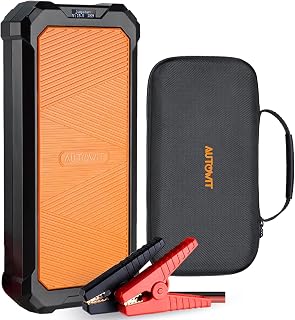 Autowit Super Capacitor Jump StarterCheck price on Amazon
 DEWALT DXAEPS14 2000 Peak Amp Jump Starter with 120 PSI AirCheck price on Amazon
 DEWALT DXAEJ14 1600 Peak Amp Jump Starter with 120 PSI AirCheck price on Amazon
GarageToolHQ earns a commission when you buy through links on our product pages, at no extra cost to you. Read our affiliate disclosure.
Below: how engine displacement determines starting demands, how peak amperage ratings compare across published listings, and a checklist to select the right booster pack.
What size jump starter do I need? Where the power demand comes from
Starting an engine requires an external burst of rotational force. Turning the ignition draws current from the battery to overcome friction, turn the crankshaft, and compress the air-fuel charge. Sizing a booster pack requires matching that resistance across core factors:
- Engine displacement. Larger cylinders displace more volume, demanding more starter torque. A small car engine requires modest energy, whereas a large truck engine creates heavy drag that demands substantial surge current.
- Gasoline versus diesel compression ratios. Diesel engines ignite fuel using compression heat rather than spark plugs, requiring far higher compression ratios. A diesel engine consequently requires considerably more cranking amperage than a gasoline motor of identical displacement.
- Cold ambient temperatures. Motor oil thickens as temperatures drop toward freezing, increasing mechanical resistance. Simultaneously, automotive lead-acid batteries lose chemical output in winter, forcing the starter to draw peak current when the battery is weakest.
- Battery state and internal resistance. Deeply discharged batteries exhibit high internal resistance. A jump starter must supply enough energy to overcome this resistance and energize vehicle electronics while delivering starting current to the starter motor.
Jump starter amps by engine size: reference specifications
| Vehicle and Engine Class | Gasoline Engine Limit | Diesel Engine Limit | Published Peak Amps | Manufacturer Example |
|---|---|---|---|---|
| Compact cars and small utility equipment | Up to 4.0L gas | Not stated | 500A | NOCO GB20 (500A peak, up to 4.0L gas) |
| Mid-size cars, crossovers and compact pickups | Up to 6.5L gas | Up to 4.0L diesel | 1250A | NOCO GBX45 (1250A peak, up to 6.5L gas and 4.0L diesel) |
| Full-size passenger cars, large SUVs and vans | Up to 7.5L gas | Up to 5.0L diesel | 1750A | NOCO GBX55 (1750A peak, up to 7.5L gas and 5.0L diesel) |
| Full-size pickup trucks, commercial vans and motorhomes | Up to 8.0L gas | Up to 6.0L diesel | 2000A | NOCO GB70 (2000A peak, up to 8.0L gas and 6.0L diesel) |
| Large commercial trucks and heavy fleet vehicles | Up to 8.5L gas | Up to 6.5L diesel | 2500A | NOCO GBX75 (2500A peak, up to 8.5L gas and 6.5L diesel) |
| Heavy commercial haulers and large diesel equipment | Up to 9.0L gas | Up to 7.0L diesel | 3000A | NOCO GB150 (3000A peak, up to 9.0L gas and 7.0L diesel) |
| High-displacement trucks and large commercial diesels | Up to 10.0L gas | Up to 8.0L diesel | 4250A | NOCO GBX155 (4250A peak, up to 10.0L gas and 8.0L diesel) |
| Fleet vehicles and heavy diesel equipment | Under 10 liters gas | Under 10 liters diesel | 4000A | WOLFBOX MV24 (4000A peak, under 10 liters gas and diesel) |
| Universal gasoline engines and heavy industrial diesels | All gas | Up to 12L diesel | 6000A | OXILAM Y2 and AUXITO T3 (6000A peak, all gas and 12L diesel) |
Manufacturer ratings define the maximum displacement a booster supports. If a unit is rated for up to 4.0L gas, do not expect it to crank a heavy commercial diesel in winter. Check the engine displacement on your vehicle emission decal to select an amperage rating with adequate reserve power.
How to choose the right jump starter: the sizing checklist
- Confirm engine displacement and fuel specification. Review your manual or under-hood tag to identify displacement in liters. Gasoline engines demand lower starting current than diesels of comparable size.
- Factor in sub-freezing ambient temperatures. Freezing weather thickens oil and slows battery chemistry. Choosing a 2000A jump box rather than a 1250A unit provides vital margin during winter months.
- Check the manufacturer peak amperage rating. A 500A rating covers smaller engines up to 4.0L gas, passenger applications align from 1750A to 2500A, and commercial diesels feature ratings of 3000A, 4000A, or 6000A.
- Verify reverse polarity and spark-proof safety protections. Listings from NOCO, OXILAM, and AUXITO feature intelligent clamps with reverse polarity safeguards to prevent short circuits and electronic damage.
- Ensure manual override capability for drained batteries. On batteries below 3V, models like the NOCO GBX75 include a manual override button requiring a 3 seconds press to force output. Because override bypasses safety detection, verify clamp polarity before activation.
- Assess storage weight and physical dimensions. Glove box storage favors compact packs like the 2.4 lb NOCO GB20 or the 3 pounds WOLFBOX MV24, whereas 7.5 pounds packs like the NOCO GB150 suit truck tool boxes.
- Review USB-C recharge speed. Units equipped with 60-watt or 65W USB-C Power Delivery, including the NOCO Boost X line and WOLFBOX MV24, recharge in 48 minutes to 1.8 hours, or gain starting power in 5 minutes.
- Maintain regular maintenance charging intervals. Following guidelines like the OXILAM recommendation to recharge every 3 months and keep charge above 50% ensures emergency readiness.
Never crank a vehicle starter motor continuously during a boost attempt. Extended cranking draws intense current that causes rapid thermal buildup within starter windings. Keep cranking attempts brief and allow rest intervals between attempts. On units like NOCO Boost X, the integrated 60-second timer automatically shuts off power to conserve internal battery energy if a start is not completed promptly.
Lead-acid batteries can release hydrogen while charging, so charge in a ventilated space away from sparks and flames, connect positive first and negative last, set the charger to the battery type (flooded, AGM, gel, lithium), and wear eye protection. Read our Safety Disclaimer.
Jump starters vs dedicated battery chargers
While jump starters and battery chargers both connect to vehicle terminals, they serve distinct roles:
- Instant starting versus continuous restoration: A jump starter supplies brief, high-amperage surge current to spin a starter immediately. A dedicated battery charger provides low, steady amperage over extended periods to restore a drained battery to full capacity.
- Internal battery storage versus line power: Lithium booster boxes contain internal rechargeable cells that operate anywhere without an outlet. Dedicated shop chargers rely on standard alternating current wall outlets.
- Recovery speed: A jump starter allows an immobilized vehicle to start immediately. However, because a vehicle alternator is designed to maintain charge rather than restore deeply discharged cells, a dead battery should subsequently be recharged using a dedicated plug-in charger.
- Long-term storage maintenance: A battery maintainer monitors voltage continuously and provides automated float charging for stored vehicles. A jump starter cannot maintain a connected battery over winter and must be stored disconnected.
If you need to maintain parked vehicles over winter, examine our comparison of a jump starter vs battery charger, or review our guide to the best battery charger maintainer. For portable booster packs, browse our standalone guide to the best jump starter models available.
Diagnosing why a vehicle battery failed
A dead battery is frequently the visible symptom of an underlying issue. Before assuming a jump pack resolves the problem permanently, evaluate charging components to verify why the battery lost charge. A failing alternator, a slipping belt, excessive parasitic draw while parked, or degraded battery plates can cause recurring starting failure.
Once the engine runs, connect a best OBD2 scanner for DIY to check computer modules for diagnostic trouble codes and observe charging system voltage. You can also evaluate alternator output ripple and parasitic draw across fuses using an automotive multimeter. If winter triggered the failure, read our guide explaining why car batteries die in cold weather.
Frequently Asked Questions
How many peak amps do I need to jump start a car?
Manufacturer listings typically pair compact cars up to 4.0L gas with jump starters rated around 500A peak current. Larger gasoline engines up to 6.5L or 8.0L generally align with 1250A to 2000A. Diesel engines demand greater cranking output due to higher compression, with listings recommending around 1250A for a 4.0L diesel and reaching 3000A to 6000A for large commercial diesels up to 12L.
Can a jump starter have too many amps for my vehicle?
No. Automotive electrical systems operate on 12V direct current, and the starter motor only draws the amperage necessary to overcome engine resistance. Connecting a high-capacity 4000A or 6000A jump starter will not force excess current into the vehicle or damage electronic control units. The higher rating simply provides additional reserve capacity and reduced thermal stress on the booster pack.
What size jump starter do I need for cold winter weather?
Cold temperatures increase motor oil viscosity and reduce battery chemical efficiency, significantly increasing the power needed to rotate the crankshaft. Sizing up provides essential cranking reserve during freezing weather. Selecting a 2000A or 2500A jump starter rather than a 1250A model gives gasoline engines up to 6.5L added winter margin. Units like the WOLFBOX MV24 publish an operating range of -4 to 140°F, while AUXITO lists operation from -20℃ to 60℃.
What is the difference between peak amps and cranking amps?
Peak amperage indicates the highest instantaneous discharge current a lithium booster pack can produce when first connected to a circuit. Cranking amperage represents sustained electrical current delivered continuously while turning the engine flywheel. While starters depend on sustained cranking power, retail lithium jump starter manufacturers publish peak amperage as the primary comparative specification across listings.
Why will a jump starter not activate on a completely dead battery?
Modern lithium jump boxes incorporate electronic safety relays that detect connected voltage before delivering current. If a vehicle battery is discharged below a detection threshold, such as below 3V on NOCO Boost X models, the safety circuit prevents power delivery. In such cases, pressing and holding the manual override button for 3 seconds forces output to the clamps. Because override bypasses automatic safety detection, verify clamp polarity before engaging it.
How often should I recharge a portable jump starter?
Lithium jump starters slowly self-discharge during storage. Even when unused, manufacturers such as OXILAM recommend recharging the pack every 3 months and maintaining a charge level greater than 50% to ensure reliable starting performance during an emergency.
Related: diagnostics and electrical guide, the best jump starter roundup, our comparison of a jump starter vs battery charger, and the best jump starter with air compressor. Also see our guide on how long it takes to charge a car battery with a charger.