Why Won’t My Car Battery Charge: Causes and Checks
Why your car battery won't charge: a failed battery, a charging system that is not delivering, or a bad connection, and the checks that tell them apart.

On this page
Top picks at a glance
As an Amazon Associate I earn from qualifying purchases.
- 1
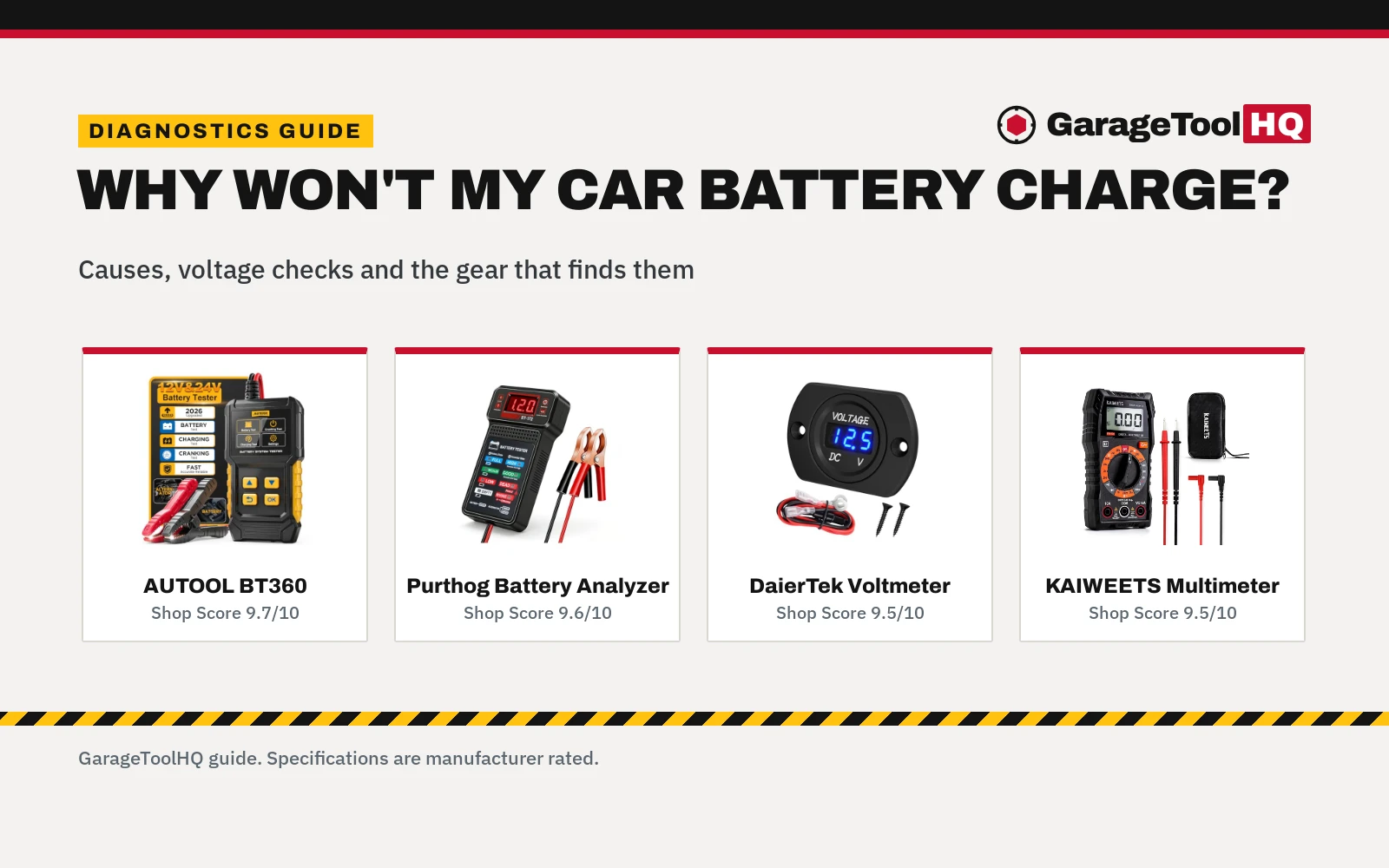
 AUTOOL 12V 24V Car Battery Tester9.7/10View on Amazon
- 2
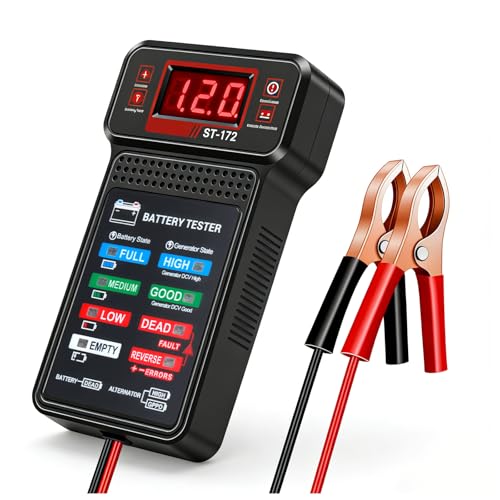 Car Battery Tester with LED Indicator & LCD9.6/10View on Amazon
- 3
 DaierTek Battery Voltage Meter Waterproof DC 12V9.5/10View on Amazon
- 4
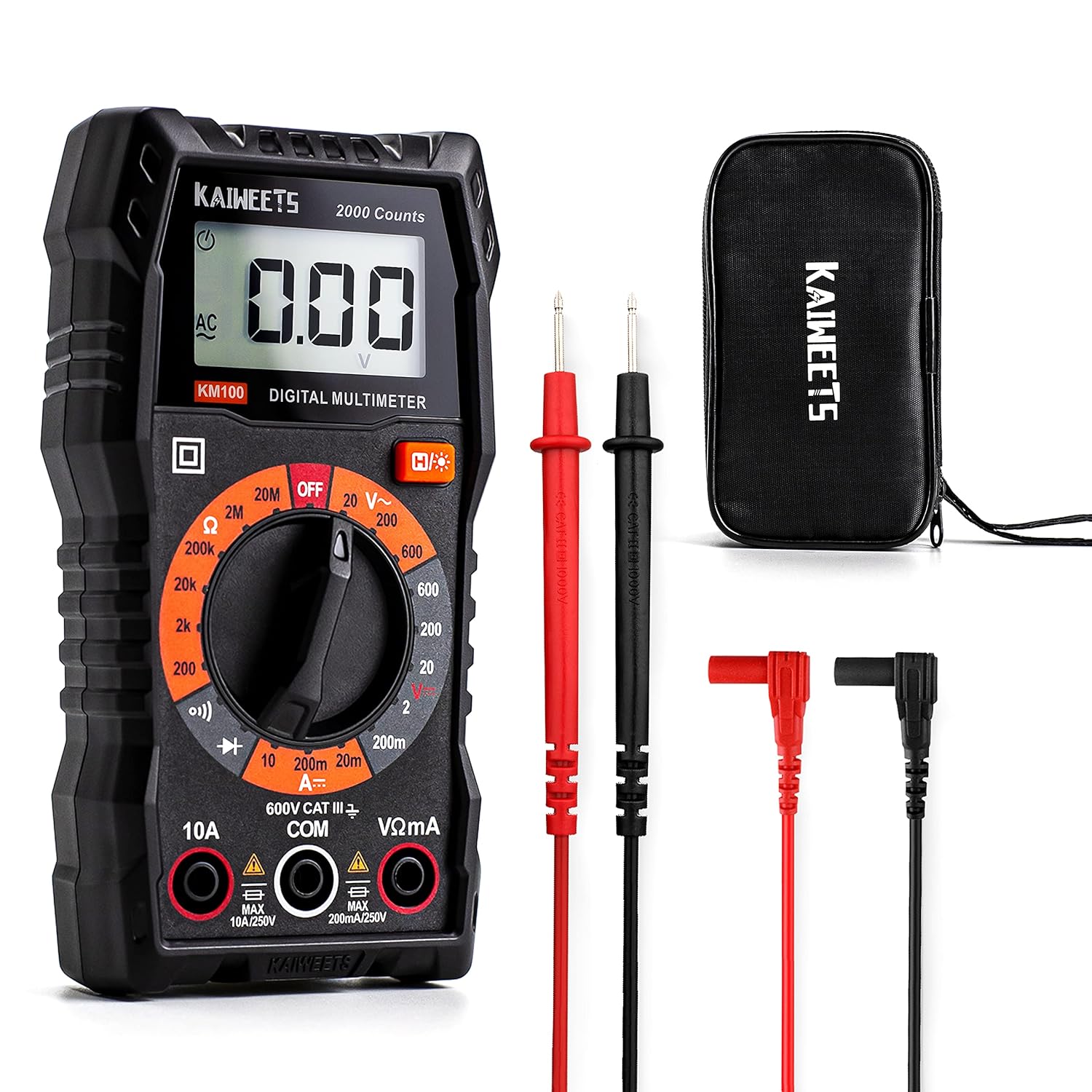 KAIWEETS Digital Multimeter Voltmeter with Case9.5/10View on Amazon
You turn the key and the starter drags, or the dash lights up and the engine never catches, and the question on your mind is why won’t my car battery charge. The short answer is that the battery, the charging system or the connection between them has failed. A battery that has failed inside will not hold a charge even from a good alternator, an alternator that has stopped working will not refill a good battery, and a loose or corroded connection will block the charge on its way to the battery. A voltmeter shows the voltage, and a battery analyzer adds the battery health and the charging output.
GarageToolHQ earns a commission when you buy through links on our product pages, at no extra cost to you. Read our affiliate disclosure.
Below: the causes, the checks that find them, and the gear that makes the checks.
AUTOOL 12V 24V Car Battery Tester
A 12V and 24V battery system analyzer that reads battery health, cranking and charging output across 30 to 2000 CCA.
Pros
- Battery health, cranking and charging checks
- 30 to 2000 CCA range for flooded, AGM, EFB and gel batteries
- Reverse polarity protection with heavy-duty clamps
- Color display, 3-year limited warranty
Cons
- 30 CCA minimum leaves very small batteries outside the range
- Lead-acid batteries only; lithium batteries are outside its stated range
- No carry case is stated for storage and roadside use
- Diagnoses the fault but does not charge the battery
Car Battery Tester with LED Indicator & LCD
A 12V battery analyzer with an LCD and color-coded LEDs that tracks voltage through startup and revving.
Pros
- Real-time voltage tracking through startup and revving
- Color-coded LEDs show battery health at a glance
- Reverse connection protection with REVERSE indicator and alarm
- Generator and battery modes
Cons
- 12V systems only; no 24V range stated
- Warranty within 3 months is a short term
- No CCA range is stated for the checks
- Battery health is LED only; no SOH or SOC reading is stated
DaierTek Battery Voltage Meter Waterproof DC 12V
A waterproof DC voltmeter with a blue LED display that reads 12V and 24V systems across DC 8 to 48V, accurate to 0.1V.
Pros
- Measures DC 8 to 48V with 0.1V accuracy
- Blue LED display reads in dark environments
- Waterproof design for moist environments
- Panel, nylon nut, wires and screws included
Cons
- Voltage only; no battery health or charging checks
- No warranty term is stated
- Needs a 29mm mounting hole for panel fitting
- Panel meter with wires; not a handheld clip-on analyzer
KAIWEETS Digital Multimeter Voltmeter with Case
A CAT III 600V manual-ranging multimeter with double fuses, a carrying case and 48 in leads.
Pros
- CAT III 600V, CE and RoHS with double fuses
- Carrying case and 2 AAA batteries included
- 48 in copper and PVC leads
- Lifetime after-sale service and support stated
Cons
- Manual ranging only, dial must match the job
- No counts stated
- Cannot measure AC current
- No counts stated in the listing
Why won’t my car battery charge: the usual causes
For a battery to charge, the battery has to accept a charge, the alternator has to deliver one, and the cables and terminals have to carry it. The checks below tell them apart.
Check the voltage first
A voltmeter is the first check: read the voltage at the battery terminals with the engine off, then read it again with the engine running. If the running reading is not higher than the resting reading, the charging system is not adding charge. If the running reading is higher, the charging system is producing output. That alone does not prove the battery is accepting the charge, so check the health reading next. The DaierTek voltmeter (on Amazon) in the gear section shows the voltage on a blue LED display with a measuring range of DC 8 to 48V and an accuracy of 0.1V.
Check the battery health and the charging system
A voltmeter shows voltage only. The AUTOOL BT360 (on Amazon) in the gear section reads the battery health, the state of charge, the internal resistance and the cranking and charging output, for 12V and 24V systems, across a 30 to 2000 CCA range, for flooded, AGM, EFB and gel lead-acid batteries. The Purthog analyzer shows the voltage on an LCD and battery health on color-coded LEDs, with a generator mode and a battery mode. Use the health reading to judge the battery, and the charging reading to judge the alternator.
The gear for checking a battery that won’t charge
The checks above need a meter or an analyzer: a voltmeter for the voltage reading, and a battery analyzer such as the AUTOOL BT360 for the health, cranking and charging readings.
Lead-acid batteries can release hydrogen while charging, so charge in a ventilated space away from sparks and flames, connect positive first and negative last, set the charger to the battery type (flooded, AGM, gel, lithium), and wear eye protection. Read our Safety Disclaimer.
What to do with the readings
If the analyzer shows a failed battery, the battery is the fault. If the charging reading shows no output, the alternator or its wiring is the fault. If the voltage is fine and the battery holds a charge, look at the connections and the terminals for corrosion and looseness, and leave any wiring work to a mechanic.
FAQ: garage tools
Why won’t my car battery charge even after a jump start?
A jump start adds power from another source, but it does not fix the fault. A battery that has failed inside will not hold the charge, and an alternator that is not delivering charge lets the battery drain again once the leads come off. A battery analyzer shows the battery health and the charging output, which tells them apart.
Can a voltmeter tell me if my alternator is bad?
A voltmeter shows the voltage at the terminals with the engine off and running. If the running voltage is not higher than the resting voltage, the charging system is not adding charge. A battery analyzer that reads charging output, such as the AUTOOL BT360, gives the charging reading directly.
What does a battery analyzer check?
The AUTOOL BT360 reads battery health, state of charge, internal resistance and real-time voltage, and runs cranking and charging checks for 12V and 24V systems. The Purthog analyzer shows real-time voltage on an LCD and battery health on color-coded LEDs, with a generator mode and a battery mode.
Does a battery analyzer work on 24V systems?
The AUTOOL BT360 covers 12V and 24V systems, and the DaierTek voltmeter reads DC 12V and 24V with a measuring range of DC 8 to 48V. The Purthog analyzer is 12V only.
Can I use a multimeter instead of a battery analyzer?
The KAIWEETS multimeter (on Amazon) in the gear section reads AC and DC voltage with a backlit LCD. A battery analyzer adds the health, cranking and charging readings that a voltage reading alone does not give.
Related: how to choose a car battery, does a new car battery need charging, best way to recharge a car battery, how to clean corroded car battery terminals and lithium vs lead acid battery analyzer.