12v vs 18v Cordless Drill: Which One Should You Buy?
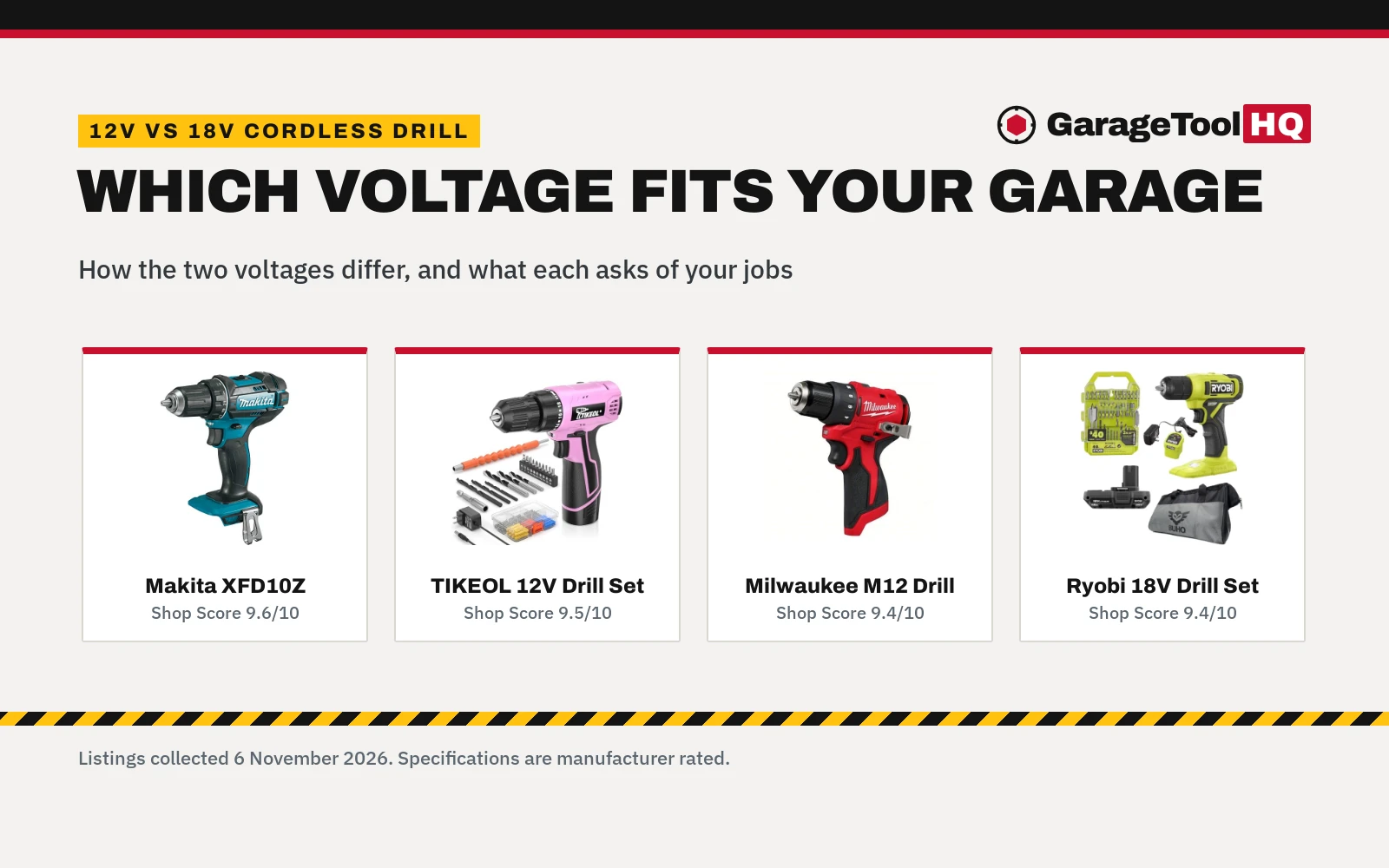
A 12v and an 18v cordless drill compared for home garage work: torque, speed, chuck size and battery, with two examples of each side.

On this page
This guide covers 12v vs 18v cordless drill. Verdict: Choose a 12v cordless drill if your jobs are light: driving screws, assembling furniture and drilling small holes around the house, where a light drill saves your wrist. Choose an 18v cordless drill if you drill larger holes, drive long fasteners or work on cars, where the extra torque earns its weight.
A Saturday job decides the voltage more than any spec sheet does: hanging shelves and assembling a bookcase ask for a light drill you can hold overhead, while drilling through a stud wall or driving long screws into deck boards asks for torque. This comparison of 12v vs 18v cordless drill walks through both sides, then looks at two examples of each voltage from the listings we reviewed.
As an Amazon Associate I earn from qualifying purchases. GarageToolHQ earns a commission when you buy through links on this page, at no extra cost to you. Read our affiliate disclosure.

Makita XFD10Z 18V LXT Lithium-Ion Cordless
An 18V driver-drill with 480 in. lbs. of max torque, a 2-speed transmission from 0-600 to 0-1,900 RPM, a 1/2 in chuck and a 3-year limited warranty.
Pros
- 480 in. lbs. of max torque, the highest figure among the examples
- 2-speed transmission, 0-600 and 0-1,900 RPM
- 1/2 in chuck takes larger bits than the 3/8 in chucks on the 12v examples
- Extreme Protection Technology for dust and water resistance on the job site
Cons
- Tool only: no battery or charger in the box
- No clutch settings stated in the listing
- No weight figure stated in the listing
- No certification stated

TIKEOL 12V Cordless Drill Set with Battery
A 12V drill set with 180 In-lbs of torque, an 18+1 clutch, a 3/8 in keyless chuck, a 1300mAh battery, charger, bits and a 1 Year Manufacturer warranty.
Pros
- 180 In-lbs of max torque from a pure copper motor
- 18+1 clutch and variable speed from 0-800 RPM
- Complete kit: battery, charger, drill bits, screwdriver bits and fasteners
- LED work light and a rubber-overmolded handle
Cons
- Only one battery pack in the kit
- 3/8 in chuck takes smaller bits than the 1/2 in Makita example
- No weight figure stated in the listing
- No certification stated
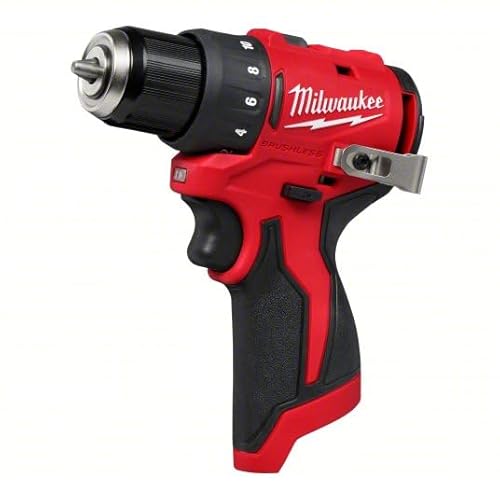
Milwaukee Electric - M12 SUBCOMPACT BRUSHLESS 3/8
A 12V subcompact brushless drill/driver with a metal 3/8 in keyless chuck, 12 clutch settings and a listed weight of 1.59 pounds.
Pros
- Brushless motor, built to prevent overloads and overheating
- Metal 3/8 in keyless chuck for durability
- 1.59 pounds, the lightest stated weight among the examples
- 12 clutch settings for precise control
Cons
- No torque figure stated in the listing
- No speed figure stated in the listing
- No battery or charger details stated in the listing
- No warranty term stated in the listing

Ryobi 18V Drill Set with Lithium-Ion Battery
An 18V drill set with a lithium-ion battery, charger, drill bits and a bag, on the ONE+ platform with batteries that fit over 250 tools.
Pros
- Battery, charger, bits and bag in the box
- 18V ONE+ battery fits over 250 tools
- A complete first kit for a new 18V owner
- Compact battery in the set
Cons
- No torque figure stated in the listing
- No speed figure stated in the listing
- No chuck size stated in the listing
- No warranty term stated in the listing
12v vs 18v cordless drill: what actually differs
| 12v cordless drill | 18v cordless drill | Notes | |
|---|---|---|---|
| Example max torque | 180 In-lbs (TIKEOL example) | 480 in. lbs. (Makita example) | The Milwaukee and Ryobi listings state no torque figure |
| Example speed | 0-800 RPM (TIKEOL example) | 0-600 and 0-1,900 RPM (Makita example) | The Milwaukee and Ryobi listings state no speed figure |
| Example chuck | 3/8 in keyless chuck on both 12v examples | 1/2 in on the Makita example | The Ryobi listing states no chuck size |
| Example clutch settings | 18+1 settings (TIKEOL example); 12 settings (Milwaukee example) | Not stated in the 18v listings | The 18v listings state no clutch settings |
| Example battery | 12V 1300mAh battery and charger (TIKEOL example) | 18V ONE+ Compact Battery, charger and bag (Ryobi example) | The Makita listing is tool only; the Milwaukee listing states no battery size |
| Example weight | 1.59 pounds (Milwaukee example) | Not stated in the 18v listings | The TIKEOL listing gives no weight figure |
| Example warranty | 1 Year Manufacturer (TIKEOL example) | 3-year limited warranty (Makita example) | The Milwaukee and Ryobi listings state no warranty term |
Example figures are manufacturer rated, as published on each listing and collected 5 November 2026.
Power and torque
Torque is where the two examples that state a figure separate most clearly. The TIKEOL 12v example states 180 In-lbs of max torque, while the Makita 18v example states 480 in. lbs. of max torque. That gap matches the job split in those two examples: the TIKEOL suits light drilling and screwdriving, while the 18v Makita example suits larger holes and long fasteners. Two listings state no torque figure at all, the Milwaukee and the Ryobi, so compare the Ryobi on its kit and platform, and the Milwaukee on its stated weight, chuck and clutch, rather than on torque.
Speed and control
Only two listings state a speed range. The TIKEOL 12v example runs a variable speed trigger from 0-800 RPM with an 18+1 clutch, and the Milwaukee 12v example lists 12 clutch settings without a speed figure. The Makita 18v example runs a mechanical 2-speed transmission at 0-600 and 0-1,900 RPM. The Ryobi listing states no speed figure and no clutch settings, so the listing leaves its control unclear.
Size, weight and chuck
The 12v listings describe themselves as compact: the TIKEOL listing calls its design compact, and the Milwaukee listing calls itself subcompact. The Milwaukee example weighs 1.59 pounds and both 12v examples carry a 3/8 in keyless chuck. The Makita 18v example carries a 1/2 in chuck and measures 8.6 inches x 3.7 inches x 8.9 inches in the spec table, so it takes larger bits. The Ryobi listing states no chuck size and no weight figure, and the TIKEOL listing gives no weight figure either, only that it weighs much less than bulky 20V models.
Battery and kit
Two of the examples come as kits. The TIKEOL set includes a 12V 1300mAh battery pack, a charger, drill bits, screwdriver bits and fasteners. The Ryobi set includes an 18V ONE+ Compact Battery, a charger, a drill bit set and a bag, and its battery fits over 250 tools on the same platform. The Makita listing is tool only, so it suits an owner who already holds 18V LXT batteries. The Milwaukee listing states no battery details, so check the listing before you buy.
Choose a 12v if
- You drive screws and drill small holes around the house
- You want a light drill for overhead work, like the 1.59-pound Milwaukee example
- You like a full kit in one box, like the TIKEOL set
- You already own 12v batteries on the same platform
Choose an 18v if
- You drill larger holes and drive long fasteners
- You want the most torque, like the 480 in. lbs. Makita example
- You want a 1/2 in chuck for larger bits
- You already own 18v batteries on the same platform
Example drills
For more choices, see the cordless drill vs cordless screwdriver comparison, and the best drill bit set for bits to pair with either voltage.
Use rated jack stands on solid ground, wear eye protection with power and air tools, keep fuel-burning equipment out of a closed garage, and follow the manual for every tool. Read our Safety Disclaimer.
Garage Fit Check
- Check the chuck: the 12v examples take a 3/8 in chuck, while the Makita 18v example takes a 1/2 in chuck, so match your bits to the drill.
- Check the box: the Makita listing is tool only, so a battery and charger come separately.
- Check the battery: the TIKEOL set holds a 12V 1300mAh battery pack, and the Ryobi battery fits over 250 tools on the ONE+ platform.
- Check the weight: the Milwaukee example lists 1.59 pounds, while the other listings state no weight figure.
- Check the warranty: the Makita example carries a 3-year limited warranty and the TIKEOL set a 1 Year Manufacturer warranty, while the Milwaukee and Ryobi listings state no term.
FAQ: garage tools
Is a 12v or 18v cordless drill better for home use?
It depends on the job. A 12v drill suits light work like driving screws and assembling furniture, while an 18v drill suits larger holes and long fasteners.
Can a 12v drill handle drilling into studs?
The listings state no stud-drilling results. The TIKEOL 12v example states 180 In-lbs of torque and a 0-800 RPM range, and its listing pitches it at home repair and furniture assembly, while the Makita 18v example states 480 in. lbs. of torque.
Do 12v and 18v drills use the same batteries?
No. A 12v battery fits 12v tools on its platform, and an 18v battery fits 18v tools on its platform, like the Ryobi ONE+ battery that fits over 250 tools.
What chuck size do I need?
Both 12v examples here carry a 3/8 in chuck, while the Makita 18v example carries a 1/2 in chuck. Match the chuck to the bits you already own.
Is the Makita XFD10Z a complete kit?
No. The listing is tool only, so the battery and charger come separately. The TIKEOL and Ryobi sets include a battery and charger in the box.
Related: the cordless drill vs cordless screwdriver comparison, the hammer drill vs impact driver comparison, the best drill bit set, our cordless tools hub and the cobalt vs HSS drill bits guide.