Air Hose Repair Kit: How to Fix a Leaking Air Hose
A cut hose does not mean a new hose: a brass barb, a clamp and a flat cut put the hose back to work.

On this page
You pull the trigger on the impact wrench and hear the hiss before the socket moves: the hose is leaking somewhere between the compressor and the tool. An air hose repair kit is usually a set of brass barb fittings and clamps that lets you cut out the damaged section and join the hose again, instead of replacing the whole hose. This guide shows what is in a kit, how to match the fitting to the hose, and how to make the repair hold.
As an Amazon Associate I earn from qualifying purchases. GarageToolHQ earns a commission when you buy through links on our product pages, at no extra cost to you. Read our affiliate disclosure.
Below: what a repair kit holds, how to find the leak, the repair steps, and the sizes and pressure limits to check before you start.
Air hose repair kit: what is in the kit
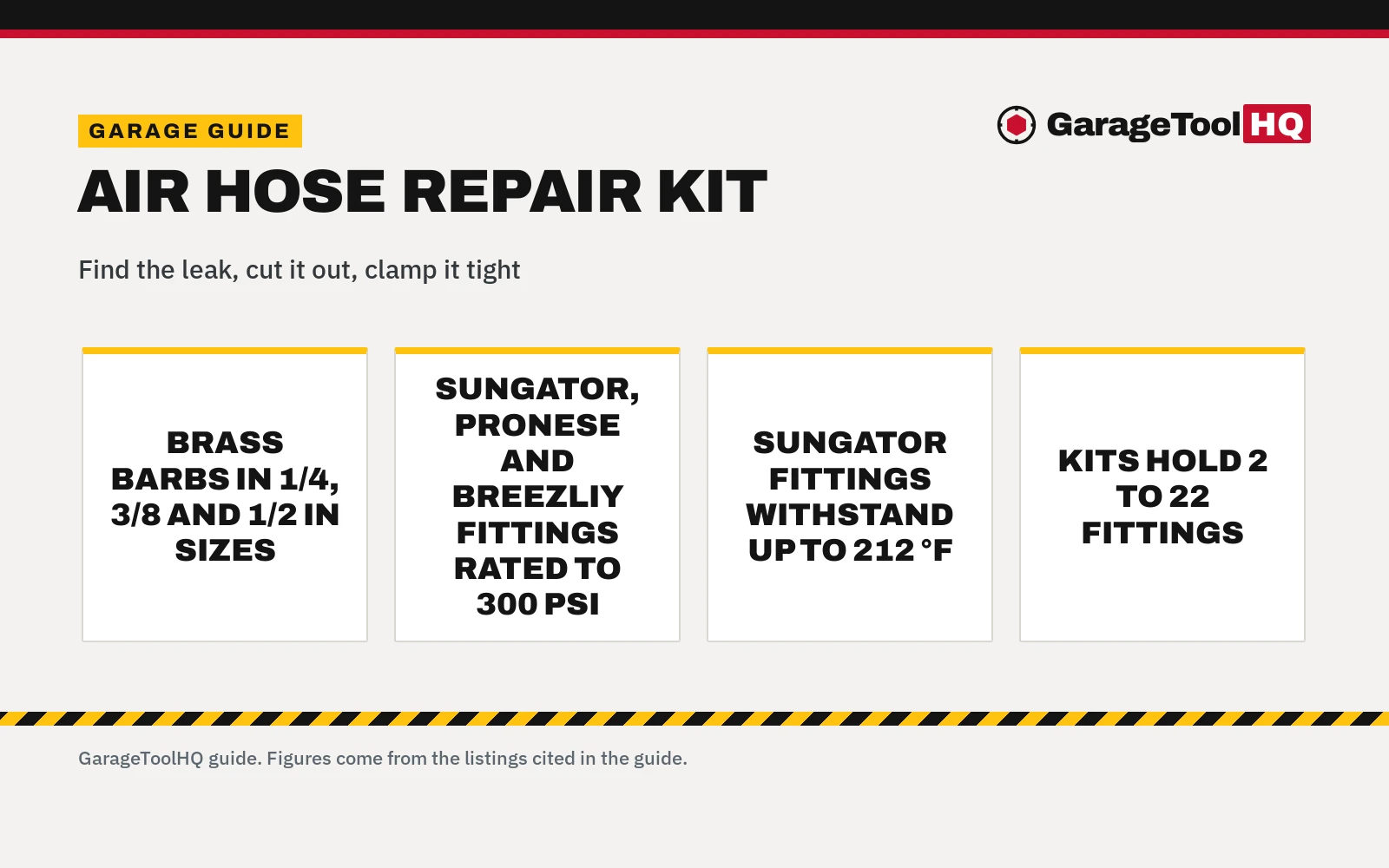
A repair kit is usually built around a brass barb fitting and a clamp. The barb pushes inside the hose and the clamp squeezes the hose wall onto the barb, so air cannot escape past the joint. Kits in the listings run from 2 pieces to 22 pieces: the SUNGATOR 2-piece kit holds 2 fittings and 2 clamps, the 6-piece kit holds 6 adapters and 6 clamps, the 12-pack holds 12 fittings and 12 clamps, and the Ailbiuko kit holds 22 barb fittings and 44 hose clamps. Some kits add thread sealant already coated on the threads, and the Pronese kits include Teflon tape, 1 piece with the 2-pack and 2 pieces with the 4-pack.
There are two main fitting shapes. A barb-to-NPT fitting joins a hose to a threaded port: the barb end goes in the hose and the male NPT end screws into a coupler, a tool or a compressor outlet. A splicer joins two cut hose ends: each end is a barb, and a nut on each side locks the joint. The Breezliy splicer kit fits hose with a 1/4 in inside diameter and a 3/8 in outside diameter, and the Pronese reusable fitting suits rubber hose with a 3/8 in barb for 3/8 in inside diameter hose and a 1/4 in NPT end.
| Fitting | What it joins | Sizes in the listings |
|---|---|---|
| Barb to NPT adapter | Hose to a threaded port | 1/4 in barb x 1/4 in NPT; 3/8 in barb x 1/4 in NPT; 1/2 in barb x 1/2 in NPT |
| Hose splicer | Two cut hose ends | 1/4 in for 1/4 in inside diameter hose; 3/8 in for 3/8 in inside diameter hose |
| Reusable hose-end fitting | Rubber hose to a threaded port | 3/8 in barb for 3/8 in inside diameter rubber hose, 1/4 in NPT |
Find the leak first
Start with the hose disconnected from the compressor and the air released, and look along its length for cuts, cracks and soft spots. To find a leak you cannot see, reconnect the hose and bring it up to pressure: a leak you can hear is usually at a fitting or a cut, and one you cannot find by ear shows up with soapy water brushed on the hose, where bubbles mark the hole. Mark the damaged section with tape, then release the air again before you cut, and cut a little past the damage on each side so no cracked rubber stays in the joint.
Cut out the damage and fit the barb
- Cut out the damaged section. Use a pipe cutter and make the cut flat, so the hose end sits square on the barb.
- Slide the clamp or nut on first. Put the clamp over the hose end before the barb goes in, or you will have to pull the fitting out again.
- Push the barb into the hose. Work the barb end fully into the hose until the hose covers the barbs.
- Tighten the clamp or nut. Use a wrench to tighten the nut and fitting, or close the clamp around the hose over the barb, until the joint feels firm.
- Check the repair under air. Reconnect the hose, bring the compressor up to pressure, and brush soapy water over the joint. Bubbles mean air is still escaping, so tighten the clamp and check again.
Match the fitting to the hose
The barb has to match the inside diameter of the hose: a 1/4 in barb fits a 1/4 in inside diameter hose, and a 3/8 in barb fits a 3/8 in inside diameter hose. The Breezliy replacement fitting also fits 5/16 in inside diameter by 15/32 in outside diameter hose on the barb end, with a 1/4 in male NPT connection on the other end. The Ailbiuko kit covers 1/8 in, 1/4 in, 3/8 in and 1/2 in threads, with clamps in 8-12 mm, 9-16 mm and 13-19 mm sizes, so one kit covers the common shop hose sizes. The BlingKingdom splicer is 1.8 in long with a 3/8 in outside diameter, and its clamps fit a hose outside diameter of 13-19 mm.
Pressure and heat limits matter as much as size. The SUNGATOR and Pronese fittings are rated to a maximum of 300 PSI, and the SUNGATOR fittings withstand up to 212 °F while the Pronese fittings list a temperature range of -40 to +250 degrees F. Stay inside the fitting’s stated limits and what the hose itself is made for: a repair cannot make a hose hold more pressure than the hose itself is rated for. The SUNGATOR brass fittings meet ASTM B584 and ASME/ANSI B16, which the maker lists as the standard for the brass.
Never cut into a hose that is still connected to a live compressor. Disconnect the hose, pull the trigger on the tool or open the coupler to release the air, and only then pick up the cutter.
When a repair is not enough
A barb repair suits a clean cut or a short damaged section in an otherwise sound hose. If the hose is cracked along its length, soft and swollen, or damaged at several spots, a fitting cannot save it: replace the hose. A hose that leaks at the factory crimp can sometimes be saved by cutting off the crimped end and fitting a reusable hose-end fitting, if enough sound hose is left after the cut; if the hose would end up too short, replace the hose. The best air hose for garage picks compare hoses for the shop, and the steel reinforced air hose guide covers tougher hose for rough use.
Drain the tank after use so water does not rust it from the inside, never exceed the tool's rated pressure, wear eye protection, and run 240V units on the circuit the manual calls for. Do not run a gas engine compressor in a closed garage. Read our Safety Disclaimer.
FAQ: garage tools
Can I repair an air hose with a barb fitting?
Yes. Cut out the damaged section, push a barb fitting into the hose end, and tighten a clamp over the barb. The repair holds if the barb matches the hose inside diameter and the clamp sits over the barbs, and the SUNGATOR and Pronese fittings in the listings are rated to a maximum of 300 PSI.
What size barb fitting do I need for my air hose?
Match the barb to the hose inside diameter: a 1/4 in barb for a 1/4 in inside diameter hose and a 3/8 in barb for a 3/8 in inside diameter hose. The Breezliy fitting also covers 5/16 in inside diameter by 15/32 in outside diameter hose. Check the NPT end too: the SUNGATOR, Pronese and Breezliy fittings here use a 1/4 in male NPT thread, while the Ailbiuko kit also includes 1/8, 3/8 and 1/2 in NPT ends, so match the thread to the port it screws into.
Do I need thread sealant on a hose barb fitting?
The barb end needs no sealant: the clamp does the sealing. The threaded NPT end does: the SUNGATOR fittings come with sealant already coated on the threads, and the Pronese kits include Teflon tape.
How much pressure can a repaired air hose hold?
The SUNGATOR, Pronese and Breezliy fittings in the listings are rated to a maximum of 300 PSI; the other kits in the listings state no pressure rating, so check the listing for the fitting you buy. The repair is only as strong as the hose itself, so stay inside what the hose itself is made for and the fitting’s stated limit.
Can I reuse a hose repair fitting?
The Pronese and Breezliy fittings are reusable: the nut and barb can come off and go on again. The screw clamps in these kits can be loosened and reused too, but spares are handy: a kit such as the Ailbiuko set holds 44 hose clamps.
What is the difference between a barb fitting and a hose splicer?
A barb-to-NPT fitting joins a hose to a threaded port, while a splicer joins two cut hose ends with a barb on each end. The Breezliy splicer fits hose with a 1/4 in inside diameter and a 3/8 in outside diameter, and its kit holds 4 splicers, 8 nuts and 2 pieces of thread seal tape.
Related: air hose fittings brass vs steel, the best heavy duty air hose fittings, the quick connect air compressor fittings picks and the air compressors hub. Also see the air compressor problems and solutions guide.