Air Compressor vs Tire Inflator: Which One Should You Buy?
How an air compressor differs from a dedicated tire inflator: air tank storage, airflow delivery, duty cycle, portability, and choosing the right unit for your garage.

On this page
Top picks at a glance
As an Amazon Associate we earn from qualifying purchases.
- 1
 Stealth Air Compressor 2 Gallon9.7/10View on Amazon
- 2
 ALL-TOP Air Compressor Kit9.6/10View on Amazon
- 3
 AstroAI AIRUN H Tire Inflator Portable Air Compressor9.6/10View on Amazon
- 4
 Digital Air Compressor for Car Auto Pump Portable TireView on Amazon
- 5
 ROCGORLD R8 Tire Inflator Portable Air CompressorView on Amazon
- 6
 Fanttik X8 APEX Tire Inflator Portable Air CompressorView on Amazon
- 7
 AstroAI Tire Inflator Portable Air CompressorView on Amazon
- 8
 ETENWOLF VORTEX S6 Tire Inflator Portable Air CompressorView on Amazon
- 9
 CARSUN AC/DC Tire Inflator Portable Air CompressorView on Amazon
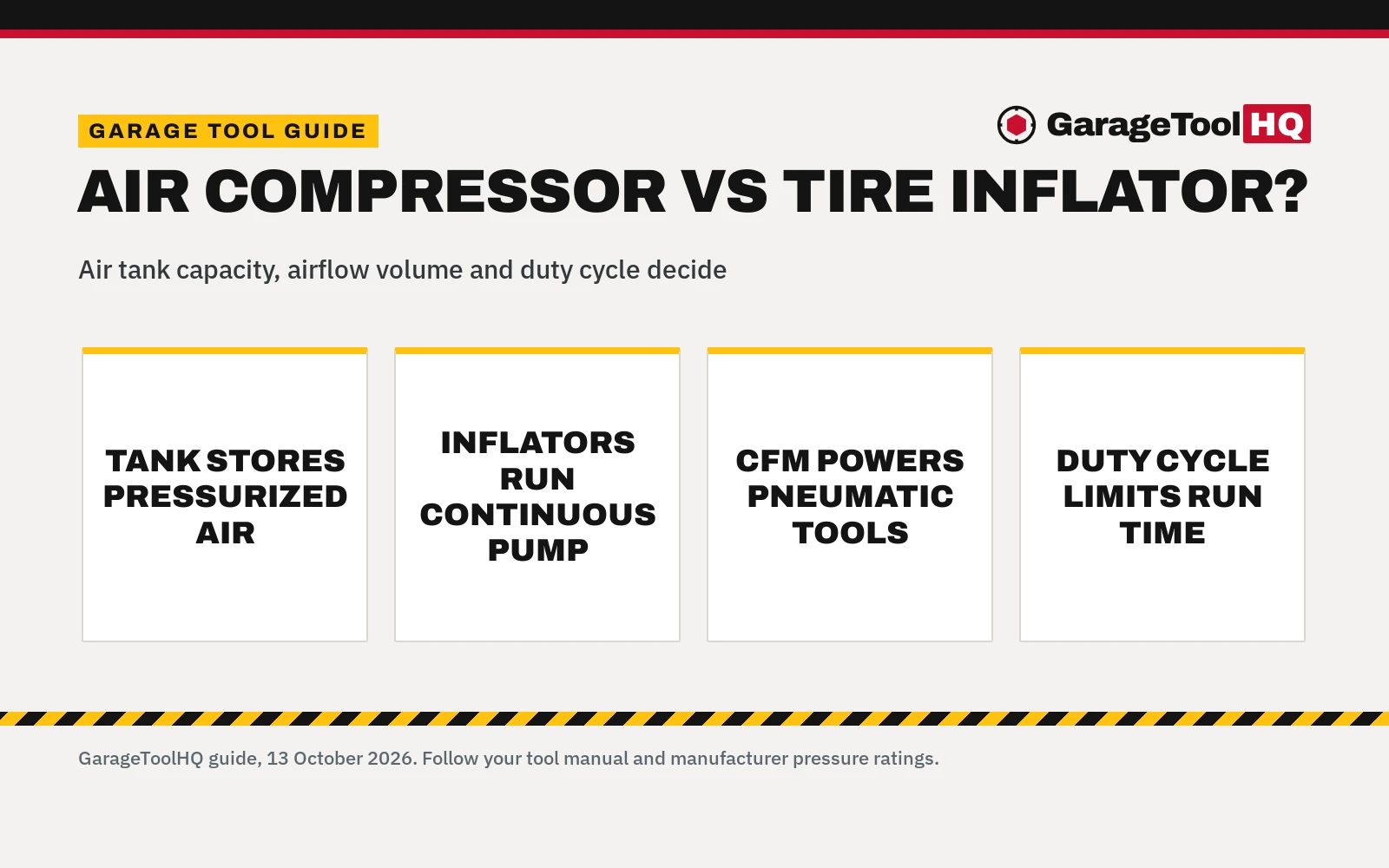
When you are rotating wheels or checking tire pressure before a road trip, deciding between an air compressor vs tire inflator comes down to whether you only need to fill tires or plan to run air tools. A dedicated tire inflator is a compact pump built strictly to fill tires and sports gear directly from your vehicle or garage wall. An air compressor stores air under pressure inside a steel tank, providing the volume and flow required to drive pneumatic tools like impact wrenches, spray guns, and air ratchets as well as fill tires. If your only job is tire inflation and roadside emergency top-offs, a portable tire inflator is all you need; if you want to power pneumatic tools in the shop, you need an air compressor with a storage tank.
More options to compare
 Digital Air Compressor for Car Auto Pump Portable TireCheck price on Amazon
 ROCGORLD R8 Tire Inflator Portable Air CompressorCheck price on Amazon
 Fanttik X8 APEX Tire Inflator Portable Air CompressorCheck price on Amazon
 AstroAI Tire Inflator Portable Air CompressorCheck price on Amazon
 ETENWOLF VORTEX S6 Tire Inflator Portable Air CompressorCheck price on Amazon
 CARSUN AC/DC Tire Inflator Portable Air CompressorCheck price on Amazon
GarageToolHQ earns a commission when you buy through links on our product pages, at no extra cost to you. Read our affiliate disclosure.
Below: how air compressors and tire inflators work mechanically, how tank storage and airflow differ, a side-by-side comparison of capabilities, and how to decide which tool belongs in your garage.
Air compressor vs tire inflator: key mechanical differences
While both machines compress air and deliver it through a hose, their internal mechanics are completely different:
- Tire inflators: A dedicated tire inflator uses a direct-drive reciprocating piston or diaphragm without an air storage tank. When turned on, the motor drives the piston rapidly, pushing air directly into the tire valve stem. Because there is no reservoir to store volume, airflow is modest, but pressure builds steadily until the target pressure is reached. Many models feature digital pressure gauges and automatic shut-off circuits.
- Air compressors: An air compressor pairs an electric motor and pump with a pressurized steel storage tank. The pump draws in atmospheric air, compresses it, and fills the ASME-rated tank until an internal pressure switch shuts the motor off at maximum pressure. When you attach an air tool or tire chuck, stored air discharges through a regulator at high volume. The motor restarts only when tank pressure drops below the cut-in threshold.
Comparing tire inflators and shop air compressors
| Feature | Dedicated Tire Inflator | Air Compressor with Tank |
|---|---|---|
| Primary Purpose | Inflating car, bike, and trailer tires; sports gear | Powering pneumatic shop tools, sprayers, and tires |
| Air Storage | No tank; direct pump-to-tire delivery | Steel pressure tank (such as 2.4, 15, or 60 gallon tanks) |
| Airflow Delivery | Low continuous airflow; unrated for air tools | High airflow (delivering 4.5 to 14.6 CFM at 90 PSI) |
| Maximum Pressure | Up to 150 PSI for high-pressure bicycle and car tires | Up to 125 to 175 PSI regulated output |
| Power Source | 12V vehicle plug, rechargeable battery, or 110V cord | 110V standard outlet or 240V workshop circuit |
| Portability | Compact; weighs 1.9 lbs; fits in trunk or glovebox | Shop equipment; 68.3 to 81.6 pounds, or stationary |
| Duty Cycle | Short duty cycle; requires cooling periods between tires | Automatic cycling managed by pressure switch |
This mechanical split explains why each tool serves a distinct role in home garages.
Airflow delivery: why CFM matters more than PSI
The most common mistake when comparing these tools is looking only at maximum pressure (PSI). Pressure alone does not determine whether a machine can run workshop equipment.
For example, the CRAFTSMAN portable 12V tire inflator listing specifies a maximum pressure of 150 PSI while weighing only 1.9 lbs. It connects to a 12V car plug with a 10 ft cord and a 2.17 ft hose, inflating a 195/65 R15 tire from 30 to 36 PSI in under 1 minute. While 150 PSI is ample pressure to inflate vehicle tires, the pump delivers minimal air volume per minute, meaning it cannot run pneumatic air tools.
Air tools require airflow volume, measured in cubic feet per minute (CFM) at 90 PSI. Without a pressurized tank to supply high CFM, an air tool stalls instantly. Different workshop jobs require distinct compressor capacities:
- Compact compressors: The VELPAX 2.4 gallon compressor listing features a 1.5 HP motor delivering 6.71 CFM at 115 PSI, while the MZB 2.4 gallon model uses a 1.2 HP motor delivering 5.65 CFM at 115 PSI and fills its tank in 28 to 32 seconds. These suit tire inflation, brad nailing, and light air brushing.
- Mid-size garage compressors: The VEVOR 15 gallon compressor pairs a 2 HP motor with a 15 gallon tank, delivering 5.3 CFM at 90 PSI up to 125 PSI at 78 dB, weighing 81.6 pounds. Similarly, the RyanTek 15 gallon unit delivers 4.5 CFM at 90 PSI with a 125 PSI maximum pressure at 66 dB, weighing 68.3 pounds. These ratings supply the continuous CFM needed for impact wrenches during wheel rotations.
- Stationary shop compressors: The DEWALT 60 gallon stationary compressor features a 5 HP motor on a 240V circuit (20 A). Its listing shows 14.6 CFM at 90 PSI and 17 CFM at 40 PSI with a maximum pressure of 175 PSI, sustaining heavy pneumatic grinders and paint guns.
Learn more about matching air volume to your equipment in our guide to what CFM do air tools need and review our explanation of what CFM at 90 PSI means.
Duty cycle, heat buildup, and motor longevity
Compressing air creates significant friction and heat, and these machines manage thermal buildup in different ways.
A portable tire inflator houses its motor and cylinder in a small enclosed shell with minimal cooling surface. Most manufacturer manuals specify a strict duty cycle, requiring the pump to rest after continuous operation. Inflating multiple large tires back-to-back can overheat the unit or trigger internal thermal protection.
A workshop air compressor relies on its tank to buffer the workload. The motor runs only until the vessel reaches full pressure, then shuts down while you work from the stored air reserve. Workshop compressors also feature cooling fins and safety relief valves. For example, the VELPAX compressor includes an integrated safety valve opening at 128 PSI, while the VEVOR compressor includes automatic overheating protection.
Compressed air produces water condensation inside steel tanks as warm air cools. Always open the tank drain valve after each garage session to remove moisture and prevent internal tank corrosion. See our guide on how to drain water from an air compressor tank.
Drain the tank after use so water does not rust it from the inside, never exceed the tool's rated pressure, wear eye protection, and run 240V units on the circuit the manual calls for. Do not run a gas engine compressor in a closed garage. Read our Safety Disclaimer.
Which one should you buy for your garage?
Use this practical checklist to decide which tool fits your garage needs:
- Choose a dedicated tire inflator if: You only need to maintain correct pressure on cars, bicycles, lawn tractors, or trailers. You want a lightweight unit that stows in your vehicle trunk for roadside emergencies and runs directly off a 12V car accessory plug.
- Choose an air compressor with a tank if: You plan to use pneumatic tools like impact wrenches, air ratchets, die grinders, or paint spray guns. You need high airflow volume, fast tire bead seating, and a permanent air supply for workshop projects.
- Owning both: Many home mechanics keep a 15 gallon compressor in the garage for maintenance jobs and tool power, while keeping a 12V digital inflator in the trunk for road trips.
Explore our recommendations on how to choose an air compressor or browse our top picks for the best portable tire inflator.
Frequently Asked Questions
Can I use an air compressor to inflate car tires?
Yes. An air compressor works exceptionally well for inflating car tires when paired with a standard air hose and tire chuck. Because it draws from a pressurized tank, it fills tires faster than a portable 12V inflator. Check our guide to the best tire inflator with gauge for shop attachments.
Can a portable 12V tire inflator run pneumatic air tools?
No. Pneumatic air tools require substantial continuous airflow, measured in CFM at 90 PSI. A 12V portable tire inflator lacks an air tank and cannot deliver the air volume needed to spin an impact wrench or air ratchet.
What is the difference between CFM and PSI?
PSI (pounds per square inch) measures the force of the air, whereas CFM (cubic feet per minute) measures the volume of air delivered. Tires require proper PSI to reach vehicle pressure specifications, while pneumatic tools need high CFM to operate continuously.
How do you make an air compressor quiet in a home garage?
Choose an oil-free model equipped with dual intake silencer mufflers and low-RPM operation. For example, VELPAX lists noise at 60 dB and RyanTek at 66 dB, compared to typical compressors running at 78 dB to 90 dB. Placing rubber pads under the feet also dampens vibration.
Is air compressor oil the same as regular automotive motor oil?
No. Oil-lubricated compressors require non-detergent air compressor oil. Automotive motor oil contains detergent additives that suspend engine contaminants, which can cause carbon deposits and valve foaming inside a compressor pump. Always check your manual specifications.
Related: our guide to how to choose an air compressor, our review of the best portable tire inflator, what CFM do air tools need, best air compressor for home garage, and our air compressors hub.