Best Automotive Smoke Machine (2026): 5 Leak Detectors Compared
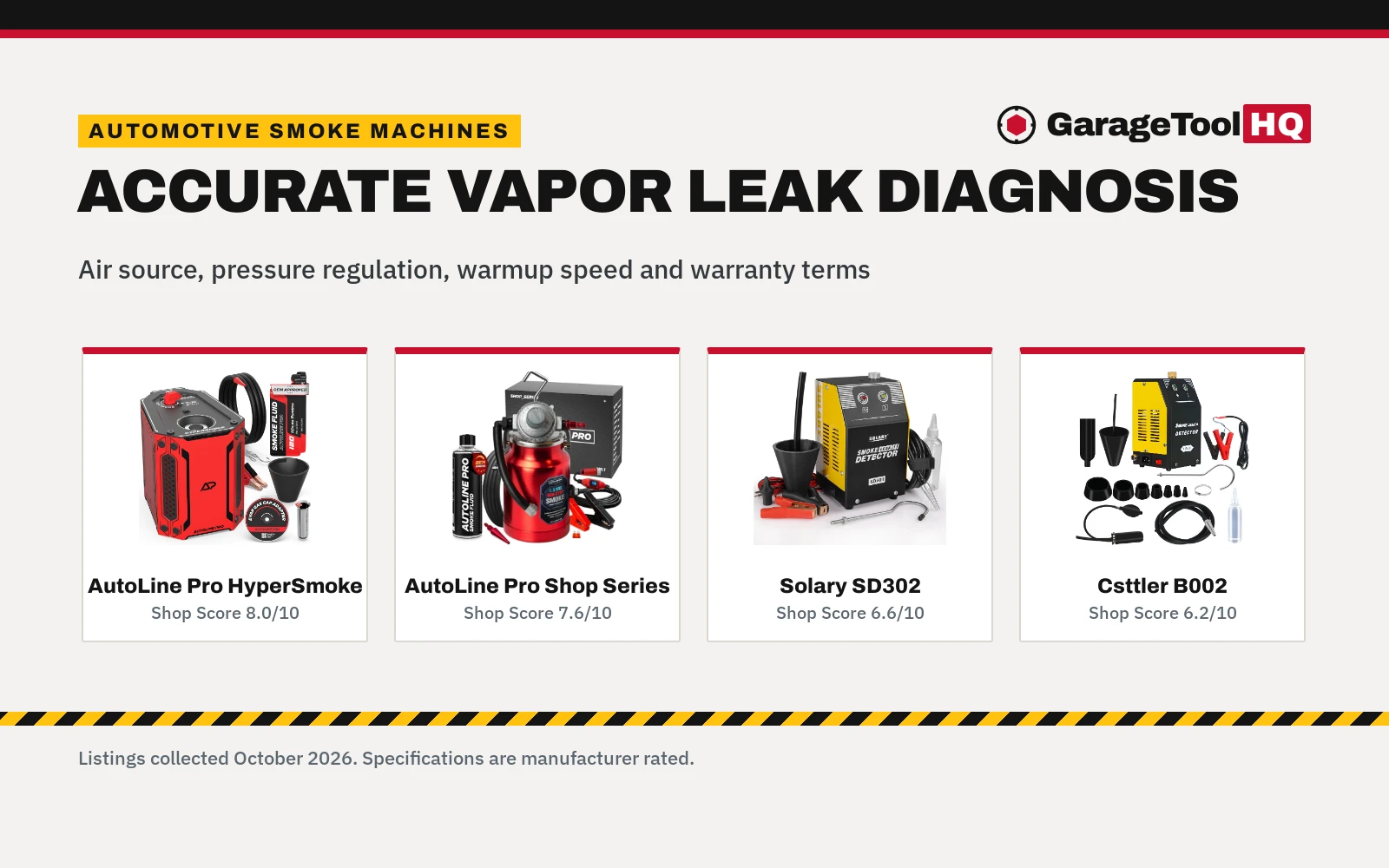
Five automotive smoke machines for diagnosing EVAP and vacuum leaks, compared by air source, operating pressure, warmup speed, fluid, and warranty.

On this page
Top picks at a glance
As an Amazon Associate we earn from qualifying purchases.
- 1
 Top PickAutoLine Pro HyperSmoke9.6/10View on Amazon
- 2
 Best Workshop PickAutoLine Pro Shop Series9.6/10View on Amazon
- 3
 Best Compact Pump UnitSolary SD3029.4/10View on Amazon
- 4
 Best Accessory SetCsttler B0029.3/10View on Amazon
- 5
 AutoLine Pro HyperSmoke™ Automotive Smoke Machine EVAP VacuumView on Amazon
- 6
 Automotive Smoke MachineView on Amazon
- 7
 ANCEL L8000 EVAP&Turbo High Pressure Automotive Smoke MachineView on Amazon
When an elusive evaporative emission trouble code trips your check engine light or an unmetered intake leak causes rough idling after an intake manifold gasket replacement, spraying soapy water or carb cleaner rarely reveals the source. Finding hairline vacuum cracks and weeping hose connections requires vapor diagnostics, making the best automotive smoke machine an essential diagnostic tool for your home garage. This guide compares five smoke machines by air supply mechanism, operating pressure regulation, warmup speed, included adapters, fluid, and warranty terms.
GarageToolHQ earns a commission when you buy through links on this page, at no extra cost to you. Read our affiliate disclosure.
Quick picks
- Top Pick AutoLine Pro HyperSmoke: Built-in compressor motor, adjustable pressure with low-pressure EVAP mode, instant warmup, fluid included, and a 3 year warranty. Check price on Amazon
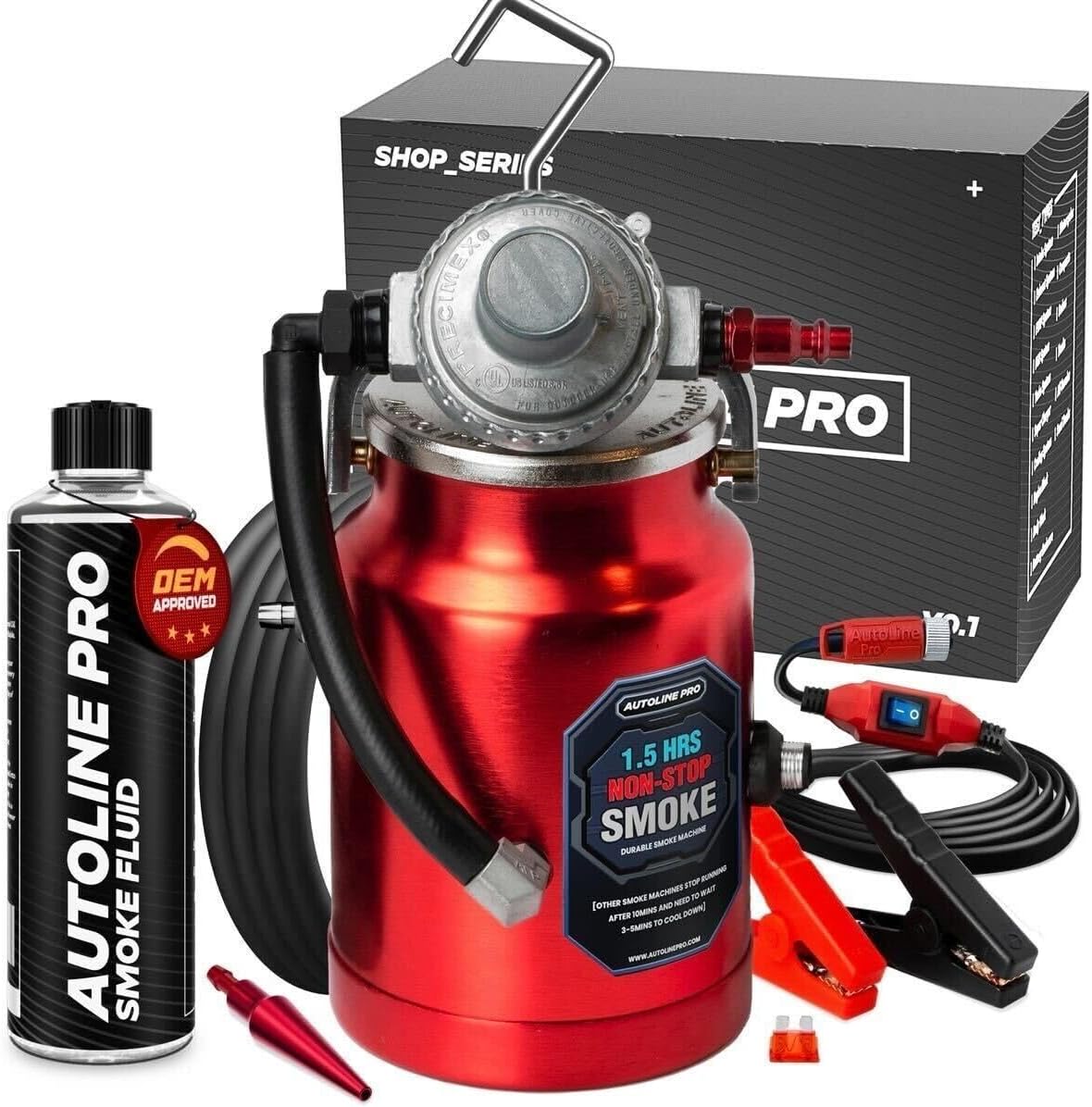
- Best Workshop Pick AutoLine Pro Shop Series: Thick metal construction, ceramic coil, 1.5-hour nonstop smoke, 800-minute OEM fluid, and a 3 year warranty using your shop air compressor. Check price on Amazon
- Best Compact Pump Unit Solary SD302: Built-in air pump, 10-second smoke output, 12V DC power, and overheat protection at 4.4 lb. Check price on Amazon
- Best Accessory Set Csttler B002: Built-in air pump, spare intake bladder, cone adapters, full-size cap plugs, and 10-second smoke output. Check price on Amazon
The picks

AutoLine Pro HyperSmoke™ Automotive Smoke Machine
A compact 1.4 lb automotive smoke machine with a built-in compressor motor, adjustable pressure for EVAP diagnosis, and included smoke fluid.
Pros
- Built-in air compressor motor eliminates external air supply
- Adjustable pressure includes under 1 PSI mode to protect EVAP systems
- OEM approved smoke fluid included with 240 minutes of runtime
- Three-year manufacturer warranty with US-based support
Cons
- Operating voltage is not stated on the listing
- No pressure gauge readout numbers provided in listing specs
- Higher initial investment than basic single-mode units
- No safety listing stated
AutoLine Pro Shop Series Smoke Machine
A solid metal automotive smoke machine with a ceramic coil, 1.5-hour continuous output, and 800-minute OEM smoke fluid that connects to any air compressor.
Pros
- Solid thick metal construction with ceramic smoke coil
- Continuous 1.5-hour smoke output per use
- Generous 800-minute OEM approved smoke fluid included
- Tapered injection nozzle fits virtually all automotive lines
Cons
- Requires an external air compressor to operate
- Listing title claims lifetime warranty while bullets state 3 years
- No integrated pressure regulator or gauge provided
- No safety listing stated

Solary Automotive Smoke Machine Leak Detector
A 12V automotive smoke machine with an internal air pump, 10-second smoke production, and overheat protection for EVAP and intake diagnosis.
Pros
- Built-in air pump requires no external shop compressor
- Produces thick diagnostic smoke within 10 seconds of startup
- Intelligent overheat and anti-frost protection built in
- Runs on standard 12V vehicle battery power
Cons
- Listing contradicts weight between 4.4 lb in text and 5.52 lb in table
- Smoke fluid is not included in the package
- No warranty term is stated on the listing
- Spec table contains copy error listing manual mirror adjustment

Automotive Smoke Machine
A 12V smoke machine with an internal air pump, rapid 10-second output, spare intake bladder, and adapter plugs for automotive diagnostics.
Pros
- Integrated air pump generates fast smoke output in 10 seconds
- Includes spare intake bladder, cone adapters, and cap plugs
- Powered by standard 12V DC battery clamps
- Built-in overheat and freeze protection shutoff
Cons
- Generates 20 to 25 PSI which can overload delicate EVAP systems
- Smoke fluid is not included, providing only empty bottles
- No warranty term is stated (listing specifies other)
- Spec table incorrectly lists power source as no

Solary Smoke Machine Leak Detection
A 3.94 lb compact smoke leak detector designed for auto repair workshops diagnosing EVAP and automotive pipe systems.
Pros
- Lightweight 3.94 lb housing is easy to move around the garage
- Engineered for EVAP and automotive pipe system diagnosis
- Simple setup with straightforward operational controls
- Compact package dimensions for convenient shop storage
Cons
- Listing does not state whether air pump is internal or external
- No operating voltage, wattage, or flow specifications provided
- No warranty term is stated on the listing
- Product dimensions and included accessory details are omitted
More options to compare
 AutoLine Pro HyperSmoke™ Automotive Smoke Machine EVAP VacuumCheck price on Amazon
 Automotive Smoke MachineCheck price on Amazon
 ANCEL L8000 EVAP&Turbo High Pressure Automotive Smoke MachineCheck price on Amazon
Compare the picks
| Model | Shop Score | Air source | Pressure regulation | Smoke fluid | Dimensions | Weight | Warranty |
|---|---|---|---|---|---|---|---|
| AutoLine Pro HyperSmoke | 9.6/10 | Built-in compressor motor | Adjustable (under 1 PSI EVAP mode) | Included (240 min) | 5 x 5 x 4 in | 1.4 lb | 3 years |
| AutoLine Pro Shop Series | 9.6/10 | External compressor required | Not stated | Included (800 min) | 1.97 x 2.36 x 1.97 in | 3.12 lb | 3 years (title lists lifetime) |
| Solary SD302 | 9.4/10 | Built-in air pump | Not stated | Not included (takes 20 ml) | 5.04 x 4.65 x 7.99 in | 4.4 lb (spec table lists 5.52 lb) | Not stated |
| Csttler B002 | 9.3/10 | Built-in air pump (20 to 25 PSI) | Not stated | Not included (takes 10 to 15 ml) | 5.05 x 7.99 x 4.66 in | Not stated | Not stated (lists other) |
| Solary SD101-Green | 9.2/10 | Not stated | Not stated | Not stated | 7.99 x 7.56 x 6.26 in (package) | 3.94 lb | Not stated |
Specifications are manufacturer rated, as published on each listing and collected 13 October 2026. Where a listing contradicts itself, both figures are shown.
How we scored them
Each smoke machine is scored out of 10 on performance, build, value, safety and warranty, with the weights published on our How We Pick page. None states a UL, ETL or CSA listing, so all score zero on safety, and three give no stated warranty term.
| Product | Shop Score | Perf. /35 | Build /25 | Value /25 | Safety /10 | Warranty /5 |
|---|---|---|---|---|---|---|
| AutoLine Pro HyperSmoke | 9.6 | 33 | 22 | 21 | 0 | 3 |
| AutoLine Pro Shop Series | 9.6 | 29 | 22 | 21 | 0 | 3 |
| Solary SD302 | 9.4 | 28 | 19 | 19 | 0 | 0 |
| Csttler B002 | 9.3 | 24 | 18 | 20 | 0 | 0 |
| Solary SD101-Green | 9.2 | 21 | 18 | 18 | 0 | 0 |
Scores run from 9.2 to 9.8: each product’s point total is placed on that range, so more points always means a higher score.
What the listings tell you
Across the five smoke machine listings in our comparison, documentation varies substantially. Three models incorporate an internal air pump, one depends on an external shop air compressor, and one fails to specify its air source entirely. Pressure regulation is critically neglected: only one model advertises dedicated low-pressure EVAP regulation under 1 PSI, while another claims 20 to 25 PSI without an integrated regulator. Only two listings include OEM approved smoke fluid in the package, and only two state a concrete 3-year warranty term.
Best automotive smoke machine buying guide
Built-in air pump vs external air compressor
Automotive smoke generators require pressurized air to push dense vapor through vehicle circuits. Models with an integrated electric air pump run directly from vehicle battery clips, delivering a self-contained setup you can carry straight to the vehicle. In contrast, pneumatic units require connecting to a separate garage air compressor. If you already have dedicated air lines plumbed in your shop, a pneumatic model offers continuous flow, but portable battery-powered units save setup time on quick diagnostic jobs.
Operating pressure and EVAP system safety
Pressure regulation is the most critical technical factor when diagnosing evaporative emission assemblies. Modern vehicle EVAP networks are engineered for pressures under 1 PSI. Introducing unrestricted compressor pressure or high-output pump air can rupture delicate charcoal canisters, fuel tank pressure sensors, and purge valves. Look for a smoke machine with dedicated low-pressure EVAP calibration. When using higher output machines delivering 20 to 25 PSI, restrict the pressure before introducing vapor into EVAP lines.
Smoke fluid and heating assembly
Smoke generation relies on heating specialized fluid across a ceramic or metallic coil. Premium units supply OEM approved fluid formulated to protect oxygen sensors, catalytic converters, and rubber seals, with included bottles offering between 240 and 800 minutes of runtime. Other machines arrive without fluid, requiring you to source USP-grade mineral oil or baby oil separately and fill 10 to 20 ml per session.
Diagnostic adapters and intake bladders
A smoke generator is only as capable as its connection to the vehicle. Look for universal stepped cone adapters that wedge securely into intake boots, exhaust tips, and PCV hoses. Inflatable intake bladders expand inside round or oval air ducts to create an airtight seal without disconnecting awkward plumbing.
Scanning trouble codes before vapor inspection
Before connecting smoke equipment under the hood, scan the vehicle for diagnostic trouble codes using an OBD2 scanner for DIY. Codes indicating evaporative system leaks (such as small or large vapor leak codes) or lean fuel trim conditions point you directly toward the relevant vacuum or fuel vapor circuits.
Use rated jack stands on solid ground, wear eye protection with power and air tools, keep fuel-burning equipment out of a closed garage, and follow the manual for every tool. Read our Safety Disclaimer.
Garage Fit Check
- Compact bench footprint: the smallest unit measures 1.97 x 2.36 x 1.97 inches, while larger units occupy up to 5.05 x 7.99 x 4.66 inches, easily fitting on a tool cart shelf.
- Power supply: portable pump models connect to a 12V DC vehicle battery with alligator clamps, while shop-series models operate without electrical cords by connecting directly to an air compressor.
- Storage and weight: weights range from 1.4 pounds for lightweight portable units up to 4.4 to 5.52 pounds for self-contained pump models, making them easy to pack into a cabinet drawer or vehicle trunk.
- Fluid verification: check whether your model includes smoke fluid (offering 240 to 800 minutes of runtime) or requires adding 10 to 20 ml of baby oil or glycerin before your first diagnostic job.
- Pressure verification: verify operating pressure before connecting to EVAP lines to ensure output stays under 1 PSI rather than high 20 to 25 PSI output.
Frequently Asked Questions
How do you use an automotive smoke machine?
Connect the power leads to a 12V DC battery or hook the air inlet to your compressor. Fill the fluid reservoir with OEM approved smoke fluid or baby oil, insert the stepped cone or intake bladder into the intake duct or vacuum line, and activate smoke output. Use a work light to inspect engine joints, hoses, and gaskets for escaping smoke plumes to pinpoint the leak.
How does an automotive smoke machine work?
An automotive smoke machine uses an internal heating coil to vaporize specialized diagnostic fluid into a dense, visible mist. An internal electric pump or an external shop air supply pushes this mist through automotive plumbing. Wherever a crack, faulty gasket, or loose fitting exists, pressurized smoke escapes into the open air, revealing the exact leak location.
What is automotive smoke machine fluid made of?
Automotive smoke fluid typically consists of highly refined, cosmetic-grade mineral oil, medicinal paraffin oil, or glycerin. Premium formulas are designed to vaporize cleanly without leaving corrosive residues that could contaminate oxygen sensors, mass airflow sensors, or catalytic converters.
Why is low operating pressure essential for EVAP diagnostics?
Vehicle fuel vapor recovery and EVAP systems are engineered to withstand low pressures, specifically under 1 PSI. Applying standard shop air or high pump pressures can rupture fuel vapor lines, crack charcoal canisters, or ruin delicate pressure sensors. Machines designed for EVAP work include dedicated low-pressure modes.
Can you use baby oil in an automotive smoke machine?
Several manufacturers explicitly note that standard unscented baby oil or pure mineral oil can be used when commercial smoke fluid is not available. Always check the manufacturer manual for recommended fluid amounts, typically between 10 and 20 ml per session, to avoid flooding the heating chamber.
Related: the best OBD2 scanner for DIY, our diagnostics and electrical hub, the how to choose an OBD2 scanner guide, and our explanation of what do OBD2 codes mean. Also see our best automotive multimeter, our guide on how to use automotive multimeter, our advice on how to choose an air compressor, the best air compressor for home garage, our review of the best bluetooth OBD2 scanner, and the best bidirectional diagnostic scan tool.