18v vs 12v Cordless Ratchet: Which One Should You Buy?
18v vs 12v cordless ratchet: torque, size and battery platforms compared with figures from the 18V listings, so you can pick the voltage that fits your work and your batteries.

On this page
Top picks at a glance
As an Amazon Associate we earn from qualifying purchases.
- 1
 Extended 18V Cordless Electric Ratchet Wrench Set 3/8" Drive9.6/10View on Amazon
- 2
 KIMO 3/8 Cordless Electric Ratchet Wrench9.5/10View on Amazon
- 3
 FULLYEA 3/8" Cordless Electric Ratchet Wrench Set9.5/10View on Amazon
- 4
 VESSEL 400ER3 Cordless Electric Slim Ratchet CordlessView on Amazon
- 5
 Vessel 400ER3-1M Cordless Electric Slim Ratchet Set with 31View on Amazon
- 6
 Makita XDG02Z 18V LXT 1/4" Compact Die GrinderView on Amazon
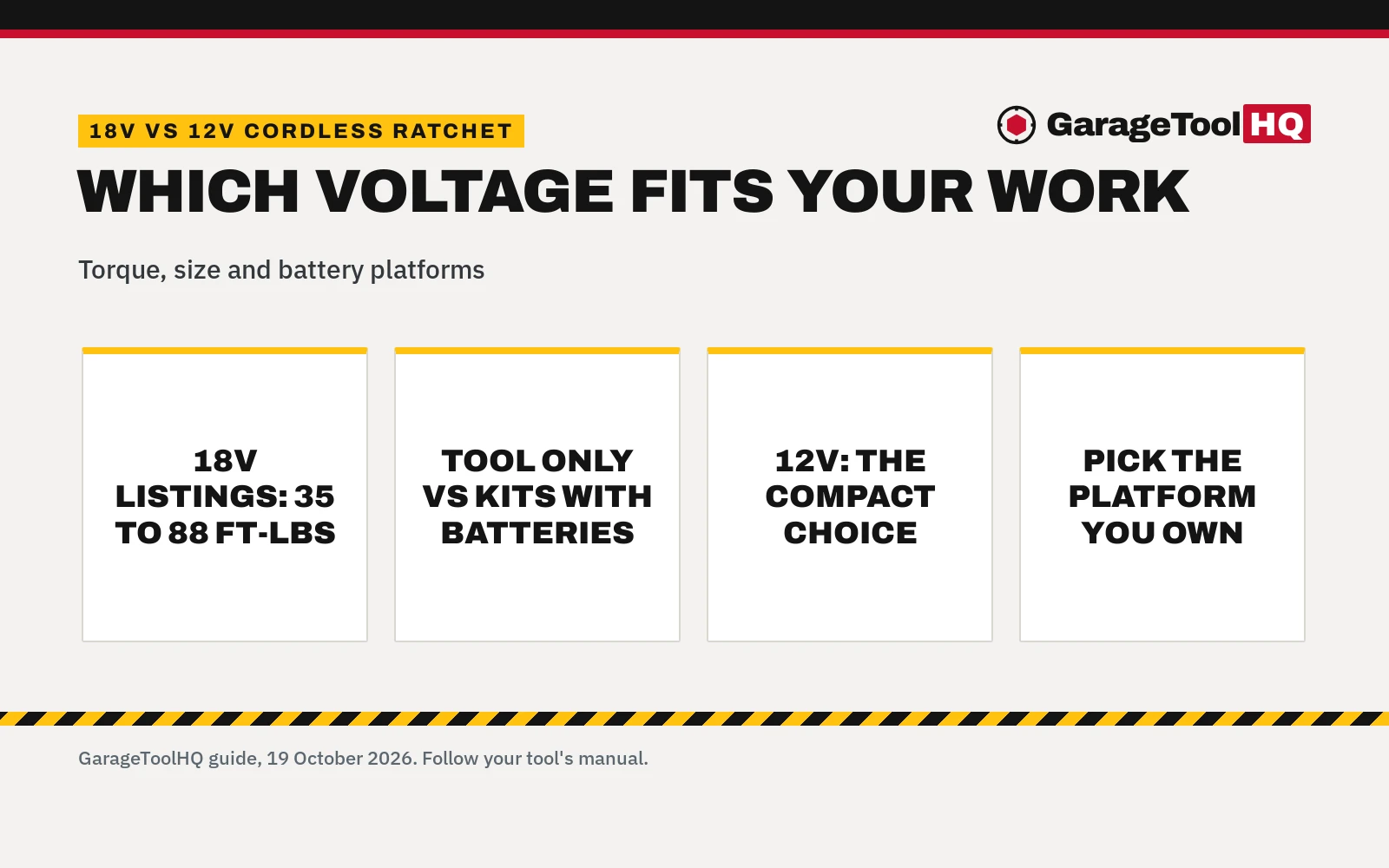
In the 18v vs 12v cordless ratchet question, pick 18V if you are already on an 18V battery platform or want the most torque: the listings show 18V-class ratchets up to 88 ft-lbs. Pick 12V if you want the smallest, lightest ratchet for tight spaces and already own 12V batteries. No 12V listings were in this round, so the 12V side below is explained without figures; every number here comes from the 18V listings.
More options to compare
 VESSEL 400ER3 Cordless Electric Slim Ratchet CordlessCheck price on Amazon
 Vessel 400ER3-1M Cordless Electric Slim Ratchet Set with 31Check price on Amazon
 Makita XDG02Z 18V LXT 1/4" Compact Die GrinderCheck price on Amazon
GarageToolHQ earns a commission when you buy through links on our product pages, at no extra cost to you. Read our affiliate disclosure.
18v vs 12v cordless ratchet: what changes with voltage
Voltage is the platform decision that shapes everything else. An 18V ratchet carries a bigger battery and motor, so the listings attach higher torque figures and longer runtimes to it; a 12V ratchet is the compact, light tool for engine bays, interior trim and fasteners that do not need much torque. Drive size, 3/8 in on nearly every listing here, matters less than voltage for how the tool feels in the hand.
What the 18V listings actually state
Torque on the 18V listings runs from 35 ft-lbs on the RYOBI P344, the Makita XRW01Z, the Makita XRW01SR1 kit and the RYOBI PCL280, through 45 ft-lbs on the TQUAGGA and 60 ft-lbs on the Seesii and DEVTBLUN, to 75 ft-lbs on the ADOTOCAM and 88 ft-lbs on the VERVEWAVE. Speeds vary just as widely: 0-800 RPM on the Makita XRW01Z, 300 RPM on the Seesii, 400 RPM on the DEVTBLUN, 230 RPM on the RYOBI PBLRC25B, 260 RPM on the RYOBI PCL280, 0-500 RPM on the VERVEWAVE and 0-250 RPM on the ADOTOCAM.
Weight and length decide how the tool fits the job. Listed weights run 2 lb on the RYOBI P344, the Makita XRW01Z and the TQUAGGA, 2.3 lb on the RYOBI PCL280, 2.7 lb on the Makita XRW01SR1 kit, 3 lb on the DEVTBLUN and 3.3 lb on the VERVEWAVE, with the Seesii listed at 1.2 kg. Lengths run 10 in on the TQUAGGA, 12 in on the RYOBI P344, 15 in on the Makita XRW01Z, 15.37 in on the RYOBI PBLRC25B, 16.14 in on the VERVEWAVE and 16.5 in on the Seesii, while the ADOTOCAM lists a 5.5 in extended neck and the DEVTBLUN a 4 in long neck for reach.
Batteries split the listings in two. The Seesii, DEVTBLUN and TQUAGGA include 2 2000mAh batteries and a charger, and the Makita XRW01SR1 kit includes an 18V LXT 2.0Ah battery and charger. The Makita XRW01Z, all three RYOBI 18V tools, the VERVEWAVE and the ADOTOCAM are tool only, batteries and charger sold separately. On warranties, the Makita and Seesii listings state a 3-year limited warranty, while the RYOBI PBLRC25B and PCL280 listings state a 30-day limited warranty.
Where 12V fits
No 12V listings were in this round, so this side gets no figures, only the shape of the tool. A 12V ratchet is the smaller, lighter sibling: less torque, a slimmer head, and a battery that keeps the whole tool light in overhead and one-hand work. It suits light fasteners, interior work and quick jobs where an 18V tool feels bulky. If you already own 12V batteries and chargers, staying on the platform keeps the kit light and the cost down; if you own nothing, the 18V side gives you more tool for the money in torque and runtime.
Battery platform first
The listings make the platform the real purchase. Six of the 18V listings are tool only, so the battery you own decides which of them you can run on day one. The kits that include batteries, the Seesii, DEVTBLUN and TQUAGGA with 2 2000mAh batteries each, and the Makita XRW01SR1 with its 2.0Ah battery, are the complete buys. Either way, match the voltage to the batteries already in your garage before you compare torque figures.
Torque: match the ratchet to the fastener
A ratchet is a speed tool, not a breaker bar. The DEVTBLUN listing says it plainly: the tool is ideal for speeding up nut pre-tightening and removal, and for large or tight screws you should use a manual wrench for final tightening or loosening and avoid excessive torque. Use the listed torque to pick the class, 35 ft-lbs for light work on the brand-name 18V listings, 60 to 88 ft-lbs for tougher automotive work on the third-party listings, and finish tight fasteners by hand.
| 18V ratchet | 12V ratchet | |
|---|---|---|
| Listed torque | 35 to 88 ft-lbs | Not stated in this round |
| Listed weight | 2 to 3.3 lb | Not stated in this round |
| Batteries | Kits or tool only, per listing | Runs on 12V batteries you own |
| Best for | More torque, longer runtime | Tight spaces, light fasteners |
Use rated jack stands on solid ground, wear eye protection with power and air tools, keep fuel-burning equipment out of a closed garage, and follow the manual for every tool. Read our Safety Disclaimer.
Keep eyes protected when a fastener lets go, and do not force a ratchet on a tight screw: several listings include a safety lock for storage, and the DEVTBLUN warning stands for every ratchet here, finish tight fasteners with a manual wrench.
Frequently Asked Questions
Can a 12V ratchet do the same work as 18V?
No 12V listings were in this round, so there are no 12V figures to compare. The 18V listings run 35 to 88 ft-lbs; a 12V ratchet suits lighter fasteners and tighter spaces, not the top end of that range.
Do the listings include batteries?
Some do. The Seesii, DEVTBLUN and TQUAGGA list 2 2000mAh batteries and a charger, and the Makita XRW01SR1 kit lists an 18V LXT 2.0Ah battery and charger. The Makita XRW01Z, all three RYOBI 18V tools, the VERVEWAVE and the ADOTOCAM are tool only.
What torque do I need?
For light work, 35 ft-lbs as listed on the RYOBI and Makita 18V ratchets. For tougher automotive fasteners, the 60 to 88 ft-lbs listings. Heed the DEVTBLUN warning: speed up removal and pre-tightening with the ratchet, finish tight fasteners by hand.
What do the warranties look like?
The Makita and Seesii listings state a 3-year limited warranty. The RYOBI PBLRC25B and PCL280 listings state a 30-day limited warranty. The other listings state no warranty term.
Will an 18V ratchet fit in an engine bay?
Check the length figures. The TQUAGGA lists a compact 10 in body, the ADOTOCAM a 5.5 in extended neck, and the DEVTBLUN a 4 in long neck, all aimed at tight spaces. The longer tools need more room.
Related: the 12v vs 20v cordless ratchet guide, the best cordless ratchet picks, the best cordless 3/8 ratchet picks and how to use a ratchet wrench.