How to Use a Ratchet Wrench: Step-by-Step Garage Guide
How to use a ratchet wrench safely and efficiently: direction switch setup, socket seating, breaking fasteners loose, running nuts down and torque rules.

On this page
Top picks at a glance
As an Amazon Associate we earn from qualifying purchases.
- 1
 KLEIN TOOLS 69408G Ratcheting Combination Wrench Set9.6/10View on Amazon
- 2
 HORUSDY 24-Piece Ratcheting Wrench Set9.6/10View on Amazon
- 3
 3/8" Cordless Ratchet Wrench for Dewalt 20V Battery9.5/10View on Amazon
- 4
 Egofine 12pcs 1/4 Inch Mini Ratchet Socket Wrench SetView on Amazon
- 5
 Egofine 12pcs 1/2 Inch Ratchet Socket Wrench SetView on Amazon
- 6
 HORUSDY 50-Piece 3/8" Drive Impact Socket SetView on Amazon
- 7
 Amazon Basics 3/8-inch Drive Click Torque Wrench RatchetView on Amazon
- 8
 Ingersoll Rand 170G 3/8" Drive Air Ratchet Wrench Features upView on Amazon
- 9
 AIRCAT 805-HT 3/8" High Torque Ratchet WrenchView on Amazon
When you are tucked under a wheel well replacing brake calipers, a standard hand wrench quickly runs out of swing room. Knowing how to use a ratchet wrench solves that problem by letting you swing the handle back and forth to turn fasteners without lifting the socket off the bolt head. To use a ratchet wrench, snap the matching socket onto the drive square, set the direction switch, seat the socket flush on the bolt, and swing the handle in smooth strokes. The internal gear and pawl mechanism grips in the drive direction while slipping freely on the return swing, running bolts down with minimal movement.
More options to compare
 Egofine 12pcs 1/4 Inch Mini Ratchet Socket Wrench SetCheck price on Amazon
 Egofine 12pcs 1/2 Inch Ratchet Socket Wrench SetCheck price on Amazon
 HORUSDY 50-Piece 3/8" Drive Impact Socket SetCheck price on Amazon
 Amazon Basics 3/8-inch Drive Click Torque Wrench RatchetCheck price on Amazon
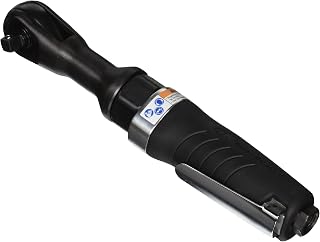 Ingersoll Rand 170G 3/8" Drive Air Ratchet Wrench Features upCheck price on Amazon
 AIRCAT 805-HT 3/8" High Torque Ratchet WrenchCheck price on Amazon
GarageToolHQ earns a commission when you buy through links on our product pages, at no extra cost to you. Read our affiliate disclosure.
Below: how the internal ratchet mechanism works, how drive sizes compare, a step-by-step checklist for safe fastening, and how manual ratchets compare to cordless models.
How to Use a Ratchet Wrench: How the Mechanism Works
A ratchet wrench turns fasteners incrementally through a compact mechanical drive inside the head. Leaving the socket engaged, you work the handle back and forth rather than lifting the tool off the bolt after every turn.
The tool relies on distinct mechanical components:
- The drive square and detent ball. The square anvil accepts sockets, held in place by a spring-loaded steel detent ball that snaps into an internal recess inside the socket base.
- The drive gear and pawl. Hardened gear teeth mesh with spring-loaded pawls. Pulling the handle in the drive direction wedges the pawl against the gear, locking the anvil to turn the fastener.
- The direction control. A lever or dial shifts pawl alignment, reversing drive direction between forward tightening and reverse loosening.
On the return stroke, the pawl slides over angled gear ramps with a light clicking sound. Fine-tooth mechanisms need smaller swing arcs to catch the next tooth, speeding up work in cramped bays where handle clearance is tight.
Common Ratchet Drive Sizes and Formats
Ratchets are sized by their square drive anvil to match tool strength with fastener requirements.
| Drive size | Common garage applications | Torque characteristics |
|---|---|---|
| 1/4-inch drive | Small fasteners, interior trim, dash panels, small engine covers | Low torque, high clearance in cramped spaces |
| 3/8-inch drive | General automotive maintenance, brake calipers, water pumps, spark plugs | Balanced torque and access, the primary shop workhorse |
| 1/2-inch drive | Suspension bolts, wheel lugs, large frame fasteners | High torque capacity, larger head requiring greater clearance |
A 3/8-inch drive serves as the standard workhorse for general maintenance. Use a 1/4-inch drive for delicate hardware in cramped spots, and step up to a 1/2-inch drive for heavy suspension bolts. Compare options in our guide to the best 3/8 socket set and our guide to socket set types.
How to Use a Ratchet Wrench Safely: The Step-by-Step Checklist
- Select the correct socket size and drive match. Match the socket opening cleanly to the fastener head. Confirm the drive size matches the anvil, avoiding loose sockets that round bolt corners under load.
- Inspect the direction switch. Check the selector on the ratchet head before placing the tool on the bolt. Set the switch to forward for tightening or reverse for loosening. Twist the anvil by hand to verify it locks in the drive direction and ratchets in reverse.
- Seat the socket fully and square. Push the socket completely onto the fastener until flush. Tilting the ratchet allows the socket to cam off, marring the fastener and tool.
- Position your grip and brace the head. Place one hand on the handle grip and brace the ratchet head with your free hand to keep the socket square on the bolt.
- Break fastener resistance with steady leverage. Pull smoothly toward your body for superior muscle control and knuckle protection. If a bolt is rusted or seized beyond normal hand leverage, switch to a solid breaker bar.
- Ratchet through the stroke. Pull the handle through the swing arc to turn the fastener, then push backward to let the pawl click and reset. Repeat this pumping motion without removing the socket.
- Spin free fasteners by hand. Once a bolt turns freely, pawl back-drag can rock it back and forth. Spin the socket or fastener by hand to remove it quickly.
- Final torque belongs to a torque wrench. Run fasteners down snug with the ratchet, then finish critical joints with a calibrated torque wrench to manufacturer specifications.
Internal pawls and gear teeth are built for manual leverage alone. Never hit the handle with a hammer or slide a pipe over it for leverage. Excessive shock load shears gear teeth and cracks the anvil. Use a breaker bar or penetrating oil on frozen hardware.
Use rated jack stands on solid ground, wear eye protection with power and air tools, keep fuel-burning equipment out of a closed garage, and follow the manual for every tool. Read our Safety Disclaimer.
Manual vs Cordless Ratchet Wrenches
Manual ratchets remain garage staples, while powered cordless ratchets accelerate repetitive teardowns.
Key differences between manual and battery-powered models include:
- Speed and run-down efficiency: Manual ratchets require continuous swinging, tiring forearms over long jobs. Cordless ratchets spin fasteners via trigger. For instance, the KIMO 3/8-inch cordless ratchet delivers 400 RPM, FULLYEA lists a maximum of 550 RPM, and Ruzorbolt lists 500 RPM. In smaller quarters, the AOBEN 1/4-inch model produces 280 RPM.
- Working torque and fastener breaking: Manual ratchets take firm hand leverage, while cordless ratchets deliver rated motor torque. Manufacturer specifications list the KIMO 3/8-inch model at 40 ft-lbs of torque, the ShieldPro 3/8-inch unit at 45 ft-lbs, the ALLOY POWER 3/8-inch tool at 60 ft-lbs, the DEWALT 3/8-inch ratchet at 70 ft-lbs, and the Ruzorbolt 3/8-inch kit at 88 ft-lbs. Hold powered ratchets firmly to manage reaction torque when fasteners seat.
- Head clearance and access: Manual ratchets feature slim heads for cramped spaces. Cordless ratchets are bulkier, though units like the ALLOY POWER 3/8-inch ratchet provide a 5.5-inch extended neck to access recessed bolts past obstacles.
- Tool weight and balance: Manual 3/8-inch ratchets feel featherweight, whereas cordless options add motor and battery mass. The KIMO and FULLYEA cordless models each weigh 2.2 lbs with battery, while the DEWALT bare ratchet lists at 2.6 pounds.
Keep both styles ready: crack seized fasteners loose with a breaker bar, speed up run-down with our best cordless ratchet picks, and organize your drawer with our best ratchet wrench set guide. For heavy lug nuts, consult our cordless ratchet vs impact wrench breakdown.
Fastener Torque Rules and Tool Maintenance
A ratchet wrench is built for run-down convenience, not final fastener tension measurement.
Vehicle makers specify tightening values to avoid stripped threads, warped castings, or bolts backing out under vibration. Snug hardware evenly with your ratchet, then complete final tightening using a dedicated clicker tool from our guide to the best torque wrench for home mechanics.
Keep ratchets operating smoothly with basic care:
- Wipe tools clean after messy repairs. Remove oil, grit, and road grime from the head and selector with a clean rag.
- Lubricate the mechanism periodically. If gears drag, remove the faceplate, clean dried residue, and apply light machine oil. Avoid heavy grease that stiffens in cold weather and jams pawl springs.
- Store ratchets and sockets on rails. Prevent chipped chrome and lost pieces by keeping drive tools organized on rails from our guide to the best wrench organizer.
Frequently Asked Questions
Which way do you turn a ratchet wrench to loosen a bolt?
Turn counterclockwise for standard right-hand threads. Set the direction switch to reverse so the anvil locks counterclockwise, backing the bolt out as you swing the handle. Certain assemblies, like fan clutches, use reverse threads that loosen clockwise.
Can I use a ratchet wrench as a breaker bar?
No. Internal gear teeth and pawls can strip under heavy leverage. Use a solid breaker bar to crack seized hardware loose, then spin bolts out with your ratchet.
Why does my ratchet wrench turn the bolt both ways without loosening?
When thread resistance drops below internal pawl back-drag, the ratchet drags the loose bolt back and forth. Hold the socket or bolt shoulder with your fingers to add drag, or spin it out by hand.
Can I use chrome sockets on an impact wrench?
No. Hardened chrome sockets are brittle and can shatter under impact concussions. Always use thick-walled black oxide impact sockets with powered impact tools.
How do I know what size ratchet drive to use?
Match drive size to fastener size and clearance. Use a 1/4-inch drive for interior trim and small fasteners, a 3/8-inch drive for standard engine maintenance, and a 1/2-inch drive for heavy chassis bolts.
Related: our guide to the best ratchet wrench set, our comparison of the best cordless ratchet models, our overview of socket set types, and our cordless tools category hub. Also see our breakdown of cordless ratchet vs impact wrench options.