What Size Breaker for a 240V Garage Heater? Sizing Guide
How to size a breaker for a 240V garage heater: watts to amps, the 125% continuous-load rule, a sizing table and why an electrician should do the circuit.

On this page
Top picks at a glance
As an Amazon Associate we earn from qualifying purchases.
- 1
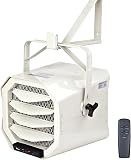 DR. INFRARED HEATER DR-910F 109.7/10View on Amazon
- 2
 CTSC 8500W Garage Heater Electric9.7/10View on Amazon
- 3
 InoKraft 7500W Electric Garage Heater9.6/10View on Amazon
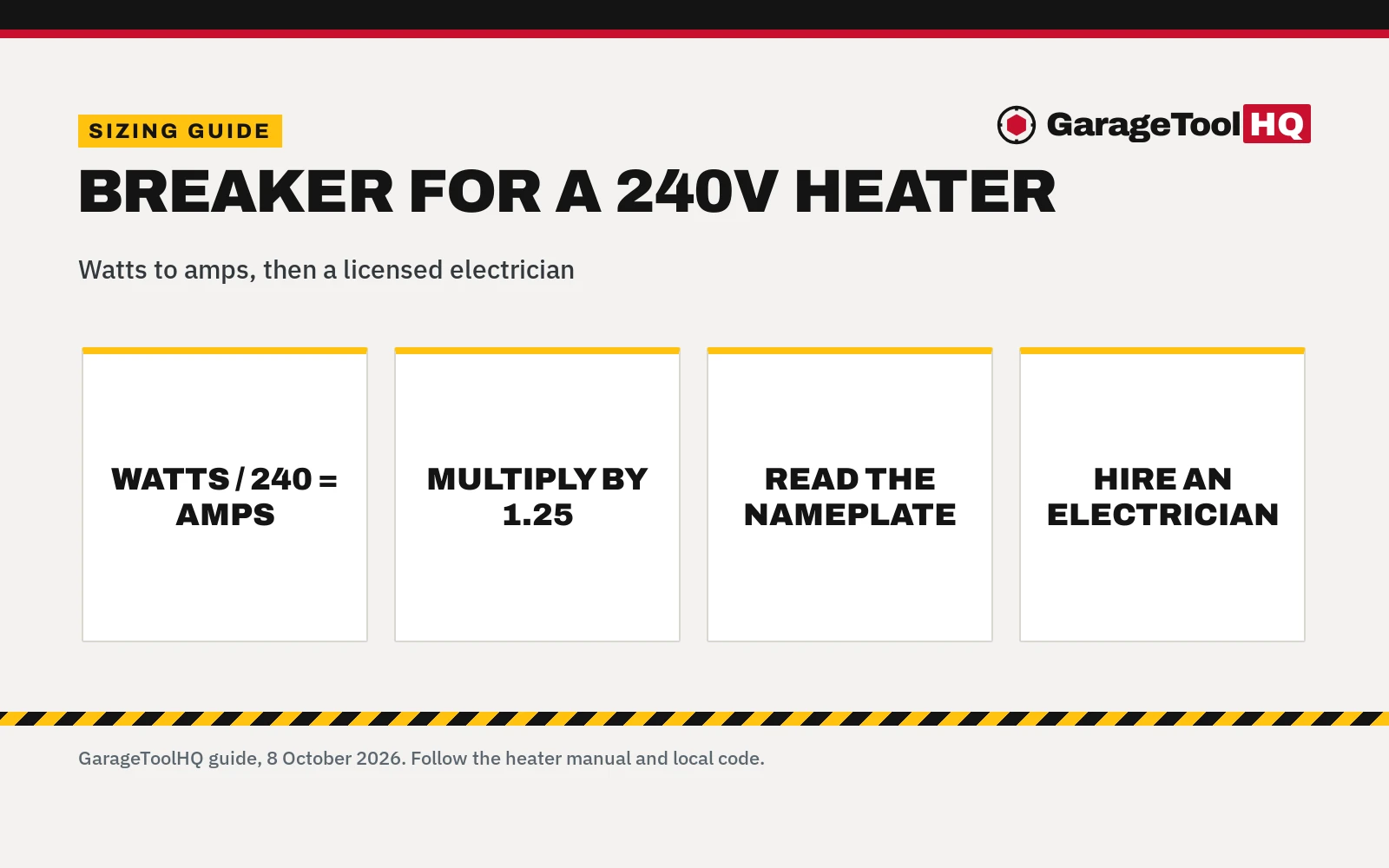
What size breaker for a 240V garage heater? Divide the heater’s watts by 240 to get its running amps, multiply by 1.25 for a continuous load, then round up to the next standard breaker size. A 5,000 W heater draws about 20.8 A, so the minimum is about 26 A and the usual breaker is 30 A. The heater’s nameplate and manual override this rule of thumb, and a licensed electrician should size, install and connect the circuit.
GarageToolHQ earns a commission when you buy through links on this page, at no extra cost to you. Affiliate disclosure.
Below: the arithmetic, a sizing table for common heater wattages, what the nameplate tells you and what to bring to an electrician. This guide covers sizing only, not wiring steps.
What size breaker for a 240V garage heater: the math
Electric heaters run for hours, which the electrical code treats as a continuous load. The usual rule keeps the load at 80% of the breaker rating, which is the same as multiplying the running amps by 1.25.
- Amps = watts / volts. A 5,000 W heater on 240 V draws 5,000 / 240 = 20.8 A.
- Continuous load = amps x 1.25. 20.8 x 1.25 = 26 A.
- Round up to the next standard breaker. Standard sizes include 15, 20, 25, 30, 40 and 50 A, so 26 A rounds to 30 A.
| Heater watts | Running amps at 240 V | x 1.25 | Usual breaker |
|---|---|---|---|
| 3,000 W | 12.5 A | 15.6 A | 20 A |
| 4,000 W | 16.7 A | 20.8 A | 25 A (or 30 A if the maker allows) |
| 5,000 W | 20.8 A | 26 A | 30 A |
| 7,500 W | 31.3 A | 39.1 A | 40 A |
| 10,000 W | 41.7 A | 52.1 A | 60 A |
The table is a rule of thumb. Some heaters are listed with a maximum overcurrent protection that is smaller or larger than the math suggests, and the nameplate wins.
Read the heater’s nameplate and manual first
Every listed electric heater states its electrical needs on a label and in the manual. Look for:
- Voltage and phase. A 240 V heater may be single-phase or three-phase. Most home garages have single-phase service.
- Wattage or amps. Use the nameplate figure, not the box.
- Minimum circuit ampacity and maximum overcurrent protection. If the maker lists them, they decide the breaker.
- Hardwired or plug-in. A plug-in heater needs the matching outlet, not just a breaker.
Why the wire size matters as much as the breaker
The breaker protects the wire. If the wire is too small for the breaker, the wire can overheat before the breaker trips. That is why the circuit is sized as a set (breaker, conductors, outlet or connection) and why it should not be mixed and matched.
Do not swap a larger breaker onto an existing circuit to stop it tripping. Panel capacity, wire size, run length and local code all affect what is allowed, and a mistake can start a fire. Have a licensed electrician check your panel and install the circuit.
Check your panel capacity before you buy
A 30 A, 240 V heater adds a large load to a home panel. Older panels, 100 A services and garages that already have a welder, EV charger or compressor may not have room. Ask an electrician to run a load calculation, and bring the heater’s nameplate data.
What to bring to an electrician
- The heater’s model number, wattage and nameplate data
- Whether it is hardwired or plug-in
- The distance from the panel to the heater
- Other big loads in the garage: compressor, welder, lift or EV charger
- Your garage size and insulation, from our garage heater BTU calculator
To choose the heater first, see what size garage heater do I need and the best garage heaters for a 2-car garage.
Common mistakes when sizing a garage heater circuit
- Sizing to the amps alone. A heater that draws 20.8 A on a 20 A breaker will trip or run hot, because a continuous load should stay at 80% of the breaker rating.
- Upsizing the breaker to stop nuisance trips. A breaker that trips is telling you the circuit is overloaded. A bigger breaker on the same wire removes the protection.
- Ignoring other loads. A compressor, a welder or a second heater on the same circuit adds to the total.
- Using an extension cord. Hardwired and 240 V plug-in heaters are not made for extension cords or adapters.
- Forgetting the thermostat. Some heaters have a built-in thermostat, and others need a wall-mounted one rated for the load. Check the manual.
Permits and inspections
Adding a 240 V circuit usually needs an electrical permit, and many areas require an inspection. A licensed electrician knows the local rules and pulls the permit. Skipping the permit can create problems with home insurance after a fire or when you sell the house.
Never run a fuel-burning heater, generator or engine in a closed garage: carbon monoxide builds up fast and has no smell. Fit a CO alarm, keep clearances to cars and storage, use vented gas heaters installed to code, and put 240V electric heaters on a dedicated circuit. See CPSC carbon monoxide guidance. Read our Safety Disclaimer.
Frequently Asked Questions
What size breaker do I need for a 5,000 watt 240V heater?
A 5,000 W heater draws about 20.8 A at 240 V. With the 1.25 continuous-load factor that is about 26 A, so a 30 A breaker is usual. Confirm against the nameplate and have an electrician size the circuit.
Can I use a 20 amp breaker for a 240V garage heater?
Only if the heater’s draw allows it. A 20 A breaker with the 1.25 factor supports about 16 A, or roughly 3,800 W at 240 V. Larger heaters need a larger circuit.
What wire size goes with a 30 amp 240V heater circuit?
Wire size depends on code, material and run length, and it must match the breaker. Leave it to a licensed electrician rather than copying a chart.
Do I need a dedicated circuit for a garage heater?
Almost always, yes. A fixed electric heater is a continuous load, and the manual and code generally call for its own circuit.
Is 240V better than 120V for a garage heater?
240 V heaters deliver more heat for the same amps. A 120 V heater on a 15 A circuit is limited to roughly 1,500 W, while 240 V can deliver several thousand.
Can I install a 240V heater myself?
Heater placement is a DIY job in some cases, but the circuit, breaker and connection should be done by a licensed electrician and inspected where the code requires.
Related: garage heater sizing by BTU, the best garage heaters for a 2-car garage, our garage upgrades hub and the safety disclaimer.