Kerosene vs Diesel Garage Heater: Which One Should You Buy?
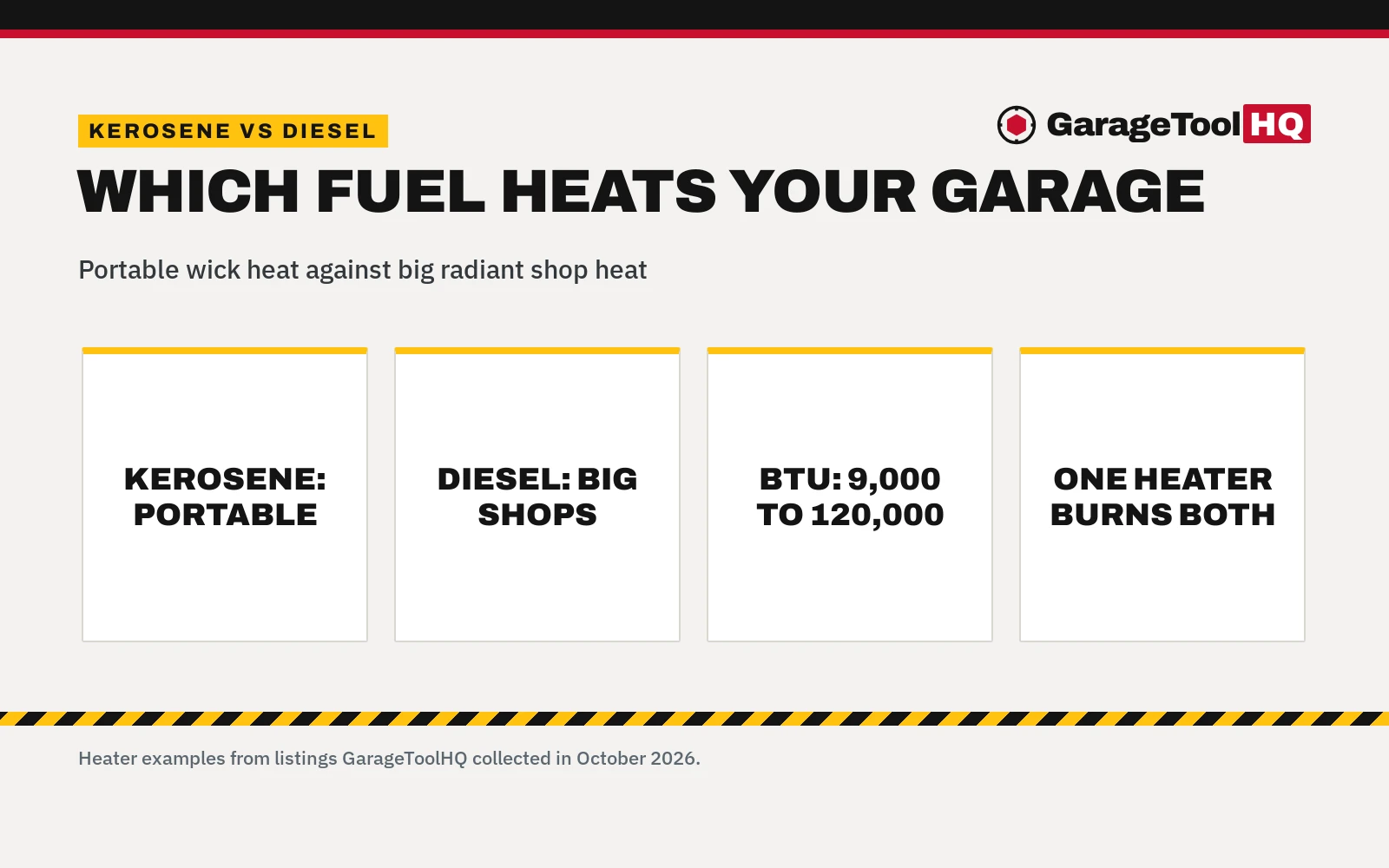
Kerosene suits portable wick heaters and diesel suits big radiant shop heaters; four heaters compared by BTU, tank size, runtime and fuel.

On this page
Top picks at a glance
As an Amazon Associate we earn from qualifying purchases.
- 1
 Dyna-Glo Indoor Kerosene Convection Heater9.3/10View on Amazon
- 2
 VEVOR 8KW Diesel Heater9.5/10View on Amazon
- 3
 LF Bros 110V/12V 5KW All-in-1 Diesel Heater9.4/10View on Amazon
- 4
 Sengoku HeatMate Portable Kerosene HeaterView on Amazon
- 5
 Kerosene Heaters Indoor with 3 WicksView on Amazon
- 6
 9View on Amazon
- 7
 10View on Amazon
- 8
 VEVOR Kerosene Forced Air HeaterView on Amazon
- 9
 BILT HARD 85View on Amazon
Kerosene vs diesel garage heater comes down to the heater, not the fuel alone: kerosene suits portable wick heaters you carry where the work is, and diesel suits big radiant or forced-air units that heat a whole shop. One heater here, the Sunfire SF120, burns both. This guide compares the two fuels for garage heat and ranks four heaters by what their listings state.
More options to compare
 Sengoku HeatMate Portable Kerosene HeaterCheck price on Amazon
 Kerosene Heaters Indoor with 3 WicksCheck price on Amazon
 9Check price on Amazon
 10Check price on Amazon
 VEVOR Kerosene Forced Air HeaterCheck price on Amazon
 BILT HARD 85Check price on Amazon
GarageToolHQ earns a commission when you buy through links on our product pages, at no extra cost to you. Read our affiliate disclosure.
The difference in one paragraph: kerosene vs diesel garage heater
Kerosene is the classic portable heater fuel: wick heaters like the HeatMate and VEVOR burn it with no electricity, push-button or match-free starts, and tanks measured in gallons that run 14 to 20 hours. Diesel is the big-shop fuel: the Sunfire SF120 burns diesel or #2 fuel oil in a 14-gallon tank to put out 120,000 BTU of radiant heat for up to 2,800 sq ft. Same garage, different jobs: spot heat you carry versus shop heat you roll in on wheels.
The gear: four heaters, ranked
Sunfire SF120. The big one: a 120,000 BTU radiant heater with a 14-gallon tank and a 16-hour runtime, heating up to 2,800 sq ft. It burns diesel/#2 fuel oil at 0.85 GPH or kerosene at 0.78 GPH, claims no smell and no fumes, runs quieter than torpedo-style heaters, and is made in the USA.
VEVOR 2-in-1. A 9,000 BTU portable kerosene heater and stove in one, with 360-degree surround heating for 30 square meter spaces. The 1.3-gallon (5L) tank runs up to 20 hours at 0.24 to 0.28 gallons per hour, the adjustable-height lid fits camping cookware, and the top supports up to 33 lbs (15 kg) of pots and kettles.
Sengoku HeatMate 110. A 10,000 BTU portable kerosene heater with a 1.2-gallon tank, up to 14 hours of burn time, and heat for up to 400 sq ft. It starts with a push button, needs no electricity, and carries an automatic safety shut-off, a tip-over switch, an EZ flame adjuster and protective grills.
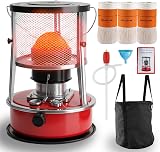
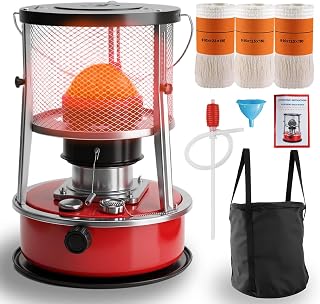
GfsGsjzc 3-wick. A 9,000 BTU non-electric kerosene heater and stove with 3 wicks, one of which the listing says lasts up to 12 months. It claims heat in 1 second, a burn time of 18 hours, and a height-adjustable hood that brings the cooking surface closer to the flame.
When kerosene is the better choice
- Portable spot heat. Wick heaters like the HeatMate and VEVOR carry where the work is, with no cord and no electricity.
- Power outages. Non-electric kerosene heaters keep running when the power is out; the GfsGsjzc listing aims it at hurricanes and heavy snow.
- Cooking too. The VEVOR and GfsGsjzc double as stoves with adjustable lids or hoods for pots and kettles.
- Small spaces. 9,000 to 10,000 BTU suits a 1-car garage or workshop bay; see our best garage heater for a 2-car garage.
When diesel is the better choice
- Big shops. The Sunfire’s 120,000 BTU heats up to 2,800 sq ft, far past any portable wick heater here.
- Fuel on hand. If the farm or shop already stores diesel, the Sunfire burns it at 0.85 GPH.
- Radiant heat. Radiant heaters are not subject to wind and run quieter than torpedo-style forced-air heaters, per the listing.
- One heater, two fuels. The Sunfire burns diesel or kerosene, so you are not locked to one fuel; see our best fuel for a diesel heater.
Fuel consumption: what the listings state
The listings state consumption plainly enough to compare. The Sunfire burns 0.85 gallons per hour on diesel or 0.78 GPH on kerosene, which is how its 14-gallon tank stretches to 16 hours. The VEVOR sips 0.24 to 0.28 gallons per hour, stretching 1.3 gallons to 20 hours. The HeatMate runs up to 14 hours on 1.2 gallons, and the GfsGsjzc claims 18 hours per fill. Smaller heaters burn less per hour but also put out far less heat: 9,000 to 10,000 BTU against the Sunfire’s 120,000.
Ventilation and carbon monoxide. Every fuel-burning heater needs fresh air and a working carbon monoxide alarm in the garage. Never run a heater in a sealed space, follow the manual’s clearance and ventilation requirements, and store fuel in approved containers away from the heater. See the manual that ships with your heater.
One more practical note: wick heaters need their wicks. The GfsGsjzc listing says the heater has 3 wicks and one wick lasts up to 12 months, which covers years of seasonal use. The Sunfire has no wick to replace, being a radiant burner, but it has a 14-gallon tank to keep filled. Factor the consumable, wicks or fuel volume, into which heater suits your routine.
Frequently Asked Questions
Can a kerosene heater run on diesel?
Only if the maker says so. The Sunfire SF120 listing states both diesel/#2 fuel oil and kerosene with separate flow rates. Do not put diesel in a wick heater rated for kerosene only.
Which is cheaper to run, kerosene or diesel?
It depends on local fuel prices and the heater’s consumption. The Sunfire lists 0.85 GPH on diesel and 0.78 GPH on kerosene; multiply by your local price per gallon.
What size heater does my garage need?
These examples span 9,000 BTU for small spaces to 120,000 BTU for up to 2,800 sq ft. See our garage heater sizing by BTU.
Are kerosene heaters safe indoors?
The three wick-heater listings describe indoor use. The HeatMate names an automatic safety shut-off and a tip-over switch, the VEVOR a security grill and fuel gauge, and the GfsGsjzc anti-pouring and anti-scalding protection. Always follow the manual, ventilate, and keep a carbon monoxide alarm in the garage.
How long does a tank of fuel last?
Per the listings: up to 14 hours on the HeatMate’s 1.2 gallons, up to 20 hours on the VEVOR’s 1.3 gallons, 18 hours claimed on the GfsGsjzc, and 16 hours on the Sunfire’s 14 gallons.
Related: garage heater sizing by BTU, the best garage heater for a 2-car garage, our best fuel for a diesel heater.