Air Compressor Maintenance: Step-by-Step Care and Inspection Guide
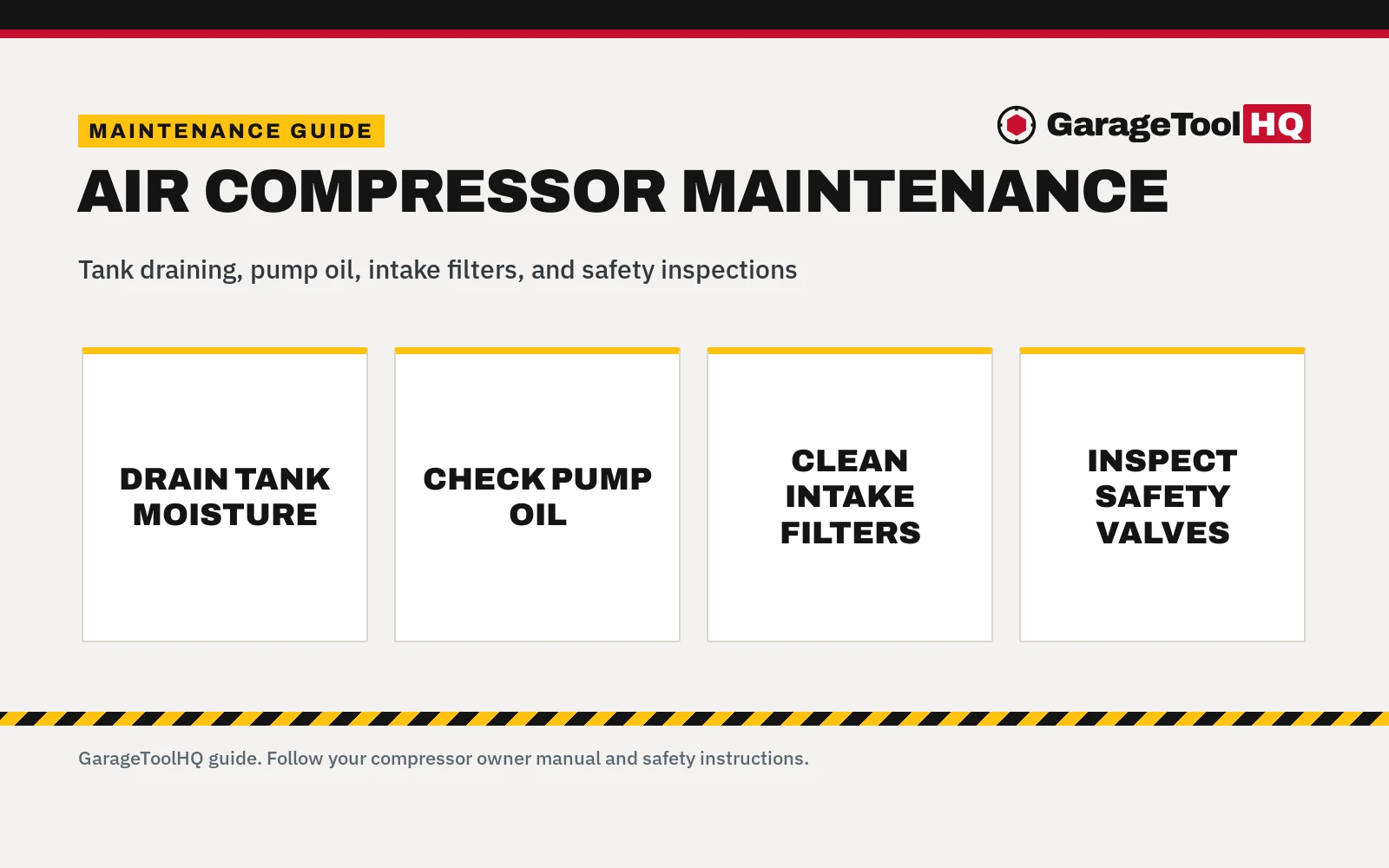
A practical guide to air compressor maintenance: draining tank moisture, cleaning intake filters, checking pump oil, inspecting drive belts and safety valves.

On this page
Top picks at a glance
As an Amazon Associate we earn from qualifying purchases.
- 1
 Craftsman 3 Gallon Hot Dog Air Compressor9.6/10View on Amazon
- 2
 Klutch 29-Gallon Air Compressor9.5/10View on Amazon
- 3
 Craftsman 2 Gallon Portable Air Compressor9.4/10View on Amazon
What does air compressor maintenance require? Air compressor maintenance requires draining tank condensation, cleaning intake filters, checking pump oil, inspecting drive belts, and verifying safety valves. Regular maintenance on air compressor equipment prevents corrosion and maintains airflow. Check your manual to confirm service schedules and oil specifications.
GarageToolHQ earns a commission when you buy through links on our product pages, at no extra cost to you. Read our affiliate disclosure.
Below: where wear develops, category differences, a service checklist, and common questions.
Air compressor maintenance: where system wear and hazards occur
Compressing air creates heat and moisture, leading to common maintenance challenges:
- Moisture and tank corrosion. Compressed air cools in the receiver, condensing water that pools at the bottom. Standing moisture rusts steel walls, creating rupture hazards.
- Filter clogging. Shop dust clogs intake filters, forcing pumps to run hotter. Missing filters let abrasive grit score cylinders and valve plates.
- Oil degradation. Crankcase oil lubricates pump cylinders and bearings. Heat and moisture break down oil, forming carbon on valves. Low oil causes seizure.
- Vibration and leaks. Pump vibration loosens pipe fittings. Air leaks force motors to cycle frequently, increasing wear.
Compressor categories and how their maintenance demands differ
| Category | Design | Primary Service |
|---|---|---|
| Compact portable (such as the 3-gallon ECOMAX) | Oil-free pump, 110 max PSI, iron tank | Drain condensation, clean intake screen, inspect couplers |
| Mid-sized shop (such as the 15-gallon RyanTek or 6.4-gallon MZB) | Oil-free pump, 115 to 125 PSI max pressure | Drain condensation, clean air filters, inspect relief valve |
| Stationary shop (such as the 60-gallon DEWALT) | Belt-drive oil-lubricated pump, 5 HP motor, 175 max PSI, 60-gallon ASME tank | Check oil, change lubricant, inspect belt, verify 240V wiring |
An oil-free pump eliminates oil changes but still requires regular tank drainage and filter cleaning.
How to perform air compressor maintenance: the step-by-step checklist
- Drain tank condensation after each session. Open the drain valve at the tank base to discharge water. RyanTek includes a horizontal drain valve, and VELPAX features a condensate drain outlet. Drain completely so water does not sit in the steel vessel.
- Inspect and clean the air intake filter. Tap out dust or blow dry air through the filter. Replace damaged filters promptly. RyanTek equips its pump with screw-mounted 1/4 plastic shell air filters that stay secure during vibration.
- Check pump oil level on lubricated models. On compressors like the DEWALT 60-gallon unit, check the sight glass before starting. Top off with non-detergent air compressor oil and change fluid per your manual. Oil-free units skip this.
- Inspect drive belt condition. On belt-driven models, disconnect power and inspect the belt for cracks, fraying, or slack. Verify alignment and keep the belt guard fastened.
- Inspect the safety pressure relief valve. With tank pressure, pull the safety valve ring to verify air releases, then release it to confirm it seals. Valves open at set thresholds, such as the VELPAX valve configured to open at 128 PSI. Never operate with a stuck valve.
- Check lines and fittings for leaks. Apply soapy water around joints, regulator ports, and couplers under pressure. Bubbles indicate leaks. Depressurize before tightening fittings.
- Clean motor cooling fins. Blow shop dust from cooling fins and shrouds with a blow gun. Clean surfaces prevent motors from overheating and tripping overloads.
- Inspect electrical connections. Inspect power cords for damage. Stationary units operating at 240 volts and drawing 20 A, like the DEWALT unit, require dedicated circuits. Because high voltage presents severe hazards, always use a licensed electrician for stationary compressor wiring rather than DIY steps.
- Depressurize lines and disconnect power. Switch off power, disconnect supply, bleed hose pressure, and store lines coiled neatly to protect hose walls and seals.
Compressed air stores immense energy. If a tank develops a pinhole, seam leak, or crack, never weld, solder, or patch the vessel. Internal corrosion weakens walls. Remove a damaged air receiver from service immediately.
Drain the tank after use so water does not rust it from the inside, never exceed the tool's rated pressure, wear eye protection, and run 240V units on the circuit the manual calls for. Do not run a gas engine compressor in a closed garage. Read our Safety Disclaimer.
Oil-lubricated vs oil-free air compressor maintenance
Key differences between pump designs:
- Lubrication: Oil-lubricated pumps require regular oil checks and fluid changes. Oil-free units, such as the 3-gallon ECOMAX or 1.2 HP MZB, use permanently lubricated bearings, eliminating fluid maintenance.
- Airflow and duty cycle: Stationary compressors like the 60-gallon DEWALT (14.6 SCFM at 90 PSI, 17 cfm at 40 psi) handle continuous shop air. Compact oil-free units suit intermittent tasks, while multi-cylinder models like the 15-gallon RyanTek support continuous painting and nailing.
- Noise levels: Standard compressors generate 80 to 90 dB per MZB listing data, but quiet units run lower. The oil-lubricated DEWALT 60-gallon unit is listed at 70 dB, matching the 70 dB oil-free MZB and JIR JINGREN, while the RyanTek runs at 66 dB, the VELPAX at 60 dB, and the ECOMAX at 78 dB.
- Air purity: Oil-free pumps eliminate oil vapor, protecting paint finishes. Both designs produce condensation requiring inline water traps for painting. Oil-lubricated units also need oil-coalescing filters.
Calculate airflow demands with our guide on what size air compressor do I need for air tools. For tank configurations, see our comparison of hot dog vs pancake air compressors. To compare workshop models, read our review of the best air compressor for home garage.
Tank rust prevention and air compressor oil selection
Moisture management is the most critical maintenance task. Compression concentrates atmospheric humidity inside the receiver. Left unmanaged, standing water forms rust scale that fouls tools and thins the walls of the ASME-certified pressure tank.
For oil-lubricated pumps, oil choice is vital. Automotive motor oil contains detergents that foam under reciprocating action and create valve carbon deposits. Always use non-detergent air compressor oil or synthetic compressor lubricant. To compare recommended fluids, consult our guide to the best air compressor oil.
Keeping an air compressor maintenance report or log near the unit simplifies tracking oil changes, filter cleanings, and safety valve inspections.
Frequently Asked Questions
How often should I perform maintenance on air compressor equipment?
Perform basic checks whenever operating the compressor. Drain tank moisture after each session and check pump oil on lubricated units before starting. Clean air filters and inspect belts per manual intervals, checking more frequently in dusty shops.
Why does water come out of my air compressor hose?
Moisture condenses into liquid as warm air cools inside the tank. If not drained, water travels into hoses and air tools. Drain the tank after each session and use an inline moisture filter.
What happens if I never drain my air compressor tank?
Water reduces usable air volume, causing rapid motor cycling. Standing water also rusts steel walls from inside, risking pinholes or tank failure, while scale fouls tool mechanisms.
Can I use automotive motor oil in an air compressor?
No. Automotive oils contain detergents that foam and form carbon deposits on compressor valves. Always use non-detergent air compressor oil or synthetic compressor lubricant.
How do I verify that the safety relief valve is operating properly?
With the tank pressurized, pull the safety valve ring. Air should discharge briskly. Release the ring; the valve must snap closed without hissing. If it sticks or leaks, replace it with an ASME-rated valve matched to your tank pressure.
Why is my air compressor taking longer to reach maximum pressure?
Slow pressure recovery stems from a dirty intake filter, slipping belts, leaking fittings, or worn valves. Clean the filter, inspect joints with soapy water, and verify belt tension.
Related: our guide on how to choose an air compressor, our guide on what size air compressor do I need for air tools, our comparison of hot dog vs pancake air compressors, and our air compressors hub. Also see our guides to the best air compressor oil and the best air compressor for home garage.