Ratcheting Wrench vs Combination Wrench: Which One Should You Buy?
A ratcheting wrench and a combination wrench compared for the home garage: how each turns fasteners, offset and return angle, grip, and one example set of each.

On this page
Top picks at a glance
As an Amazon Associate we earn from qualifying purchases.
- 1
 CRAFTSMAN 20-Piece SAE/Metric Ratcheting Wrench Set9.6/10View on Amazon
- 2
 24-Piece All-Purpose Master Combination Wrench Set with9.7/10View on Amazon
- 3
 VEVOR Ratcheting Wrench Set9.5/10View on Amazon
- 4
 Amazon Basics Metric Ratcheting Combination Wrench SetView on Amazon
- 5
 GEARWRENCH 20 Piece SAE/MM Ratcheting Combination Wrench SetView on Amazon
- 6
 GEARWRENCH 16 Piece 72T Ratcheting Combination Metric WrenchView on Amazon
- 7
 DISEN 22 PCS Ratcheting Wrenches SetView on Amazon
- 8
 GEARWRENCH 13 Piece 12 Point Ratcheting Combination WrenchView on Amazon
- 9
 DEKOPRO 8-PC Flex Head Ratcheting Wrench SetView on Amazon
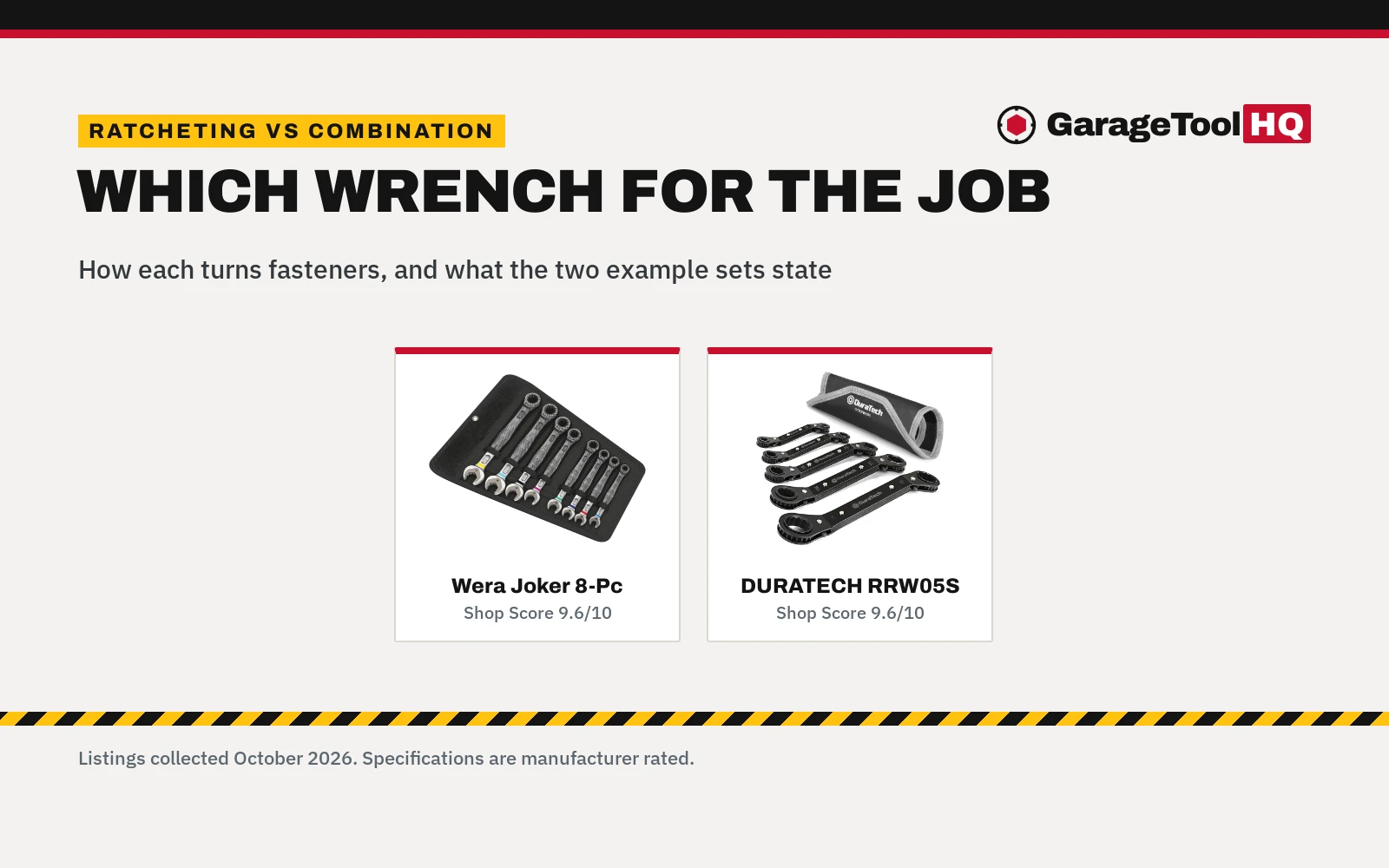
Verdict: Pick a ratcheting wrench if you work in tight spots and want to keep the wrench on the fastener between swings. Pick a combination wrench if you want simple open-end access with a box end for final torque, like the Wera Joker example whose ring end adds an 80-tooth ratchet.
A brake job in a tight wheel well is where wrenches show their character: you get a short swing if you are lucky, and lifting the wrench off to reset costs time. In ratcheting wrench vs combination wrench, the question is whether the fastener keeps advancing while you swing the handle back. This comparison pits the two types against each other, with one example set of each from the listings.
GarageToolHQ earns a commission when you buy through links on this page, at no extra cost to you. Read our affiliate disclosure.

Wera 05020012001 Joker Set Imperial Combination
An 8-piece imperial combination set with a 30° return angle, an 80-tooth ratcheting ring end and a limit stop that holds the fastener for tight-spot versatility.
Pros
- 80-tooth ratchet on the ring end for tight swings
- 30° return angle, stated as half that of a standard wrench
- Limit stop plus a jaw plate that holds the fastener
- Chrome molybdenum steel with nickel-chrome coating
Cons
- No warranty term in the listing
- Ratchet is on the ring end only; the open end still lifts off
- 8-piece set with no individual size list in the listing
- No offset angle stated

DURATECH 5-Piece Double Box Reversible Ratcheting
A 5-piece double-box reversible ratcheting set in SAE, with 25° offset ends, off-corner loading and a rolling pouch, built for continuous turning.
Pros
- Double-box ends both ratchet, with a reversing lever on each end
- 25° offset on both ends for clearance
- Off-corner loading design grips without rounding
- Rolling pouch included, sizes stamped on both ends
Cons
- Title says 5-piece but lists SAE sizes from 1/4" to 7/8"; the count is unclear
- No warranty term in the listing
- Heavier than ordinary wrenches, per the listing
- No return angle stated
More options to compare
 Amazon Basics Metric Ratcheting Combination Wrench SetCheck price on Amazon
 GEARWRENCH 20 Piece SAE/MM Ratcheting Combination Wrench SetCheck price on Amazon
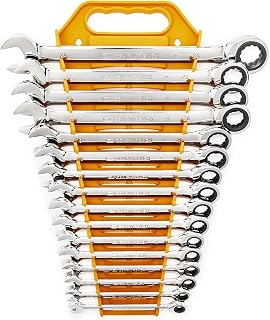 GEARWRENCH 16 Piece 72T Ratcheting Combination Metric WrenchCheck price on Amazon
 DISEN 22 PCS Ratcheting Wrenches SetCheck price on Amazon
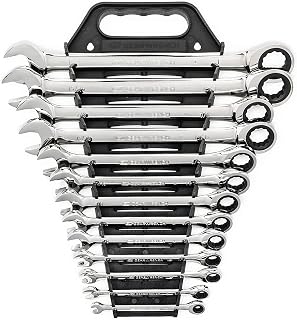 GEARWRENCH 13 Piece 12 Point Ratcheting Combination WrenchCheck price on Amazon
 DEKOPRO 8-PC Flex Head Ratcheting Wrench SetCheck price on Amazon
Side by side
| Ratcheting wrench | Combination wrench | Notes | |
|---|---|---|---|
| How it turns | Ratchets on the backswing; the wrench stays on the fastener | Open end lifts off and resets; the Wera example adds an 80-tooth ratcheting ring end | The Wera blurs the line |
| Box ends | Double box, both ends ratchet on the DURATECH example | Open end plus box end on the Wera example | |
| Offset | 25° on both ends (DURATECH example) | Not stated on the Wera example | Only the DURATECH listing states it |
| Return angle | Not stated on the DURATECH example | 30°, half a standard wrench (Wera example) | Only the Wera listing states it |
| Anti-rounding | Off-corner loading design (DURATECH example) | Double-hex geometry plus limit stop (Wera example) | Both claim better grip |
| Sizes listed | SAE 1/4″ to 7/8″; title says 5-piece (DURATECH example) | 8-piece imperial set (Wera example) | The DURATECH count is unclear |
| Set weight | 1.36 kg (DURATECH example) | 1 kg (Wera example) | Different piece counts |
| Reversing | Lever on each end (DURATECH example) | Reversing not stated; open end flips by hand |
Example figures are manufacturer rated, as published on each listing and collected 22 October 2026.
How each wrench turns the fastener
A ratcheting wrench keeps its grip on the backswing: the gear clicks and the fastener only moves on the push. The DURATECH example doubles down with a reversing lever on each end of every double-box wrench, so you never lift off to reset. A combination wrench is the classic pair: an open end for quick spinning and a box end for final torque. The open end lifts off between swings, but the Wera Joker example narrows the gap with an 80-tooth ratcheting ring end for tight spots.
Count the contact points too. The DURATECH uses a 12-point ratchet gear that fits hexagon nuts, 12-point nuts and other shapes, per its listing. The Wera pairs its open end with double-hex geometry on the box end. More points of contact mean the wrench seats in more positions, which helps when you can only swing a short arc.
Ratcheting wrench vs combination wrench in tight spots
Clearance decides more jobs than strength does. The DURATECH listing states a 25° offset on both box ends to create clearance in confined spaces. The Wera listing states a 30° return angle, half that of a standard wrench, which means fewer repositions in an engine bay. Neither listing states the other side’s figure, so call it a draw on paper: the DURATECH wins on stated offset, the Wera on stated return angle.
Think about the whole job, not just the fastener. A brake job means repeated loosening and tightening in the same cramped wheel well; that is where the DURATECH reversing levers pay off, since each end flips direction without leaving the nut. An oil change or a battery terminal is one or two fasteners in the open; the Wera open end spins those off fast, and the limit stop keeps it planted.
Grip and fastener rounding
Both listings claim their geometry protects fasteners. DURATECH credits off-corner loading on the box end for better grip and less rounding. Wera credits double-hex geometry that bites into the fastener, plus an integrated limit stop that keeps the wrench from sliding off. A metal plate in the Wera jaw even holds the fastener while you start it by hand. Neither states a torque figure, so judge them on the features, not on claimed strength.
Finish matters for grip as well. The DURATECH lists a sandblasting finish with black electrophoresis treatment for rust resistance, and the Wera lists a nickel-chrome coating over chrome molybdenum steel. Either way, wipe oil off the fastener before you pull; no coating saves a wrench on a greasy bolt.
What the listings leave unclear
The DURATECH title says 5-piece but lists SAE sizes from 1/4″ to 7/8″, and the bullets repeat both figures, so the piece count is genuinely unclear. Neither listing states a warranty term. Weights are per set, 1.36 kg for the DURATECH set and 1 kg for the Wera set, with different piece counts, so they do not compare directly. When a figure is missing, that is the listing leaving it unclear, not a win for the other side.
Neither listing states a torque figure or a tooth count for the DURATECH gear, so do not shop these on strength. What you can compare is concrete: the DURATECH states 25° offset ends and a rolling pouch, while the Wera states a 30° return angle, an 80-tooth ring and a 12.2 inch length. Buy the set whose stated features match your tightest job.
Choose a ratcheting wrench if
- You work in tight engine bays and wheel wells
- You want both ends of every wrench to ratchet
- You hate lifting the wrench off to reset mid-job
- A 25° offset for clearance appeals to you
Choose a combination wrench if
- You want open-end access plus a box end
- An 80-tooth ratcheting ring end sounds useful
- The limit stop and 30° return angle matter to you
- You prefer chrome molybdenum steel
Example wrenches
For more choices, see the best ratchet wrench set for beginners and the open end vs box end wrench guide.
Use rated jack stands on solid ground, wear eye protection with power and air tools, keep fuel-burning equipment out of a closed garage, and follow the manual for every tool. Read our Safety Disclaimer.
Garage Fit Check
- Match the SAE sizes to your cars: the DURATECH set lists 1/4″ to 7/8″, the Wera set is an 8-piece imperial set.
- The DURATECH set includes a rolling pouch; the Wera listing states no storage, so plan drawer space.
- Both sets are SAE (inch); keep metric fasteners on a separate set.
- No warranty term is stated on either listing, so inspect both sets on arrival.
Frequently Asked Questions
Can a combination wrench ratchet?
A plain one cannot, but the Wera Joker example shows the hybrid: its ring end carries an 80-tooth ratchet while the open end works like any combination wrench. If you want ratcheting on both ends, that is the ratcheting wrench’s job. For a full ratcheting set, the DURATECH double-box design is the purpose-built answer.
What does a 25° offset do?
Per the DURATECH listing, the 25° offset on both box ends creates clearance in confined spaces, tilting the handle away from the work. It is a stated feature of that set, not of ratcheting wrenches in general. Pair it with the off-corner loading box ends and you get clearance plus grip in one tool.
Is a ratcheting wrench stronger than a combination wrench?
Neither listing states a torque figure, so neither side wins on strength here. Pick by access and speed: ratcheting for tight swings, combination for simple open-end work. If strength is the question, look for a stated torque figure; neither listing gives one.
Why does my wrench round off bolts?
Usually a worn or wrong-size wrench. The DURATECH listing credits off-corner loading and the Wera listing credits double-hex geometry plus a limit stop for grip, but no geometry saves a wrench that does not fit. Replace the wrench when the jaws spread; a sprung open end rounds everything it touches.
Do I need both types?
Many home mechanics keep both: a ratcheting set for speed in tight spots and a combination set for simple access jobs. The two example sets here cover different ends of that trade-off. Start with the type that matches your most common job, then add the other when the work demands it.
Related: the ratchet vs torque wrench guide, the open end vs box end wrench comparison, our best ratchet wrench set for beginners and the best adjustable wrench set.