What Is a Low Profile Floor Jack? What to Know
How a low profile floor jack works, why lowered vehicles need its low minimum saddle height, and how to choose the right lift range and capacity for your garage.

On this page
Top picks at a glance
As an Amazon Associate we earn from qualifying purchases.
- 1
 AV Steel Low Profile Floor Jack 3 Ton9.7/10View on Amazon
- 2
 Jack Boss 3 Ton Low Profile9.7/10View on Amazon
- 3
 YELLOW JACKET 3 Ton Floor Jack Full Aluminum Ultra9.7/10View on Amazon
- 4
 Pro-Lift Low Profile Floor Jack Color GreyView on Amazon
- 5
 Pro-LifT F-757G 2 Ton Floor JackView on Amazon
- 6
 TONDA 2 Ton Low Profile Floor JackView on Amazon
- 7
 GEARWRENCH 3.5 Ton Low Profile Floor JackView on Amazon
- 8
 ARCAN 3-Ton Aluminum Low Profile Floor JackView on Amazon
- 9
 VEVOR Low Profile Floor Jack 2 TonView on Amazon
What is a low profile floor jack? A low profile floor jack is a hydraulic service jack engineered with a low starting saddle and a slim chassis to roll beneath vehicles with minimal ground clearance. While a conventional floor jack requires more vertical clearance than a sports car or lowered sedan provides, a low-profile model slides under low rocker panels to reach designated vehicle lift points. Once in position, the hydraulic ram raises the vehicle so rated jack stands can support it for maintenance.
More options to compare
 Pro-Lift Low Profile Floor Jack Color GreyCheck price on Amazon
 Pro-LifT F-757G 2 Ton Floor JackCheck price on Amazon
 TONDA 2 Ton Low Profile Floor JackCheck price on Amazon
 GEARWRENCH 3.5 Ton Low Profile Floor JackCheck price on Amazon
 ARCAN 3-Ton Aluminum Low Profile Floor JackCheck price on Amazon
 VEVOR Low Profile Floor Jack 2 TonCheck price on Amazon
GarageToolHQ earns a commission when you buy through links on our product pages, at no extra cost to you. Read our affiliate disclosure.
Below: design differences, published lifting specifications, steel versus aluminum frames, and a safety checklist.
What is a low profile floor jack? How it differs from standard jacks
Standard floor jacks work well for trucks and SUVs with generous clearance, but sports cars and lowered vehicles sit too low for standard saddles. A low profile floor jack solves this through specific design elements:
- Low minimum saddle height. The retracted saddle sits lower to the ground, sliding under low pinch welds without hitting body panels.
- Flat chassis profile. A low frame extends forward to reach underbody lift points without contacting bodywork.
- Bypass protection. Built-in bypass valves prevent over-pumping at maximum stroke.
- Steel casters. Front steel wheels support the load while rear swivel casters steer into position.
Types of floor jacks and how low-profile models compare
| Jack Style | Published Minimum Height | Chassis Profile and Reach |
|---|---|---|
| Long-chassis ultra low-profile jack | 3 inches to 3.35 inches | Long low arm reaches deep subframe and center lift points on lowered vehicles |
| Compact low-profile trolley jack | 3-1/3 inch to 3-5/8 inches | Shorter frame with carrying handle for perimeter pinch welds and garage mobility |
| Trolley jack with elevated starting height | 5.3 inches | Trolley frame with higher saddle suited for standard clearance rather than lowered cars |
Manufacturer listings show distinct minimum saddle heights across styles. Among ultra low-profile service jacks, the LiftMaster 6490 lists a 3 inches minimum height (7.5 centimeters in its specifications table), 19.7 inches maximum lift, and 3 ton capacity. The TONDA T070106 lists a 3.35 inches minimum height, 14.57 inches maximum lift (14.75 inches in its specifications table), and 2.5 ton (5,000 lb) capacity. The BIG RED AT825051UR publishes a 3-1/3 inch minimum height (8.4 centimeters in its specifications table) and 15 inch maximum lift (14.9 inches in its title) at 2.5 ton (5,000 lb) capacity.
In the compact class, the Pro-LifT F-767 lists a 3-3/8 inches to 15 inches range (14 inches and 9 centimeters in its specifications table) at 2 ton capacity. The Pro-LifT F-757G lists a 3-5/8 inches minimum height (3.74 inches in its specifications table) and 13-3/8 inches maximum lift (13.38 inches in its specifications table) at 2 ton (4,000 lbs) capacity. Listings require careful checking: the DNA Motoring TOOLS-00327-BK includes low profile in its title, yet lists a 5.3 inches minimum height and 12 inches maximum lift at 1.5 ton (3,000 lb). The ARCAN A20002_A20003 claims low-profile access at 3 ton (6,000 lb), but its specifications table lists a 7.5 inches minimum height despite 6.3 x 29.3 x 13.8 inches dimensions. Similarly, the Pro-LifT PL2920 bullets state a 3-5/8 inches to 13-3/8 inches range, but its specifications table lists an 8 inches maximum lift (and 3.63 inches minimum height).
How to use a low profile floor jack safely: the checklist
- Park on level concrete. Always work on a solid, flat floor. Never lift on asphalt, gravel, or slopes where jacks or stands can sink or tilt.
- Secure the vehicle. Put the transmission in park (or reverse), set the parking brake firmly, and chock wheels remaining on the ground.
- Check factory lift points. Consult the vehicle owner’s manual. Never place a saddle on floor pans or steering linkages; use reinforced pinch welds or frame points.
- Align the saddle. Center the jack saddle squarely beneath the approved jacking point before applying pressure.
- Close the valve and lift. Turn the handle clockwise to close the release valve. Pump smoothly until the vehicle reaches working height.
- Position jack stands. Place rated mechanical jack stands beneath factory support points.
- Lower onto the stands. Turn the handle counterclockwise slowly to lower the load onto the stands. Ensure full vehicle weight rests on the stands.
- Verify stability. Lightly push the vehicle bumper to confirm it sits solidly on the stands before starting work.
- Never get under a vehicle on a jack alone. A hydraulic jack only lifts; mechanical stands must support the load.
Hydraulic seals can leak or fail suddenly. Never get under a vehicle on a jack alone. Always lower the load onto rated mechanical jack stands on solid level ground before placing your body beneath the vehicle.
A jack is for lifting, not holding. Never work under a vehicle supported only by a jack: set it on rated jack stands, on solid, level ground, at the manufacturer's lift points, chock the wheels, and give the car a firm shake before you go under. Read our Safety Disclaimer.
Steel vs aluminum low profile floor jacks
Choosing between steel, aluminum, or hybrid construction involves weight and speed trade-offs:
- Weight and mobility. Solid steel jacks offer rigidity but add weight. The ARCAN A20002_A20003 lists 76.8 pounds and the LiftMaster 6490 lists 33 kg. Compact steel units weigh less: the Pro-LifT F-767 lists 30 pounds, the BIG RED AT825051UR lists 27.7 pounds, and the Pro-LifT F-757G lists 22 pounds. Hybrid models like the TONDA 2 Ton pair aluminum side plates with steel arms for easier carrying.
- Lift speed. Dual-piston systems raise saddles faster. The LiftMaster 6490, the Maxority MAX1901-20SR with RAPID PUMP, and the TONDA 2 Ton dual-pump model displace more fluid per stroke than single-piston jacks like the BIG RED AT825051UR.
- Purging trapped air. Instructions for the Pro-LifT F-757G and PL2920 direct pumping 6 to 8 full strokes with the handle in the sleeve to release trapped air from the reservoir before use.
Compare models in our review of the best aluminum floor jack 3 ton options and our roundup of the best low-profile floor jack picks.
Pairing your low profile jack with jack stands and ramps
Safe vehicle lifting requires matching equipment:
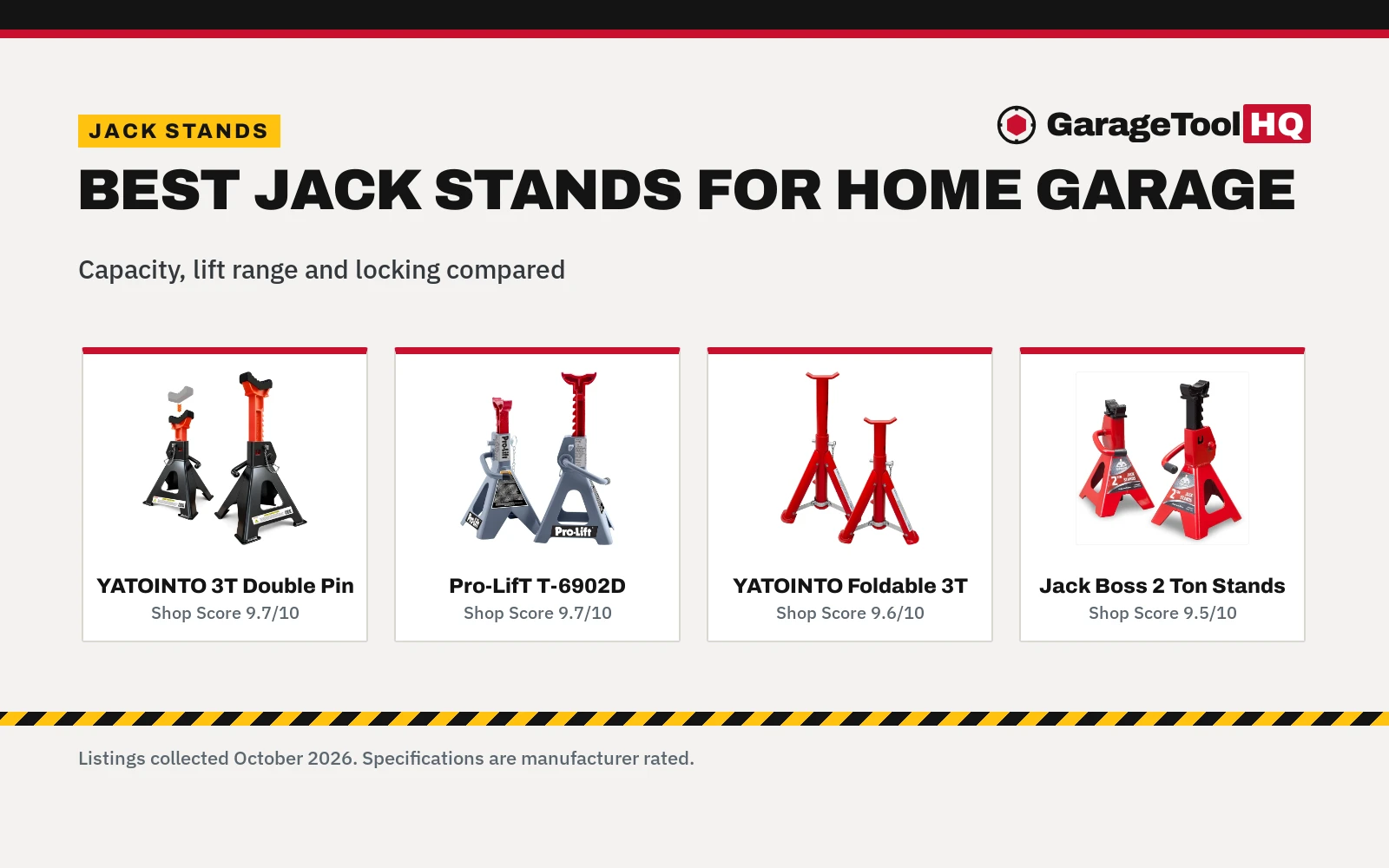
- Rated jack stands. When lifting a vehicle with a 2 ton or 2.5 ton jack, place matching rated stands beneath factory support points on solid concrete. Review locking designs in our guide to the best jack stands.
- Car ramps for low clearance. Low-angle ramps provide quick elevation for oil changes, but splitters may scrape. In tight spots, a low profile jack with a 3-inch saddle reaches underbody points directly. Compare options in our guide to the best car ramps.
- Chassis reach. Compact trolley jacks prioritize storage, while full-length service jacks reach deeper crossmembers. See our breakdown in floor jack vs trolley jack and our guide to the best floor jack for cars.
Frequently Asked Questions
What minimum height qualifies as a low profile floor jack?
Low-profile floor jacks typically feature starting saddle heights between 3 inches and 3-5/8 inches. Listings show minimum heights of 3 inches on the LiftMaster 6490, 3.3 inches or 3-1/3 inch on the BIG RED AT825051UR, 3.35 inches on TONDA models, 3-3/8 inches on the Pro-LifT F-767, and 3-5/8 inches on the Pro-LifT F-757G. These clear low pinch welds where jacks starting above 5 inches (like the 5.3 inches DNA Motoring model) cannot fit.
Can a low profile floor jack lift an SUV or light truck?
Yes, provided vehicle weight is within the rated capacity and maximum lift clears the tires. High-lift models reach 19.9 inches on the Maxority MAX1901-20SR and 19.7 inches on the LiftMaster 6490, providing ample lift for taller vehicles.
What is the difference between single pump and dual pump floor jacks?
A dual-pump jack uses dual hydraulic pistons to raise the saddle in fewer pump strokes than a single-piston pump, speeding up positioning under the frame.
Is steel or aluminum better for a low profile floor jack?
Steel provides maximum durability on shop floors but results in heavier units like the 76.8 pounds ARCAN A20002_A20003. Aluminum and hybrid models weigh less, making them easier to carry and maneuver.
Can I use a low profile floor jack without jack stands?
No. Never get under a vehicle supported only by a hydraulic jack. Hydraulic seals can fail without warning. Mechanical jack stands on solid level ground are mandatory.
How do I bleed air from a hydraulic low profile floor jack?
Insert the handle into the handle sleeve and pump 6 to 8 full strokes per manufacturer instructions to purge trapped air from the hydraulic reservoir.
Related: our review of the best low-profile floor jacks, our comparison of floor jack vs trolley jack, our guide to the best floor jack for cars, our roundup of the best jack stands, and the jacks and stands hub.