Torque Wrench vs Torque Angle Gauge: Which One Should You Buy?
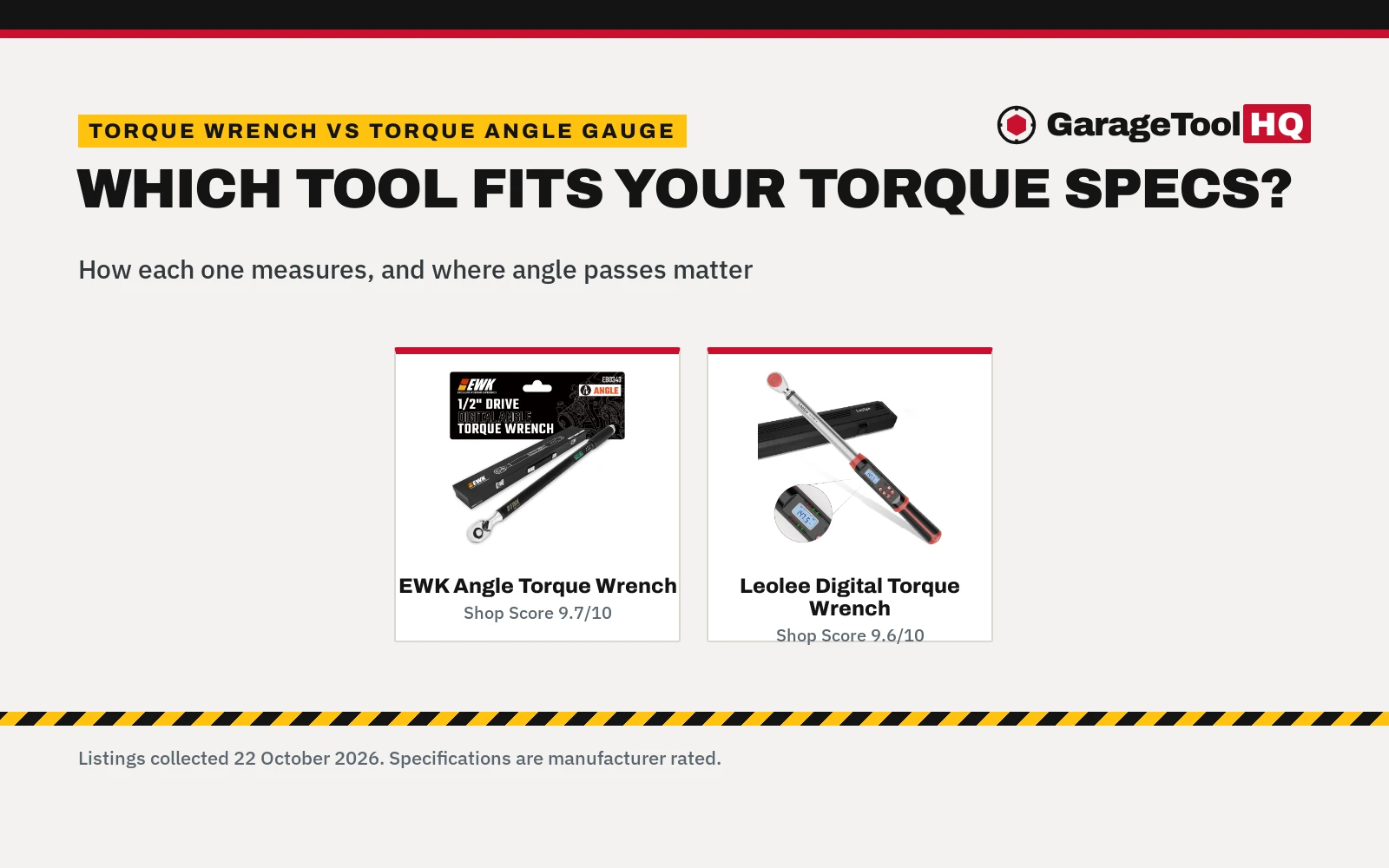
A torque wrench controls tightening force and a torque angle gauge measures rotation after the torque pass; here is how the two differ, with two angle-capable wrench examples scored.

On this page
Top picks at a glance
As an Amazon Associate we earn from qualifying purchases.
- 1
 toolant 13-Piece 1/2" Torque Wrench Set9.8/10View on Amazon
- 2
 1/2" Drive Digital Angle Torque Wrench 12.5-250 ft-lbs9.7/10View on Amazon
- 3
 Leolee 1/2-Inch Drive Digital Torque Wrench with Angle9.6/10View on Amazon
- 4
 Torque Angle MeterView on Amazon
- 5
 JOYFUL&HOPEFUL Torque Angle Gauge 1/2View on Amazon
- 6
 1/2 Torque WrenchView on Amazon
- 7
 OTC 4554 Torque Angle Gauge with Male and Female 1/2" DrivesView on Amazon
- 8
 EPAuto 1/2-inch Drive Click Torque WrenchView on Amazon
- 9
 LEXIVON Torque Wrench 1/2-Inch Drive Click 10~150View on Amazon
Verdict: In this torque wrench vs torque angle gauge comparison, choose a torque wrench if the job is controlled tightening force: lug nuts, suspension and general fasteners, where the Leolee example covers 10-200 Nm and the EWK covers 17-340 Nm. Choose a torque angle gauge, or a wrench with angle mode like both examples here, if the spec calls for torque-to-yield angle passes on head bolts and main caps. Both listings reviewed here sit on the torque wrench side and both measure angle. No standalone angle gauge was in the listings reviewed, so the gauge side is described from how the tool family works.
The head gasket job is where this choice stops being academic. Torque wrench vs torque angle gauge is the fork: one tool controls how hard you pull, the other measures how far the fastener turns after the pull. This comparison covers both, then scores two examples from the listings we reviewed. Both examples are digital torque wrenches with angle measurement built in, so every figure below describes those listings only.
GarageToolHQ earns a commission when you buy through links on this page, at no extra cost to you. Read our affiliate disclosure.

1/2" Drive Digital Angle Torque Wrench 12.5-250
A 1/2 in digital torque wrench with angle control, 12.5-250 ft-lb range and ISO 6789 certification.
Pros
- 12.5-250 ft-lb (17-340 Nm) range, the wider range of the two
- ±1.5% clockwise and ±2.5% counterclockwise torque accuracy with ±2% angle accuracy
- Angle, Track and Peak Hold modes for torque-to-yield sequences
- ISO 6789 certified with 30 memory presets and multi-sensory alerts
Cons
- No warranty term is stated
- 3.1 lb, the heavier of the two examples
- Digital tool needs battery care the mechanical gauge never needs
- Angle accuracy stated as ±2% with no degree range given

Leolee 1/2-Inch Drive Digital Torque Wrench
A 1/2 in digital torque wrench with 0-360 degree angle measurement, 10-200 Nm range and data storage.
Pros
- 0-360 degree angle measurement with Peak, Angle and Peak+Angle modes
- 10-200 Nm (7.38-147.5 ft-lb) with ±2% clockwise accuracy
- Data storage with 6 quick presets for repeat jobs
- Buzzer and LED flash alerts plus 5-minute auto-sleep
Cons
- No warranty term is stated
- 200 Nm top end is lower than the EWK 340 Nm
- ±3% counterclockwise accuracy is looser than the EWK
- 2.4 kg with no stated drop rating
More options to compare
 Torque Angle MeterCheck price on Amazon
 JOYFUL&HOPEFUL Torque Angle Gauge 1/2Check price on Amazon
 1/2 Torque WrenchCheck price on Amazon
 OTC 4554 Torque Angle Gauge with Male and Female 1/2" DrivesCheck price on Amazon
 EPAuto 1/2-inch Drive Click Torque WrenchCheck price on Amazon
 LEXIVON Torque Wrench 1/2-Inch Drive Click 10~150Check price on Amazon
Side by side: torque wrench vs torque angle gauge
| EWK Angle Torque Wrench | Leolee Digital Torque Wrench | |
|---|---|---|
| Drive | 1/2 in | 1/2 in |
| Torque range | 12.5-250 ft-lb (17-340 Nm) | 7.38-147.5 ft-lb (10-200 Nm) |
| Torque accuracy | ±1.5% CW, ±2.5% CCW | ±2% CW, ±3% CCW |
| Angle | ±2% angle accuracy | 0-360 deg angle measurement |
| Memory | 30 values | 6 presets plus data storage |
| Alerts | Buzzer, vibration, LED | Buzzer, LED flash |
| Weight | 3.1 lb | 2.4 kg |
| Cert | ISO 6789 | Not stated |
| Warranty | Not stated | Not stated |
Example figures are manufacturer rated, as published on each listing and collected 22 October 2026.
How each one measures
A torque wrench measures tightening force as you pull and tells you when the target is reached. The Leolee example beeps progressively faster with an LED shifting from flashing green to solid red at target; the EWK example adds buzzer alerts from 80% of target, vibration at 90%, and LED indication near it. A torque angle gauge measures rotation instead: a mechanical one sits between the ratchet and the socket and shows degrees turned, so you can complete the angle pass that follows the torque pass. One tool answers “how hard”, the other answers “how far”. The Leolee display shows the live reading as you pull, and its Track mode is the one the listing recommends for smooth, controlled pulls on ball joint fasteners.
Torque-to-yield: where angle matters
Many modern engine bolts use a torque-then-angle sequence, which both listings describe. The EWK listing states that angle mode completes torque-to-yield procedures more accurately than a torque-only wrench. The Leolee listing names the angle-pass applications: diesel head gaskets, main bearing caps, connecting rods and differential carrier bolts. A standalone angle gauge does the same angle pass with a pointer and dial, paired with any wrench for the torque pass. If the factory manual lists an angle after the torque value, you need angle measurement from one of these two tools. The Leolee listing adds a practical warning for the torque side of the sequence: clear the auto-saved historical data before starting a brand-new measurement, and never exceed 120% of the maximum torque value, to protect the internal sensor.
Range and accuracy
The two examples cover different spans. The EWK lists 12.5-250 ft-lb (17-340 Nm) with ±1.5% clockwise and ±2.5% counterclockwise accuracy; the Leolee lists 7.38-147.5 ft-lb (10-200 Nm) with ±2% clockwise and ±3% counterclockwise. On angle, the EWK states ±2% angle accuracy and the Leolee states 0-360 degree measurement. Neither listing states a warranty term, and only the EWK states a certification, ISO 6789. Do not exceed 120% of the maximum torque value on the Leolee, per its listing, to protect the internal sensor. Both wrenches switch between metric and SAE units without a conversion chart: the Leolee toggles Nm, ft.lb, in.lb and kg.cm, and the EWK switches Nm, kg-cm, lb-ft and lb-in.
Alerts, memory and daily use
Both are digital tools with batteries to manage. The EWK stores 30 memory values; the Leolee stores 6 quick presets plus data storage, and the Leolee adds a 5-minute auto-sleep to preserve battery life. The Leolee ships with a calibration certificate, manual and storage case; the EWK lists a quick-release button, reversible ratchet and anti-slip handle. A mechanical standalone angle gauge needs no battery at all, which is its quiet advantage in a drawer that sits for months. The EWK quick-release button and reversible ratchet speed socket changes between fasteners, and its anti-slip handle matters when hands are oily. For fleet wheel service, the Leolee six presets recall the common lug nut values without re-entering them.
Choose a torque wrench if
- You need controlled torque for lug nuts, suspension and general fasteners.
- You want one tool for both torque and angle, like the two examples here.
- You value the EWK wider 17-340 Nm range or the Leolee included calibration certificate.
- You want alerts that tell you when the target is reached.
Choose a torque angle gauge if
- You already own a good torque wrench and only need the angle pass.
- You want a tool with no battery to maintain between engine jobs.
- Your work is occasional torque-to-yield jobs, not daily torque use.
- You prefer the simplest possible tool for the angle step.
Example tools
The two examples above are the listings this comparison is built on, ranked by their scores. Both are torque wrenches with angle measurement; no standalone angle gauge was in the listings reviewed. The ranking reflects listing completeness, not a workshop trial.
Use rated jack stands on solid ground, wear eye protection with power and air tools, keep fuel-burning equipment out of a closed garage, and follow the manual for every tool. Read our Safety Disclaimer.
Frequently Asked Questions
Can a torque wrench replace a torque angle gauge?
Only if it measures angle. Both examples here do: the Leolee with 0-360 degree measurement and the EWK with stated angle accuracy. A torque-only wrench cannot complete an angle pass, which is where the standalone gauge or an angle-capable wrench comes in.
What is a torque-to-yield bolt?
The listings describe bolts tightened with a torque value followed by an angle pass, naming diesel head gaskets, main bearing caps, connecting rods and differential carrier bolts. The angle pass stretches the bolt into its yield zone for even clamping force.
How accurate are these two wrenches?
The EWK states ±1.5% clockwise and ±2.5% counterclockwise torque accuracy with ±2% angle accuracy. The Leolee states ±2% clockwise and ±3% counterclockwise with 0-360 degree angle measurement. Both are 1/2 in drive digital wrenches.
Do these wrenches need batteries?
Yes, both are digital battery-powered tools. The Leolee adds a 5-minute auto-sleep to preserve battery life. A standalone mechanical angle gauge needs no battery, which the listings do not state but follows from the tool type.
Do either of these state a warranty?
Neither listing states a warranty term, so both score zero on warranty. The Leolee includes a calibration certificate in the box, which is not a warranty but documents its accuracy.
Which units do these wrenches read in?
The Leolee toggles between Nm, ft.lb, in.lb and kg.cm; the EWK switches between Nm, kg-cm, lb-ft and lb-in. Both cover metric and SAE without a conversion chart, so the shop can work in whatever units the manual prints.
Related: the best digital torque wrench under 100 picks, the pliers set picks and the oxygen sensor socket set picks.