Impact vs Torque Wrench: Which One Should You Buy?
Understand the difference between an impact wrench and a torque wrench, including how each mechanism works and when to reach for each tool in the garage.

On this page
Top picks at a glance
As an Amazon Associate we earn from qualifying purchases.
- 1
 DEWALT 20V MAX Cordless Impact Wrench9.6/10View on Amazon
- 2
 CRAFTSMAN V20 RP Cordless Impact Wrench9.6/10View on Amazon
- 3
 Alloyman Cordless Impact Wrench 1500 FT-LBS9.6/10View on Amazon
- 4
 Milwaukee 2864-20 Fuel One-Key 3/4" High Torque ImpactView on Amazon
- 5
 Milwaukee 2962-20 M18 18V Fuel 1/2" Mid-torque Impact WrenchView on Amazon
- 6
 Ingersoll Rand 231C 1/2" Drive Air Impact Wrench Features upView on Amazon
- 7
 Ingersoll Rand 2235TiMAX 1/2"-Drive Air Impact WrenchView on Amazon
- 8
 Milwaukee 2767-20 M18 Fuel High Torque 1/2" Impact WrenchView on Amazon
- 9
 AIRCAT 1056-XL 1/2" Nitrocat Composite Compact Impact WrenchView on Amazon
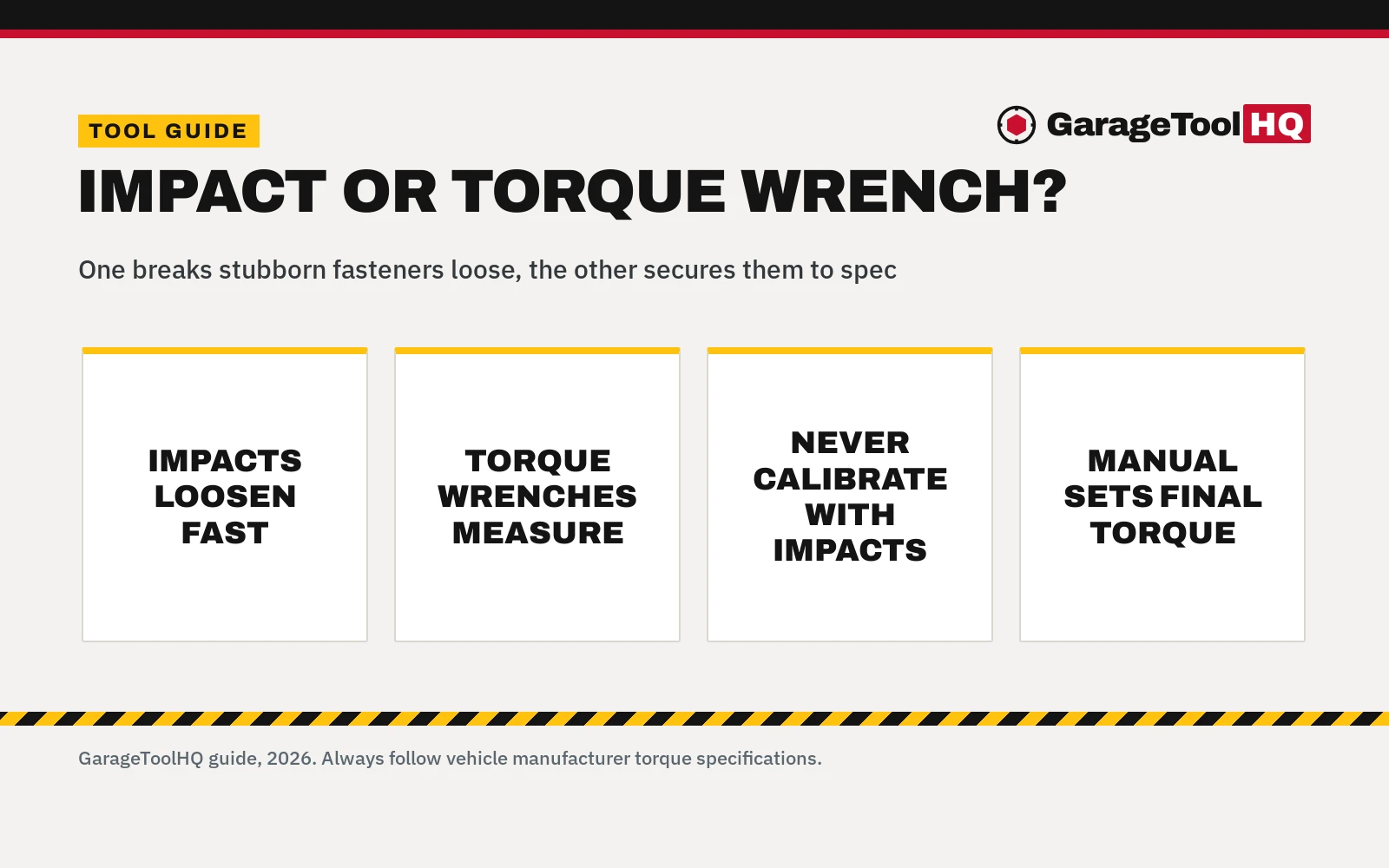
When comparing an impact vs torque wrench, the key difference comes down to raw rotational force versus precise tightening measurement. An impact wrench spins fasteners on or off quickly with repeated concussive impacts, while a torque wrench is a manual measuring instrument that tightens fasteners to an exact manufacturer specification. Use an impact wrench to break loose stubborn hardware or speed up assembly, but always finish critical fasteners with a torque wrench to prevent damaged threads or loose wheels.
More options to compare
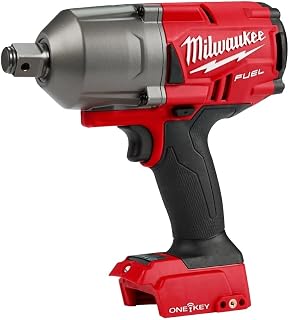 Milwaukee 2864-20 Fuel One-Key 3/4" High Torque ImpactCheck price on Amazon
 Milwaukee 2962-20 M18 18V Fuel 1/2" Mid-torque Impact WrenchCheck price on Amazon
 Ingersoll Rand 231C 1/2" Drive Air Impact Wrench Features upCheck price on Amazon
 Ingersoll Rand 2235TiMAX 1/2"-Drive Air Impact WrenchCheck price on Amazon
 Milwaukee 2767-20 M18 Fuel High Torque 1/2" Impact WrenchCheck price on Amazon
 AIRCAT 1056-XL 1/2" Nitrocat Composite Compact Impact WrenchCheck price on Amazon
GarageToolHQ earns a commission when you buy through links on our product pages, at no extra cost to you. Read our affiliate disclosure.
Below: how each tool works, how their outputs compare, and the exact steps for using both tools together safely on automotive fasteners.
Impact vs torque wrench: key differences and how they work
While both tools fit standard sockets, they serve opposite purposes in a garage. Confusing them can damage expensive parts, snap wheel studs, or leave critical hardware loose.
An impact wrench uses an internal motorized hammer and anvil assembly. As the motor spins, a spring-loaded hammer strikes the anvil repeatedly, delivering rapid rotational shock. This concussive action breaks rusted or seized threads loose with minimal twisting force transferred to your hands. However, this hammering action cannot measure or control torque with precision.
A torque wrench relies on mechanical calibration rather than impact shock. Most shop models use an internal calibrated spring connected to a lever arm and ratcheting head. When you pull the handle to your target specification, the internal mechanism slips with an audible and tactile click, signaling that the fastener has reached its exact tightness.
The primary differences center on distinct operational areas:
- Rotational action. An impact wrench uses concussive impacts to spin fasteners rapidly. A torque wrench uses smooth manual leverage to achieve controlled tension.
- Torque measurement. An impact wrench cannot measure applied torque; it simply hammers until the trigger is released. A torque wrench provides direct, calibrated measurement.
- Directional utility. An impact wrench loosens or runs down hardware in forward and reverse. A torque wrench is designed strictly for tightening; using it to loosen hardware can ruin its calibration.
- Fastener protection. An impact wrench can easily over-torque bolts and stretch threads. A torque wrench stops you right at the engineered specification.
Comparing impact wrenches and torque wrenches side by side
To understand where each tool fits in your garage, compare their mechanical characteristics side by side:
| Feature | Impact Wrench | Torque Wrench |
|---|---|---|
| Primary function | Rapid fastener removal and preliminary rundown | Final tightening to exact manufacturer specification |
| Power delivery | Repeated concussive hammer blows on an anvil | Smooth, continuous manual leverage |
| Measurement capability | None; speed and cutoff modes do not measure torque | Calibrated internal spring with audible click or scale readout |
| Common drive sizes | 3/8-inch, 1/2-inch, and 3/4-inch square drives | 1/4-inch, 3/8-inch, and 1/2-inch square drives |
| Loosening hardware | Primary tool for breaking loose seized bolts | Not recommended; loosening tight hardware damages calibration |
| Garage workflow stage | Disassembly and initial thread run-in | Final inspection before operating the vehicle |
These tools do not compete; they complement each other. The impact wrench handles the heavy labor of spinning fasteners, while the torque wrench provides final engineering verification.
How to use impact and torque wrenches together: the shop workflow
Professional mechanics use both tools in sequence. Follow this shop workflow when servicing wheels or suspension hardware:
- Support the vehicle safely. Park on level concrete, set the parking brake, and raise the vehicle with a rated jack. Always lower the chassis onto rated jack stands placed beneath manufacturer lift points before starting work. Never work under a vehicle supported only by a jack.
- Break hardware loose with the impact wrench. Fit a dedicated impact socket to your impact wrench. Set the tool to reverse to spin off stubborn wheel lug nuts or suspension bolts.
- Start replacement fasteners by hand. Always thread nuts or bolts onto threads by hand for several turns to prevent cross-threading.
- Run hardware down lightly. Use a low setting or feather the trigger to spin the fastener down until the socket face contacts the surface. Stop immediately once seated; never hammer on the fastener with the impact tool during assembly.
- Lower the vehicle to the ground. Lower the vehicle until tires rest firmly on the ground so wheels cannot turn.
- Torque to exact specification in a crisscross pattern. Set your torque wrench to the manual specification. Pull in a smooth, steady motion until you feel the click. On multi-lug assemblies, tighten in a star or crisscross pattern to distribute clamping force evenly.
- Unwind the torque wrench for storage. Turn the micrometer scale back to its lowest setting to prevent spring fatigue and maintain accuracy.
An impact wrench cannot replace a calibrated torque wrench. Even impact models with power settings deliver fluctuating torque based on battery charge, joint stiffness, and trigger time. Always finish critical fasteners with a dedicated torque wrench.
Use rated jack stands on solid ground, wear eye protection with power and air tools, keep fuel-burning equipment out of a closed garage, and follow the manual for every tool. Read our Safety Disclaimer.
When to use an impact wrench vs a torque wrench
Knowing which tool to grab saves shop time and prevents component damage:
Grab an impact wrench for:
- Removing stubborn lug nuts. Breaking loose lug nuts overtightened by a shop or frozen by road grime is the classic role for an impact tool. See our guide to the best cordless impact wrench for lug nuts.
- Suspension teardown. Subframe bolts, strut pinch bolts, and ball joint nuts frequently seize together. An impact tool shocks these fasteners free without awkward breaker bars.
- Freeing corroded hardware. Breaking loose rusted exhaust or chassis bolts where hand leverage risks rounding the fastener head.
Grab a torque wrench for:
- Final wheel lug nut torquing. Overtightening stretches studs and warps brake rotors; under-tightening allows wheels to vibrate loose. Always torque lug nuts to factory specification with a quality tool from our best torque wrench picks.
- Engine and transmission assembly. Cylinder head bolts, rod caps, and valve covers require precise clamping loads to seal gaskets without cracking castings.
- Brake caliper mounting bolts. Caliper bracket bolts experience extreme heat cycles and vibration, making proper fastener tension critical for safety.
Torque ratings and drive sizes: working torque versus breakaway torque
When browsing our cordless tools category, pay close attention to published torque specifications. Impact wrench listings publish two distinct ratings: working torque (fastening torque) and breakaway torque (nut-busting torque).
Working torque is the rotational force delivered when tightening a fastener forward. Breakaway torque is the reverse impact force generated to jar frozen hardware loose. Breakaway torque is typically rated higher on cordless impact wrenches because manufacturers optimize reverse modes for breaking loose frozen threads.
Published manufacturer specifications illustrate these ratings across tool classes:
- Compact and mid-torque models. Milwaukee lists up to 250 ft-lbs of nut-busting torque on its 3/8-inch compact tool, while its listing notes an auto shut-off mode applying no more than 20 ft-lbs for hand-tight rundown. In the 1/2-inch mid-torque category, DEWALT rates its DCF892B at 600 ft-lbs of maximum fastening torque and 800 ft-lbs of breakaway torque. Robustrue lists a 1/2-inch brushless model delivering 590 ft-lbs (800 N.m) of maximum torque.
- High-torque heavy-duty models. When tackling commercial truck wheels or rusted equipment, high-torque tools deliver massive force. PAOWAFOL publishes a peak disassembly rating of 1180 ft-lbs (1600 N.m) for its 1/2-inch model. DEWALT rates its heavy-duty DCF961B at 1320 ft-lbs of maximum fastening torque and 1900 ft-lbs of maximum breakaway torque. For severe industrial fasteners, Milwaukee lists a 3/4-inch model delivering 1500 ft-lb.
Drive sizes also determine shop applications. A 3/8-inch drive suits brake jobs and light automotive service. A 1/2-inch drive is the standard for wheel lugs and suspension work; see our guide to the best cordless impact wrench 1/2 models and our guide on what size cordless impact wrench for lug nuts. Always pair impact tools with rated alloy sockets from a dedicated socket set for impact tools rather than brittle chrome sockets.
Frequently Asked Questions
Can I use an impact wrench instead of a torque wrench?
No. An impact wrench cannot replace a torque wrench. Impact wrenches deliver unmeasured concussive blows that vary with battery charge and joint stiffness. Using an impact wrench for final tightening leads to stripped threads, stretched bolts, warped rotors, or snapped hardware. Always use a calibrated torque wrench for final tightening.
How do I check torque on an impact wrench?
You cannot check or set torque on an impact wrench because it does not contain a torque measuring instrument. Speed settings and auto-stop modes regulate motor speed or trigger cutoffs, but cannot measure clamping load. To check or achieve an accurate torque specification, you must use a calibrated torque wrench.
Do I need a high torque impact wrench for lug nuts?
Most passenger car wheel lug nuts do not require a high-torque impact wrench for routine maintenance; a compact or mid-torque model easily breaks loose normal hardware. However, heavy pickup trucks, trailers, or severely rusted fasteners benefit from the extra breakaway power of a high-torque model.
What is a good torque for an impact wrench?
A good torque rating depends on the job. For routine passenger car maintenance, a compact or mid-torque model provides sufficient breakaway power without excess weight. Heavy truck chassis work, commercial trailers, and severely rusted hardware require heavy-duty models with maximum breakaway shock. Check manufacturer specifications to match ratings to your needs.
Can you use a torque wrench to loosen bolts?
No. Do not use a torque wrench to loosen stubborn or frozen bolts. Breaking loose seized hardware can exceed the tool’s maximum calibrated threshold, damaging the internal spring and destroying measurement accuracy. Always use a breaker bar or an impact wrench to loosen hardware.
What is the difference between a cordless ratchet and an impact wrench?
A cordless ratchet uses an electric motor to turn a standard ratcheting head without concussive hammer impacts. It provides lower torque for rapid rundown in tight spaces where an impact wrench cannot fit. For details, read our comparison of cordless ratchet vs impact wrench.
Related: our guide to what size cordless impact wrench for lug nuts, the best cordless impact wrench for lug nuts, our review roundup of the best torque wrench options, the cordless ratchet vs impact wrench comparison, and our cordless tools hub.