Hacksaw vs Reciprocating Saw: Which One Should You Buy?
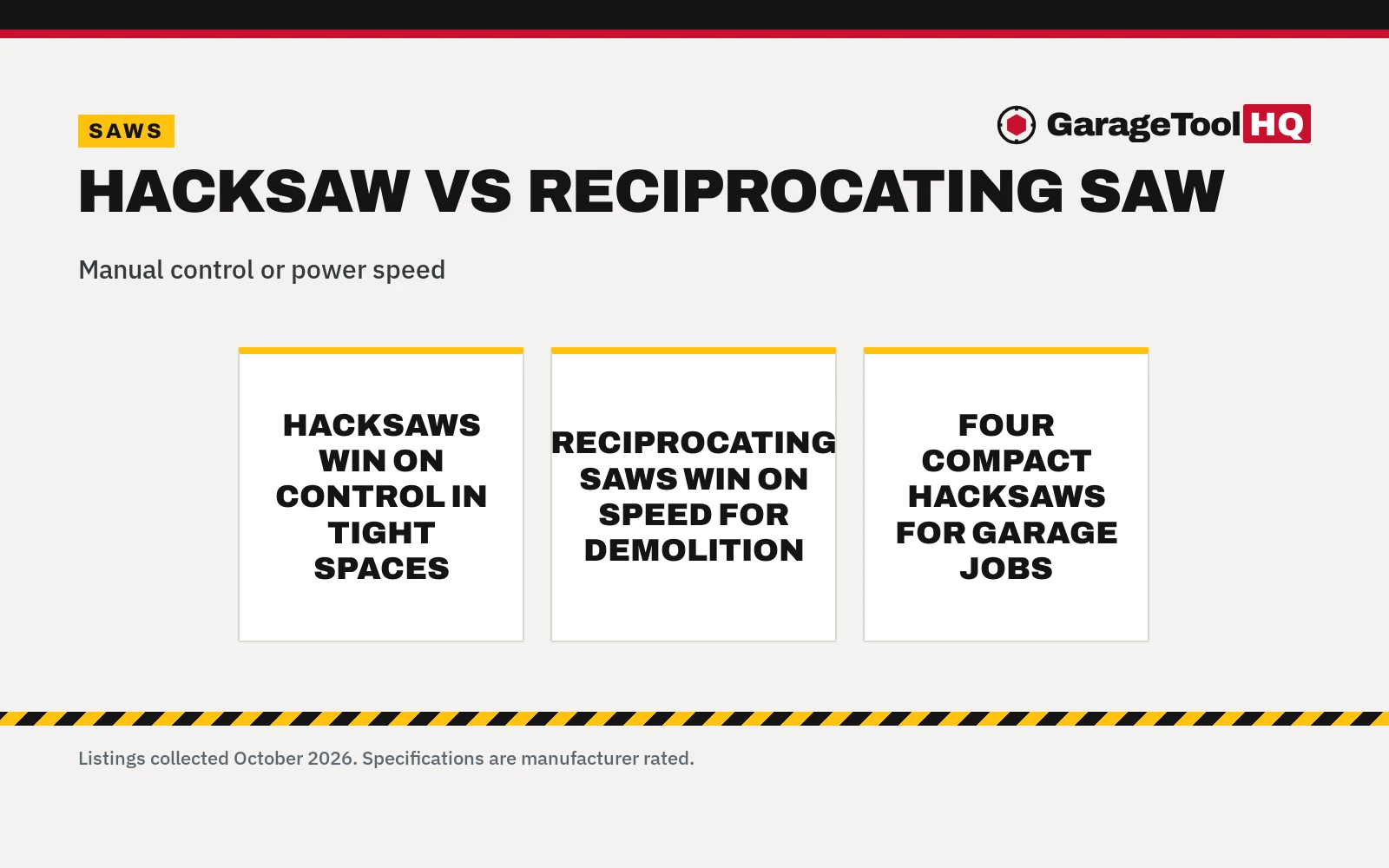
When a hacksaw beats a reciprocating saw on control in tight spaces, when power wins on demolition and exhaust work, and four compact hacksaws for the garage.

On this page
Top picks at a glance
As an Amazon Associate I earn from qualifying purchases.
- 1
 DEWALT 20V MAX Reciprocating Saw9.6/10View on Amazon
- 2
 TaskStar Cordless Reciprocating Saw Kit9.6/10View on Amazon
- 3
 CRAFTSMAN Reciprocating Saw9.5/10View on Amazon
- 4
 Pasco 4290 Tiny Tim HacksawView on Amazon
- 5
 Skil 9206-02 7.5-Amp Variable Speed Reciprocating SawView on Amazon
- 6
 DEWALT Reciprocating SawView on Amazon
- 7
 Ingersoll Rand 429 3/8" Reciprocating Air Saw Features up toView on Amazon
- 8
 SKIL 13 Amp Corded Reciprocating Saw with Buzzkill TechnologyView on Amazon
- 9
 SKIL 9216-01 9 Amp Reciprocating SawView on Amazon
When a rusted bolt needs cutting in a tight spot under the car, the choice in hacksaw vs reciprocating saw comes down to control against speed. A hacksaw wins for short, controlled cuts where space is tight; a reciprocating saw wins for fast cuts through demolition and exhaust work. For short cuts in tight spaces, the hacksaw is the right buy, and the reciprocating saw earns its place when the cutting list grows long and the material gets thick.
Other tools worth a look
 Pasco 4290 Tiny Tim HacksawCheck price on Amazon
 Skil 9206-02 7.5-Amp Variable Speed Reciprocating SawCheck price on Amazon
 DEWALT Reciprocating SawCheck price on Amazon
 Ingersoll Rand 429 3/8" Reciprocating Air Saw Features up toCheck price on Amazon
 SKIL 13 Amp Corded Reciprocating Saw with Buzzkill TechnologyCheck price on Amazon
 SKIL 9216-01 9 Amp Reciprocating SawCheck price on Amazon
GarageToolHQ earns a commission when you buy through links on our product pages, at no extra cost to you. Read our affiliate disclosure.
Below: how the two saws differ, when each one wins, and four compact hacksaws for the garage.
Hacksaw vs reciprocating saw: where the two differ
A hacksaw is a hand saw: the user drives a short blade back and forth, which gives fine control in tight spaces. A reciprocating saw is a power saw that drives its blade the same way, only faster and with far more force, which suits long cuts and demolition. The trade is simple: the hacksaw trades speed for control, and the reciprocating saw trades control for speed.
| Saw | Power | Best for | Watch out for |
|---|---|---|---|
| Hacksaw | Hand | Short, precise cuts in tight spaces | Slow on long cuts |
| Reciprocating saw | Power | Demolition, exhaust work, long cuts | Less control in tight spaces |
That trade shows up in the listings below: every compact hacksaw here is built for tight spaces and short cuts, and one listing states plainly that its saw is not intended for heavy-duty demolition.
When the hacksaw wins
Tight spaces are the hacksaw’s home ground. The Milwaukee compact hack saw is built for versatile cutting in tight spaces, with an adjustable blade length for easier flush cutting. The KATA mini hacksaw uses a compact aluminum frame that is easier to control than a full-size hacksaw, and the Pasco Tiny Tim is described as a great hacksaw for tight areas. Short, precise cuts are the point: keep the material steady and use steady strokes, as the KATA listing advises.
Short cuts in common garage materials are the other win. The KATA cuts metal rods, PVC pipe, plastic, thin tubing and bolts. The Vanquish cuts wood, PVC, plasterboard, sheet metal and Styrofoam. The Pasco cuts steel and brass. For a single bolt or a short length of tubing, a hacksaw is fast enough and easier to place than a power saw.
When the reciprocating saw wins
When the cut gets long, the material gets thick, or the job is demolition, the power saw takes over. A reciprocating saw keeps cutting where a hand saw tires, and exhaust work is the classic garage case: long runs of pipe that a hand saw would take longer to finish. The KATA listing draws the line plainly: its compact hacksaw is not intended for heavy-duty demolition, large lumber or thick hardened steel. That line is where the reciprocating saw starts. See our picks for the best reciprocating saw for exhaust work and the best cordless reciprocating saw for home mechanics when the job crosses that line.
Four compact hacksaws for the garage
All four hacksaws below are compact, hand-operated saws for tight spaces.
Milwaukee 48-22-0012 Compact Hack Saw. Tool-less blade change, adjustable blade length for easier flush cutting, a rubber overmold grip, and a 10 inch blade of high speed steel with 24 teeth. The listing states the saw is hand operated and compact for tight spaces, and weighs 227 g. Note the spec table lists electricity, 18 volts and 5000 rpm, which does not match the hand-operated description in the title and bullets; trust the title and bullets here.
KATA 10 Inch Mini Hacksaw. A compact aluminum frame with 3 bi-metal 24 TPI blades: 1 installed 10 inch blade and 2 extra 10 inch / 250 mm blades. The ergonomic soft TPR and rubber handle gives a secure hold, and the saw measures 11.4 by 2.75 by 1.18 inches at 4.8 ounces. It cuts metal rods, PVC pipe, plastic, thin tubing and bolts, but is not intended for heavy-duty demolition, large lumber or thick hardened steel. Note the spec table lists 0.6 volts and 4500 rpm for this hand-operated saw, which does not match the manual description; trust the title and bullets.
Vanquish 4851 Compact Hacksaw. An aluminum alloy frame with an adjustable blade length, a 10 inch bi-metal HSS blade, and a rubber handle for a comfortable, non-slip hold. It measures 3 by 0.75 by 11.38 inches at 4.64 ounces, with 32 teeth, and cuts wood, PVC, plasterboard, sheet metal and Styrofoam.
Pasco 4290 Tiny Tim Hacksaw. The smallest saw here, with a 6 inch alloy steel blade, a vinyl grip handle, and dimensions of 10 by 0.5 by 3 inches at 3.84 ounces. It has 32 teeth and cuts steel and brass, described as a great hacksaw for tight areas.
Use rated jack stands on solid ground, wear eye protection with power and air tools, keep fuel-burning equipment out of a closed garage, and follow the manual for every tool. Read our Safety Disclaimer.
FAQ: garage tools
Can a hacksaw cut an exhaust pipe?
For short cuts, yes: the KATA cuts metal rods, tubing and bolts, and the Pasco cuts steel and brass. For long exhaust runs, a reciprocating saw finishes the job faster; see the picks linked above.
What blade length do these hacksaws use?
Three of the four list a 10 inch blade: the Milwaukee, the KATA and the Vanquish. The Pasco Tiny Tim lists a 6 inch blade.
Are these hacksaws good in tight spaces?
Yes. The Milwaukee is compact for tight spaces, the KATA frame is compact for control, and the Pasco is described as a great hacksaw for tight areas.
Can a hacksaw handle heavy demolition?
No. The KATA listing states its compact hacksaw is not intended for heavy-duty demolition, large lumber or thick hardened steel. That work belongs to a reciprocating saw.
Do these hacksaws need power?
No. All four are hand-operated saws. The Milwaukee and KATA spec tables list power figures that do not match their hand-operated descriptions, so trust the titles and bullets.
Related: exhaust pipe cutters for home mechanics, the air body saw vs reciprocating saw comparison, and our best cordless reciprocating saw picks.