Jump Starter vs Jumper Cables: Differences Explained
A direct comparison of jump starters and jumper cables: how each tool starts a dead battery, safety rules, emergency use and which option fits your vehicle.

On this page
Top picks at a glance
As an Amazon Associate we earn from qualifying purchases.
- 1
 YaberAuto 12-in-1 Jump Starter with Air Compressor 8000A9.7/10View on Amazon
- 2
 OXILAM 8000A Jump Starter9.7/10View on Amazon
- 3
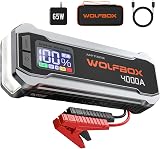 WOLFBOX 4000A Jump Starter9.7/10View on Amazon
- 4
 Autowit Super Capacitor Jump StarterView on Amazon
- 5
 DEWALT DXAEPS14 2000 Peak Amp Jump Starter with 120 PSI AirView on Amazon
- 6
 DEWALT DXAEJ14 1600 Peak Amp Jump Starter with 120 PSI AirView on Amazon
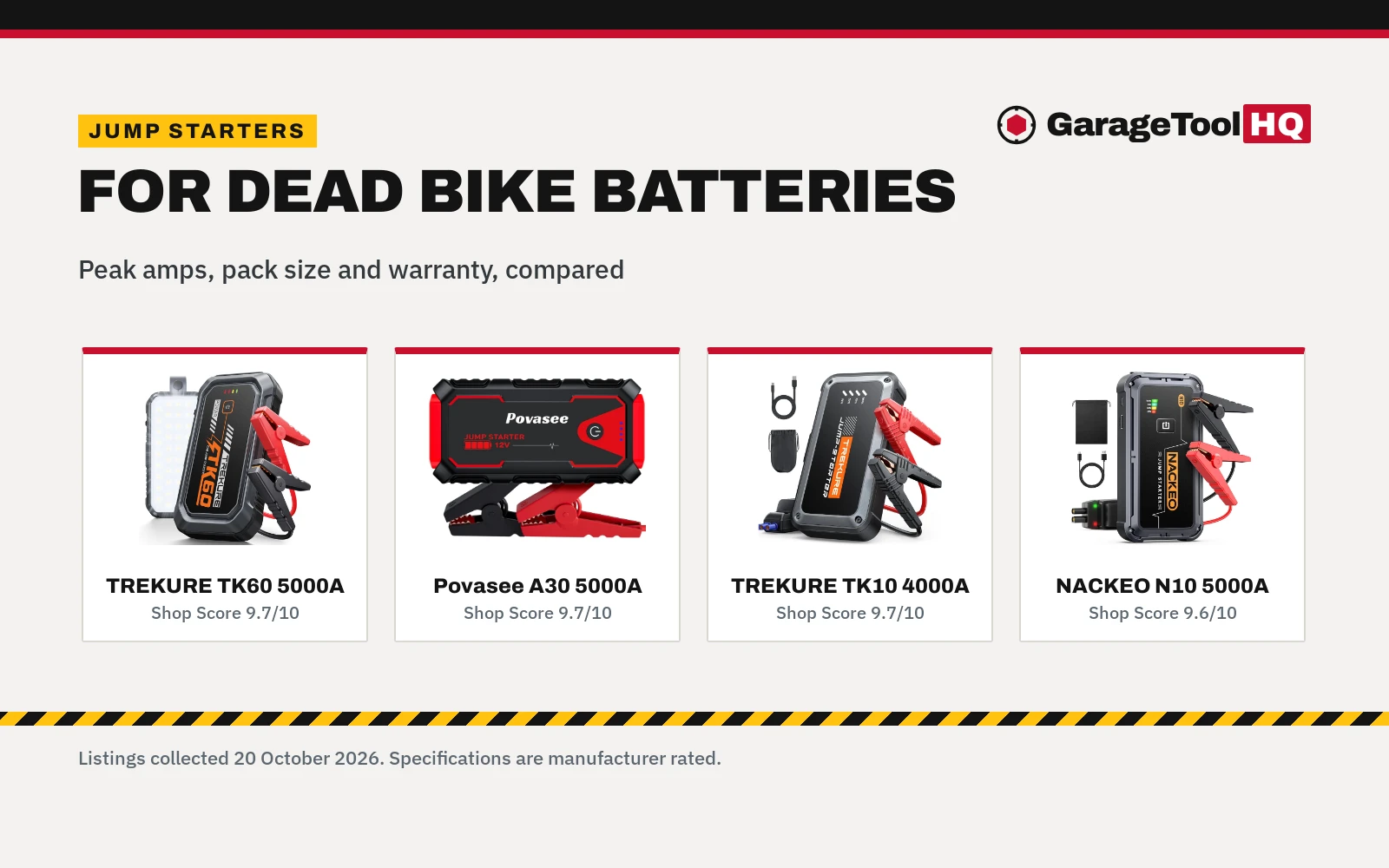
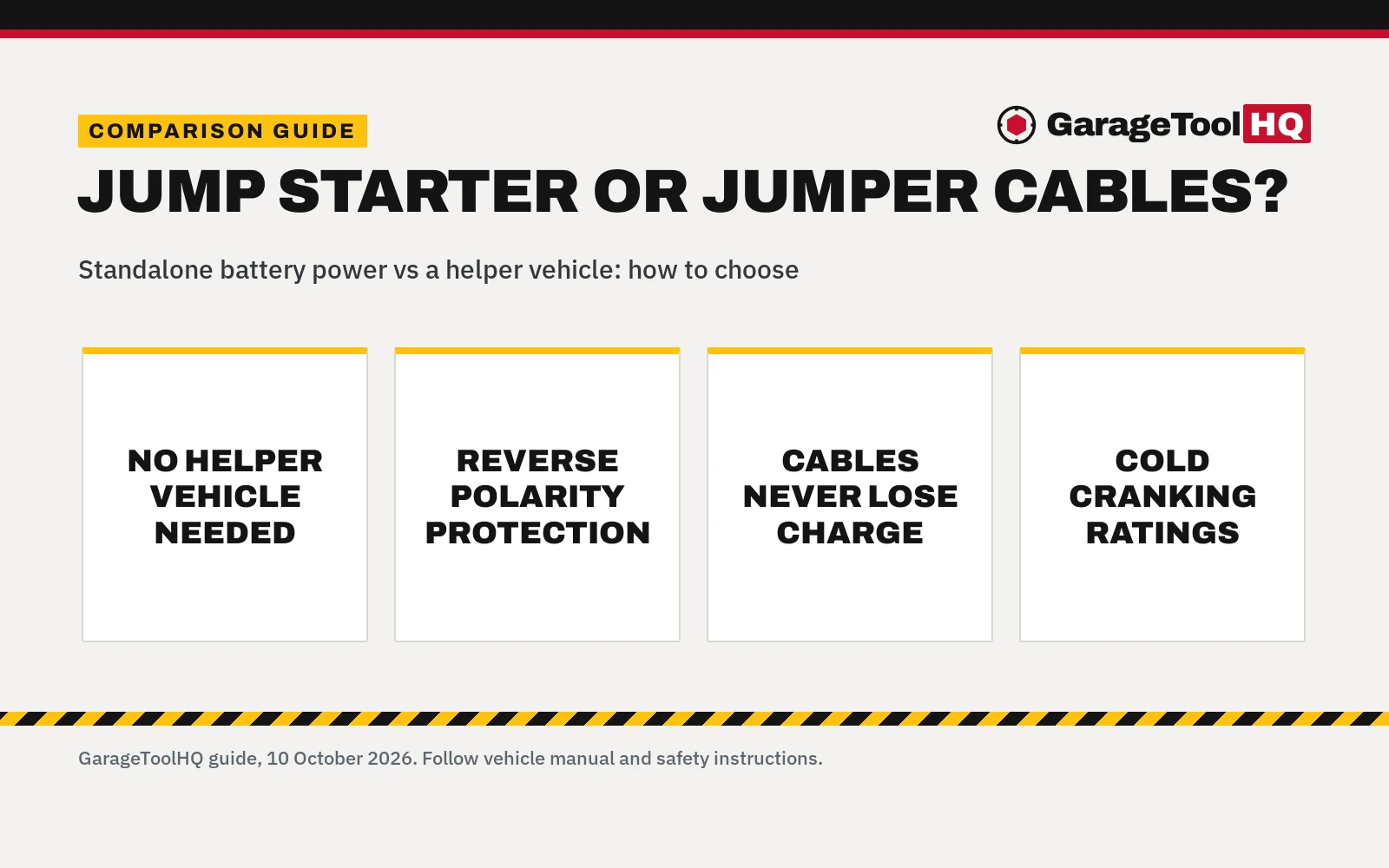
Jump starter vs jumper cables: a portable jump starter is the safer, self-contained choice for solo emergencies, while traditional jumper cables are an inexpensive backup that never needs recharging. A jump starter carries an internal battery pack to supply cranking amps directly to a dead 12V battery. Booster cables require a helper vehicle and an assisting driver. For most motorists, a jump starter provides independence, while cables serve as a dependable secondary backup.
More options to compare
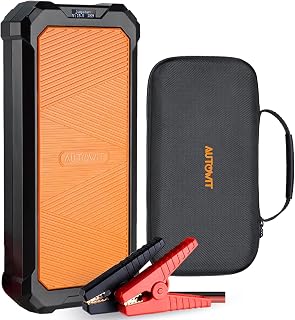 Autowit Super Capacitor Jump StarterCheck price on Amazon
 DEWALT DXAEPS14 2000 Peak Amp Jump Starter with 120 PSI AirCheck price on Amazon
 DEWALT DXAEJ14 1600 Peak Amp Jump Starter with 120 PSI AirCheck price on Amazon
GarageToolHQ earns a commission when you buy through links on our product pages, at no extra cost to you. Read our affiliate disclosure.
Below: how jump starters and booster cables differ, how power transfers, safety protections, a step-by-step checklist, and guidance on choosing the right tool.
Jump starter vs jumper cables: how each tool starts a dead battery
Both tools deliver direct electrical current to crank an internal combustion engine when a vehicle battery lacks sufficient starting voltage. However, power delivery differs fundamentally between the systems.
Traditional jumper cables are passive conductors that transfer current from a donor vehicle electrical system to the discharged battery. Cable performance depends on wire gauge. For example, Clore Automotive equips its JNC770R jump starter with heavy-duty 2 AWG welding cable leads measuring 68 inches. Across jump equipment and cables, thicker wire (such as 2 AWG) provides lower resistance, carrying heavy cranking current with minimal voltage drop.
A portable jump starter is an active power source housing a high-discharge lithium or AGM battery pack. Because it stores its own energy, it requires no donor vehicle. The operator connects the clamps to designated jump posts, turns on the unit, and cranks the engine.
- Independence: jump starters allow an individual driver to revive a vehicle alone without waiting for assistance.
- Physical access: compact jump starters fit easily into tight parking spaces where positioning another car is impossible.
- Electrical safety: quality jump starters include solid-state reverse polarity and spark protection. Cables rely entirely on correct clamp placement.
- Maintenance: cables need no recharging, while jump packs require periodic recharging to maintain battery readiness.
Comparing jump starters and booster cables side by side
| Feature | Portable Jump Starter | Traditional Jumper Cables |
|---|---|---|
| Primary power source | Internal lithium or AGM battery pack | External donor vehicle electrical system |
| Helper car required | No, operates independently with a single driver | Yes, requires a second vehicle as a power source |
| Electronic safety circuitry | Integrated spark-proof tech and reverse polarity alerts | None, relies entirely on operator caution |
| Physical weight range | 16 ounces (Acmount P100) to 23 pounds (Clore Automotive JNC770R) | Typically coiled copper-clad aluminum or copper wire |
| Peak current capability | 500 amps (NOCO GB20) to 5000A (Acmount P100, BIUBLE JS001) | Determined by donor vehicle battery and cable resistance |
| Vehicle engine coverage | Up to 4.0L gas (NOCO GB20) to 10.0L gas and 8.0L diesel (Acmount P100) | Dependent on donor vehicle output and cable gauge |
| Storage maintenance | Periodic recharging recommended (such as every 2 to 3 months per BIUBLE and Acmount) | No battery charging required; periodic visual inspection for corrosion |
| Secondary emergency utilities | Built-in USB power bank, LED flashlight with strobe and SOS modes | None, dedicated solely to vehicle jump-starting |
Portable jump starters offer added utility, including USB charging ports and multi-mode emergency LED lights. Jumper cables lack secondary features, but their mechanical simplicity ensures they need no charging before use.
How to jump-start a vehicle safely: the step-by-step checklist
- Prepare the vehicles. Set parking brakes, place transmissions in park or neutral, and switch off all ignitions, headlights, and cabin accessories.
- Inspect the battery. Examine the casing for cracks, leaks, or bulges. Never jump-start a cracked, frozen, or leaking battery.
- Locate jump posts. Identify positive (plus sign, red cover) and negative (minus sign, black cover) terminals or remote jump posts in the vehicle manual.
- Connect positive clamps first. Attach a red clamp to the dead vehicle positive terminal. For cables, connect the opposite red clamp to the donor positive terminal.
- Connect negative clamps. For cables, attach the black clamp to the donor negative terminal, and the final black clamp to an unpainted metal engine ground on the dead car. For jump packs, attach the black clamp as instructed by the maker.
- Verify polarity. Ensure reverse polarity indicators on units like NOCO Boost, NEXPOW Q10S, or Acmount P100 show safe connections before proceeding.
- Power on and crank. Turn on the jump starter (or start the donor vehicle). Crank the disabled engine smoothly. NOCO Boost X models include a 60-second timer to conserve battery power after activation.
- Disconnect in reverse order. Remove the black ground clamp first, followed by the red positive clamp. Never allow clamp ends to touch.
Reversing clamp polarity creates an immediate short circuit that can melt wiring, destroy alternators, blow fuses, or ruin onboard vehicle control modules.
Lead-acid batteries can release hydrogen while charging, so charge in a ventilated space away from sparks and flames, connect positive first and negative last, set the charger to the battery type (flooded, AGM, gel, lithium), and wear eye protection. Read our Safety Disclaimer.
Jump box or cables: which one belongs in your vehicle?
Choosing between a jump box or cables depends on driving habits and storage preferences. A portable jump starter is ideal for solo commuters, night drivers, and anyone traveling through remote areas. Compact lithium models store easily in glove boxes. For example, NEXPOW lists its Q10S at 3.15″D x 6.3″W x 1.57″H, while NOCO lists the GB20 at 4.61″D x 8.19″W x 4.21″H with a weight of 2.4 lb.
Conversely, traditional cables remain valuable because they require no battery charging routine, provided insulation and clamps are kept clean and free of corrosion.
Operating temperature is another factor. Extreme cold reduces battery capacity. Lithium units like the BIUBLE JS001 and Acmount P100 list operating temperature ranges down to -4°F (-4℉ to 140℉). In severe cold, storing a jump starter in the vehicle cabin ensures full starting power. Explore our guides to jump starters for cold weather and why car batteries die in winter.
Engine size must also match equipment ratings. NOCO rates the GB20 up to 4.0L gas, the GB50 up to 7.0L gas and 4.5L diesel, while Acmount rates the P100 up to 10.0L gas and 8.0L diesel. See our sizing guide on what size jump starter you need.
Vehicle electronics, charging systems and battery diagnostics
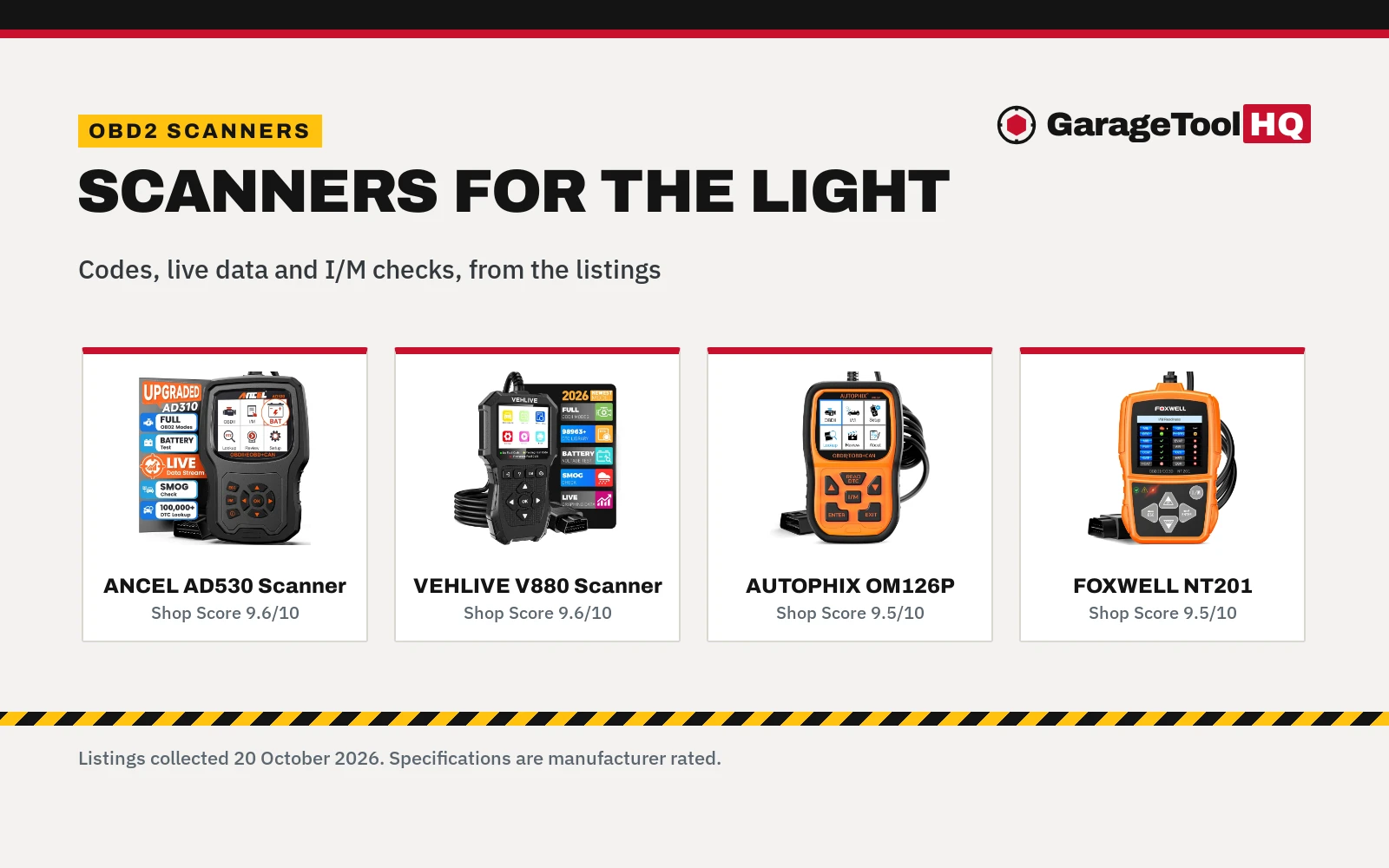
A jump-start resolves an immediate breakdown, but a dead battery often indicates an aging battery, charging failure, or parasitic drain. Low voltage during starting can also store fault codes across electronic control modules. Inspecting the vehicle with a quality diagnostic scan tool verifies alternator charging output and clears transient trouble codes. Review our guide on how to choose an OBD2 scanner.
Jump starters provide momentary starting power but do not recharge a battery to full health. To safely restore a deeply drained battery or maintain a vehicle in storage, connect a dedicated battery charger maintainer. Learn more in our comparison of jump starter vs battery charger.
Frequently Asked Questions
Can a jump starter damage vehicle electronics?
Quality jump starters feature voltage suppression and reverse polarity safeguards to protect onboard electronics. Standard cables carry higher spike risks if disconnected while an alternator charges heavily.
How long does a portable jump starter hold its charge?
The Acmount P100 listing states it holds a charge up to 12 months. However, makers like BIUBLE and Acmount recommend recharging every 2 to 3 months to preserve peak cranking capacity.
Why does cable thickness matter on jump equipment?
Lower numerical gauge wire carries high current with less resistance. For example, Clore Automotive equips the JNC770R jump starter with 68-inch 2 AWG welding cable leads to maximize energy transfer.
Can a completely dead battery be jump-started?
Smart units may not detect batteries drained below standard thresholds. The NOCO GBX75 includes a manual override button pressed for 3 seconds to deliver power to batteries below 3V.
Do I need another car if I own a jump starter?
No. A jump starter is an independent power source that allows a single driver to start a vehicle without another car or roadside assistance.
Related: the best jump starter guide, our diagnostics and electrical hub, and the best jump starter for trucks and diesel.