How Thick Does Concrete Need to Be for a Car Lift?
What determines car lift concrete thickness: manufacturer specifications, anchor embedment depth, slab integrity, and when to pour dedicated concrete footings.

On this page
Top picks at a glance
As an Amazon Associate we earn from qualifying purchases.
- 1
 QISHIDA 7000 LBS Portable Car Lift Mid Rise Scissor Lift 110V9.6/10View on Amazon
- 2
 KATOOL Portable Car Lift Mid Rise Scissor Lift 110V Electric9.6/10View on Amazon
- 3
 APlusLift HW-8S 8000LB 4-Post Storage Service Car Lift 3 Year9.6/10View on Amazon
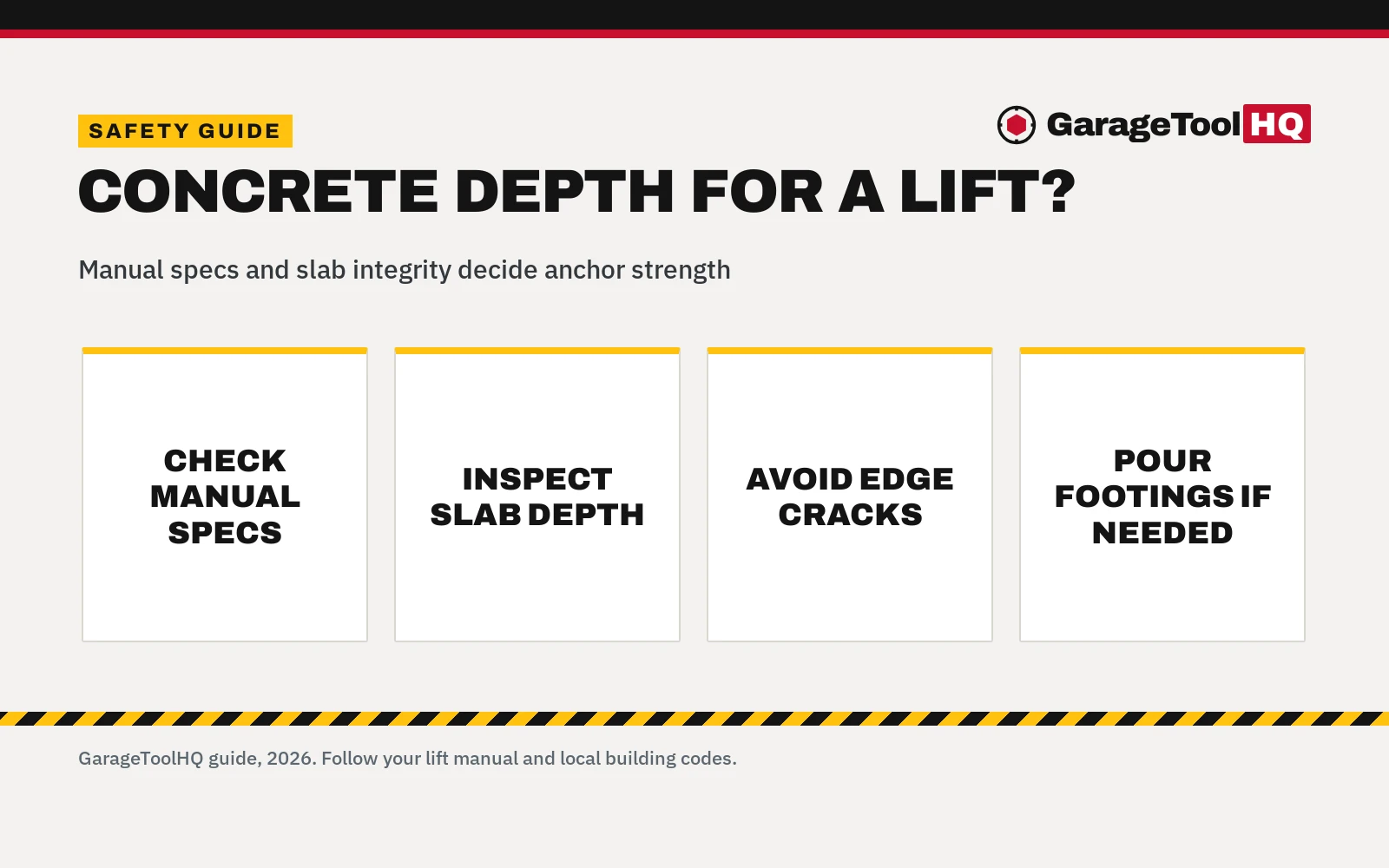
How thick does concrete need to be for a car lift? Concrete thickness for a car lift is determined strictly by the specific lift manufacturer engineering specifications and Automotive Lift Institute (ALI) standards for that model, rather than a universal standard. Permanent two-post automotive hoists exert massive pulling and bending forces on anchor bolts, meaning your concrete slab must meet the exact depth and compressive strength requirements published in the manufacturer installation manual. If your existing garage floor does not meet the manufacturer foundation requirements, or if the listing leaves foundation thickness as not stated, hire a licensed professional to inspect the slab or pour dedicated reinforced concrete footings before bolting down a lift.
GarageToolHQ earns a commission when you buy through links on our product pages, at no extra cost to you. Read our affiliate disclosure.
Below: why concrete slab depth matters for vehicle lifting, how two-post and four-post foundation demands compare, a checklist to verify your floor before installation, and when you must pour dedicated footings.
How thick does concrete need to be for a car lift? Why slab depth matters
A car lift does not simply press down against the floor. When an automotive hoist raises a vehicle, the mechanical forces transfer through the columns, baseplates, and concrete foundation in distinct ways:
- Tension and anchor pull-out. On a two-post hoist, the vehicle weight overhangs the swing arms, creating leverage that pulls upward on the anchor bolts while pressing down against the opposite edge of the column baseplate. If the concrete slab lacks adequate depth, the expansion anchors pull straight out of the floor or break out a cone of concrete, leading to column tipping.
- Compressive strength under column baseplates. Concrete must withstand the concentrated downward load of the vehicle and hoist without crushing or spalling. Slabs poured with substandard mixes or unverified aggregate risk localized crumbling under high point loads.
- Slab deflection and cracking. A slab that is too thin bends under load. Repeated deflection creates structural stress cracks that propagate across the floor, compromising the structural grip of surrounding wedge anchors.
- Sub-base voids and settling. Concrete requires a solid, compacted gravel sub-base underneath. If soil settles or water washes away the base material, hollow voids form below the slab, leaving unsupported concrete that fractures under heavy vehicles.
Lift styles and manufacturer foundation specifications
Different lift styles place vastly different demands on a garage floor. Permanent hoists require anchored foundations, while portable models distribute weight differently across the floor surface:
| Lift Style | Floor Anchoring Demand | Concrete Foundation Requirements |
|---|---|---|
| Two-post lift | Heavy anchor bolts bolted directly into concrete slab to resist tension and tipping forces | Must meet manufacturer depth and compressive strength; listing figures often not stated, requiring manual check |
| Four-post lift | Baseplates rest flat on floor; anchoring optional or recommended for lateral stability | Distributes vehicle weight across posts; slab must be solid, level, and free of cracks |
| Portable scissor or frame lift | Free-standing on wheels or base frames; no floor anchors required | Operates on flat, solid surfaces; requires level ground per manufacturer instructions |
In retail listings, manufacturers regularly publish lifting capacities and dimensions but leave foundation concrete specifications as not stated. For example, the AUTOKATO ME-M130 2-post lift specifies a 13,000 lb lifting capacity and a maximum height of 167 inches, with CE certification for 115% dynamic load and 150% static load, but its listing leaves slab thickness as not stated. The XK-1150 2-post lift lists an 11,500 lb capacity and requires a 220V circuit with a 30A minimum circuit breaker, yet foundation slab depth is not stated. Similarly, the MutsMover ClearBay Service 110 specifies an 11,000 lb capacity, a 74 in rise, 114 inches between posts, a 138-inch overall width, and a 4 HP motor running on 110V power, while foundation concrete depth remains not stated. Meanwhile, individual portable models specify their own surface limits: the Albott portable lift (8,000 lb capacity, 27.4″ max height) and Real Relax portable lift (7,000 lb capacity, 26.8″ max height) do not require floor anchors but instruct users to avoid slopes exceeding 4°. Because retail listings omit foundation details, you must consult the manufacturer installation manual before purchasing or pouring concrete.
How to inspect your concrete slab before installing a car lift: the checklist
- Consult the manufacturer installation manual first. The manual defines minimum slab depth, anchor embedment depth, minimum edge clearances, and required compressive strength. Never install a lift when foundation specifications are not stated in retail documentation.
- Check for Automotive Lift Institute certification. Look for hoists certified under ANSI/ALI ALCTV standards. ALI certified lifts undergo rigorous structural evaluation and supply strict engineering specifications for concrete foundations.
- Examine the floor for structural cracks and spalling. Inspect the planned column locations. Concrete that shows settling, spiderweb cracking, or surface crumbling cannot reliably hold mechanical expansion anchors.
- Drill a core sample to verify slab depth. Residential garage slabs vary in thickness from the center to the edges. Drilling a pilot inspection hole or taking a core sample confirms true slab depth at the exact mounting points.
- Identify post-tensioned cables before drilling. Many newer residential slabs contain post-tensioned steel cables under tension. Drilling into a post-tension cable causes violent cable snap, severe foundation destruction, and catastrophic injury.
- Maintain required anchor edge distances. Position column baseplates away from expansion joints, saw cuts, and slab perimeters. Placing anchors too close to an edge allows lateral expansion force to blow out the concrete.
- Verify floor levelness across the bay. Check the slope of the slab with a precision level. Uneven floors cause columns to stand out of plumb, leading to carriage binding, uneven arm loading, and premature wear.
- Hire a licensed electrician for power wiring. For hydraulic power units requiring 220V circuits or dedicated 110V lines, hire a licensed electrician rather than attempting DIY electrical modifications.
- Follow core vehicle lifting safety rules. Always position lift arms at the vehicle maker designated lift points found in the vehicle owner manual. Core workshop safety rules dictate that you never get under a vehicle on a jack alone; always support raised vehicles with rated stands on solid level ground.
Never drill or anchor into a post-tensioned concrete slab without professional scanning. Post-tensioned slabs contain high-strength steel cables under extreme tension. Severing a cable can cause catastrophic structural failure, cracked foundations, and serious injury. Look for a stamp on the garage floor or consult your home builder before drilling.
Check the lift's rated capacity against your heaviest vehicle, and its ceiling and concrete requirements (thickness and strength) before you buy. Install it exactly as the manufacturer specifies, use the mechanical locks before you go under, and look for ALI certification on the model. See the Automotive Lift Institute (ALI). Read our Safety Disclaimer.
Existing residential slab vs poured concrete footings
Before ordering an automotive hoist, compare your existing floor conditions against the option of pouring new concrete footings:
- Existing slab suitability: An existing slab works only if verified depth and compressive strength satisfy the lift manufacturer manual, the concrete is free of cracks, and anchors maintain required clearance from expansion seams.
- When footings are required: For standard slabs that are too thin, show structural cracking, or have unknown compressive strength, you can saw-cut the floor and pour dedicated reinforced concrete pads according to manufacturer engineering drawings.
- Post-tensioned slab restrictions: If your garage floor is a post-tensioned slab, never saw-cut the concrete or drill without specialized structural engineering scanning and approval, as cutting tensioned cables compromises the entire building foundation.
- Footing excavation and reinforcement: Pouring dedicated footings involves cutting the existing slab, excavating soil down to compacted sub-base, adding rebar cages, and pouring high-strength concrete.
- Allowing full strength development: Freshly poured concrete requires sufficient time to harden and reach full design strength before drilling anchor holes or bolting down columns.
If you are planning your garage layout, read our guide to the best car lift for home garage to compare two-post and four-post configurations. You can also review differences in our 2-post vs 4-post lift comparison and verify overhead room with our guide on what ceiling height you need for a car lift.
Anchor bolt mechanics and expansion joint clearance
A two-post lift relies entirely on mechanical wedge anchors to stay upright. Understanding how anchors engage concrete clarifies why slab depth and edge distances are so vital:
When you torque a wedge anchor nut, the threaded rod pulls upward, drawing a tapered mandrel into an expansion clip. The clip expands outward, biting deep into the concrete hole walls. This creates intense lateral outward pressure inside the slab. If the slab is too thin, the bottom of the hole blows out, or the anchor pulls free under tension. If an anchor is installed too close to a slab edge, expansion joint, or saw cut, the outward force splits the concrete edge away from the slab.
Always keep anchor bolts well clear of expansion joints and slab borders as specified by the manufacturer. Learn proper column setup and arm positioning in our walkthrough on how to use a 2-post lift, and explore garage planning considerations in how to choose a car lift for a home garage.
Frequently Asked Questions
Can I install a 2-post lift on a standard garage floor?
Only if the slab satisfies the lift manufacturer published foundation specifications. Many residential slabs have unknown thickness or aggregate quality. You must verify actual concrete depth and compressive strength, check the installation manual, and consult a structural engineer or concrete professional before bolting down a 2-post hoist.
What happens if garage concrete is too thin for a car lift?
Thin concrete cannot support the upward tensile force on anchor bolts or the concentrated downward weight of the columns. Under load, anchor bolts pull loose, the concrete fractures or punches through, and the columns can tip over, resulting in catastrophic equipment failure and severe vehicle damage.
How can I verify the thickness of my existing concrete slab?
Drill a small pilot inspection hole in the concrete where the column baseplates will stand, then measure the depth using a hooked wire or depth probe. Alternatively, hire a professional concrete scanning and coring contractor to take a core sample and inspect concrete integrity.
Does a 4-post lift require concrete anchors?
A 4-post lift distributes vehicle weight across four corner columns and does not experience the intense cantilever tipping forces of a two-post lift. While many 4-post lifts can stand free on a level slab for vehicle storage, bolting the baseplates down is still recommended by many manufacturers to prevent column shifting over time.
What should I do if my concrete slab does not meet lift specifications?
For standard concrete floors, you can saw-cut and remove sections of the existing garage floor at each column position, excavate the ground to the depth required by the manufacturer, place reinforcing rebar cages, and pour dedicated high-strength concrete footings. However, if your home has a post-tensioned slab, never saw-cut the concrete, as cutting tension cables compromises the building foundation; consult a structural engineer instead.
Can I anchor a car lift to a post-tensioned concrete slab?
Never drill into a post-tensioned slab without professional ground-penetrating radar scanning to locate every tension cable. Post-tension cables are under immense structural tension; severing a cable with a concrete drill bit can cause foundation failure and life-threatening injury.
Related: our guide to the best car lift for home garage, our 2-post vs 4-post lift guide, ceiling height requirements for a car lift, and the car lifts category.