What Size Air Hose for Impact Wrench? Sizing and Setup Guide
What size air hose an impact wrench needs: 3/8-inch vs 1/2-inch inner diameter, airflow ratings, friction loss, coupler restrictions and setup rules.

On this page
Top picks at a glance
As an Amazon Associate we earn from qualifying purchases.
- 1
 Ingersoll Rand 2235TiMAX 1/2"-Drive Air Impact Wrench9.8/10View on Amazon
- 2
 Ingersoll Rand 36QMAX 1/2"-Drive Air Impact Wrench Features9.7/10View on Amazon
- 3
 Ingersoll Rand 231C 1/2" Drive Air Impact Wrench Features up9.7/10View on Amazon
- 4
 Flexzilla Air Compressor HoseView on Amazon
- 5
 YOTOO Hybrid Air Hose 3/8-Inch by 50-Feet 300 PSI Heavy DutyView on Amazon
- 6
 Amazon Basics Retractable Air Hose ReelView on Amazon
- 7
 AIRZILLA Premium Steel Retractable Air Hose Reel With Dual ArmView on Amazon
- 8
 AIRZILLA Retractable Air hose reel 3/8" Inch x 50 ft FlexView on Amazon
- 9
 GLAHODEN Double Arm Air Hose Reel 50 ft RetractableView on Amazon
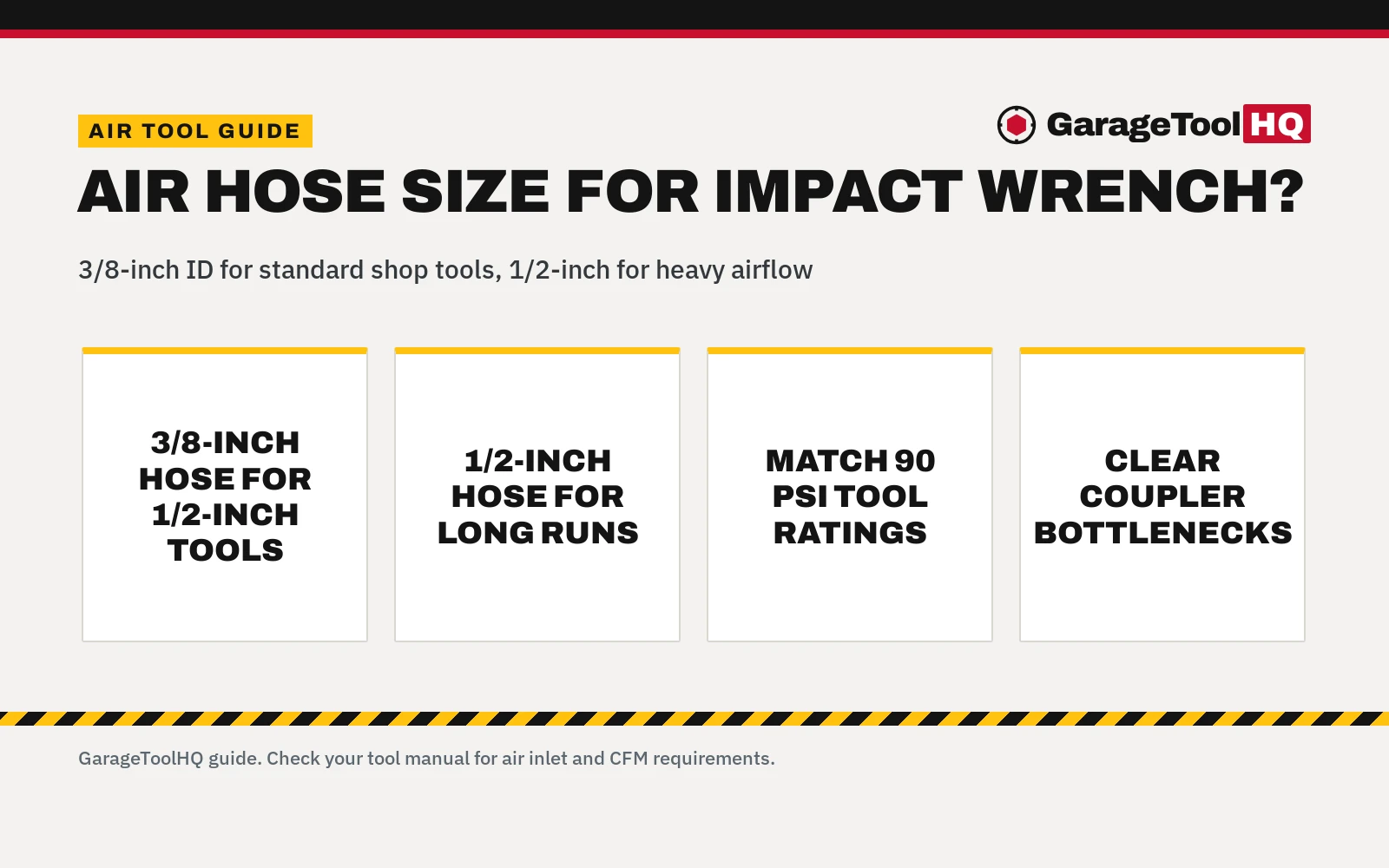
What size air hose for impact wrench work in a home garage? For a standard 1/2-inch pneumatic impact wrench, a 3/8-inch internal diameter air hose is the standard recommendation, while high-demand pneumatic tools benefit from a 1/2-inch hose. Most common 1/2-inch shop impact wrenches use a 1/4-inch NPT air inlet and operate at 90 to 120 PSI. A 3/8-inch hose provides the airflow required for typical automotive repair without unnecessary bulk, whereas undersized lines restrict air delivery and reduce tool power.
More options to compare
 Flexzilla Air Compressor HoseCheck price on Amazon
 YOTOO Hybrid Air Hose 3/8-Inch by 50-Feet 300 PSI Heavy DutyCheck price on Amazon
 Amazon Basics Retractable Air Hose ReelCheck price on Amazon
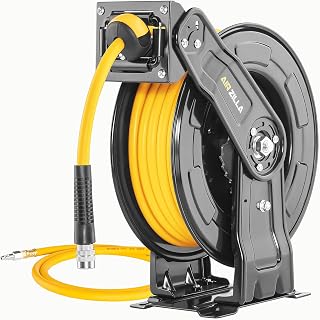 AIRZILLA Premium Steel Retractable Air Hose Reel With Dual ArmCheck price on Amazon
 AIRZILLA Retractable Air hose reel 3/8" Inch x 50 ft FlexCheck price on Amazon
 GLAHODEN Double Arm Air Hose Reel 50 ft RetractableCheck price on Amazon
GarageToolHQ earns a commission when you buy through links on our product pages, at no extra cost to you. Read our affiliate disclosure.
Below: how hose diameter impacts torque output, comparing 3/8 vs 1/2 air hose options, and how to eliminate airflow bottlenecks between your compressor and tool.
What size air hose for impact wrench performance: why diameter matters
Pneumatic impact wrenches consume a substantial burst of air whenever the hammer mechanism strikes. When an air hose is too narrow, friction along the inner walls starves the air motor, causing operating pressure to plunge below the rated level. Sizing your air line properly addresses several airflow factors:
- Friction loss and pressure drop. Compressed air traveling through a hose creates friction against the interior surface. Narrow hose lines create high resistance, causing air pressure at the tool inlet to fall significantly while the trigger is depressed.
- Dynamic pressure vs static pressure. An air compressor gauge shows high static pressure when the line is closed, but dynamic pressure dictates tool performance. If air cannot pass quickly through the hose, the tool motor starves for volume during heavy hammering.
- Impact mechanism demand. Twin-hammer mechanisms require sudden, high-volume air delivery to spin the rotor and strike the anvil with full force. Insufficient air volume slows rotor speed and diminishes nut-busting torque.
- Hose run distance. Friction loss accumulates as hose distance increases. A short hose run minimizes airflow restriction, whereas extending a narrow hose across a garage causes severe pressure drop before air reaches the impact gun.
Air hose sizes and their matching impact wrench classes
| Hose Internal Diameter | Recommended Tool Drive | Application and Airflow |
|---|---|---|
| 1/4-inch ID | 3/8-inch drive ratchets and light tools | Restricted airflow; suitable for small fasteners but chokes standard 1/2-inch impact wrenches |
| 3/8-inch ID | 3/8-inch and 1/2-inch impact wrenches | Standard shop setups; recommended for automotive maintenance and general fastener removal |
| 1/2-inch ID | 1/2-inch high-torque impact wrenches | High-demand shop work, longer hose runs, and heavy fastener removal requiring maximum airflow |
| 1/2-inch ID or larger | 1-inch drive heavy impact wrenches | Heavy commercial equipment rated up to 3550 ft-lbs |
Manufacturer listings confirm these sizing relationships. For example, AEROPRO specifies a 3/8-inch internal diameter air hose and a 1/4-inch air inlet for its 1/2-inch air impact wrench rated at 1200 ft-lbs of loosening torque and 7500 RPM at 90 PSI. Similarly, NEIKO specifies a 3/8-inch ID hose for its 3/8-inch butterfly impact wrench rated at 4 CFM and 75 ft-lbs of torque under 90 to 120 PSI. For heavy industrial equipment, Trivd Frol lists a 1-inch drive pneumatic gun producing 3550 ft-lbs of torque at 5000 RPM, which requires significantly larger air volume than a standard home garage line provides.
How to size and set up an air hose for an impact wrench: the checklist
- Check the tool manual specifications. Identify the recommended hose internal diameter and inlet size. Tools like the AEROPRO 1/2-inch impact wrench explicitly call for a 3/8-inch ID hose with a 1/4-inch inlet.
- Verify operating air pressure. Manufacturer listings from ACDelco and AEROPRO rate their tools at 90 PSI operating pressure at the tool inlet, while listings like BESWELL and NEIKO specify 90 to 120 PSI. Because air pressure drops through the hose when the trigger is pulled, set your compressor regulator high enough so dynamic pressure at the tool inlet meets the tool’s operating rating under load.
- Select 3/8-inch hose for general shop work. For garage tasks within standard reach, a 3/8-inch inner diameter hose delivers sufficient volume for 1/2-inch impact wrenches without excessive weight or stiffness.
- Step up to 1/2-inch hose for long hose runs. When running airline across a large garage or out to a driveway, air friction inside the line multiplies. Stepping up to a 1/2-inch hose prevents noticeable torque loss over distance.
- Inspect fitting and coupler sizes. Standard industrial quick-connect couplers can create severe flow restrictions. Using high-flow fittings allows air to pass freely into the 1/4-inch NPT tool inlet.
- Keep hose runs as direct as possible. Avoid chaining multiple hoses together or using unnecessary coils, which increase internal turbulence and drop operating pressure.
- Maintain clean, dry compressed air. Moisture accelerates motor wear inside pneumatic cylinders. Place moisture filters upstream from your hose and drain compressor tank condensation regularly.
- Lubricate pneumatic tools properly. Add air tool oil directly into the air inlet before each use unless an inline lubricator is installed. Regular oiling protects twin hammer mechanisms and rotor vanes from friction.
- Inspect hose condition before pressurizing. Check for cracks, bulges, abrasions, or leaking crimped ends. Depressurize the air line completely before disconnecting fittings or swapping tools.
Always verify the internal diameter (ID) printed along the hose jacket. An air hose sold by outer diameter (OD) may have thick rubber or PVC walls with a much narrower internal bore, severely choking air delivery to your impact wrench.
Wear eye protection with every air tool, use impact-rated sockets on impact wrenches, disconnect the air line before changing accessories, and finish lug nuts with a torque wrench to the vehicle's spec. See OSHA eye and face protection. Read our Safety Disclaimer.
3/8 vs 1/2 air hose: which should you choose?
When outfitting a home garage workshop, deciding between 3/8-inch and 1/2-inch air hose comes down to balancing airflow volume against daily usability:
- Airflow volume: A 1/2-inch hose features a larger internal cross-sectional area than a 3/8-inch hose, allowing significantly greater air volume to reach the impact wrench during heavy burst use.
- Pressure drop over distance: Over longer hose runs, a 3/8-inch hose experiences noticeable pressure drop when paired with hungry impact wrenches. A 1/2-inch hose minimizes pressure drop, preserving nut-busting power at the tool.
- Weight and flexibility: A 3/8-inch hose is lighter, more flexible, and easier to drag around a vehicle or store on a reel. A 1/2-inch rubber hose is heavier and stiffer, which can increase wrist strain during extended mechanical work.
- Tool handling and fit: A 3/8-inch hose offers nimble maneuverability around wheel wells and engine bays. A 1/2-inch hose is bulkier and places more drag on the tool, making it better suited for stationary drop lines or severe-duty jobs.
To ensure your compressor can deliver the required airflow to your air line, check our guide on what CFM at 90 PSI means and our overview on what size air compressor do I need for air tools. If you are selecting a dedicated machine for tire and suspension work, compare models in our guide to the best air compressor for impact wrench setups.
Couplers, fittings, and whips: eliminating airflow bottlenecks
Even when using a 3/8-inch or 1/2-inch hose, quick-disconnect couplers and fittings can severely restrict air delivery. Standard 1/4-inch industrial couplers have an internal passage smaller than the hose bore, acting as an airflow bottleneck right at the tool inlet. Switching to high-flow couplers provides a wider internal opening, ensuring that the air volume from your hose enters the tool without premature pressure drop.
High-torque 1/2-inch impact wrenches, such as the BESWELL BW-112BN rated at 1180 ft-lbs or the Trivd Frol 1/2-inch gun rated at 1500 ft-lbs, generate substantial vibration while delivering repeated hammer blows. Attaching a short whip hose between the impact wrench and the quick disconnect helps absorb vibrations, preventing premature coupler wear and keeping connections airtight.
Proper lubrication is equally vital to maintain smooth operation. Follow our shop guide on how to oil air tools to keep the air motor spinning freely, and check how to use air impact wrench tools safely on automotive fasteners.
Frequently Asked Questions
Can I use a 1/4-inch air hose with a 1/2-inch impact wrench?
A 1/4-inch air hose will physically connect if fitted with a 1/4-inch adapter, but it severely restricts airflow. The narrow internal diameter causes substantial pressure drop when the tool is fired, preventing the impact wrench from reaching its advertised torque rating. For 1/2-inch impact wrenches, use at least a 3/8-inch inner diameter hose.
What size air hose do I need for a 3/8-inch impact wrench?
A 3/8-inch internal diameter air hose is ideal for a 3/8-inch impact wrench. As seen on the NEIKO 3/8-inch butterfly impact wrench listing, manufacturers specifically call for a 3/8-inch ID hose paired with a 1/4-inch NPT air inlet to deliver its rated 4 CFM and 75 ft-lbs of torque.
Does hose length affect impact wrench power?
Yes. Air experiences friction as it travels through any hose, leading to pressure drop over distance. A shorter hose run preserves maximum pressure at the tool. When longer hose reach is required in a garage or driveway, stepping up from a 3/8-inch hose to a 1/2-inch hose minimizes pressure drop and maintains bolt-busting torque.
What air pressure should I run through my air hose?
Check your tool manual for its rated operating pressure. Many automotive impact wrenches, including models from AEROPRO, ACDelco, and Trivd Frol, specify 90 PSI at the tool inlet, while listings like NEIKO and BESWELL specify 90 to 120 PSI. To account for friction loss along the hose, adjust your compressor regulator so pressure at the tool remains at the recommended operating level while the tool is running.
Do high-flow couplers make a difference for impact wrenches?
Yes. Standard 1/4-inch couplers have narrow internal passages that restrict airflow even when attached to a 3/8-inch or 1/2-inch hose. High-flow fittings provide a larger internal orifice, reducing flow resistance and ensuring that high-demand pneumatic tools receive adequate air volume.
Should I use a whip hose on an air impact wrench?
A short whip hose connected directly to the impact wrench helps isolate the quick-disconnect coupler from the intense vibrations produced by the hammer mechanism. This reduces wear on air fittings, minimizes air leaks, and makes maneuvering the impact wrench easier in tight workspaces.
Related: our guide to the best air impact wrench options, air compressors for impact wrenches, our air tools hub and plumbing compressed air lines in a garage. Also see torque needed to remove lug nuts.