Single Stage vs Two Stage Air Compressor: Differences Explained
Single-stage and two-stage air compressors compared for a home garage: how compression stages work, pressure and airflow differences, power needs, continuous tool duty, and three example listings.

On this page
Top picks at a glance
As an Amazon Associate we earn from qualifying purchases.
- 1
 Ingersoll Rand P1.5IU-A9 2 HP Single-Stage Air Compressor9.7/10View on Amazon
- 2
 Campbell Hausfeld 80-Gallon Vertical Electric Air Compressor9.7/10View on Amazon
- 3
 DEWALT 27-Gallon Vertical Portable Air Compressor9.5/10View on Amazon
- 4
 Ingersoll Rand SS3L3 Single Stage Air CompressorView on Amazon
- 5
 Ingersoll Rand 2340L5-V 5 HP Type 30 Two-Stage Air CompressorView on Amazon
- 6
 Ingersoll Rand 2475N7.5 7.5 HP Two-Stage Air CompressorView on Amazon
Verdict: Choose a single stage compressor if you need an affordable setup for intermittent garage jobs like tire inflation, nailing, and woodworking where tools run at standard pressures around 90 PSI. Choose a two stage air compressor if you run demanding air tools like grinders, sanders, and paint sprayers that need continuous airflow and higher tank pressures up to 175 PSI to maintain sustained volume, and your shop can support a 240V stationary installation.
When deciding between a single stage vs two stage air compressor for a home garage, the primary difference lies in how many times the air is compressed before entering the storage tank. A single stage unit compresses air once per stroke up to moderate pressures, making it suitable for intermittent jobs. A two stage air compressor compresses air in two steps with cooling between cylinders, delivering tank pressures up to 175 PSI to support demanding continuous tools. This comparison covers both designs, followed by the example listings reviewed.
GarageToolHQ earns a commission when you buy through links on this page, at no extra cost to you. Read our affiliate disclosure.
| # | Product | Shop Score | Buy |
|---|---|---|---|
| 1 | Campbell Hausfeld 80-Gallon Vertical Electric Air | 9.7/10 | Buy on Amazon |
| 2 |  VEVOR Air Compressor Pump Head | 9.3/10 | Buy on Amazon |
| 3 |  VEVOR Air Compressor Pump, 3HP 11 CFM | 9.3/10 | Buy on Amazon |

Campbell Hausfeld 80-Gallon Vertical Electric Air
A 5 HP, 80-gallon two-stage stationary air compressor delivering 11.9 SCFM at 90 PSI and up to 175 PSI on 230V power.
Pros
- 11.9 SCFM at 90 PSI and 11.3 SCFM at 175 PSI for demanding shop tools
- Two-stage cast-iron pump rated for up to 10,000 hours of life
- 80-gallon vertical ASME receiver stores ample air while saving floor space
- 3 Year Limited Warranty stated by the manufacturer
Cons
- 326 pounds and stationary design require permanent shop floor placement
- Requires a dedicated 230V, 22A single-phase electrical supply
- Spec table lists 0.2 hp maximum power, contradicting the 5 HP motor listing
- Noise rating of 84 db requires hearing protection during operation

VEVOR Air Compressor Pump Head
A single-stage twin-cylinder aluminum compressor pump head rated for 5.8 CFM at 90 PSI and 116 PSI max pressure.
Pros
- Clearly states air delivery of 5.8 CFM at 90 PSI
- Twin-cylinder aluminum pump head with heat dissipation fins
- Oil observation mirror makes checking the lubricant level straightforward
- Lightweight 21.6 pounds design for replacement or custom builds
Cons
- Pump head only; motor, tank, and pressure switch are not included
- Listing contradicts itself by listing corded electric power despite motor not included
- No warranty term is stated in the listing
- No safety certifications are stated

VEVOR Air Compressor Pump, 3HP 11 CFM
A single-stage twin-cylinder replacement pump head rated for 11 CFM maximum delivery at up to 116 PSI.
Pros
- Cast iron crankcase paired with aluminum head and valve plate
- 1300 RPM operating speed with belt-driven pulley design
- Twin-cylinder single-stage compression reaching 116 PSI maximum pressure
- Stated maximum air delivery of 11 CFM
Cons
- Does not state the delivery pressure for the 11 CFM rating
- Spec table contradicts title with 12 cfm airflow and 3 hundredths pound capacity
- No warranty term is stated in the listing
- No safety certifications are stated
More options to compare
 Ingersoll Rand SS3L3 Single Stage Air CompressorCheck price on Amazon
 Ingersoll Rand 2340L5-V 5 HP Type 30 Two-Stage Air CompressorCheck price on Amazon
 Ingersoll Rand 2475N7.5 7.5 HP Two-Stage Air CompressorCheck price on Amazon
Side by side
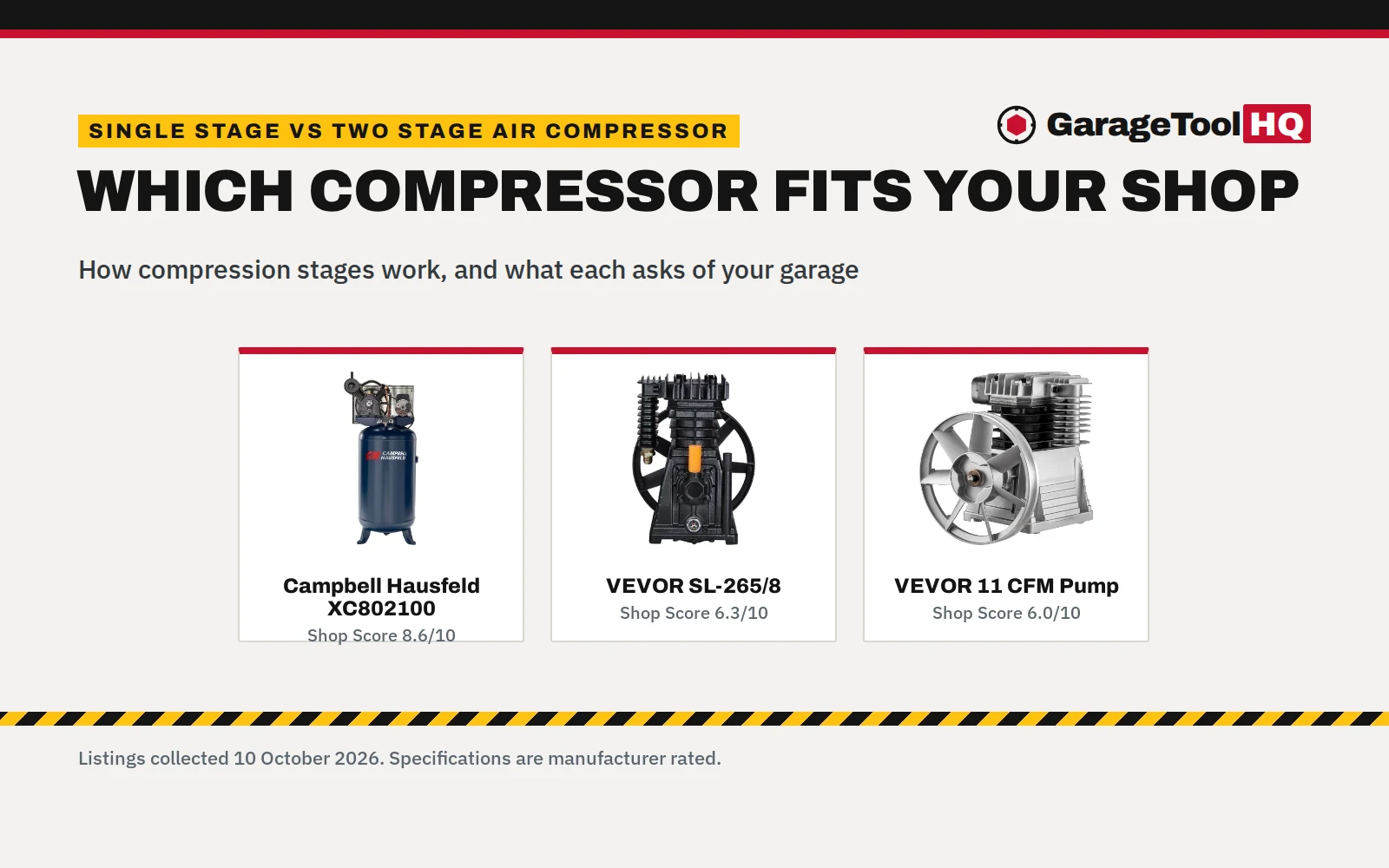
| Campbell Hausfeld XC802100 | VEVOR SL-265/8 | VEVOR 11 CFM Pump | |
|---|---|---|---|
| Stage type | Two-stage | Single-stage | Single-stage |
| Air delivery | 11.9 SCFM @ 90 PSI, 11.3 SCFM @ 175 PSI | 5.8 CFM @ 90 PSI (164 L/min) | 11 CFM max (text), 12 cfm (table), pressure not stated |
| Maximum pressure | 175 PSI | 116 PSI | 116 PSI |
| Motor and power | 5 HP induction motor, 230V, 22A | Motor not included (spec table states 3 hp corded) | 3 hp motor listed, 240 volts, 1300 RPM |
| Tank capacity | 80 gallons vertical ASME receiver | Tankless pump head | Tankless pump head |
| Pump construction | Cast-iron 2-stage pump | Aluminum twin cylinder with cooling fins | Cast iron crankcase, aluminum head and valve plate |
| Weight | 326 pounds | 21.6 pounds | 30.6 pounds |
| Sound level | 84 db | 90 db | 90 db |
| Warranty | 3 Year Limited Warranty | Not stated | Not stated |
Example figures are manufacturer rated, as published on each listing and collected 9 October 2026.
Single stage vs two stage air compressor: how each works
In a single stage compressor, ambient air enters the cylinder through an intake valve and is compressed to its final tank pressure in a single piston stroke. Twin-cylinder single stage models use both cylinders to pull in ambient air and compress it simultaneously into the outlet. In contrast, a two stage air compressor uses two distinct compression steps. A larger low-pressure cylinder compresses ambient air first, then forces it through an intercooler tube to a smaller high-pressure cylinder. The second piston compresses the cooled air a second time to reach higher final pressures, such as the 175 PSI produced by the Campbell Hausfeld XC802100 example.
Air pressure and CFM delivery
Pressure and airflow define what air tools a compressor can run. The single-stage pump head listings reviewed reach a maximum pressure of 116 PSI, with the VEVOR SL-265/8 specifying 5.8 CFM at 90 PSI. In comparison, the two-stage Campbell Hausfeld example reaches a maximum pressure of 175 PSI, delivering 11.9 SCFM at 90 PSI and 11.3 SCFM at 175 PSI. Higher tank pressure allows a given tank volume to store more air mass, keeping tools running longer before the pump restarts. For guidance on sizing your air volume, read our guide on how to choose an air compressor and check what CFM at 90 PSI means.
Duty cycle and heat management
Compressing air generates substantial heat. Because a single-stage pump accomplishes all compression in one stroke, heat builds quickly in the cylinder head and valve plate. This makes single-stage units generally best suited for intermittent duty cycles where the pump can cool between bursts of tool use, particularly in compact or aluminum designs. A two-stage compressor reduces heat buildup by passing air through an intercooler between cylinders. Lower operating temperatures extend pump life, allowing the Campbell Hausfeld two-stage pump to carry a maker rating of up to 10,000 hours of pump life based on a B-10 bearing rating. To keep either pump running reliably, follow standard air compressor maintenance.
Electrical and installation requirements
Power requirements vary across equipment types. The stationary two-stage Campbell Hausfeld compressor features a 5 HP induction motor drawing 22A on 230V power (noted as 240V in the title). Dedicated 240V circuits are standard for large shop equipment: use a licensed electrician to size and install the breaker and wiring rather than attempting DIY steps. Standalone pump heads require careful setup: the VEVOR SL-265/8 explicitly notes that the motor is not included, requiring the buyer to supply and align a motor, belt, and pulley, while the VEVOR 11 CFM listing claims a 3 hp motor in its text despite listing only the bare pump head in its included components. The stationary Campbell Hausfeld weighs 326 pounds and requires permanent placement on a solid concrete floor, whereas bare pump heads weigh 21.6 to 30.6 pounds and mount onto custom frames or existing compressor tanks.
Tank capacity and air storage
Storage capacity determines how much compressed air is immediately available before the motor kicks on. The Campbell Hausfeld two-stage unit includes an 80-gallon vertical ASME receiver, offering a substantial air cushion for high-consumption air tools. In contrast, the single-stage VEVOR listings reviewed are bare replacement pump heads that omit the receiver tank entirely. If you are assembling a custom system around a pump head, pair it with an appropriately rated ASME tank to maintain safe pressure containment.
Choose a single stage compressor if
- You use air tools intermittently for nailing, inflation, or woodworking
- Your air tools operate at standard pressures around 90 PSI with moderate airflow demand
- You need a lighter, compact setup or a replacement pump head
- You want simpler mechanical maintenance
Choose a two stage air compressor if
- You run continuous air tools like sanders, grinders, or paint sprayers
- You need high tank pressure up to 175 PSI to store more air and sustain high-CFM continuous tools
- Your garage has a dedicated 240V circuit installed by a licensed electrician
- You have dedicated floor space for a heavy stationary upright tank
Example compressors
For more options across tank sizes and airflow ratings, see our guide to the best air compressor for home garage and the what is a two stage air compressor overview.
Drain the tank after use so water does not rust it from the inside, never exceed the tool's rated pressure, wear eye protection, and run 240V units on the circuit the manual calls for. Do not run a gas engine compressor in a closed garage. Read our Safety Disclaimer.
Frequently Asked Questions
What is the main difference between a single stage and a two stage air compressor?
A single stage compressor compresses air to its final pressure in one stroke per cycle. A two stage air compressor compresses air partially in a low-pressure cylinder, cools it through an intercooler tube, and then compresses it to higher pressure in a high-pressure cylinder.
Can a single stage compressor run continuous air tools?
A single stage compressor can run continuous tools like sanders or grinders if its CFM output meets the tool’s rating, but it generates higher operating temperatures because compression occurs in a single stage without intercooling. For prolonged continuous duty, a two-stage compressor runs cooler and handles high-demand workloads more efficiently.
Do two stage air compressors require 240V power?
Most stationary two stage compressors designed for garage or shop use require a dedicated 230V or 240V electrical connection. The Campbell Hausfeld example reviewed uses a 5 HP induction motor drawing 22A, which requires a dedicated high-voltage circuit rather than a standard household outlet. Use a licensed electrician to handle the circuit sizing and hookup.
What PSI does a two stage compressor reach compared to single stage?
In the listings reviewed, the two-stage Campbell Hausfeld reaches up to 175 PSI, while the single-stage VEVOR pump heads reach a maximum of 116 PSI. Two-stage compression generally allows higher maximum tank pressures because dividing compression across two cylinders reduces heat and mechanical strain per stage.
Is a two stage compressor quieter than a single stage model?
In the listings reviewed, the Campbell Hausfeld two-stage compressor lists an 84 db noise rating, whereas the VEVOR single-stage pump heads list a 90 db noise rating. Operating noise depends on pump speed, materials, and motor design.
Related: our guide on how to choose an air compressor, the best air compressor for home garage, the best air compressor for impact wrench, and our air compressor hub.