Battery Charger vs Battery Maintainer: Differences Explained
How battery chargers and battery maintainers differ in charging speed, continuous monitoring, and safe long-term winter storage for vehicles.

On this page
Top picks at a glance
As an Amazon Associate we earn from qualifying purchases.
- 1
 Schumacher Electric 15A Car Battery Charger & Maintainer9.8/10View on Amazon
- 2
 NOCO GENIUS2D 2A 12V Onboard Battery Charger9.8/10View on Amazon
- 3
 Battery Tender Plus 12V 1.25 AMP Car & Motorcycle Battery9.7/10View on Amazon
- 4
 Clore Automotive PL2320 20-Amp Fully-Automatic Smart ChargerView on Amazon
- 5
 Schumacher Electric 6A Car Battery Charger & MaintainerView on Amazon
- 6
 Schumacher Electric 10A Car Battery Charger & 200A EngineView on Amazon
- 7
 CRAFTSMAN 12A Car Battery Charger & MaintainerView on Amazon
- 8
 NEXPEAK NC202 10-Amp Battery ChargerView on Amazon
- 9
 DEWALT DXAEC100 30A Battery ChargerView on Amazon
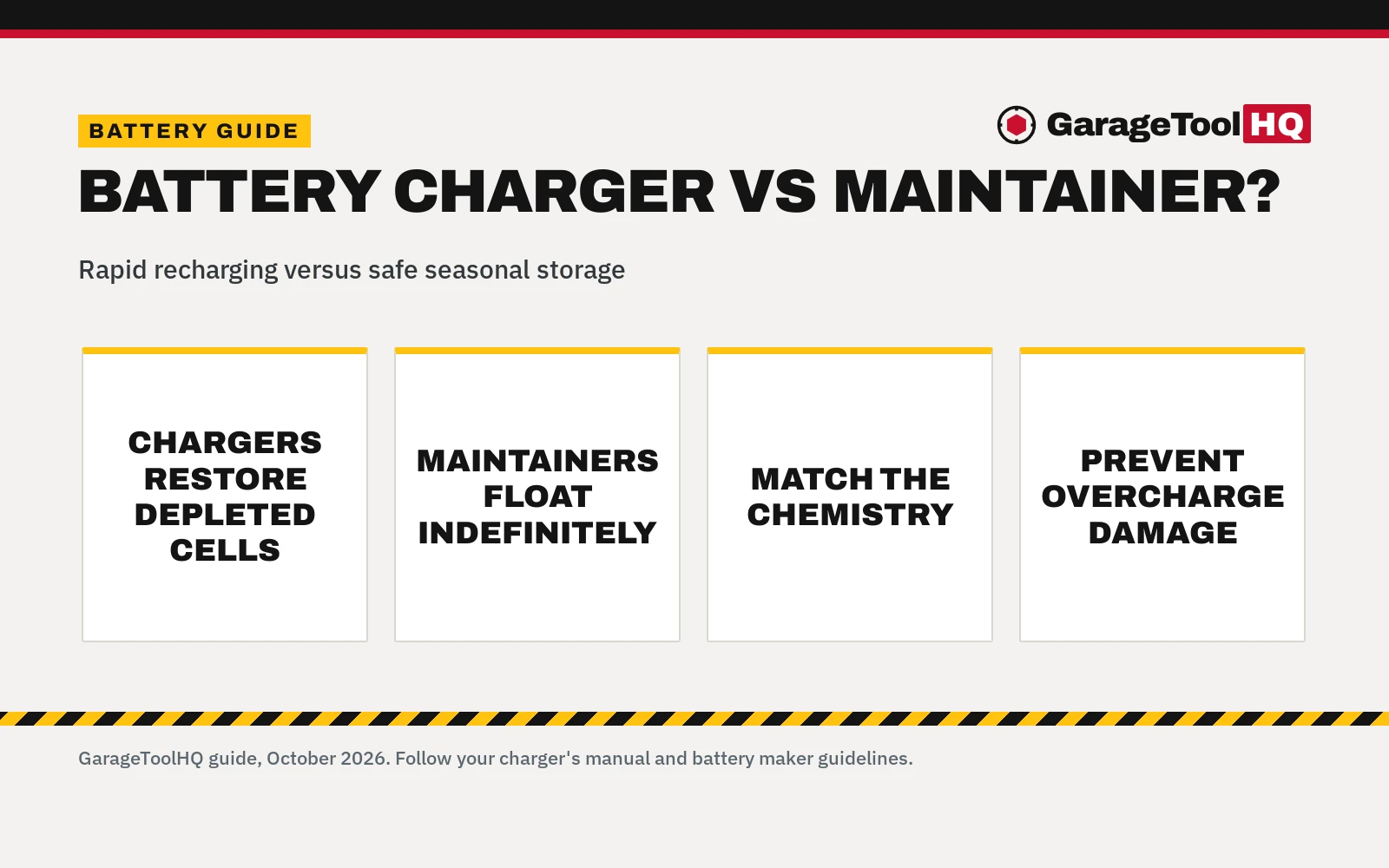
When comparing a battery charger vs battery maintainer, the difference comes down to charging speed versus continuous voltage monitoring. A dedicated battery charger delivers higher current to restore a dead or deeply discharged battery in several hours, but manual models must be disconnected once the battery reaches full charge to avoid damaging internal plates. A battery maintainer delivers low current and automatically shifts to a float mode, allowing it to remain connected during seasonal storage without overcharging. Choosing the right device depends on whether you need rapid recovery for an uncharged vehicle or long-term preservation during storage.
More options to compare
 Clore Automotive PL2320 20-Amp Fully-Automatic Smart ChargerCheck price on Amazon
 Schumacher Electric 6A Car Battery Charger & MaintainerCheck price on Amazon
 Schumacher Electric 10A Car Battery Charger & 200A EngineCheck price on Amazon
 CRAFTSMAN 12A Car Battery Charger & MaintainerCheck price on Amazon
 NEXPEAK NC202 10-Amp Battery ChargerCheck price on Amazon
 DEWALT DXAEC100 30A Battery ChargerCheck price on Amazon
GarageToolHQ earns a commission when you buy through links on our product pages, at no extra cost to you. Read our affiliate disclosure.
Below: how chargers and maintainers operate, how their electrical characteristics differ, a direct comparison table, practical steps for selecting each tool, and safe connection practices for garage storage.
Battery charger vs battery maintainer: how each tool works
Lead-acid automotive batteries naturally discharge over time due to internal chemical activity and the small electrical draw of onboard vehicle electronics. If a battery sits discharged, lead sulfate builds up on the internal plates, reducing capacity and cranking ability. Chargers and maintainers handle this challenge through different electrical approaches:
- Battery chargers. A charger supplies substantial electrical current to drive the reverse chemical reaction inside the battery cells. It quickly refills depleted capacity, making it the right tool when an accidental headlight drain leaves a car dead in the driveway. High-output garage chargers, such as the YDBAO car battery charger, deliver up to 15A for rapid charging of 12V batteries, though its listing notes not to let the unit operate unattended for more than 12 hours. Multi-mode units like the NOCO GENIUS10 provide 10A of charging current and include automatic monitoring that allows safe indefinite connection. With traditional manual chargers that lack automatic regulation, the unit must be disconnected as soon as the battery reaches full charge to avoid plate damage.
- Battery maintainers. A battery maintainer, also called a float charger, is designed for long-term vehicle preservation. It delivers low current, such as the 1A output supplied by the NOCO GENIUS1. Crucially, a maintainer monitors terminal voltage continuously. When the battery reaches its full charge threshold, internal circuitry reduces output to a gentle float charge that offsets natural self-discharge without heating the electrolyte. This allows the unit to remain connected during seasonal storage without risking overcharge damage.
Comparing battery chargers and battery maintainers side by side
| Device Type | Primary Function | Current Output | Long-Term Storage Safe? |
|---|---|---|---|
| Manual Battery Charger | Restoring depleted batteries quickly | Higher current | No; disconnect once charged to prevent overheating and plate damage |
| Battery Maintainer (Float Charger) | Preserving charge during vehicle storage | Low current (for example, 1A on the NOCO GENIUS1) | Yes; monitors terminal voltage and floats safely |
| Multi-Mode Smart Charger / Maintainer | High-current recovery plus automated maintenance | Variable current (for example, 10A on the NOCO GENIUS10 or 15A on the YDBAO unit) | Yes on units rated for continuous float (NOCO states indefinite connection; YDBAO advises not leaving unattended over 12 hours) |
| Traditional Trickle Charger | Slow unmonitored charging | Continuous low current without voltage regulation | No; unmonitored current can boil off electrolyte over time |
As outlined above, the core trade-off is recovery speed versus unattended safety. A high-output manual charger revives a flat battery in hours but requires supervision. A maintainer provides worry-free seasonal storage but lacks the current needed to restore a flat automotive battery quickly. Smart multi-mode units bridge this gap by pairing higher charging rates with automated float shutdown.
How to choose between a charger and a maintainer: garage checklist
- Identify your vehicle usage schedule. Vehicles parked for weeks or months, such as motorcycles, classic cars, and lawn tractors, are best served by an automatic maintainer that counteracts self-discharge. Daily drivers that encounter an occasional flat battery benefit from higher-amperage charging capabilities for faster recovery.
- Evaluate battery discharge depth. Many automatic chargers and maintainers require some residual terminal voltage before standard automatic charging begins. For instance, the NOCO GENIUS1 listing specifies standard detection down to 1 volt, but also provides a manual force mode to deliver charge down to zero volts for severely depleted batteries. If dealing with a completely flat battery, confirm whether your unit requires residual voltage or features a manual recovery mode.
- Match battery chemistry. Flooded wet cells, absorbent glass mat (AGM), gel, and lithium iron phosphate (LiFePO4) chemistries require specific charging profiles. Both the NOCO GENIUS1 and YDBAO listings confirm compatibility with lead-acid and lithium batteries. Always match your device mode to your battery chemistry.
- Confirm automatic float shutoff. Never rely on unmonitored equipment for seasonal storage. Verify that the unit specifies an automatic float or maintenance mode that cuts current flow once the battery reaches full charge.
- Check cable length and connectors. Consider your garage layout. The NOCO GENIUS1 features a 110-inch DC cable with clamps and eyelets, while the NOCO GENIUS10 includes a 72-inch AC cord and an 80-inch DC cable. Eyelet harnesses allow quick hookup without removing vehicle bodywork.
- Look for core safety protections. Prioritize reverse polarity protection, spark-proof connections, and thermal compensation. The YDBAO listing specifies an 8-layer protection system, and both NOCO and YDBAO listings cite UL and FCC safety compliance.
Traditional manual trickle chargers push continuous low current without monitoring battery voltage. Left connected over weeks or months, continuous current can boil off electrolyte in flooded batteries and degrade plates. An automatic maintainer monitors voltage constantly and shifts to an idle float stage once the battery is full.
Lead-acid batteries can release hydrogen while charging, so charge in a ventilated space away from sparks and flames, connect positive first and negative last, set the charger to the battery type (flooded, AGM, gel, lithium), and wear eye protection. Read our Safety Disclaimer.
Charger or tender: terminology and multi-mode smart units
Garage owners frequently ask about choosing a charger or tender. In automotive terminology, “battery tender” originated as a brand name that became a common term for any automatic maintainer. When someone recommends a tender for winter storage, they mean an automatic float maintainer.
Many modern smart chargers combine both capabilities in a single unit. These multi-mode devices deliver high amperage during initial bulk charging, then automatically shift into float maintenance once full capacity is reached. For multi-vehicle households, a multi-mode unit provides the flexibility to recharge a dead commuter vehicle or maintain a stored vehicle. You can compare top models in our guide to the best battery charger maintainer picks.
Keep in mind that chargers and maintainers both require hours of wall-outlet power. If you need immediate starting capability during a roadside emergency, consider a portable jump pack instead. Learn more in our comparison of jump starter vs battery charger equipment, or check expected charging durations in our guide on how long it takes to charge a car battery with a charger.
Battery safety and parasitic draw diagnostics
Lead-acid batteries emit flammable hydrogen gas during active charging. Always maintain garage ventilation, keep chargers away from open flames, and connect clamps to battery terminals before plugging the charger into an AC wall outlet to prevent sparks near venting caps.
If a vehicle battery continuously goes dead despite regular driving or maintenance charging, an active parasitic electrical drain may be responsible. Malfunctioning electronic modules can fail to enter sleep mode, pulling current while the car is parked. Learning how to choose an OBD2 scanner allows DIY owners to scan onboard modules for communication faults and diagnostic trouble codes that point to electrical draw issues before replacing a sound battery.
Frequently Asked Questions
Can a battery maintainer recharge a completely dead battery?
A standard low-current maintainer is designed for preservation, not rapid recovery. While a 1A unit like the NOCO GENIUS1 includes a force mode to deliver current down to zero volts, recharging a large automotive battery from zero at 1A can take several days. When rapid recovery of a depleted vehicle battery is required, a higher-current charger (such as 10A on the NOCO GENIUS10 or 15A on the YDBAO unit) restores capacity much more quickly.
Can a battery charger be left connected continuously?
Manual chargers must never be left connected unattended because continuous current flow boils electrolyte and damages battery plates. Smart units with automatic float regulation can maintain a battery during storage, though you should always follow the maker’s instructions: the NOCO GENIUS10 listing permits indefinite connection, while the YDBAO listing advises not leaving the unit unattended for more than 12 hours.
What is the difference between a charger and a tender?
A charger supplies higher current to replenish a depleted battery over several hours. A tender (maintainer) supplies low current and monitors voltage to keep a fully charged battery topped off during long-term storage.
Can you leave a battery maintainer connected all winter?
Yes, provided it is an automatic unit with float capability that monitors terminal voltage. Learn more in our guide on whether you can leave a battery maintainer on all winter.
How does cold weather affect automotive batteries?
Cold temperatures slow internal chemical reactions, reducing available cranking power while thick motor oil increases starter demand. Read our guide on why car batteries die in cold weather for winter care details.
Can you maintain a motorcycle battery with a car maintainer?
Yes, if the maintainer supplies low current suitable for smaller batteries. A 1A unit like the NOCO GENIUS1 works safely on both motorcycles and passenger cars. For bike-specific options, see our guide to the best battery maintainers for motorcycles.
Related: leaving a battery maintainer on all winter, the best battery charger maintainers, our diagnostics and electrical hub, and jump starter vs battery charger. Also see our guide on how long it takes to charge a car battery with a charger.