Bench Grinder Safety Gauge: What It Does
A bench grinder safety gauge checks the gaps between the wheel, the tongue and the work rest, so you can catch a worn wheel or a moved rest before it leaves an opening that can catch a workpiece.

On this page
After a wheel change, the bench grinder looks ready, but the gaps around the wheel still need checking before you switch it on. A bench grinder safety gauge is a small flat gauge that checks the opening between the grinding wheel and the tongue, and the opening between the wheel and the work rest. If either gap has grown too wide, a workpiece can catch in it, so the gauge gives a quick pass or fail check before the first grind of the day.
As an Amazon Associate I earn from qualifying purchases. GarageToolHQ earns a commission when you buy through links on our product pages, at no extra cost to you. Read our affiliate disclosure.
Below: what the gauge checks, how to use it step by step, what the gauges on the market list, and when to check the gaps again.
Bench Grinder Safety Gauge: What It Checks
A bench grinder safety gauge checks the openings the safety standards set for bench grinders. The SCOTTCHEN gauge lists the openings to check: the gap between the grinding wheel and the tongue, at 1/4 inch, and the gap between the wheel and the work rest, at 1/8 inch. As a wheel wears down, both gaps grow, so a gap that passed yesterday can fail today. The gauge itself is a flat piece of metal or laminate with stepped edges sized to those openings: if the step slides into a gap, the gap is too wide.
The KFMK gauge covers bench grinder tongue and tool rest openings and adds belt sander work rest openings for 1×30 inch and 4×36 inch belt sanders, and the maker lists compatibility with ANSI standards UL987 and UL62841. The MAKESAFE gauge is made from glass-reinforced epoxy laminate. A gauge does not fix a gap: it only shows whether the gap is within the opening the standards allow, and the grinder needs adjusting when the gauge says the gap is too wide.
How to Use a Bench Grinder Safety Gauge
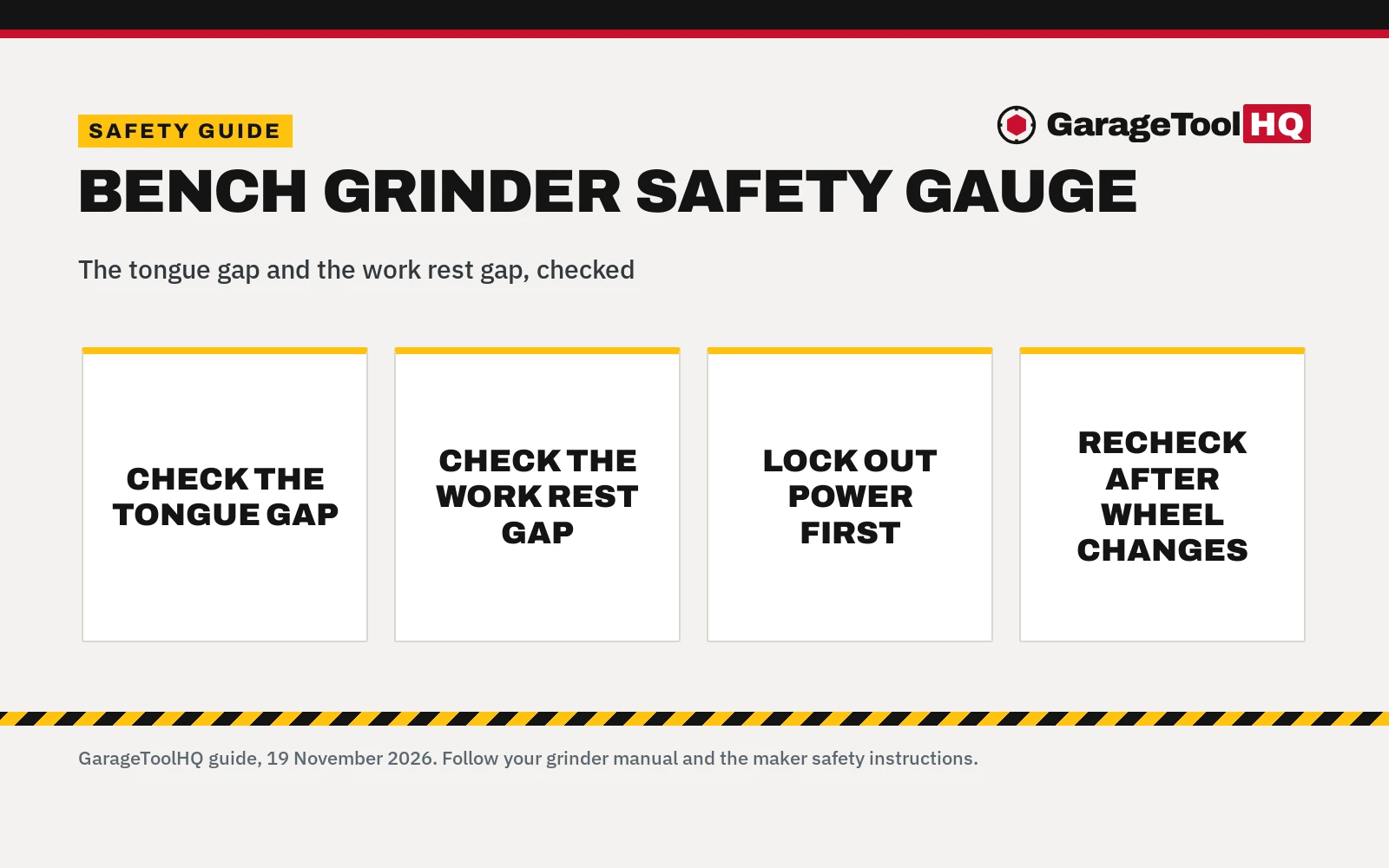
- Lock out power and let the wheels stop. The SCOTTCHEN gauge warns to lock out power and make sure the grinding wheels are at rest before using the gauge. Unplug the grinder or lock the switch off, then wait until both wheels have fully stopped.
- Check the tongue gap. Hold the gauge against the wheel at the tongue, the curved guard plate above the work rest. The gauge should not slide into the opening past its marked step. If it does, the tongue needs moving closer to the wheel.
- Check the work rest gap. Hold the gauge between the wheel and the work rest, the flat shelf the workpiece sits on. Again, the gauge should not pass into the opening. If it does, move the rest closer to the wheel.
- Adjust and recheck. Loosen the tongue or the work rest, move it toward the wheel, tighten it, and check again with the gauge. Check both gaps every time the wheel is changed or dressed, and after any knock to the grinder.
- Store the gauge where it will not get lost. The SCOTTCHEN gauge has an anti-lost magnet that holds it on the bench grinder when it is not in use, and the KFMK pack comes with a storage case.
Never check a gap with the grinder running. Lock out power, wait for the wheels to stop completely, and keep hands clear of the wheel while the gauge is in place.
Read the manual before first use, wear eye protection, keep the work area clear and ventilated, and stay within every stated rating. Read our Safety Disclaimer.
What the Gauges on the Market List
Three gauges show what is on offer. The SCOTTCHEN gauge is stainless steel, measures 1.8 by 2.2 inches, weighs 54 grams, and comes as a 1-pack with a storage case or a 2-pack. The KFMK gauge comes as a pack of 2 with a storage case and covers bench grinder and belt sander openings. The MAKESAFE gauge is made from glass-reinforced epoxy laminate and comes as a single gauge. Size and weight matter when the gauge lives on the grinder: the SCOTTCHEN gauge is small enough to stick to the grinder body on its magnet, while a cased pair suits a shared shop where the gauge moves between benches.
| Gauge | Material | Size | Pack |
|---|---|---|---|
| SCOTTCHEN | Stainless steel | 1.8 by 2.2 inches | 1-pack with case or 2-pack |
| KFMK | Not stated | Not stated | Pack of 2 with case |
| MAKESAFE | Glass-reinforced epoxy laminate | Not stated | 1 gauge |
When to Check the Gaps Again
Gaps grow as the wheel wears, so a single check does not last the life of a wheel. Check both gaps after fitting a new wheel, after dressing the wheel, and after moving the work rest or the tongue for a job. A wheel that has worn smaller leaves a wider gap at the tongue and the rest, which is when a thin workpiece can catch. If the gauge shows a gap is too wide and the tongue or rest cannot move any closer, the wheel is worn out and needs replacing before the next job.
FAQ: garage tools
What gap does a bench grinder safety gauge check?
The SCOTTCHEN gauge lists the opening between the grinding wheel and the tongue at 1/4 inch, and the opening between the wheel and the work rest at 1/8 inch. If the gauge slides into either opening, the gap is too wide and the tongue or rest needs adjusting.
Can a bench grinder safety gauge check a belt sander?
Some can. The KFMK gauge covers belt sander work rest openings for 1×30 inch and 4×36 inch belt sanders as well as bench grinder openings, and it comes as a pack of 2 with a storage case. A gauge made only for bench grinders does not list belt sander openings.
Do I check the gaps with the grinder running?
No. Lock out power and wait until the grinding wheels are fully at rest before using the gauge. The gauge is a hand tool for a stopped wheel, not a running one.
What is a bench grinder safety gauge made of?
It depends on the gauge. The SCOTTCHEN gauge is stainless steel, and the MAKESAFE gauge is glass-reinforced epoxy laminate. Either material works for a shop gauge as long as the stepped edges stay flat and true.
Does a bench grinder safety gauge fit every bench grinder?
The gauge checks standard tongue and work rest openings, so it fits grinders built to those openings. If a grinder has a different guard or rest design, compare the openings the gauge is made for with the grinder manual before buying.
Related: bench grinder safety checks before every job, bench grinder uses and attachments, the best 8 inch bench grinder picks and the engine and shop equipment hub.