Best Floor Jack Under $500: 5 Picks by Capacity and Lift Range
Five hydraulic floor jacks under 500 compared by lifting capacity, minimum saddle height, maximum lift, frame material, weight and warranty terms.

On this page
Top picks at a glance
As an Amazon Associate we earn from qualifying purchases.
- 1
 Best OverallMaxority 3-Ton9.6/10View on Amazon
- 2
 Best Low ProfileTONDA T0701069.6/10View on Amazon
- 3
 Best LightweightTONDA TD0501149.5/10View on Amazon
- 4
 Best Budget 2-TonDNA TOOLS-004749.4/10View on Amazon
- 5
 LARBANKE 3Ton Hydraulic Floor JackView on Amazon
- 6
 VEVOR 3 Ton Low Profile Floor Jack Heavy-Duty RacingView on Amazon
- 7
 SATA 3-TonView on Amazon
- 8
 5 Ton Hydraulic Low Profile Floor JackView on Amazon
- 9
 Pro-Lift Low Profile Floor Jack Color GreyView on Amazon
The best floor jack under 500 gives a home garage the lifting capacity and stability needed for tire rotations, brake jobs, and underbody maintenance without commercial shop equipment prices. This guide compares five hydraulic floor jacks by rated capacity, minimum saddle height, maximum lift, frame material, weight, and safety features.
GarageToolHQ earns a commission when you buy through links on this page, at no extra cost to you. Read our affiliate disclosure.
Quick picks
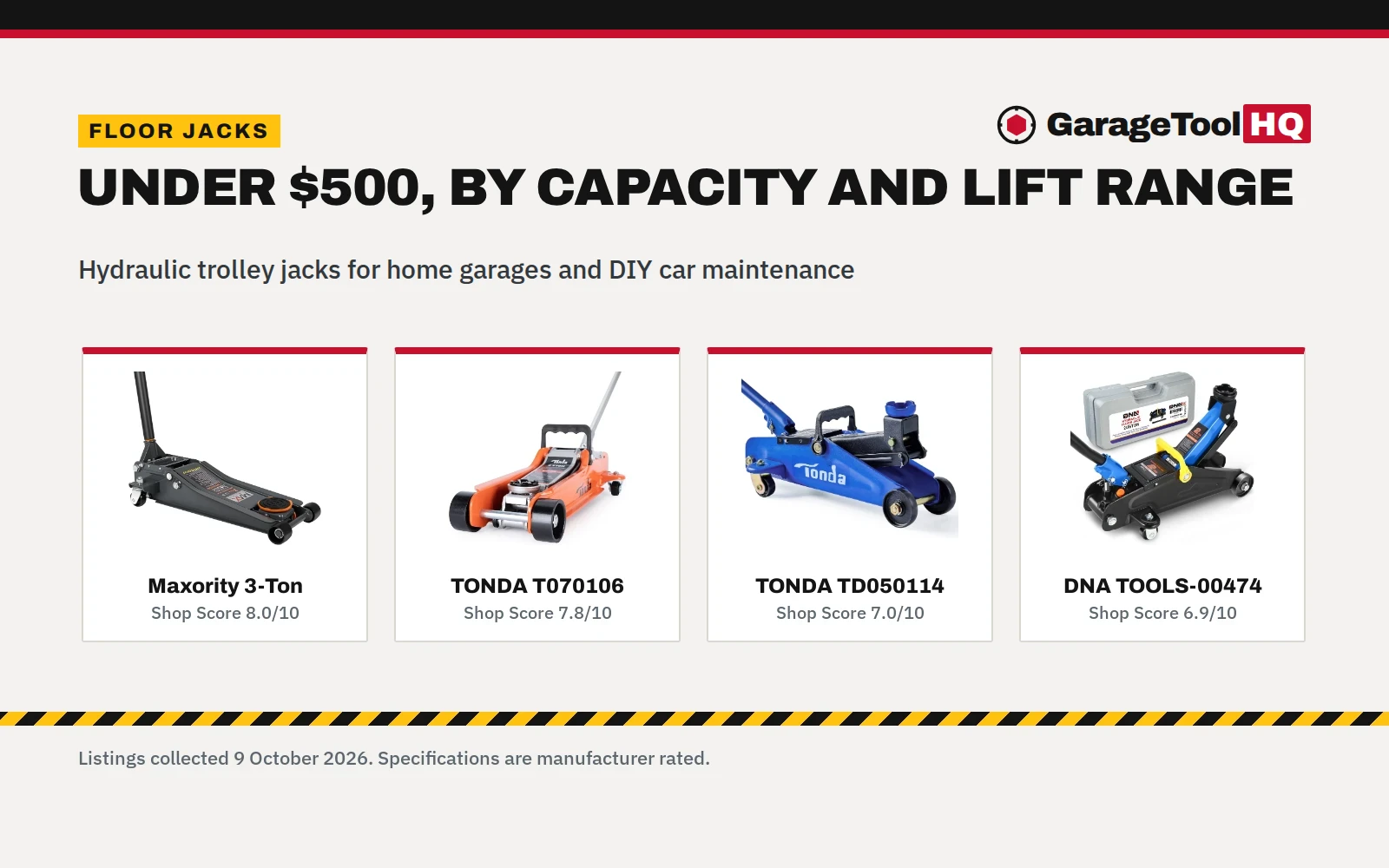
- Best Overall Maxority 3-Ton: 3-ton (6,600 lb) capacity, 19.9-inch maximum lift and dual pistons for fast lifting, backed by a 90-day warranty. Check price on Amazon
- Best Low Profile TONDA T070106: 3.35-inch minimum saddle height fits low-clearance cars, with 2.5-ton (5,000 lb) capacity and a 14.57-inch maximum lift. Check price on Amazon
- Best Lightweight TONDA TD050114: 14.3 pounds with a built-in carrying handle, 3,800 lb capacity and a stated 1-year warranty for portable garage use. Check price on Amazon
- Best Budget 2-Ton DNA TOOLS-00474: 2-ton (4,000 lb) steel trolley jack with 5.1 to 13-inch lift range and 9.66 kg stated weight for basic car maintenance. Check price on Amazon
The picks


Maxority 3-Ton (6600lbs) Low Profile Hydraulic
A 3-ton (6,600 lb) alloy steel floor jack featuring dual pistons for quick lifting and a 19.9-inch maximum lift height.
Pros
- 3-ton (6,600 lb) capacity is the highest in this guide
- 19.9-inch maximum lift height offers the most lift here
- Dual pistons quick lift pump raises the saddle faster
- 90-day warranty stated by the manufacturer
Cons
- Minimum saddle height is not stated on the listing
- Item weight is not stated on the listing
- Ships in random color according to the listing
- No ASME PASE certification stated

TONDA 2.5 Ton Low Profile Floor Jack
A 2.5-ton (5,000 lb) low-profile floor jack with a 3.35-inch minimum height and carbon steel construction.
Pros
- 3.35-inch minimum saddle height slides under low vehicles
- 2.5-ton (5,000 lb) capacity handles cars and many SUVs
- 14.57-inch maximum lift height provides ample working room
- Two large steel wheels and two 360-degree swivel casters
Cons
- No warranty term is stated on the listing
- Title lists 14.57 inches max lift while spec table states 14.75 inches
- 14.24 kg weight requires effort to lift by hand
- No ASME PASE certification stated

TONDA Floor Jack, 3,800 lb Hydraulic Car Jack
A lightweight 14.3-pound hydraulic car jack with a 3,800 lb capacity, 4.9 to 11.8-inch lift range, and built-in carrying handle.
Pros
- 14.3 pounds with an integrated handle for easy carrying
- 1-year warranty stated by the manufacturer
- 4.9-inch minimum height fits under standard passenger cars
- Built-in safety bypass valve protects against overloading
Cons
- 11.8-inch maximum lift is the lowest in this guide
- 3,800 lb capacity falls below the standard 2-ton threshold
- Title states 3,800 lb while spec table claims 2 tons
- No ASME PASE certification stated

DNA Motoring Low Profile Hydraulic Trolley
A 2-ton (4,000 lb) blue alloy steel trolley jack with a 5.1 to 13-inch lift range, overload safety valve, and 9.66 kg weight.
Pros
- 2-ton (4,000 lb) capacity covers most standard passenger cars
- Built-in safety release valve prevents overload damage
- Alloy steel frame with smooth-rolling swivel casters
- Weighs 9.66 kg for manageable positioning around the shop
Cons
- No warranty term is stated on the listing
- 5.1-inch minimum height is tall for a low-profile label
- 13-inch maximum lift limits clearance under taller vehicles
- No ASME PASE certification stated

DNA Motoring TOOLS-00234 Low Profile Hydraulic
A 2-ton (4,000 lb) black alloy steel trolley jack with a 5.1 to 13-inch lift range and built-in overload protection.
Pros
- 2-ton (4,000 lb) lifting capacity for everyday passenger cars
- Dependable safety release valve protects against overloading
- Alloy steel body with rear swivel casters for mobility
- Compact dimensions of 10 x 19 x 8 inches store easily
Cons
- No warranty term is stated on the listing
- Title states 5.1 inches min height while spec table states 13 centimeters
- Item weight is not stated on the listing
- No ASME PASE certification stated
More options to compare
 LARBANKE 3Ton Hydraulic Floor JackCheck price on Amazon
 VEVOR 3 Ton Low Profile Floor Jack Heavy-Duty RacingCheck price on Amazon
 SATA 3-TonCheck price on Amazon
 5 Ton Hydraulic Low Profile Floor JackCheck price on Amazon
 Pro-Lift Low Profile Floor Jack Color GreyCheck price on Amazon
Compare the picks
| Model | Shop Score | Capacity | Min Height | Max Height | Weight | Material | Warranty |
|---|---|---|---|---|---|---|---|
| Maxority 3-Ton | 9.6/10 | 3 ton (6,600 lb) | Not stated | 19.9 in | Not stated | Alloy Steel | 90 days |
| TONDA T070106 | 9.6/10 | 2.5 ton (5,000 lb) | 3.35 in | 14.57 in | 14.24 kg | Carbon Steel | Not stated |
| TONDA TD050114-BLUE | 9.5/10 | 3,800 lb | 4.9 in | 11.8 in | 14.3 lb | Alloy Steel | 1 year |
| DNA Motoring TOOLS-00474 | 9.4/10 | 2 ton (4,000 lb) | 5.1 in | 13 in | 9.66 kg | Alloy Steel | Not stated |
| DNA Motoring TOOLS-00234 | 9.4/10 | 2 ton (4,000 lb) | 5.1 in | 13 in | Not stated | Alloy Steel | Not stated |
Specifications are manufacturer rated, as published on each listing and collected 9 October 2026. “Not stated” means the listing does not give the figure.
How we scored them
Each floor jack is scored out of 10 on performance, build, value, safety and warranty, with the weights published on our How We Pick page. None of the five listings states an ASME PASE safety certification, so every floor jack scores zero on safety, which pulls all scores down.
| Product | Shop Score | Perf. /35 | Build /25 | Value /25 | Safety /10 | Warranty /5 |
|---|---|---|---|---|---|---|
| Maxority 3-Ton | 9.6 | 30 | 20 | 20 | n/a | 1 |
| TONDA T070106 | 9.6 | 28 | 20 | 22 | n/a | 0 |
| TONDA TD050114 | 9.5 | 22 | 19 | 20 | n/a | 2 |
| DNA TOOLS-00474 | 9.4 | 23 | 19 | 20 | n/a | 0 |
| DNA TOOLS-00234 | 9.4 | 23 | 18 | 19 | n/a | 0 |
Scores run from 9.2 to 9.8: each product’s point total is placed on that range, so more points always means a higher score. Safety counts only for powered gear or where the listing states safety features; where it does not apply, the score is taken over the remaining 90 points.
What the listings tell you
Across the five floor jack listings under 500, rated capacities range from 3,800 lb to 6,600 lb (3 tons). Four of the five listings publish a minimum saddle height, spanning from 3.35 inches on the low-profile TONDA to 5.1 inches on the DNA Motoring trolley jacks, while the Maxority listing omits minimum height entirely. Maximum lift heights range from 11.8 inches to 19.9 inches. Only two listings publish a written warranty term: one year for the compact TONDA and 90 days for the Maxority. None of the five listings cites an ASME PASE safety certification or independent proof load standard. Contradictions between listing titles and specification tables appeared on three of the five products, specifically regarding weight capacity, minimum clearance, and maximum lift height.
Buying guide: best floor jack under 500
Lifting capacity and vehicle weight
A floor jack does not need to lift an entire vehicle at once. In a typical home garage setup, raising one corner or one axle lifts a fraction of the total curb weight. A 2-ton (4,000 lb) jack covers sedans, hatchbacks, and small wagons. Heavier SUVs, crossovers, and light trucks benefit from 2.5-ton (5,000 lb) or 3-ton (6,600 lb) ratings, which provide a broader margin when lifting heavier front ends. Always check your vehicle gross vehicle weight rating on the driver door jamb before choosing a jack.
Minimum saddle height and clearance
Minimum saddle height determines whether a floor jack can slide under factory lift points without driving onto boards or ramps. Sports cars, sedans with ground effects, and lowered vehicles often require a low-profile saddle, such as the 3.35-inch clearance on the TONDA T070106. Standard passenger cars clear 5.1-inch trolley jacks easily, but checking your vehicle ground clearance prevents fitment issues. For dedicated low-clearance vehicles, see our guide to the best low-profile floor jack.
Maximum lift height
Maximum lift height dictates whether you can raise a vehicle high enough to insert jack stands and unload the suspension. A lift height of 11.8 inches works for emergency tire swaps on compact cars but leaves little room for tall jack stands. A maximum lift reaching 14.57 to 19.9 inches provides adequate clearance for brake calipers, suspension arms, and creeper access.
Steel construction and portable trolley designs
All five models here feature steel construction, using alloy steel or carbon steel frames. Full-size shop jacks offer broad bases and dual pump pistons for fast lift action, but their bulk makes them permanent garage fixtures. Compact trolley jacks weigh significantly less, ranging down to 14.3 pounds with integrated handles, making them practical to move between vehicles or carry in a trunk.
Crucial floor jack safety rules
Hydraulic pressure raises a vehicle, but mechanical stands keep it elevated. Never get under a vehicle supported only by a floor jack; hydraulic seals and bypass valves can leak or fail without warning. Always support the raised vehicle on properly rated jack stands placed on solid, level concrete ground. Always consult your vehicle owner manual to locate the designated factory lift points and avoid crushing unibody pinch welds or floor pans. If you need quick elevation for simple oil changes without lifting wheels off, consider our roundup of the best car ramps.
A jack is for lifting, not holding. Never work under a vehicle supported only by a jack: set it on rated jack stands, on solid, level ground, at the manufacturer's lift points, chock the wheels, and give the car a firm shake before you go under. Read our Safety Disclaimer.
Frequently Asked Questions
Can I get under a car supported by a hydraulic floor jack?
No. A hydraulic floor jack is designed strictly for lifting, never for holding a load while working underneath. Internal seals or pressure valves can lose pressure suddenly. Always lower the vehicle onto properly rated jack stands set on solid, level ground before inspecting or servicing any component under the car.
Where should I place a floor jack under my vehicle?
Always place the jack saddle directly under the lifting points specified by your vehicle maker in the owner manual. Common lift points include reinforced pinch welds along the rocker panels, designated frame rails, or front and rear center subframe jack pads. Lifting under floorboards, steering linkages, or oil pans will cause costly damage.
What is the advantage of dual pistons in a floor jack?
Dual pump pistons move a larger volume of hydraulic fluid with every stroke of the handle. This allows the jack saddle to rise rapidly toward the vehicle chassis in fewer pumps compared to a single-piston pump, reducing the effort and time required to position the saddle against the lift point.
How much capacity do I need for an SUV or crossover?
A 2.5-ton (5,000 lb) or 3-ton (6,600 lb) floor jack is recommended for mid-size SUVs, crossovers, and light pickups. Because a floor jack only lifts one corner or one axle at a time, a 2.5-ton jack provides ample margin for the front axle of most personal utility vehicles.
Why does a low-profile floor jack matter?
Modern passenger cars, sports coupes, and hybrids often feature aerodynamic front splitters and lower ground clearance. A standard trolley jack with a 5.1-inch saddle may not clear the bodywork or reach the pinch weld without scraping. A low-profile jack with a 3.35-inch saddle height slides cleanly underneath without catching.
Related: our guide to the best jack stands, the best low-profile floor jack, the best car ramps, the best mechanic creeper, and our jacks and stands hub.