Bottle Jack Uses: Lifting Jobs and Limits
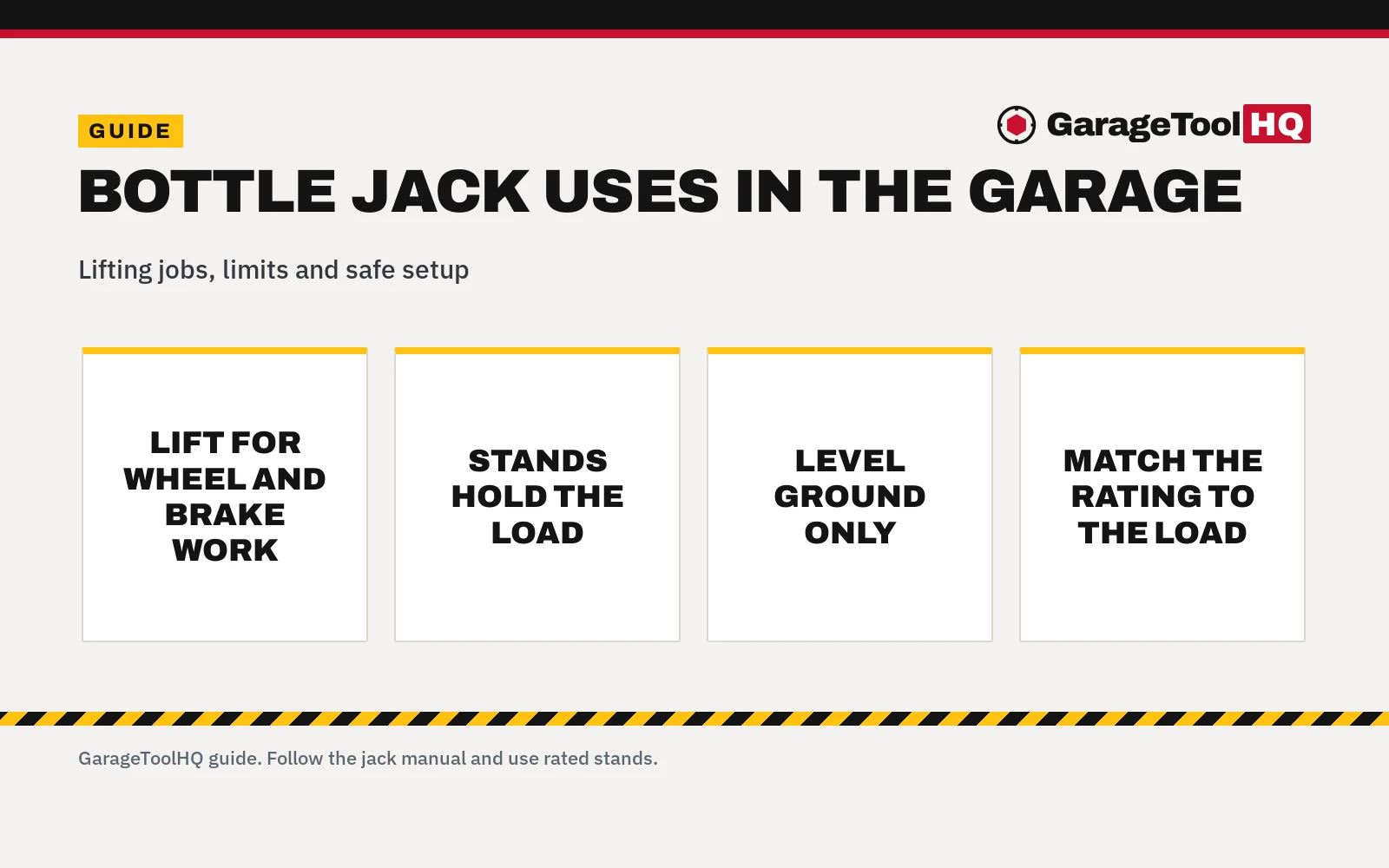
Bottle jack uses range from lifting cars and trucks for wheel and brake work to pressing and leveling jobs, always with rated stands holding the load.

On this page
Top picks at a glance
As an Amazon Associate I earn from qualifying purchases.
- 1
 Hi-Lift Jack 48" X-TREME Jack XT-4859.7/10View on Amazon
- 2
 VEVOR Farm Jack with Base9.7/10View on Amazon
- 3
 Farm Jack9.6/10View on Amazon
The wheel is off, the brake pads sit on the bench, and the car needs to stay up in the air while the work gets done. That lift, done with a compact hydraulic jack that rises straight up from a small base, is among the common bottle jack uses in a home garage. A bottle jack lifts a load for repair and service work, then hands the load over to rated stands. It also serves as the power unit in a shop press and helps with leveling heavy shop equipment. This guide covers the jobs it suits, the jobs it does not, and the setup that keeps the work safe.
GarageToolHQ earns a commission when you buy through links on our product pages, at no extra cost to you. Read our affiliate disclosure.
Below: the jobs a bottle jack handles, a table of common uses, a step-by-step checklist, how it compares with a floor jack, the limits to respect, and answers to common questions.
Bottle jack uses in the garage
A bottle jack is a hydraulic jack with a tall, narrow body and a saddle on top. The pump handle drives fluid that raises the ram, and a release valve lowers it again. Its shape suits jobs where space is tight and the lift point sits high off the ground, which is why it shows up so often beside trucks and heavy shop equipment. The same shape also sets its limits: a small base on a tall body needs level ground and a load that sits square on the saddle.
- Wheel and brake work. Lift a corner of a car or truck, set stands, then remove the wheel and reach the brakes, hub and suspension parts.
- Tire changes. Raise the frame or axle at the lift point the owner manual names, then swap the tire with the load resting on stands.
- Suspension work. Lift the frame so springs, shocks and control arms hang free for service.
- Pressing in a shop press. The jack supplies the force inside a press frame for jobs such as pressing bearings and bushings.
- Leveling heavy shop equipment. Raise a bench, cabinet or machine for small moves, then set it down on its own feet.
- Lifting farm and shop equipment. Raise mowers, trailers and implements for blade, tire and hitch work.
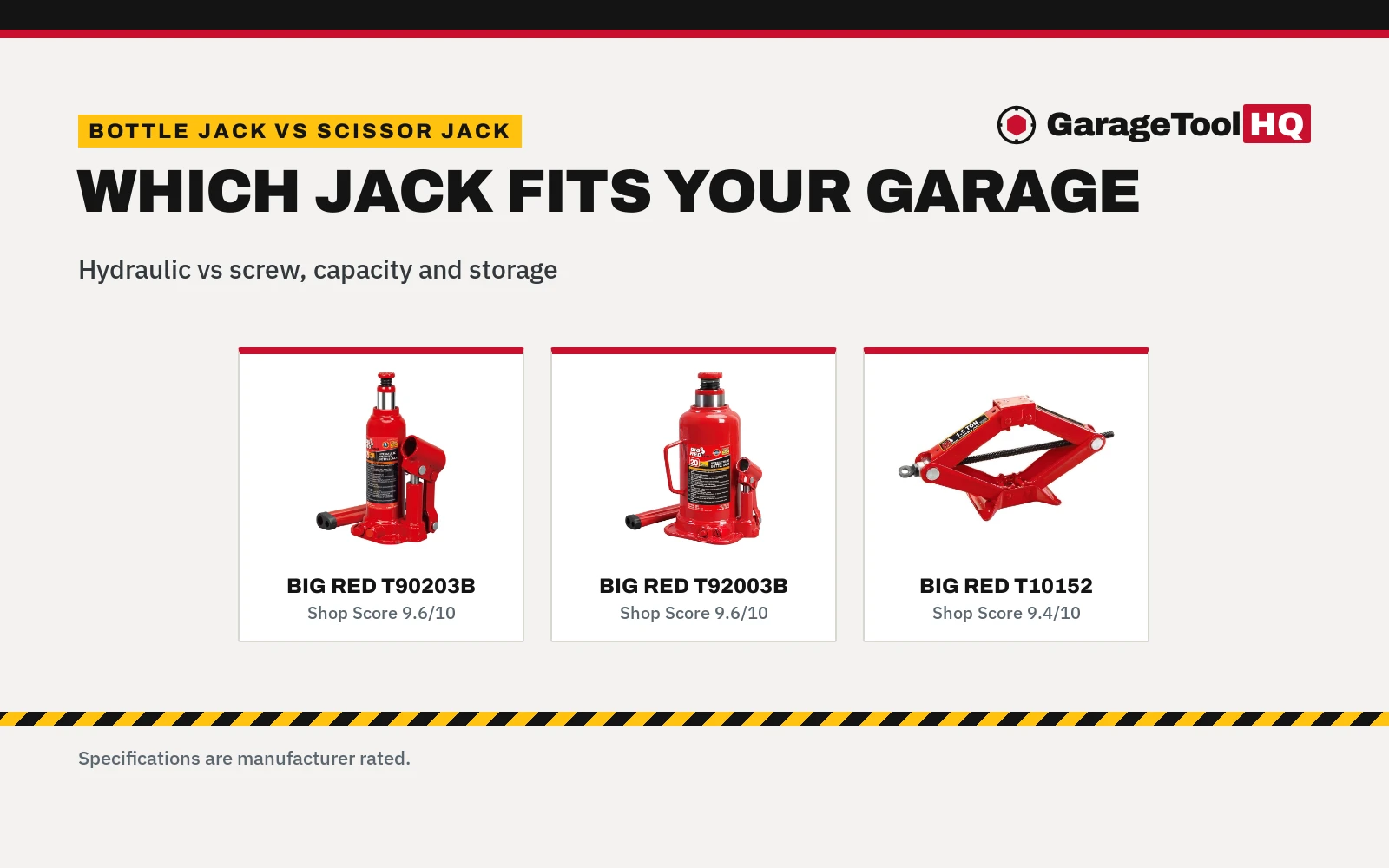
The maker lists a BIG RED bottle jack (on Amazon) rated at 4 ton (8,000 lb), with a listed height of 7.5 inches and a weight of 6.3 pounds, covered by a limited 1 year warranty. Those figures show the pattern to follow when matching a jack to a job: check the rated capacity, the closed height against the lift point, and the weight if the jack moves between jobs. A jack that fits under the lift point at rest, reaches the needed height with the ram extended, and is rated for the load on the saddle is the right size for the job.
Bottle jack uses at a glance
| Job | What the jack does | What holds the load | Limit to respect |
|---|---|---|---|
| Wheel and brake work | Lifts a corner so the wheel comes off | Rated jack stands | Never work under a jack alone |
| Tire change on a truck | Raises the frame or axle at the manual lift point | Rated jack stands | Level ground, wheels chocked |
| Suspension work | Lifts the frame so parts hang free | Rated jack stands | Load square on the saddle |
| Pressing in a shop press | Supplies force inside a press frame | The press frame | Follow the press manual |
| Leveling shop equipment | Raises a heavy item for small moves | Its own feet and cribbing | Small moves only, then set it down |
How to use a bottle jack safely: the checklist
- Park on solid, level ground, set the parking brake, and chock the wheels that stay on the ground.
- Find the lift point in the owner manual and set the saddle square under it.
- Check the jack for leaks and damage, and check the oil level if the manual calls for it. Top up with the right car jack oil when the manual calls for a top-up.
- Pump smoothly until the load clears the ground, then stop and check that the saddle still sits square.
- Set rated jack stands under the frame or axle, then lower the load onto the stands.
- Give the car a firm shake and confirm it sits solid on the stands before going under it.
- Do the work with the load on the stands, not on the jack.
- To lower, raise the load just clear of the stands, remove the stands, then open the release valve slowly.
- Store the jack upright with the valve closed, out of the way of traffic in the garage.
A jack lifts; stands hold. Always lower the load onto rated stands on solid, level ground, and use the lift points the owner manual names.
A jack is for lifting, not holding. Never work under a vehicle supported only by a jack: set it on rated jack stands, on solid, level ground, at the manufacturer's lift points, chock the wheels, and give the car a firm shake before you go under. Read our Safety Disclaimer.
Bottle jack vs floor jack
Each of these jacks lifts with hydraulics and hands the load to stands, but they suit different jobs. A bottle jack is compact and tall, so it fits in a truck toolbox and reaches high lift points, while a floor jack rolls on wheels and slides under low cars with a long handle for quick positioning. The floor jack suits fast wheel changes in a home garage; the bottle jack suits high-clearance vehicles and tight storage. For low cars, see the guide to low-profile floor jacks. When choosing between them, match the jack to the lift point height and the space around it, and keep rated stands in the plan in any case.
Jobs a bottle jack does not suit
A bottle jack has clear limits, and knowing them matters as much as knowing its uses:
- Holding a load while work goes on underneath. That is the job of rated stands, not a jack.
- Side loads. The ram lifts straight up, and a load that pushes sideways can tip the jack.
- Soft or uneven ground. The small base sinks or tilts, so move to solid, level ground before lifting.
- Loads above the rated capacity. The BIG RED jack cited in this guide is rated at 4 ton (8,000 lb), so it suits a load on the saddle within that rating, and a heavier load needs a jack rated for it.
- Lifting by body panels or parts the manual does not name as lift points. Lift only where the owner manual says the car is made to be lifted.
FAQ: garage tools
Can a bottle jack lift a truck?
Yes, when the weight on the jack sits within the jack rating and the saddle meets a lift point the manual names. A bottle jack lifts one corner at a time, so the weight that counts is the corner weight, not the whole truck. The BIG RED jack cited in this guide is rated at 4 ton (8,000 lb), so it suits a load on the saddle within that rating. Set stands before any work goes on underneath.
Can a car be left on a bottle jack?
No. A bottle jack is a lifting tool, not a support. Lower the load onto rated jack stands and confirm it sits solid before working under the car. See the guide on how many jack stands you need for the setup.
Can a bottle jack work on its side?
No. A bottle jack works upright, with the base on level ground and the ram pointing straight up. Laid on its side it can leak and lose lift, so store and use it upright.
What should be checked before using a bottle jack?
Check the lift point in the owner manual, look for leaks or damage, confirm the saddle sits square, and have rated stands ready. Check the oil if the manual calls for it, and keep the jack clean and stored upright between jobs.
Can a bottle jack press bearings?
Yes, inside a press frame built for it, where the frame takes the force and the jack supplies it. Follow the press manual, keep hands clear of the work, and never press with a jack that leaks or drifts down under load.
Related: bottle jacks for trucks, short bottle jacks, small bottle jacks and low-profile vs standard jack stands.