How Many Jack Stands Do You Need? 2 or 4 Stands Explained
How many jack stands you need for lifting an axle versus all four wheels, how pair ratings work, and how to support a vehicle safely on solid ground.

On this page
Top picks at a glance
As an Amazon Associate we earn from qualifying purchases.
- 1
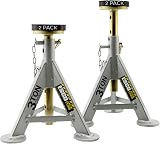 3 Ton Performance Jack Stands9.8/10View on Amazon
- 2
 Amazon Basics Steel Jack Auto Stands9.7/10View on Amazon
- 3
 ANTPOWER Car Jack Stands 3 Ton9.7/10View on Amazon
- 4
 Pro-Lift T-6906D Double Pin Jack StandView on Amazon
- 5
 BIG RED T46002A Torin Steel Jack Stands: Double LockingView on Amazon
- 6
 BIG RED T42202 Torin Steel Jack Stands: 2 TonView on Amazon
- 7
 YELLOW JACKET Car Jack Stands 3 Ton with Double Locking andView on Amazon
- 8
 TONDA Jack Stands 3 TonView on Amazon
- 9
 1 Pair 3 Ton Jack Stands for CarsView on Amazon
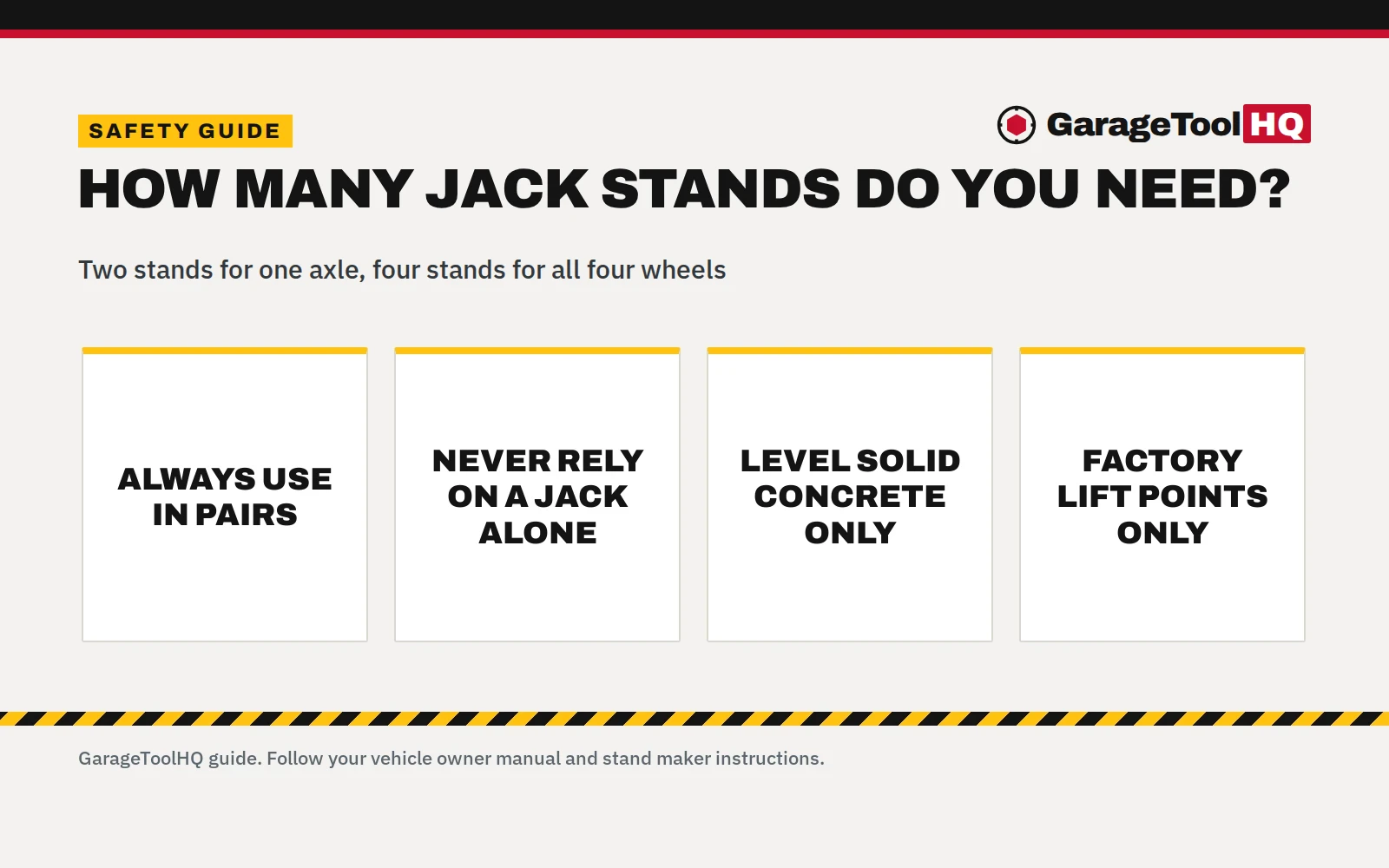
How many jack stands do you need? You need two jack stands to safely support one lifted axle, or four jack stands to raise the entire vehicle off the ground. Never support a vehicle on a single jack stand, and never work under a car held only by a hydraulic jack. Using jack stands in matched pairs balances vehicle weight across rated support columns on solid, level ground.
More options to compare
 Pro-Lift T-6906D Double Pin Jack StandCheck price on Amazon
 BIG RED T46002A Torin Steel Jack Stands: Double LockingCheck price on Amazon
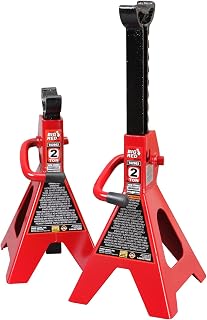 BIG RED T42202 Torin Steel Jack Stands: 2 TonCheck price on Amazon
 YELLOW JACKET Car Jack Stands 3 Ton with Double Locking andCheck price on Amazon
 TONDA Jack Stands 3 TonCheck price on Amazon
 1 Pair 3 Ton Jack Stands for CarsCheck price on Amazon
GarageToolHQ earns a commission when you buy through links on our product pages, at no extra cost to you. Read our affiliate disclosure.
Below: how many jack stands you need for specific jobs, how pair ratings work, a safety checklist for setup, and answers to common garage questions.
How many jack stands do you need? Raising an axle versus the entire vehicle
The number of jack stands you need depends on how many wheels leave the ground for your repair. Automotive work requires mechanical support under the vehicle frame or pinch welds before you place hands or tools near moving parts. Garage jobs fall into two main setups:
- Raising one axle (two wheels lifted). For common jobs like front or rear brake service, oil changes, or suspension work on one end, you need two jack stands. The stands sit under the left and right factory lift points for that axle, while the tires on the opposite end remain firmly chocked on the ground.
- Raising the entire vehicle (all four wheels lifted). For four-wheel tire rotations, complete suspension overhauls, or exhaust replacements, you need four jack stands. All four stands must sit on solid level concrete, share compatible capacity and height ranges, and maintain an even, level chassis.
Common garage jobs and how many jack stands you need
| Garage Job | Wheels Lifted | Jack Stands Needed | Placement |
|---|---|---|---|
| Front brake service or suspension repair | Front two wheels | 2 stands (one pair) | Left and right front factory lift points |
| Rear brake service or differential drain | Rear two wheels | 2 stands (one pair) | Left and right rear factory lift points |
| Engine oil change or underbody inspection | Front two wheels | 2 stands (one pair) | Front factory lift points |
| Four-wheel tire rotation | All four wheels | 4 stands (two pairs) | All four factory lift points |
| Exhaust installation or transmission swap | All four wheels | 4 stands (two pairs) | Four factory reinforced frame points |
The vehicle owner manual marks the reinforced points designed to hold the chassis. Never place a stand under floor pans or thin sheet metal, which can buckle under load.
How to support a vehicle on jack stands safely: the checklist
- Park on solid, level concrete. Always support a vehicle on flat poured concrete. Never use jack stands on hot asphalt, dirt, or gravel, where stand feet can sink or tilt.
- Chock the wheels and engage the transmission or brake. Put automatic transmissions in Park (or manual transmissions in gear) and set the parking brake if the rear wheels remain on the ground. Place heavy wheel chocks on both sides of the tires that stay on the floor to prevent rolling in either direction.
- Locate factory lift points. Consult the vehicle owner manual to find the reinforced jacking points along the pinch welds or frame rails.
- Raise the vehicle with a floor jack. Lift the vehicle smoothly until the tires clear the floor. If you are shopping for lifting equipment, see our guide to budget floor jacks for dependable models.
- Position the stands under the lift points. Place one stand under each designated support point with the saddle centered beneath the frame rail or seam.
- Match stand heights. Align ratchet bars or locking pins so both stands sit at identical notch heights. Insert any safety pins completely through the column.
- Lower the floor jack slowly. Ease the hydraulic release valve to let the vehicle settle onto the stand saddles, confirming both stands stay vertical.
- Perform a shake check. Push firmly against the vehicle bumper before getting near the undercarriage. If the car shifts or rocks, raise it and adjust the stands.
- Leave the floor jack as backup. Keep the floor jack raised just below a central lift point with pressure relieved as a physical secondary stop.
A hydraulic floor jack is built to lift a vehicle, not hold it in place. Hydraulic seals can bypass without warning. Always lower the vehicle onto mechanical jack stands before placing any part of your body underneath.
A jack is for lifting, not holding. Never work under a vehicle supported only by a jack: set it on rated jack stands, on solid, level ground, at the manufacturer's lift points, chock the wheels, and give the car a firm shake before you go under. Read our Safety Disclaimer.
2 or 4 jack stands: choosing the right setup for your garage
Deciding between 2 or 4 jack stands depends on the scope of maintenance you perform:
- Stability: Using 2 stands leaves two tires on the ground to provide rolling resistance. Elevating all four corners on 4 stands removes that tire contact, making level ground and matching stand height essential.
- Clearance: Lifting one end on 2 stands provides ample room for brakes or oil changes. Raising the entire vehicle on 4 stands gives level clearance along the full undercarriage for exhaust and driveline repairs.
- Storage: Owning 4 stands requires more storage space, but having two matched pairs allows you to tackle both axle jobs and full-chassis maintenance.
- Matching height: When using 4 stands simultaneously, use two pairs with compatible height ranges so the vehicle sits level without tilting.
Before buying stands, browse our review of the best jack stands to compare locking styles, and check our guide on what size floor jack do I need to match your jack to your vehicle.
Understanding jack stand weight ratings and capacity figures
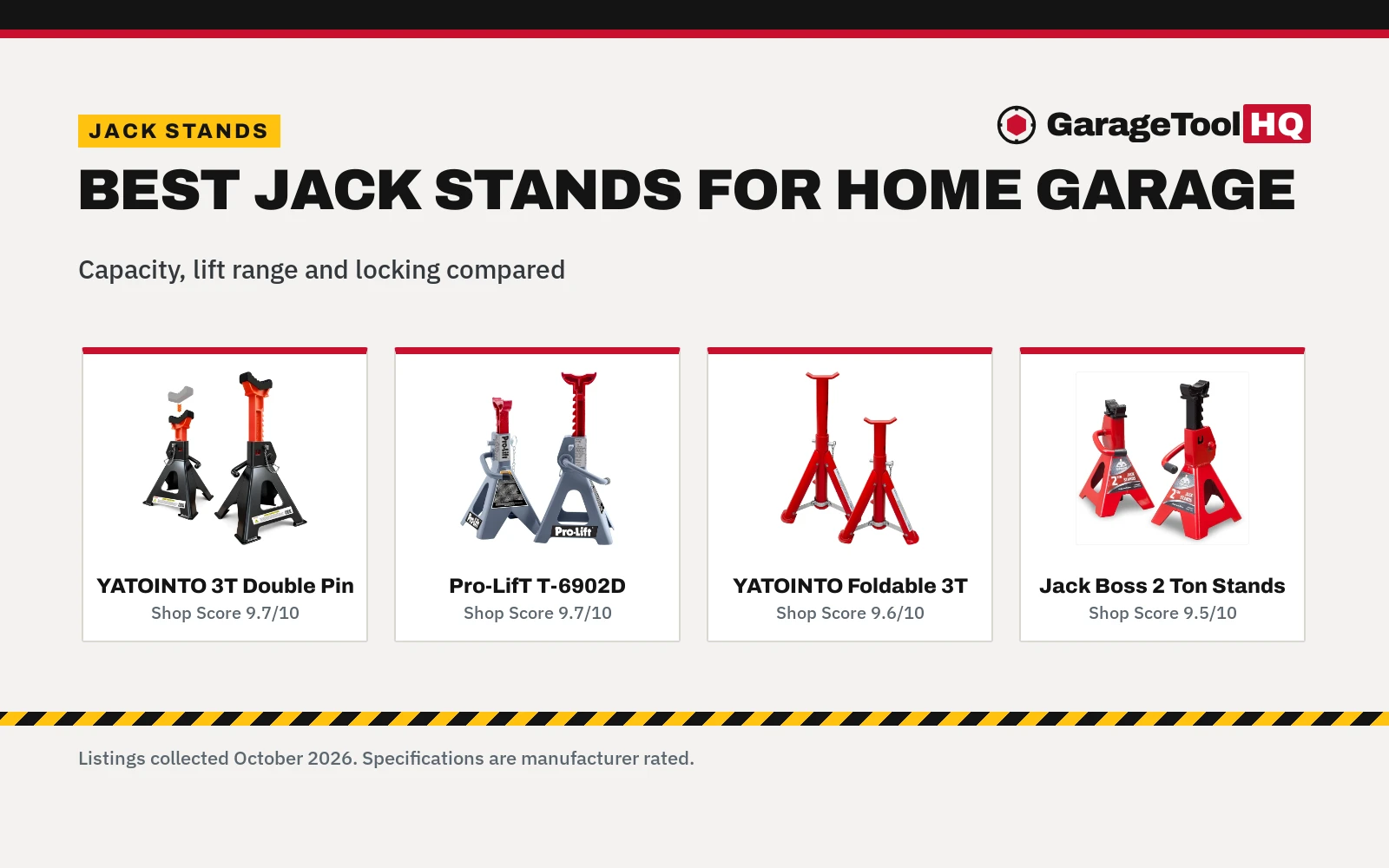
Understanding how manufacturers state capacity is vital for garage safety. In the automotive market, some brands quote load capacity per pair, while other listings cite capacity per individual stand. For example, a 3 ton rating may mean 3 tons across a pair (such as TONDA stating 6,000 lb per pair), or it may refer to each stand (such as ANTPOWER stating 3 ton per stand). Always read the product label and owner manual to confirm whether a rating applies to an individual stand or the pair before matching capacity to vehicle axle weight.
Published listings show a wide range of stated capacities and heights across different stand designs:
- 2 ton capacity stands: BIG RED lists a 2 ton (4,000 lb) capacity for its T42202 steel jack stand pair, with an adjustable height range from 10-13/16 inches to 16-9/16 inches.
- 3 ton capacity stands: ANTPOWER lists a 3 ton (6,600 lb) capacity for its ZZ30003 pair, featuring a lifting range of 11.22 inches to 16.77 inches. TONDA lists a 3 ton (6,000 lb per pair) capacity for its T210107 pair, with an adjustable height of 13.39 to 21.06 inches.
- 6 ton capacity stands: Pro-LifT lists a 6 ton capacity for its T-6906D double pin stands, with a lifting range from 16 inches to 23-1/2 inches.
- 12 ton capacity stands: BIG RED lists a 12 ton (26,400 lb) capacity for its ATZ120005R pin type pair, with a 12-5/8 inches to 18-1/8 inches lifting range.
Always verify that your vehicle axle weights do not exceed the stated pair capacity. For complete garage procedures, read our guide on how to use a floor jack safely and visit our hub for jacks and stands.
Frequently Asked Questions
Can I use one jack stand to change a tire?
No. Even when changing a single wheel, you should never support a vehicle on an individual jack stand. Lifting one corner places uneven torsional load on the chassis and suspension. Always raise the axle and support both sides on a matched pair of jack stands under factory lift points, keeping the opposite wheels firmly chocked on the ground.
Can you use 4 jack stands at the same time?
Yes. You can use 4 jack stands together to raise an entire vehicle if you work on flat concrete, lift one end at a time, use stands with matching capacities and heights, and verify stability with a push check.
Are jack stand ratings per stand or per pair?
It depends on the manufacturer. Some makers quote ratings per pair (for example, TONDA specifies 6,000 lb per pair for its 3 ton model), while other brands cite capacity per individual stand (for example, ANTPOWER specifies 3 ton capacity for each stand). Always check the manual and packaging to confirm whether the stated capacity applies to each stand or the pair.
Can I mix different brands or capacities of jack stands?
Never mix different stands under the same axle. Under one axle, both stands must be identical in model, base size, and height. If using 4 stands, you can run one matched pair in front and another matched pair in back.
Where should I place jack stands under my car?
Place stands only at factory lift points specified in your vehicle owner manual, such as reinforced pinch welds or frame rails. Never place stands under floor pans, suspension arms, or steering linkages.
Can I use jack stands on an asphalt driveway?
No. Stands can sink into asphalt during warm weather, causing the columns to tilt and drop the load. Always position jack stands on smooth, flat, poured concrete.
Related: our guide on how to bleed a floor jack, our comparison of steel vs aluminum floor jacks, our guide to low profile floor jacks, our picks for the best floor jack for cars, and our review of the best car ramps.