Can Fuel Additives Damage Your Engine? (2026)
Fuel additives can damage an engine when the product does not match the fuel type or the amount in the tank is too much, so match the label to the fuel and measure before you pour.

On this page
Can fuel additives damage your engine? Yes, they can, when the wrong product meets the wrong fuel or when too much goes into the tank. A cleaner made for gasoline does not belong in a diesel tank, an amount mixed for a full tank does not belong in a small tank, and a strong solvent cleaner can disturb seals and sensors that were fine before it went in. Used the way the label directs, for the fuel type printed on the label, an additive is far less likely to cause harm, though a cleaner can still loosen old deposits in the tank.
As an Amazon Associate I earn from qualifying purchases. GarageToolHQ earns a commission when you buy through links on our product pages, at no extra cost to you. Read our affiliate disclosure.
Below: how an additive can hurt an engine, how gas and diesel products differ, and a short checklist.
Can fuel additives damage your engine? Where the harm comes from
An additive is a chemical that rides in with the fuel, so anything it touches on the way through the engine is in play: the tank, the lines, the pump, the injectors, the combustion chamber and the exhaust parts after it. A strong solvent cleaner can also swell or shrink an old seal, and a product that changes how fuel burns can change what the oxygen sensors and the catalytic converter see downstream. It happens because the product, the fuel and the engine did not match.
Harm comes from a small set of causes. The wrong fuel type is one cause: a gasoline cleaner in a diesel tank, or a diesel treatment in a gasoline tank, puts chemistry where the maker never meant it to go. Too much product is another: an additive is mixed for a stated amount of fuel, and adding more raises the concentration past what the maker lists. A weak part already in the engine can also fail after a treatment, and the additive gets the blame.
The listings show how narrow the instructions are. Hot Shot’s Secret Everyday Diesel Treatment lists 1 oz. or 2 oz. for every 25 gallons of diesel. Red Line SI-1 (on Amazon) lists one bottle per tank, and Archoil AR6500 lists two 40 oz bottles that treat 800 gallons in total. The ratio is the point: each product is meant for the amount the maker lists, and going above it can cause trouble.
Gasoline additives and diesel additives are not the same product
The shelf holds two families that look alike and are not. Gasoline cleaners such as Red Line SI-1 and Gumout Multi-System Tune-Up (on Amazon) are built for gas engines, carburetors and injectors, and Gumout lists use in gas, diesel or ethanol engines, so the label is the only way to know: a gas cleaner fits a diesel only when its label says so. Diesel treatments such as Hot Shot’s Secret EDT and Archoil AR6500 are built around cetane and lubricity: EDT lists a cetane boost of up to 7 points, and AR6500 lists up to 8 points and a lubricity improvement of 43% under ASTM D6079.
Small engines are a family of their own. STA-BIL Fast Fix (on Amazon) is made for lawn mowers, trimmers, chainsaws, snow blowers, generators and other 2-cycle and 4-cycle engines, and it treats 20 gallons from an 8 oz bottle. A product made for a mower tank is not a car product: the fuel systems differ, the amounts differ, and the labels say so.
| Product | Fuel | Size listed | Amount it treats |
|---|---|---|---|
| Red Line SI-1 Complete Fuel System Cleaner | Gasoline | 15 oz bottle, 12 pack | One bottle per tank |
| Hot Shot’s Secret Everyday Diesel Treatment | Diesel | 16 oz | 400 gallons |
| Archoil AR6500 Diesel Treatment | Diesel | 40 oz, two pack | 800 gallons in total |
| STA-BIL Fast Fix Small Engine Treatment | Small engines | 8 oz | 20 gallons |
| Hot Shot’s Secret LX4 Lubricity Extreme | Gasoline, ethanol or diesel | 32 oz | 320 gallons |
| Archoil Diesel Fuel System Kit | Diesel | 12 oz plus 40 oz | 30 to 40 gallons, then up to 400 gallons |
The table makes the point plain: the same shelf holds a 16 oz bottle that treats 400 gallons and an 8 oz bottle that treats 20 gallons. The amounts are not interchangeable, and neither are the fuels.
Signs an additive has hurt the engine
Trouble after an additive shows up in how the engine runs. The signs the listings name for small engines are rough running, hard starts, sputtering and no-start issues, and a car shows trouble in similar ways: a rough idle, a stumble under load, smoke that was not there before, or a warning light on the dash. A fuel filter can also clog when a cleaner loosens deposits that move downstream.
If any of that appears right after a treatment, stop adding product and check the simple things first: the fuel type on the label, the amount poured, and whether the tank holds the fuel the label names.
How to use a fuel additive without harming your engine
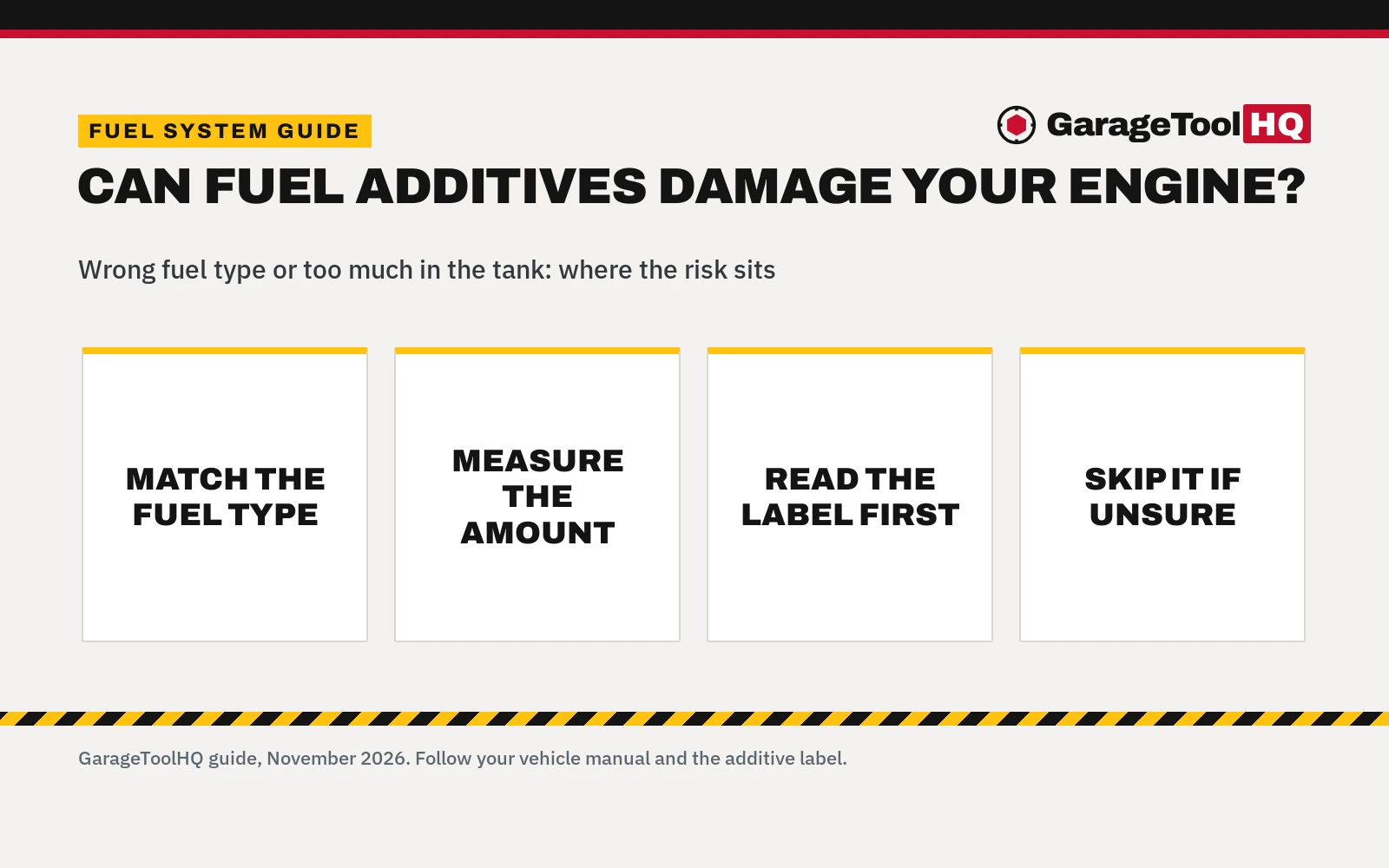
- Match the fuel. Buy the product whose label names your fuel, gas or diesel, and your engine type.
- Measure the amount. Use the amount the label lists for the fuel in the tank: Hot Shot’s Secret EDT lists 1 oz. or 2 oz. for every 25 gallons of diesel.
- Treat a full tank when the label calls for it. Red Line SI-1 lists one bottle per tank.
- Pour it in at fill-up. Add the product as you fill so it mixes through the tank; EDT and AR6500 both list use at every fill-up.
- Do not mix two cleaners in one tank. Use one treatment at a time, unless a label lists the combination: LX4 lists use with fuel stabilizers and fuel system treatments.
- Watch the first tank. Note rough running, hard starts, smoke or a warning light, and stop if any appear.
- Keep the bottle and the receipt. They are what a mechanic will ask about if the engine runs badly after a treatment.
- Check the manual first. A new car manual, or a diesel manual for a DPF model, may warn against aftermarket additives.
If the label does not name your fuel type, or the amount is not listed, do not use it. A product with no stated treat amount cannot be measured, and a guessed amount is how an engine gets too much.
Read the manual before first use, wear eye protection, keep the work area clear and ventilated, and stay within every stated rating. Read our Safety Disclaimer.
When to skip the additive and check the manual
Some engines do not need an additive at all. A car that runs well on pump fuel gains little from a cleaner, and a new car manual may warn against aftermarket additives outright. Check the manual before the bottle.
A diesel with a DPF is a special case. Archoil AR6500 lists support for the DPF and reduced regeneration frequency, a maker claim for that product, not a promise for every diesel treatment. When in doubt, use only a product whose label names DPF use, or skip the additive.
For picking a product that fits, see the guide to the best fuel injector cleaner for gas engines and the diesel picks in the guide to the best diesel fuel additive to clean injectors. For storage, see the best fuel stabilizer for old gas.
FAQ: garage tools
Can fuel additives damage your engine if you use too much?
Yes. An additive is mixed for a stated amount of fuel, and pouring in more than the label lists raises the concentration in the tank. Hot Shot’s Secret EDT lists 1 oz. or 2 oz. for every 25 gallons of diesel, so measure for the gallons in the tank, not for the size of the bottle.
Can I use a gasoline fuel additive in a diesel engine?
No, unless the label names diesel use. Diesel products list cetane and lubricity work, such as the cetane boost of up to 8 points and the 43% lubricity improvement Archoil lists for AR6500, while gasoline cleaners list injector cleaning for gas engines. A product that lists use in gas, diesel or ethanol engines, such as Gumout Multi-System Tune-Up, states that range on its label.
Can fuel additives damage fuel injectors?
They can when the product does not fit the fuel or the amount is too much: deposits loosened in the tank can move downstream and clog a filter or an injector, and a strong solvent can disturb seals. Used at the listed amount for the listed fuel, injector cleaners are made to clean injectors, and Red Line SI-1 lists cleaning injectors, carburetors, valve and combustion chamber deposits.
Can fuel additives damage a catalytic converter?
A product that changes how fuel burns can change what reaches the converter, and Gumout lists its formula as a catalytic converter cleaner, a maker claim for that product. The risk is highest with the wrong product or too much of it. A cleaner used the way its label directs carries the least risk, but the label is not a promise that nothing can go wrong.
Should you use a fuel additive at every fill-up?
Only if the label says so. Hot Shot’s Secret EDT and Archoil AR6500 both list use at every fill-up. Archoil AR6400-D (on Amazon) is listed for a deep clean, with 12 oz treating 30 to 40 gallons, before AR6500 takes over at every fill-up.
Related: how long for fuel injector cleaner to work, when to use fuel injector cleaner, where to put fuel injector cleaner, the best complete fuel system cleaner, the engine and shop equipment hub and the best fuel pump cleaner.