Car Battery Charge Voltage Chart: Charge Levels Explained
A car battery charge voltage chart turns a voltage reading into a charge level, and this guide shows how to read it with a battery meter.

On this page
Top picks at a glance
As an Amazon Associate I earn from qualifying purchases.
- 1
 DaierTek Battery Voltage Meter Waterproof DC 12V 24V LED9.5/10View on Amazon
- 2
 AUTOOL 12V 24V Car Battery Tester9.7/10View on Amazon
- 3
 Car Battery Tester with LED Indicator & LCD Display9.6/10View on Amazon
A car that cranks slowly after sitting unused, or lights that dim when the key turns, can trace back to the battery. A car battery charge voltage chart turns a voltage reading into a plain charge level: full, partly charged, or low. Read the voltage with a meter, match the reading to the chart, and the chart says whether to charge the battery, look at the charging system, or plan a replacement.
GarageToolHQ earns a commission when you buy through links on our product pages, at no extra cost to you. Read our affiliate disclosure.
Below: what the chart shows, how to read it with a meter, what state of charge and state of health mean, and how to stay safe while charging.
Car battery charge voltage chart: how to read the levels
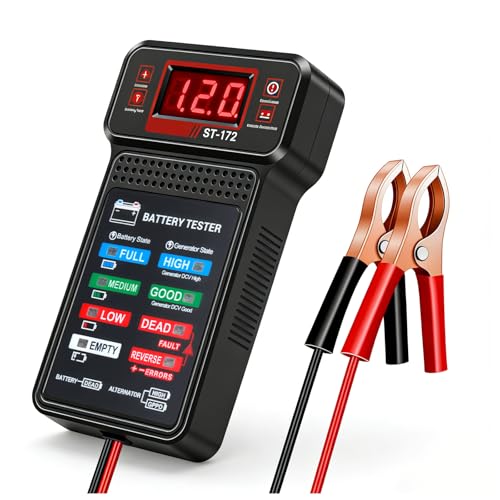
A charge voltage chart lists charge levels next to the readings that go with them. The meter gives the reading, and the chart gives the meaning. Meters report charge in different ways: some light an indicator, and some show a result on a screen. The ANCEL BT410 (on Amazon) shows state of charge, state of health, voltage, and internal resistance on a 2.4-inch color TFT screen, and gives a result of GOOD BATTERY, GOOD-RECHARGE, or REPLACE BATTERY. The Tuxihapp meter (on Amazon) uses a digital LED display with FULL, LOW, HIGH, and EMPTY indicators. The two meters report in different ways, so read each result on its own terms.
| Charge level | What the meter shows | What to do |
|---|---|---|
| Full | FULL indicator lit | No charging needed on this reading. |
| Partly charged | GOOD-RECHARGE result | Recharge the battery before it drops further. |
| Low | LOW indicator lit | Voltage is low; charge the battery promptly. |
| Too high | HIGH indicator lit | Voltage is too high; check the charging system for overcharging. |
| Discharged | EMPTY indicator lit | The battery is completely discharged; charge it before use. |
| Worn out | REPLACE BATTERY result | Plan a replacement for the battery. |
The same chart covers the battery types and systems the meter supports. The ANCEL BT410 supports 12V and 24V systems and works with lead-acid batteries, including AGM, GEL, regular flooded, and EFB types, and with lithium-ion batteries. The Tuxihapp meter covers 12V batteries for cars, motorcycles, trucks, SUVs, RVs, boats, golf carts, and lawn mowers. Match the meter to the system voltage before connecting, since a meter built for 12V systems will not cover a 24V system.
How to check battery voltage step by step
Checking voltage takes a meter and care with the clips. The steps below follow the way the meters in this guide connect and report.
- Clip the red clip to the positive terminal and the black clip to the negative terminal. Alligator clip connections make the hookup quick, and the clips hold firm while the meter reads.
- Read the voltage on the display. The Tuxihapp meter shows real-time voltage on a digital LED display that stays readable in low light and at night, with an accuracy of approximately 0.01V.
- Read the charge indicator as well as the voltage. A FULL reading means the battery is fully charged, LOW means voltage is too low, HIGH means voltage is too high, and EMPTY means the meter shows the battery as discharged.
- On the ANCEL BT410, read the full result as well. The meter reports state of charge, state of health, voltage, and internal resistance, plus a cranking voltage and charging system check, with a result of GOOD BATTERY, GOOD-RECHARGE, or REPLACE BATTERY. The meter covers 100-2000 CCA and supports 12V and 24V systems.
- If the reading is unclear, check the clips and read again. The ANCEL BT410 has 800mm (31.5-inch) cables that reach hard-to-reach battery connections, and its screen has adjustable contrast and a day and night mode for clear reading in bright sunlight or a dark garage.
A meter with short-circuit protection and reverse polarity protection guards against reversed connections and short-circuit issues, which the ANCEL BT410 lists. The Tuxihapp meter has a reverse connection alarm and overvoltage protection: if the clips are reversed, the LED display shows nothing and the REVERSE indicator lights and sounds an alarm.
What state of charge and state of health mean
State of charge, or SOC, says how much charge the battery holds right now. State of health, or SOH, says how the battery compares with a fresh battery of the same kind. A battery can show a full charge and still be in poor health, which is why a meter that reports SOH adds more than a voltage reading alone. Internal resistance is another figure the ANCEL BT410 reports, and it rises as a battery wears, so a high internal resistance reading can point to a worn battery.
Cranking voltage is the voltage the battery holds while the starter turns the engine, and the charging system check looks at how the alternator charges the battery while the engine runs. The ANCEL BT410 analyzes cranking voltage and charging system performance under load, and can point to a weak starter, a failing alternator, or excessive ripple voltage. The meter works in temperatures from -4°F to 158°F and supports 8 languages, including English and Spanish.
Lead-acid batteries can release hydrogen while charging, so charge in a ventilated space away from sparks and flames, connect positive first and negative last, set the charger to the battery type (flooded, AGM, gel, lithium), and wear eye protection. Read our Safety Disclaimer.
Battery charging safety
Flooded lead-acid batteries can release hydrogen while charging, and hydrogen ignites easily, so charge with ventilation and keep the battery away from flames and sparks. Never run a fuel engine or an unvented heater in a closed garage while charging. Use a battery charger maintainer that drops to a float charge when the battery is full, and follow the charger manual for the charging routine. Reverse polarity protection and a reverse connection alarm guard against crossed clips, but the clips still go red to positive and black to negative every time.
FAQ: garage tools
What does a car battery charge voltage chart show?
It maps voltage readings to charge levels, so a reading becomes a plain answer: full, partly charged, low, or discharged. A meter gives the voltage, the chart gives the meaning, and the meter indicators or screen result say what to do next.
Do meters cover both 12V and 24V batteries?
Some do and some do not. The ANCEL BT410 supports 12V and 24V systems and works with lead-acid and lithium-ion batteries, while the Tuxihapp meter covers 12V batteries. Check the system voltage and the meter rating before connecting.
What is the difference between state of charge and state of health?
State of charge says how much charge the battery holds right now, while state of health says how the battery compares with a fresh battery of the same kind. A battery can read fully charged and still be in poor health, which is why the ANCEL BT410 reports SOC and SOH together with voltage and internal resistance.
What does the FULL indicator mean on a battery meter?
On the Tuxihapp meter, the FULL indicator lights when the battery is fully charged. LOW means the voltage is too low, HIGH means the voltage is too high, and EMPTY means the meter shows the battery as discharged. Each indicator points to the matching row of the charge chart.
What should I do when the meter shows REPLACE BATTERY?
Plan a replacement for the battery. The REPLACE BATTERY result from the ANCEL BT410 means the meter rates the battery as worn out rather than in need of charging, so the fix is a replacement, not another charge.
Can a meter check the charging system as well as the battery?
Yes. The ANCEL BT410 analyzes cranking voltage and charging system performance under load, and can point to a weak starter, a failing alternator, or excessive ripple voltage. The Tuxihapp meter also analyzes battery health, charging status, and alternator output, and warns early about overcharging or undercharging.
Related: why a car battery will not charge, how to choose a car battery, the best way to recharge a car battery, battery charger maintainers, and the diagnostics and electrical hub.