Can I Charge Car Battery While Connected? What to Know Before You Plug In
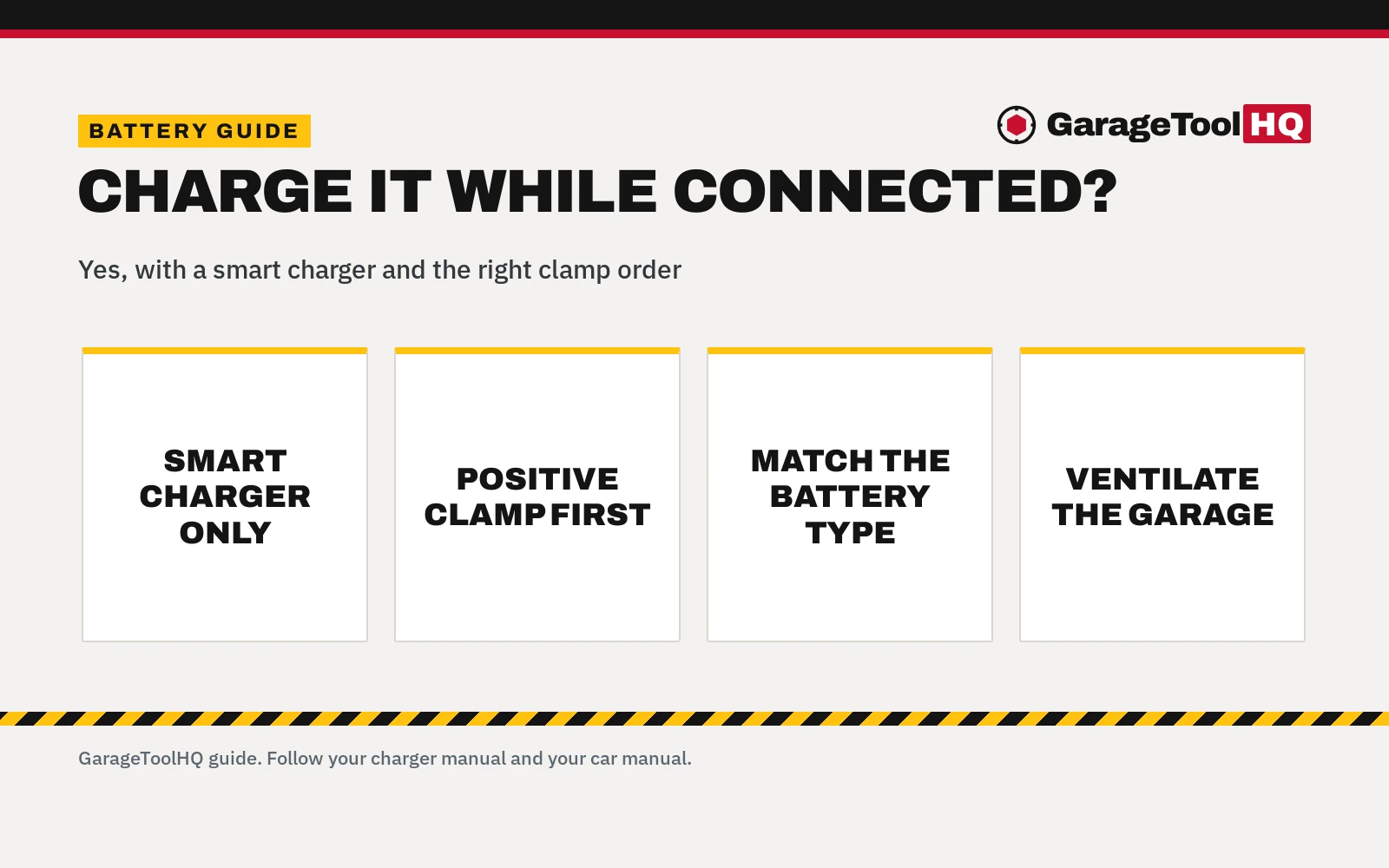
Yes, a smart charger can charge a car battery with the cables still attached, as long as the charger matches the battery type and the clamps go on in the right order.

On this page
Top picks at a glance
As an Amazon Associate I earn from qualifying purchases.
- 1
 AUTOOL 12V 24V Car Battery Tester9.7/10View on Amazon
- 2
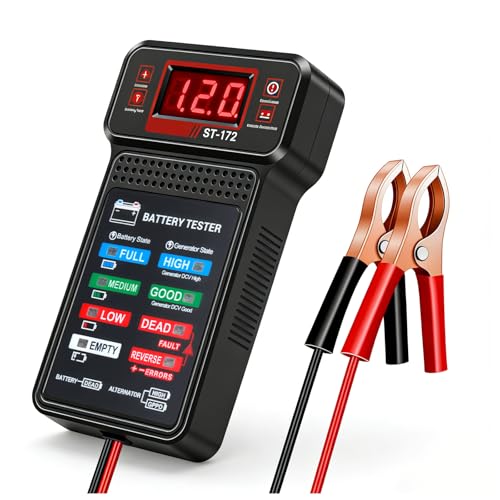 Car Battery Tester with LED Indicator & LCD Display9.6/10View on Amazon
- 3
 DaierTek Battery Voltage Meter Waterproof DC 12V 24V LED9.5/10View on Amazon
Can I charge car battery while connected? Yes, a smart charger can charge the battery with the cables still attached to the car, and that is how a maintainer is meant to be used. The charger controls the voltage and drops to a float charge when the battery is full, so the car can stay wired up while the battery tops off. What matters is the charger type, the battery type, and the clamp order, and each of those is covered below.
GarageToolHQ earns a commission when you buy through links on our product pages, at no extra cost to you. Read our affiliate disclosure.
Below: when charging while connected is fine, the clamp order to follow, which charger figures to compare, and what to watch while the battery charges.
Can I charge car battery while connected? What the answer depends on
A smart charger or maintainer watches the battery voltage and changes its output as the battery fills. When the battery reaches a full charge, the charger drops to a float or maintain mode instead of pushing current without pause. The Battery Tender 3 Amp charger (on Amazon), for example, provides a full charge and then goes into float mode automatically to maintain voltage without overcharging, according to the maker.
The battery type matters as much as the charger type. The chargers in this guide cover lead-acid batteries, including AGM and gel types, and some cover lithium-ion batteries as well. The NOCO GENIUS1 (on Amazon) suits 6-volt and 12-volt lead-acid and lithium-ion batteries, the Battery Tender suits 6-volt and 12-volt batteries, and the E-FAST suits 12-volt and 24-volt batteries. Set the charger to the type the maker states for the battery in the car.
A manual charger without automatic control is a different case. It keeps pushing current until someone switches it off, so leaving it connected without watching invites overcharging. The MOTOPOWER MP00205A (on Amazon) shows how automatic control looks in practice: it charges the battery up to 14.4V and maintains the battery at 13.6V, and a 24-hour timer ends the charge and switches to maintaining mode once the voltage is above 14V. If the charger has no automatic shutoff or maintain mode, stay with it while it charges.
How to charge a car battery while it stays connected
Work through these steps in order. The full walkthrough for a portable unit is in the guide to how to use a portable car battery charger.
- Park the car and switch everything off. Turn off the lights, the radio and the ignition, and open the hood. Work with the garage door open or the car outside so air moves around the battery.
- Read the charger manual and the car manual. Confirm the charger suits the battery voltage and type before connecting anything. The NOCO GENIUS1 suits 6-volt and 12-volt lead-acid and lithium-ion batteries, the Battery Tender suits 6-volt and 12-volt batteries, and the E-FAST suits 12-volt and 24-volt batteries.
- Connect the positive clamp first. Put the red clamp on the positive terminal, then put the black clamp on the negative terminal or on a ground point the car manual names. Check that both clamps grip firmly and sit squarely on clean metal.
- Set the mode for the battery. Pick the setting that matches the battery type and size. The E-FAST offers 5 manual current selections, 2A, 8A, 20A, 25A and Auto mode, and the maker states to select 2A for small batteries such as motorcycle and lawn mower batteries. The NOCO GENIUS1 charges batteries from as low as 1 volt, and its Force Mode charges completely dead batteries down to zero volts.
- Plug the charger in and let it run. The charger moves through its stages on its own. The MOTOPOWER charges the battery up to 14.4V and maintains it at 13.6V, with a 24-hour timer that ends the charge once the voltage is above 14V. Leave the charger alone while it works, and do not move the clamps mid-charge.
- Unplug, then unclamp. When charging is done, unplug the charger from the wall first, then take the black clamp off, then the red clamp. Coil the cables and store the charger where the cables will not get pinched or soaked.
Reach matters when the car cannot move. The NOCO GENIUS1 has a 110-inch DC cable, and the Battery Tender gives 11 total feet of combined reach, with a 6 ft AC cord and a 5 ft DC output cord. Park close enough that the cables rest without strain.
Which charger figures to compare
Charger output is the figure that sets how hard a charger can push. A maintainer holds a battery at full charge, while a larger charger brings a low battery back sooner. Compare the figures below before choosing, and match the charger to the battery type in the car. The battery charger maintainer picks compare the same figures across more models.
| Charger | Output | Battery voltage | Warranty |
|---|---|---|---|
| NOCO GENIUS1 | 1A | 6-volt and 12-volt | 3-year warranty |
| MOTOPOWER MP00205A | 800mA | 12-volt | 2-year warranty |
| Battery Tender 022-0202-COS | 3 Amp | 6-volt or 12-volt | 5-year warranty |
| E-FAST TK2500 | 25A at 12V, 15A at 24V | 12-volt and 24-volt | 1-year warranty |
Output is only part of the picture. The NOCO GENIUS1 adds a desulfator and a thermal sensor that adjusts the charge with ambient temperature, and the maker states it can stay connected for maintenance. The Battery Tender is UL/CSA, CE and BC approved. The E-FAST has an aluminum alloy shell and a cooling fan, and its booster mode gives a surge for 200 seconds for 12-volt batteries only. The MOTOPOWER is spark-proof during lead connection and protects against overcharge, short circuit and reverse polarity.
Lead-acid batteries can release hydrogen while charging, so charge in a ventilated space away from sparks and flames, connect positive first and negative last, set the charger to the battery type (flooded, AGM, gel, lithium), and wear eye protection. Read our Safety Disclaimer.
What to watch while the battery charges
- Ventilation. Flooded lead-acid batteries can release hydrogen while charging, and hydrogen ignites easily. Keep the space ventilated and keep flames and sparks away from the battery.
- Clamps and polarity. Reverse polarity protection is stated for the MOTOPOWER, Battery Tender and E-FAST chargers (on Amazon), but the clamps still need to go on the right terminals. Spark-proof connection is stated for the MOTOPOWER and Battery Tender, which helps when the clamps go on and come off.
- Heat and smell. If the battery case feels hot to the touch or gives off a strong smell, stop charging, unplug the charger and let the battery cool. Do not keep charging a battery that is swelling or leaking.
- Damaged batteries. Do not charge a battery with a cracked case, a loose terminal or fluid leaking from it. A battery in that state needs a replacement, not a charge.
- Stay nearby at the start. Watch the charger indicator when charging begins and confirm it has settled into its normal pattern before walking away.
FAQ: garage tools
Do I have to disconnect the battery to charge it?
No, not with a smart charger or maintainer. The NOCO GENIUS1 is a charger, maintainer and trickle charger in one, and the maker states it can stay connected for maintenance. The Battery Tender drops into float mode on its own when the battery is full. A manual charger without automatic control is a different case: watch it and follow its manual.
Can I leave a maintainer connected all winter?
Yes, with a maintainer made for that job. The maker of the NOCO GENIUS1 states the charger constantly monitors the battery and can stay connected for maintenance. The Battery Tender holds the battery at float voltage and resumes full charger output if the battery voltage drops under load. Keep the area ventilated and check the manual for the model in use.
What if the battery is completely dead?
Some smart chargers can start from a very low voltage. The NOCO GENIUS1 charges batteries from as low as 1 volt, and its Force Mode charges completely dead batteries down to zero volts. The E-FAST booster mode gives a surge for 200 seconds to help start a car with a depleted 12-volt battery. If the battery will not hold a charge after that, the charger manual is the next place to look.
How long does charging take while the battery stays connected?
It depends on the charger output and how low the battery is. The MOTOPOWER has a 24-hour timer that ends the charge and switches to maintaining mode once the voltage is above 14V. The E-FAST repair mode runs for 16 hours. A maintainer holds the battery at its maintain voltage after the charge ends.
Can charging while connected harm the car electronics?
A smart charger controls its voltage, which is the point of using one. The MOTOPOWER charges up to 14.4V and then maintains the battery at 13.6V. Use the mode the maker states for the battery type, keep the clamps on the right terminals, and follow the car manual.
Related: the best way to recharge a car battery, why a car battery will not charge, the car battery charge voltage chart, what a smart car battery charger is, the battery charger maintainer picks and the diagnostics and electrical hub.