Car Dolly Weight: Capacity and Specs Guide
What car dolly weight means, how rated capacity works, and what to check before rolling a car on dollies.

On this page
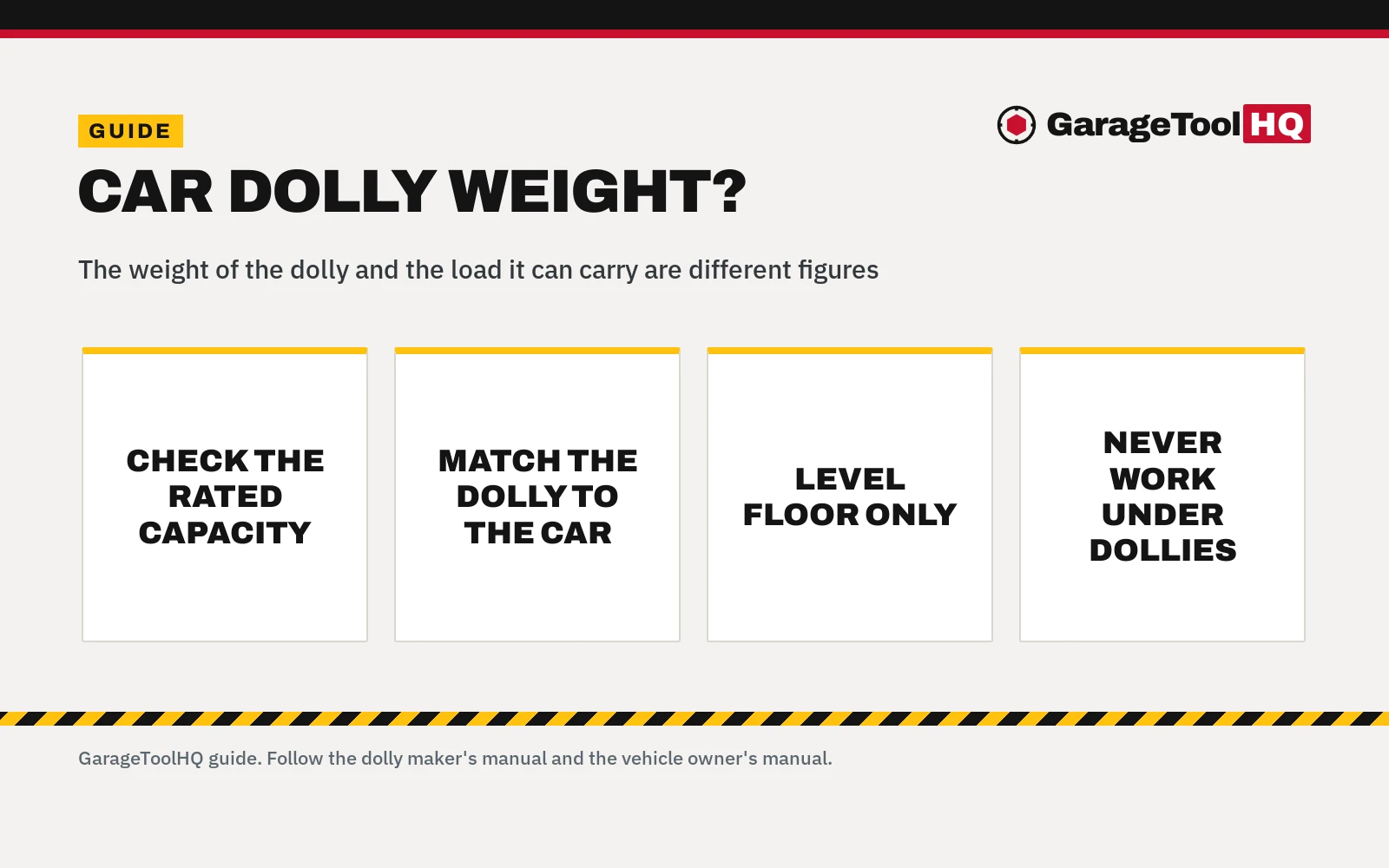
A project car has sat in the same spot all winter, boxed in by shelves and a workbench, with no room to steer it out through the door. The job is simple: roll the car sideways a short distance so there is space to work around it. Car dolly weight is the weight of the dolly itself, not the load the maker rates the dolly to carry. The rated load matters far more than the weight of the dolly, because a dolly rated below the weight at the wheel will not do the job safely.
As an Amazon Associate I earn from qualifying purchases. GarageToolHQ earns a commission when you buy through links on our product pages, at no extra cost to you. Read our affiliate disclosure.
Below: what the weight figures on a dolly listing mean, how rated capacity works, and a checklist to run before a car rolls on dollies.
Car dolly weight: what the listing tells you
A dolly listing states a weight for the dolly and a rated capacity for the load, and the figures answer different questions. The weight of the dolly tells you how heavy it is to carry from the shelf to the wheel. The rated capacity tells you the load the maker rates that dolly to carry, and that is the figure that decides whether the dolly suits the car.
- Dolly weight. The weight of the dolly itself. A lighter dolly is easier to carry and slide under a tire, while a heavier steel dolly takes more effort to move into place. Check the weight on the listing if the dolly will be carried often.
- Rated capacity. The load the maker rates the dolly to carry. This is the limit that matters: the load at the wheel must stay within the rating, with room to spare.
- Wheel and caster build. Casters carry the load and decide how the dolly rolls. Larger casters roll over cracks and small debris more easily than small ones, and a steel frame holds its shape under load.
- Floor load. A car on dollies rests on small caster wheels, so the weight of the car presses down through the small caster contact patches. The floor must be solid, level concrete, swept clear.
Read the whole listing, not just the headline. A listing may state a capacity in the title and a different figure in the spec table, or state a rating for the set while the title reads like a rating for each dolly. When the title and the spec table disagree, trust the title and the bullet points, and check the manual for the rating the maker stands behind.
Kinds of car dolly, and how weight differs
Dollies come in a few shapes, and the shape changes the weight of the dolly and the load it can carry. A plain steel frame with casters suits a car that needs to roll sideways across a flat floor. A dolly with larger casters rolls over cracks and small debris that can stop a small caster, which matters on an older concrete floor. A hydraulic dolly carries a jack in the frame, so it lifts the tire as well as rolling it.
| Type | How it carries weight | What to check |
|---|---|---|
| Standard steel car dolly | A steel frame with casters sits under each tire | The rated capacity on the listing, and whether the rating covers each dolly or the set |
| Big-wheel car dolly | Larger casters spread the rolling load and cross cracks more easily | Caster size and the rated capacity on the listing |
| Hydraulic car dolly | A built-in jack lifts the tire onto the dolly frame | The jack rating and the dolly rating, which may differ |
The listing and the manual decide which kind a dolly is, not the product name or the photo, so compare the rating on the listing, not the name on the box.
How to check car dolly weight before you buy: the checklist
- Read the rated capacity. Find the load rating on the listing. If the listing states no rating, the dolly is unrated.
- Find the weight at the wheel. The vehicle owner’s manual states the axle weight ratings, and a scale at a shop gives the weight at each corner. Use the heaviest corner the dolly will carry.
- Compare the rating with the load. The rated capacity must cover the weight at the wheel, with room to spare. If the rating covers the set rather than each dolly, check the maker’s per-dolly rating; do not divide it, because corner weights differ.
- Check the dolly’s own weight. If the dolly will be carried to the car and back to the shelf often, a lighter dolly is easier to live with.
- Check the casters. Look for casters that swivel freely, and check that the listing states the caster rating.
- Check the frame. A steel frame resists bending under load. Look for welds and joints that look solid, and check the listing for the frame material.
- Check the floor before loading. Dollies roll best on smooth, level concrete. Sweep the path clear and fill or avoid cracks and raised joints.
- Chock and lock before loading. Set the parking brake, chock the wheels that stay on the ground, and lock the casters, if the dolly has locks, while the car is lifted onto the dollies.
- Never work under a car on dollies. Dollies are for moving a car, not for holding it up while work happens underneath. Lower the car onto rated jack stands on solid, level ground before going under it.
A car dolly lets a car roll. A jack stand holds a car still. Never go under a car that rests only on dollies or on a jack alone: use rated stands on solid, level ground, set at the lift points in the owner’s manual.
Check the lift's rated capacity against your heaviest vehicle, and its ceiling and concrete requirements (thickness and strength) before you buy. Install it exactly as the manufacturer specifies, use the mechanical locks before you go under, and look for ALI certification on the model. See the Automotive Lift Institute (ALI). Read our Safety Disclaimer.
Car dolly weight vs car dolly capacity
Weight and capacity sound alike, but they measure different things:
- Weight: how heavy the dolly itself is. It affects carrying, storage and positioning.
- Capacity: the load the maker rates the dolly to carry. It decides whether the dolly suits the car.
- Set rating vs dolly rating: a listing may state a rating for the whole set or for each dolly. Read the listing to see which rating it states, and check each dolly against the load it will carry.
- Vehicle weight: the weight at each wheel comes from a scale, not the owner’s manual. The dolly rating must cover it, with room to spare.
To see how these ratings look on real listings, compare the picks in the car dolly set with big wheels and the car ramps and lifts guide.
Rolling a car on dollies: what changes
With every wheel on dollies, a car rolls freely in any direction, which is the point of the tool and also the risk. The steering wheel no longer steers the car, the brakes no longer hold it, and a slope the eye misses can start the car moving. Push slowly, keep hands clear of the casters, and have a helper watch the far side. Work only on level ground, and never let the car roll toward a person, a wall or the open door.
Plan the path before the car moves. Clear the route of hoses, cords and tools the casters could catch on, and check the floor for cracks and raised joints. Move the car in short pushes and keep the speed down to a slow walk.
FAQ: garage tools
How much does a car dolly weigh?
It varies with the frame, the casters and the size of the dolly. The listing states the weight, so check it there before ordering.
What is car dolly weight capacity?
It is the load the maker rates the dolly to carry, stated on the listing. Compare that rating with the weight at the wheel from the owner’s manual or a scale, and keep the load within the rating.
Does the weight of the dolly itself matter?
It matters for carrying and positioning, not for holding the car up. A lighter dolly is easier to carry from the shelf and slide under a tire. The rated capacity is the figure that decides whether the dolly suits the car.
Can a car dolly hold a truck?
Only if the rating covers the weight at the wheel. Trucks often carry more weight at each wheel than cars, so check the rating against the weight in the owner’s manual before loading a truck onto dollies. If the rating falls short, the dolly is the wrong tool for that vehicle.
How do I find the weight at each wheel?
The vehicle owner’s manual states the axle weight ratings, and a scale at a shop or weighbridge gives the weight at each corner. Use the heaviest corner the dolly will carry, and compare it with the rated capacity on the listing.
Do car dollies work on any garage floor?
No. Dollies roll best on smooth, level concrete that is swept clear. Rough floors, cracks, raised joints and slopes make the car hard to control, so check the floor before the car goes up on dollies.
Related: the wheel dolly picks, the dolly picks for moving cars, the car dolly set with big wheels and the car ramps and lifts guide.