Car Lift Maintenance: Shop Care and Inspection Guide
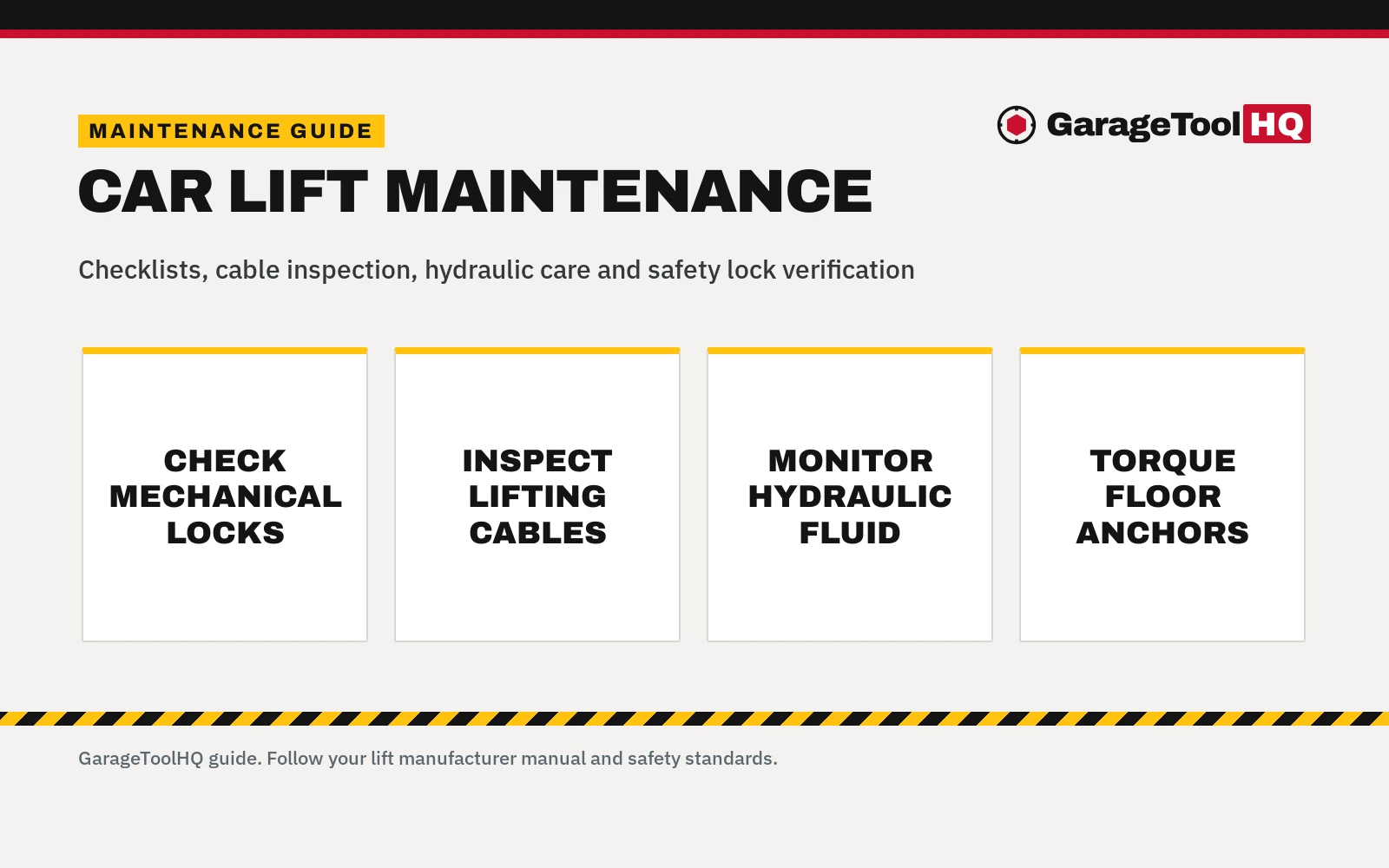
Essential car lift maintenance procedures for home garages, covering safety latch checks, cable care, hydraulic fluid inspection and concrete anchor verification.

On this page
Top picks at a glance
As an Amazon Associate we earn from qualifying purchases.
- 1
 6600 lbs Portable Car Lift9.5/10View on Amazon
- 2
 Black Widow Motorcycle Lift Table9.6/10View on Amazon
- 3
 BRCOVAN Motorcycle Portable Lift Stand Jack Wheel Chain9.3/10View on Amazon
When you roll a truck into the bay for a Saturday brake job or an oil change, you count on your lift to hold that vehicle rock solid overhead. Car lift maintenance is the regular inspection, cleaning, lubrication and adjustment that keeps your lift operating safely and prevents mechanical or hydraulic failure. Staying on top of car lift maintenance means checking safety locks and cables before lifting, inspecting hydraulic hoses and cylinders for fluid leaks, keeping columns clean and greased, and verifying concrete anchor tightness per the manufacturer manual. Skipping these checks risks catastrophic failure, vehicle damage and severe shop injury.
GarageToolHQ earns a commission when you buy through links on our product pages, at no extra cost to you. Read our affiliate disclosure.
Below: why routine inspection is essential, the core mechanical and hydraulic components to monitor, an inspection checklist before raising vehicles, and answers to common garage maintenance questions.
Car lift maintenance: why routine garage inspections matter
An automotive lift supports heavy vehicles suspended directly above your workspace. Unlike small hand tools, a vehicle lift relies on structural steel, tensioned equalizing cables, high-pressure hydraulics and mechanical locking pawls working together under severe load. Neglecting garage car lift maintenance creates subtle hazards that build over time:
- Hydraulic pressure loss. Deteriorating cylinder seals, cracked hydraulic hoses and weeping fittings allow pressure to drop, which can cause carriages to creep downward or drop suddenly if a line bursts.
- Cable stretching and fraying. Equalizing cables keep opposing carriages level. Over time, wire ropes stretch unevenly, wear against sheaves or develop broken wire strands that compromise structural balance.
- Locking mechanism binding. Mechanical safety latches rely on clean pivot pins and strong return springs. Road salt, grime and old grease can gum up latches, preventing them from catching in the column ladders.
- Anchor bolt loosening. Raising and lowering heavy vehicles produces cyclic vibration and bending loads that can loosen floor anchors in concrete, threatening overall column stability.
Core workshop safety begins before any car leaves the floor: always verify vehicle weight ratings, consult the vehicle owner’s manual lift points, and confirm your floor meets the lift maker’s concrete and ceiling requirements. Never get under a vehicle on a jack alone without rated stands on solid level ground, and never work beneath a lift that is not resting securely on its mechanical safety latches.
Car lift system maintenance across key components
| Component | What to inspect | Action required |
|---|---|---|
| Mechanical safety locks | Latch engagement, return springs, release linkage and pivot pins | Clean off debris, lubricate pivot points, and verify positive locking on each column |
| Lifting cables and sheaves | Cable tension, strand wear, wire fraying, sheave grooves and pulleys | Check equal tension, lubricate wire rope per manual, and replace damaged cables immediately |
| Hydraulic power system | Cylinders, hydraulic lines, fittings, breather caps and reservoir fluid level | Check for fluid leaks, wipe cylinder rods clean, and top off with recommended hydraulic fluid |
| Columns and carriage tracks | Vertical column tracks, slider blocks, rollers and swing arm pivot joints | Wipe tracks clear of grit, apply recommended white lithium grease, and check arm restraints |
| Concrete floor anchors | Anchor bolt tightness, base plate contact and concrete around the base | Check torque with a calibrated wrench to the lift maker specification, checking for cracks |
Proper car lift system maintenance requires knowing what each part does and addressing wear before it causes downtime. For specialized lifts like scissor platforms, see our guide to scissor lift maintenance. If you are planning an installation or upgrading your garage, review our advice on how to choose a car lift for a home garage and compare models in our roundup of car lifts for home garages.
How to perform car lift maintenance: the inspection checklist
- Conduct a pre-lift visual inspection. Walk around the lift before spotting a vehicle. Look for hydraulic oil puddles beneath cylinders, inspect lift pads for tears or missing rubber, and confirm that swing arm restraints engage firmly when arms swing outward.
- Confirm vehicle spotting and balance. Position the vehicle so the center of gravity aligns with the lift columns. Always position rubber pads directly beneath the vehicle owner’s manual lift points before raising the chassis off the tires.
- Observe travel and listen for latch clicks. As the carriages ascend, listen for the mechanical locking pawls clicking into the column slots simultaneously. If either side clicks noticeably earlier than the opposite side, the equalizing cables are out of adjustment and require tensioning.
- Lower onto the mechanical safety locks. When the vehicle reaches working height, reverse hydraulic flow to lower the carriage onto the nearest mechanical lock position. Relieve hydraulic line pressure so the mechanical locks support the full load.
- Examine hydraulic fluid level and clarity. Lower the lift completely before checking the reservoir sight glass or dipstick. If the fluid appears milky or discolored, moisture or dirt has entered the system; drain, flush and refill using the fluid recommended in our guide to hydraulic oil for car lifts.
- Inspect equalizing cables and pulleys. Run a clean cloth along equalizing wire ropes to detect broken strands or wire fraying. Inspect pulleys and sheaves for groove wear or bearing wobble, ensuring cables sit centered in every track.
- Lubricate column tracks and arm pins. Clean away old grease, metal dust and shop grime from the column channels. Apply fresh white lithium grease along the internal tracks where carriage glide blocks slide.
- Verify anchor bolt tightness. Check column base plate anchor bolts with a torque wrench to ensure they meet the torque specified by the lift manufacturer. Inspect surrounding concrete for surface cracking or spalling.
Hydraulic seals, valves and flexible hoses can rupture without warning. Always lower the lift carriage until the mechanical safety locks engage fully before stepping beneath the vehicle. Never get under a vehicle supported only by hydraulic fluid pressure, and never get under a vehicle on a jack alone without rated stands on solid level ground.
Check the lift's rated capacity against your heaviest vehicle, and its ceiling and concrete requirements (thickness and strength) before you buy. Install it exactly as the manufacturer specifies, use the mechanical locks before you go under, and look for ALI certification on the model. See the Automotive Lift Institute (ALI). Read our Safety Disclaimer.
Hydraulic system care vs mechanical cable tensioning
Maintaining a vehicle lift involves managing two interconnected systems: hydraulic fluid power and mechanical cable synchronization. Understanding how each operates helps you diagnose issues before they become hazardous:
- Hydraulic power delivery: The hydraulic power unit pumps oil through high-pressure hoses into hydraulic cylinders to raise the carriages. Maintenance centers on fluid quality, preventing air entrapment and protecting seals. Contaminated fluid causes internal valve sticking, while low fluid causes erratic lifting or failure to reach full height. Bleed air from the hydraulic cylinders following the maker instructions whenever lines are serviced.
- Mechanical cable synchronization: Equalizing cables do not lift the vehicle; instead, they pull the opposite carriage upward in unison so both sides rise at identical speeds. When cables stretch unevenly, the vehicle tilts, causing carriage glide blocks to bind against column channels. Cable tension must be equalized so both locking latches engage at the exact same moment.
- Wear limits and replacement: Wire ropes that show broken strands, kinks, corrosion or flat spots must be replaced immediately as matched sets. Never attempt to splice or clamp damaged equalizing cables.
- Cleanliness and lubrication: Hydraulic cylinder rods should be kept wiped clean with a dry rag to prevent grit from entering gland seals. Wire ropes require light cable lubricant to prevent internal friction between strands while keeping moisture out.
If you are exploring lift styles for your space, check our overview of car lifts and our guide on installing a car lift in a residential garage.
Concrete anchor inspection and electrical power unit care
A lift depends entirely on the concrete foundation beneath it and the electrical supply that powers its pump. Inspecting these areas preserves the safety of the entire shop:
Foundation and anchors: The concrete slab must meet the lift maker’s concrete and ceiling requirements. Check anchor bolts periodically with a torque wrench set to the manufacturer specification. If an anchor turns freely, pulls upward, or if the concrete slab develops cracks around the base plate, take the lift out of service immediately. Review our guides on concrete thickness for a car lift and ceiling height requirements to understand structural demands.
Electrical power unit: The electric motor and pump assembly generate substantial pressure and require proper electrical hookups. Keep the motor housing clean and free of shop dust to prevent overheating. Inspect power cords, push-button switches and overhead safety shutoff limit switches regularly for worn insulation or loose wiring. For electrical wiring, disconnect switch setup and dedicated circuit installation, always use a licensed electrician rather than attempting DIY wiring steps.
Frequently Asked Questions
How often should car lift maintenance be performed?
Visual inspections of safety locks, hydraulic hoses, lift pads and arm restraints should be conducted before every lifting session. Scheduled maintenance, such as lubricating column tracks, checking equalizing cable tension, inspecting anchor bolt torque and examining hydraulic fluid levels, should follow the service schedule outlined in your lift manufacturer manual.
What type of oil is used for car lift hydraulic systems?
Most automotive lifts specify anti-wear hydraulic oil formulated with rust and oxidation inhibitors. The viscosity grade must match the manufacturer recommendation for your ambient garage temperature. Never use motor oil, transmission fluid or brake fluid, which damage hydraulic seals. Consult our guide to hydraulic oil for car lifts for recommended fluid characteristics.
How do I know if my lift cables need adjustment?
When you raise an empty lift, listen closely to the safety latches on each column. If the latches do not click at the exact same moment, or if a carriage noticeably lags behind the opposite carriage, the equalizing cables are out of synchronization. Adjust the cable tension nuts at the carriage tops per the manufacturer manual until both latches click in unison.
Why is my car lift jerking or shuddering when raising?
Jerking movement during lifting is usually caused by dry column tracks, air trapped in the hydraulic cylinders, or uneven cable tension. Clean and grease the column glide channels with fresh white lithium grease, check cable tension, and bleed air from the hydraulic cylinders following the procedure in your operator manual.
Can I tighten car lift anchor bolts if they feel loose?
You can retighten loose anchor bolts using a calibrated torque wrench to the exact torque listed by the lift maker. However, if an anchor spins without tightening or the concrete slab displays cracking around the base plate, the anchor has failed. Cease using the lift immediately and consult a qualified installer to inspect the slab and reinstall approved anchors.
What should I do if a safety lock does not engage?
Never raise a vehicle or work beneath a lift with a malfunctioning safety lock. If a latch fails to drop into the column ladder, safely lower the vehicle if it is secure, unload the lift, and inspect the locking assembly. Check for broken or disconnected return springs, bent release rods, and dirt accumulation before returning the lift to service.
Related: our guide on installing a car lift in a residential garage, concrete thickness for a car lift, ceiling height requirements, what ALI certified means, scissor lift maintenance and our car lifts hub.