Best Hydraulic Oil for Car Lift: 4 Fluids Compared (2026)
Four hydraulic oils for car lifts compared by viscosity grade, anti-wear additives, container volume, temperature stability and foam control.

On this page
Top picks at a glance
As an Amazon Associate we earn from qualifying purchases.
- 1
 Top Pick OverallTriax Powerflow AW 469.8/10View on Amazon
- 2
 Top ISO 32 PickHapco AW ISO 329.6/10View on Amazon
- 3
 Top 5-Gallon PailCAM2 Promax AW 469.5/10View on Amazon
- 4
 Top 1-Gallon AW 32CAM2 Promax AW 329.5/10View on Amazon
- 5
 AW ISO 46 Hydraulic Oil 1 Gallon Exceptional anti-wear defenseView on Amazon
- 6
 CAM2 Promax AW 46 Hydraulic Oil with Anti-Wear AdditivesView on Amazon
- 7
 Republic Oil Premium MIL-PRF-5606 Super Clean Hydraulic Oil 1View on Amazon
- 8
 ELBALUBES S-HYD 22 Industrial Hydraulic OilView on Amazon
- 9
 Oil Pump 12V 100WView on Amazon
- 10
 AiBOB Oil Spill MatView on Amazon
Bleeding the hydraulic cylinders after servicing a car lift or refilling the pump reservoir before a weekend brake job calls for the right fluid. Finding the best hydraulic oil for car lift systems comes down to choosing the correct ISO viscosity grade and anti-wear additive package specified by your lift maker. Clean ISO 32 or ISO 46 hydraulic fluid protects the pump from cavitation, prevents internal valve rust, and keeps cylinder seals pliable so your hoist lifts smoothly and lowers steadily. This guide compares 4 hydraulic oils across container sizes from 1 gallon jugs to 5 gallon pails.
GarageToolHQ earns a commission when you buy through links on this page, at no extra cost to you. Read our affiliate disclosure.
Quick picks
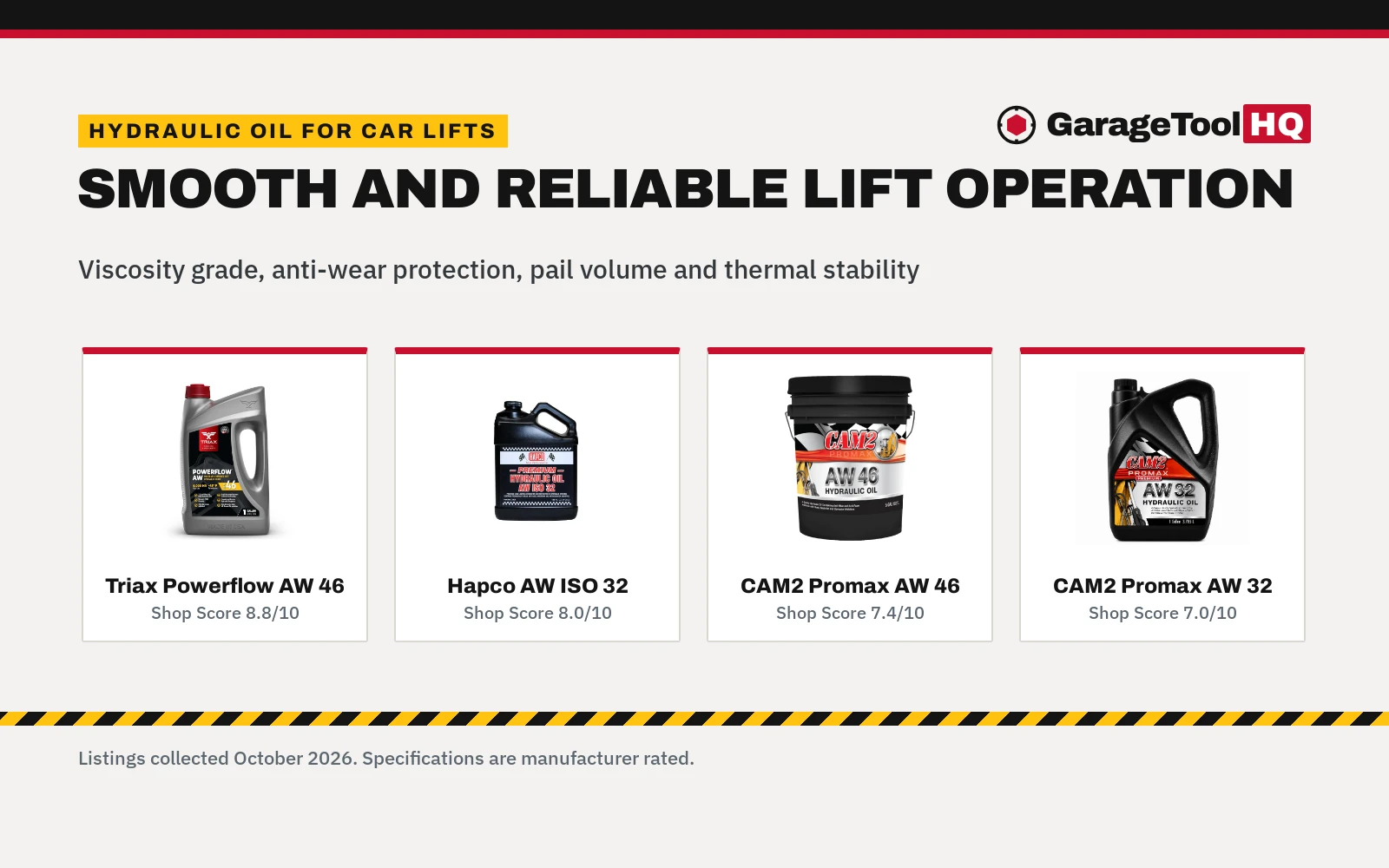
- Top Pick Overall Triax Powerflow AW 46: 6,000-hour severe service rating with triple zinc anti-wear additives and pour point down to -40°F. Check price on Amazon
- Top ISO 32 Pick Hapco AW ISO 32: 1 gallon jug of mineral oil with anti-wear, anti-rust, anti-foam and anti-oxidation additives. Check price on Amazon
- Top 5-Gallon Pail CAM2 Promax AW 46: 5 gallon pail of petroleum-based AW 46 oil with anti-wear, rust and oxidation inhibitors. Check price on Amazon
- Top 1-Gallon AW 32 CAM2 Promax AW 32: 1 gallon container of AW 32 fluid with anti-wear and foam control additives for top-offs. Check price on Amazon
The picks
TRIAX Powerflow AW 46 Multi-Viscosity HLP
A semi-synthetic ISO VG 46 hydraulic oil rated for 6,000 hours of severe service with triple zinc anti-wear additives and a -40°F pour point.
Pros
- Rated for 6,000 hours of severe service
- Triple zinc anti-wear booster pack
- Pour point down to -40°F
- Semi-synthetic virgin base oil
Cons
- 1 gallon size requires multiple bottles for a full reservoir
- No warranty term stated on the listing
- No safety certification stated
- Viscosity listed as SAE 40 in spec table
Premium Hydraulic Oil AW ISO 32 – Anti-Wear
A 1-gallon jug of ISO 32 mineral hydraulic oil with anti-wear, anti-rust, anti-foam and anti-oxidation additives.
Pros
- ISO 32 viscosity grade for hydraulic systems
- Mineral oil base with anti-wear additives
- Anti-rust and oxidation inhibitors
- Made in USA
Cons
- Pour point is not stated
- No warranty term stated on the listing
- Single 1-gallon jug requires multiple jugs for lift refills
- No safety certification stated
CAM2 Promax AW 46 Hydraulic Oil, 5 Gallon Pail
A 5-gallon pail of petroleum-based AW 46 hydraulic oil with rust, oxidation and anti-wear inhibitors.
Pros
- 5-gallon (18.9 liter) pail covers complete lift refills
- Petroleum-based oil with anti-wear additives
- Contains rust, oxidation and corrosion inhibitors
- Anti-foam properties to protect pumps
Cons
- Spec table contradicts title by listing 32.0 centistokes
- Spec table lists part number Promax Aw32
- No warranty term stated on the listing
- 40-pound pail requires careful pouring or a transfer pump
CAM2 Promax Premium AW 32 Hydraulic Oil
A 1-gallon bottle of petroleum-based AW 32 hydraulic fluid with anti-wear, anti-rust and anti-foam additives.
Pros
- AW 32 grade fluid suitable for hydraulic lifts
- Additives protect against wear, rust and corrosion
- Formulated for foam control in hydraulic systems
- 7-pound container is easy to handle
Cons
- Spec table contradicts title by listing 5 gallons and pail
- No warranty term stated on the listing
- Operating temperature range is not stated
- No safety certification stated
More options to compare
 AW ISO 46 Hydraulic Oil 1 Gallon Exceptional anti-wear defenseCheck price on Amazon
 CAM2 Promax AW 46 Hydraulic Oil with Anti-Wear AdditivesCheck price on Amazon
 Republic Oil Premium MIL-PRF-5606 Super Clean Hydraulic Oil 1Check price on Amazon
 ELBALUBES S-HYD 22 Industrial Hydraulic OilCheck price on Amazon
 Oil Pump 12V 100WCheck price on Amazon
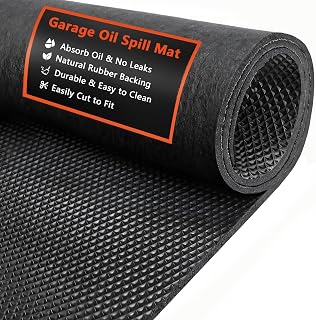 AiBOB Oil Spill MatCheck price on Amazon
Compare the picks
| Model | Shop Score | Viscosity Grade | Base Oil | Volume | Anti-Wear Additives | Pour Point | Warranty |
|---|---|---|---|---|---|---|---|
| Triax Powerflow AW 46 | 9.8/10 | ISO VG 46 | Virgin base oil semi-synthetic | 1 gallon | Triple zinc booster | -40°F | Not stated |
| Hapco AW ISO 32 | 9.6/10 | ISO 32 | Mineral oils with additives | 1 gallon | Anti-wear additives | Not stated | Not stated |
| CAM2 Promax AW 46 | 9.5/10 | ISO VG 46 (spec table lists 32.0 cSt) | Petroleum based oil | 5 gallons | Anti-wear additives | Not stated | Not stated |
| CAM2 Promax AW 32 | 9.5/10 | AW 32 (32.0 cSt) | Petroleum based oil | 1 gallon (spec table lists 5 gal) | Anti-wear additives | Not stated | Not stated |
Specifications are manufacturer rated, as published on each listing and collected 12 October 2026. Where a listing contradicts itself, both figures are shown.
How we scored them
Each hydraulic oil is scored out of 10 on performance, build, value, safety and warranty, with the weights published on our How We Pick page. None of the listings states a formal safety certification such as an ALI listing, so all score zero on safety, and none states a clear warranty term.
| Product | Shop Score | Perf. /35 | Build /25 | Value /25 | Safety /10 | Warranty /5 |
|---|---|---|---|---|---|---|
| Triax Powerflow AW 46 | 9.8 | 33 | 24 | 22 | n/a | 0 |
| Hapco AW ISO 32 | 9.6 | 29 | 21 | 21 | n/a | 0 |
| CAM2 Promax AW 46 | 9.5 | 27 | 19 | 21 | n/a | 0 |
| CAM2 Promax AW 32 | 9.5 | 27 | 18 | 19 | n/a | 0 |
Scores run from 9.2 to 9.8: each product’s point total is placed on that range, so more points always means a higher score. Safety counts only for powered gear or where the listing states safety features; where it does not apply, the score is taken over the remaining 90 points.
What the listings tell you
Reviewing the 4 hydraulic oil listings reveals consistent patterns and several clear documentation gaps. All 4 products list anti-wear and anti-foam additives, with 2 formulas in ISO 32 and 2 in ISO 46. Only 1 listing states an extended service life rating (6,000 hours) and a verified pour point (-40°F). Both CAM2 listings contain internal contradictions between their titles and technical spec tables regarding viscosity rating or container volume. None of the 4 listings states a manufacturer warranty term or a dedicated safety certification.
Best hydraulic oil for car lift: buying guide
ISO 32 vs ISO 46 viscosity grades
Car lift hydraulic power units typically call for either ISO VG 32 or ISO VG 46 hydraulic fluid. ISO 32 is a lighter oil that flows easily during cold shop mornings, allowing the hydraulic cylinders to extend and retract without valve lag. ISO 46 is a heavier viscosity fluid that provides robust hydraulic film strength when operating in warmer climates. Always match the viscosity rating specified on your lift pump reservoir or manual before pouring fluid.
Anti-wear and foam control additives
Hydraulic pumps in automotive lifts generate substantial pressure to raise vehicles. High-pressure gear and piston pumps require anti-wear additives to prevent metal contact across internal gears and relief valves. Foaming is another critical issue: aeration introduces spongy lift movement and pump cavitation. Quality hydraulic oils include anti-foam additives that promote rapid air release so the oil remains incompressible under load.
Container volume: jugs vs pails
Container choice depends on whether you are handling routine maintenance or an initial reservoir fill. A 1 gallon jug is easy to manage without spills when topping off fluid or replacing a single hydraulic hose. A 5 gallon pail supplies enough volume for complete reservoir fills on full-size automotive lifts, though lifting a 40 pound pail onto a high reservoir bracket requires a transfer pump or steady funnel setup.
Internal lift maintenance and workshop safety
Maintaining clean hydraulic fluid is essential for safe hoist operation, but fluid is only one part of lift safety. When performing maintenance on a vehicle, never get under a vehicle on a jack alone, and always support the chassis with rated stands on solid level ground. Position hoist arms strictly at the vehicle owner’s manual lift points. Before setting up a lift, confirm the lift maker’s concrete and ceiling requirements, and consult a licensed electrician for all power unit wiring.
Garage Fit Check
- Container storage: Store 5 gallon pails on the garage floor rather than high shelves, as a full pail weighs 40 pounds. Compact 1 gallon jugs fit standard tool storage shelves.
- Viscosity verification: Check the printed bottle label before breaking the seal to confirm whether you received ISO 32 or ISO 46, verifying it matches your pump reservoir specification.
- Pouring access: Pouring from a 40 pound pail into an elevated power unit reservoir requires a manual siphon or fluid transfer pump to avoid garage floor spills.
- Reservoir capacity: Compare your lift reservoir volume against the fluid count; single 1 gallon jugs work well for routine top-offs, while full reservoir fills demand bulk volume.
Check the lift's rated capacity against your heaviest vehicle, and its ceiling and concrete requirements (thickness and strength) before you buy. Install it exactly as the manufacturer specifies, use the mechanical locks before you go under, and look for ALI certification on the model. See the Automotive Lift Institute (ALI). Read our Safety Disclaimer.
Frequently Asked Questions
Which is the best car lift for a home garage?
The right lift depends on your ceiling height, slab thickness and vehicle weights. Two-post lifts offer full underbody access for suspension and transmission work, while four-post lifts are popular for storage and oil changes. See our guide to the best car lift for home garage setups and our breakdown of car lift types.
Do I need to lift a car to change oil?
You do not necessarily need a full car lift for an oil change. Many home mechanics use floor jacks with stands or drive-on ramps. However, raising the vehicle on a lift provides standing headroom, making it easy to slide an oil drain pan beneath the drain plug and inspect the undercarriage without crawling on the floor.
How tall does a garage need to be for a car lift?
Required ceiling clearance depends on the lift design and vehicle height. Low-rise and scissor lifts work under standard residential ceilings, while full-rise two-post and four-post lifts require substantially taller overhead clearances. Check our guide on car lift size and our review of what ceiling height do I need for a car lift before ordering equipment.
How to properly use a car lift safely?
Always spot the vehicle carefully, position lifting pads under factory lift points, raise the vehicle slightly off the ground to verify stability, and lower the carriage onto mechanical safety locks before working underneath. Read our step-by-step tutorial on how to use a 2 post lift for full garage procedures.
What hydraulic oil viscosity should I use in my car lift?
Most car lift manufacturers recommend either ISO VG 32 or ISO VG 46 anti-wear hydraulic oil. Check the label on your power unit hydraulic reservoir or the manufacturer manual. In colder shops, ISO 32 provides quicker flow, while warmer climates often benefit from the higher film strength of ISO 46.
Related: our car lifts hub, the best car lift for home garage, our guide to car lift types and our car lift size guide. Also see our guide on how to use a 2 post lift. Also see our comparison of 2-post vs 4-post lift. Also see our guide on what ceiling height do I need for a car lift. Also see our guide on how thick does concrete need to be for a car lift. Also see our overview of what does ALI certified mean for car lifts. Also see our guide on can you put a car lift in a residential garage. Also see our guide on how to choose a car lift for home garage. Also see our review of the best car lift for low ceiling. Also see our comparison of symmetric vs asymmetric 2 post lift. Also see our comparison of QuickJack vs scissor lift. Also see our guide to scissor lift maintenance. Also see our guide on how to use scissor lift. Also see our QuickJack 6000TLX review. Also see our 4 post lift size guide.