QuickJack vs Scissor Lift: Which One Should You Buy?
How QuickJack and scissor lifts compare on under-car access, lifting height, garage storage, and setup so you can choose the right car lift for your home shop.

On this page
Top picks at a glance
As an Amazon Associate we earn from qualifying purchases.
- 1
 QuickJack 6000TLX Portable Car Lift9.5/10View on Amazon
- 2
 QISHIDA 7000 LBS Portable Car Lift Mid Rise Scissor Lift 110V9.6/10View on Amazon
- 3
 KATOOL Portable Car Lift Mid Rise Scissor Lift 110V Electric9.6/10View on Amazon
- 4
 DIHOOL Electric Scissor Lift TableView on Amazon
- 5
 DIHOOL Electric Scissor Lift Table 330LbsView on Amazon
QuickJack vs scissor lift: choose QuickJack if you need open center access under the chassis for driveline, exhaust, and transmission work, or choose a scissor lift if you want higher vehicle elevation and a rigid platform for brakes, suspension, and detailing. QuickJack uses separate parallel lifting frames that slide in from the sides, leaving the entire middle of the vehicle unobstructed. A mid-rise scissor lift uses linked scissor assemblies and crossmembers positioned directly beneath the floor pan, providing extra rise while restricting reach to the center tunnel. Both options suit home garages with low ceilings, but each accommodates different repair priorities.
More options to compare
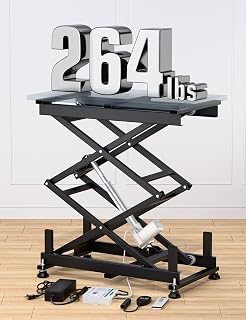 DIHOOL Electric Scissor Lift TableCheck price on Amazon
 DIHOOL Electric Scissor Lift Table 330LbsCheck price on Amazon
GarageToolHQ earns a commission when you buy through links on our product pages, at no extra cost to you. Read our affiliate disclosure.
Below: how the frame designs differ, why under-car center clearance matters for specific repair jobs, a side-by-side comparison table, and a safety checklist before lifting your vehicle.
QuickJack vs scissor lift: frame design and under-car access
The mechanical layout of each lift determines where you can reach once the car is elevated. Selecting between them comes down to which components you plan to service:
- Center tunnel clearance. QuickJack consists of dual independent frames positioned along the vehicle rocker panels. Because no hydraulic crossmembers or structural plates span the area between the frames, you have an open corridor from front to rear. That open access simplifies dropping an exhaust system, unbolting a transmission, servicing a driveshaft, or reaching an oil pan.
- Belly obstruction. A scissor lift relies on crisscrossing steel arms, hydraulic cylinders, and base stabilizing bars situated directly beneath the vehicle floor. While this design yields a stable lifting platform, the mechanism blocks the center tunnel. You cannot easily pull a transmission or drop a center exhaust section on a scissor lift without interference from the framework.
- Wheel and suspension access. Both styles leave wheels and wheel wells open for brake jobs, tire rotations, coilover swaps, and detailing. Because the vehicle rests on lifting blocks along pinch welds or chassis lift pads, the suspension hangs free.
- Perimeter and side working room. Both lifts leave the wheels and outer wheel wells unobstructed for tire and suspension work. However, because QuickJack frames sit beneath the rocker pinch welds, rolling underneath the vehicle on a creeper is done from the front or rear end. On a scissor lift, the central lifting mechanism fills the underside between the wheels, preventing cross-chassis creeper travel entirely.
QuickJack or mid rise scissor lift: design comparison
| Feature | QuickJack | Mid-Rise Scissor Lift |
|---|---|---|
| Under-Car Center Access | Fully open center corridor for exhaust, transmission, and driveshaft work | Blocked by scissor linkage, base frames, and hydraulic synchronization bars |
| Lifting Height Profile | Low-rise clearance tailored for low ceilings and creeper maintenance | Mid-rise elevation offering higher vehicle clearance for seated work |
| Storage and Portability | Independent mobile frames hang on wall mounts or roll into garage corners | Heavy platform assembly that remains parked in the bay or rolls with a tow dolly |
| Drive-Over Clearance | Frames slide under from the sides; floor remains completely bare when stored | Vehicle drives over the collapsed scissor frame when parked in the bay |
| Power Unit Source | Portable 120V electric-hydraulic power unit or 12V direct current option | Standalone hydraulic pump console, commonly running on standard 120V power |
| Vehicle Spotting Setup | Individual frames align manually under rocker pinch welds or factory jack points | Drive vehicle over platform, position rubber blocks, and swing pads to lift points |
Your available ceiling clearance and planned projects dictate which design fits your shop. Drivers planning extensive transmission swaps or exhaust fabrication require open center space, while owners focusing on brake service, body repair, and tire changes benefit from the higher elevation of a scissor platform.
How to set up and operate a garage car lift safely: the checklist
- Inspect your concrete floor. Ensure your slab is level, solid, and free from deep cracks or crumbling aggregate. Read our guide on how thick concrete needs to be for a car lift to confirm your foundation supports vehicle lifting equipment.
- Verify overhead clearances. Measure the total distance from the floor to the lowest overhead obstruction, including garage door openers, tracks, and light fixtures. Consult our breakdown on what ceiling height do I need for a car lift before raising any vehicle.
- Locate factory lift points. Consult your vehicle owner’s manual for designated structural jacking locations. Never place lift pads under body panels, floorboards, or suspension links that cannot carry the vehicle weight.
- Position lifting blocks securely. Ensure the rubber support blocks sit squarely beneath the factory pinch welds or frame rails before engaging the hydraulic pump.
- Raise slightly and check balance. Lift the vehicle just until the tires leave the pavement. Vigorously shake the bumper to confirm the car is balanced and stable before raising it to full working height.
- Lower onto mechanical safety locks. Hydraulic pressure alone must never support an elevated vehicle. Always raise past the lock position and settle the mechanical safety arms onto their steel stops before beginning work.
- Clear hoses and power cords. Keep hydraulic lines and electrical wiring clear of pinch points, scissor hinges, and rolling wheels to prevent fluid leaks or line damage.
- Never exceed rated capacity. Compare your vehicle curb weight and gross vehicle weight rating against the lift maker stated capacity plate before spotting the car.
- Confirm flat ground. Operate only on a flat, level concrete surface; never position or cycle a portable lift on an asphalt driveway, gravel, or sloped apron.
Never place any part of your body under a vehicle supported solely by hydraulic fluid pressure. When operating a car lift, always lower the assembly onto its mechanical safety locking bars before starting work. If you are instead lifting with a conventional floor jack, never get under the vehicle on the jack alone; always support it on rated jack stands positioned on solid, level ground, as detailed in our guide on how to use a floor jack safely.
Check the lift's rated capacity against your heaviest vehicle, and its ceiling and concrete requirements (thickness and strength) before you buy. Install it exactly as the manufacturer specifies, use the mechanical locks before you go under, and look for ALI certification on the model. See the Automotive Lift Institute (ALI). Read our Safety Disclaimer.
QuickJack vs scissor lift: capacity, height and power compared
When selecting portable lifting equipment, review the published manufacturer specifications for capacity, maximum height, and frame weight:
- Load capacity: Published portable lift listings show common ratings engineered for passenger cars, SUVs, and light trucks. In published specifications, VEVOR lists portable car lift models with capacities of 5,000 pounds and 7,000 pounds, while Real Relax also lists a 7,000-pound rated portable lift.
- Maximum lifting height: Compact portable frame lifts offer varied vertical reach depending on whether standard rubber pads or riser columns are used. VEVOR lists a lifting range of 5.12 inches to 18.5 inches with pads, expanding to a 25.6-inch maximum height with column adapters on its 5,000-pound model. For its 7,000-pound portable listings, VEVOR specifies a lifting range from 6.5 inches to 20 inches with pads, reaching up to a 26.8-inch maximum height with riser columns, and Real Relax publishes the same 26.8-inch maximum height for its 7,000-pound model.
- Power requirements: Portable hydraulic power units operate on standard electrical circuits. The listings from VEVOR and Real Relax specify 120V power units, allowing convenient operation from conventional garage wall outlets. For permanent commercial installations or higher-voltage shop wiring, always hire a licensed electrician.
- Assembly weight and storage: Portable frame systems balance structural steel strength with mobility. VEVOR lists an item weight of 372.6 pounds for its 5,000-pound lift and 410.1 pounds for its pneumatic 7,000-pound model, while Real Relax lists an item weight of 424.8 pounds for its 7,000-pound lift. Real Relax also specifies a minimum vehicle load requirement of 220 pounds to lower the unloaded lift structure.
When deciding whether to install a lift in your home bay, review our detailed guide on how to choose a car lift for home garage and see whether you can put a car lift in a residential garage without structural modifications.
Certification and concrete requirements
Safety certification provides verified reassurance when working beneath thousands of pounds of elevated steel. When shopping for garage lifts, look for certified construction and learn what ALI certified means for car lifts to understand national safety standards. For home mechanics comparing larger equipment, explore our comparison of a 2-post vs 4-post lift to see how full-height options differ from mid-rise platforms. If your bay features ceiling restrictions, consult our recommendations for the best car lift for low ceiling spaces.
Frequently Asked Questions
Can I change oil or drop an exhaust with a scissor lift?
You can change engine oil if the drain plug and oil filter sit outside the central footprint of the scissor platform, but dropping a center exhaust section or servicing a transmission is severely hindered. The crossmembers and scissor linkage block the centerline of the vehicle belly. QuickJack leaves that center corridor unobstructed, making it far superior for drivetrain and exhaust repairs.
Can QuickJack or a scissor lift fit in a low-ceiling garage?
Yes. Both lift types are popular choices for standard residential garages with ceilings too low for a full-height 2-post lift. Measure your garage ceiling height and vehicle roofline to confirm you have adequate overhead clearance before raising the vehicle to its maximum mechanical stop.
Do QuickJack and scissor lifts need to be bolted to the floor?
QuickJack frames and portable mid-rise scissor lifts built for home garages are free-standing units that do not require floor anchor bolts, unlike permanent commercial 2-post lifts. However, both styles must operate on a flat, level, solid concrete floor capable of supporting the concentrated vehicle weight without tipping or cracking.
How do I store QuickJack compared to a scissor lift?
QuickJack frames feature integrated wheels that allow you to roll each frame individually to a wall, prop them vertically, or hang them on dedicated wall brackets to keep your floor clear. A mid-rise scissor lift is a much heavier steel assembly that often remains centered in the bay where cars drive over it, or requires a dedicated caster dolly to roll aside.
Are portable car lifts safe to work under?
Yes, provided you lower the lift onto its mechanical safety locking bars before getting underneath. Never work beneath any lift supported only by hydraulic fluid pressure. Mechanical safety locks physically support the vehicle on solid steel stops, protecting you against hydraulic pressure loss. If your repair only requires partial clearance for oil changes or inspections without removing wheels, compare simpler support equipment in our guide on car ramps vs jack stands.
Which lift is better for brake and suspension work?
Both lifts excel at wheel, brake, and suspension servicing because both pick up the vehicle by its rocker pinch welds or frame lifting pads, leaving the wheels completely unloaded. A mid-rise scissor lift provides slightly higher elevation for seated creeper comfort, while QuickJack offers faster setup and easier garage storage.
Related: our guide on how to choose a car lift for home garage, our recommendations for the best car lift for home garage, setup advice in how to use scissor lift, overhead planning in what ceiling height do I need for a car lift, and our complete car lifts hub.