Car Ramps vs Jack Stands: Differences Explained
Car ramps and jack stands compared for home garages: how each supports the vehicle, working clearance, setup speed, the jobs each suits, and reviewed examples.

On this page
Top picks at a glance
As an Amazon Associate we earn from qualifying purchases.
- 1
 Ironton Poly Car Ramp Set9.8/10View on Amazon
- 2
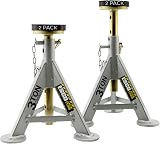 3 Ton Performance Jack Stands9.8/10View on Amazon
- 3
 OULEME 2.44" Lift Low Profile Car Service Ramp9.7/10View on Amazon
- 4
 MaxxHaul 50947 Lift Stackable Vehicle Car Ramp 6500 LBSView on Amazon
- 5
 MAXXHAUL 50699 Low Profile Car Ramps for Vehicle MaintenanceView on Amazon
- 6
 2.6" Lift Low Profile Car Ramps for MaintenanceView on Amazon
- 7
 Loading RampsView on Amazon
- 8
 Ramps Low Profile Plastic Car Service Ramps 3 Ton TruckView on Amazon
- 9
 MaxxHaul 50709 Detachable Extendable Car Ramp SetView on Amazon
Verdict: In the choice between car ramps vs jack stands, choose car ramps if you need rapid drive-on elevation for oil changes, fluid servicing, and underside inspections where the tires can stay on the vehicle. Choose jack stands if you need to remove the wheels for brake jobs, suspension work, or tire rotations, or if you need taller, adjustable working clearance.
Both tools support a vehicle for garage maintenance, but they work on fundamentally different principles. Car ramps elevate the vehicle on its tires via a fixed incline, while jack stands support the chassis or pinch welds once you lift the vehicle with a floor jack. This comparison examines how both options compare in clearance, stability, setup speed, and safety, followed by four concrete examples from the listings we reviewed.
GarageToolHQ earns a commission when you buy through links on this page, at no extra cost to you. Read our affiliate disclosure.
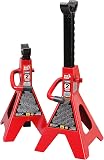


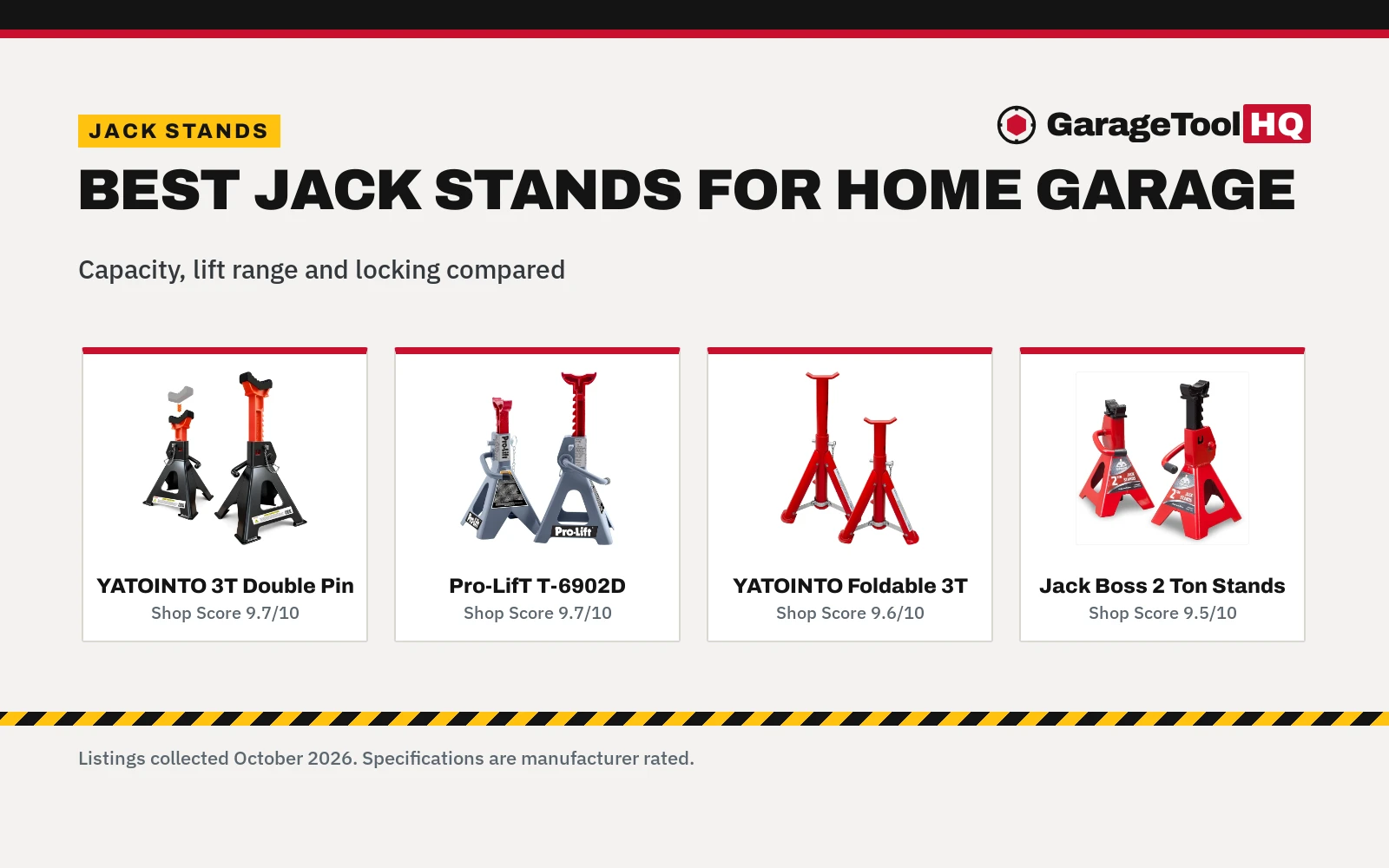
BIG RED T42202 Torin Steel Jack Stands
A 2 ton steel jack stand pair with a 10-13/16 to 16-9/16 in height range and stated ASME standards compliance.
Pros
- 2 ton (4,000 lb) load capacity per pair
- 10-13/16 to 16-9/16 in adjustable height range
- Forged steel construction with welded frame design
- Stated compliance with ASME standards
Cons
- Spec table lists minimum height as 27.5 centimeters while bullets state 10-13/16 inches
- Single ratchet bar lock without secondary locking pin
- Requires a floor jack to lift vehicle before positioning
- Spec table lists vehicle compatibility as Car only, while bullets include small cars, SUVs, and light trucks

BIG RED T46002A Torin Steel Jack Stands
A 6 ton double-locking steel jack stand pair with a 15-3/8 to 23-13/16 in lift range and removable support pin.
Pros
- 6 ton (12,000 lb) load capacity
- 15-3/8 to 23-13/16 in lifting range for taller clearance
- Double locking design with sawtooth ratchet bar and removable support pin
- Large 10.6 x 9.3 in pyramid foot base for stability
Cons
- Spec table contradicts title by listing capacity as 2 ton and style as basic
- No safety standards or certifications stated in listing
- 18 pounds item weight makes it heavier to move around the garage
- Tall 15-3/8 in minimum height cannot fit under low-clearance vehicles without high floor jack lift

ROBLOCK Car Ramps for Lift and Vehicle
A pair of 20,000 lb GVW impact-resistant plastic car ramps with a 4.2 in lift height and 9.8 in width.
Pros
- 20,000 lb GVW rated load capacity
- 9.8 in wide platform accommodates wider tires
- Internal honeycomb modular design with bottom non-slip pads
- 13-degree slope allows drive-up access for low-chassis cars
Cons
- No warranty term is stated
- Item weight is not stated in the listing
- Lifting height of 4.2 in provides limited clearance compared to jack stands
- Model number listed as RBTS266 while manufacturer part number says RBTS265

HOXWELL Portable Car Ramps for Oil Changes High
A pair of 10,000 lb GVW plastic car ramps weighing 8.8 lb per pair with a 4.1 in lift height.
Pros
- Lightweight design at 8.8 lb per pair for easy carrying and storage
- 10,000 lb GVW rated load capacity
- Longer 31.5 in length with a 13-degree approach angle for low profiles
- Internal honeycomb modular design with anti-slip texture and drainage slots
Cons
- No warranty term is stated
- Narrower 8.1 in width limits support for extra-wide tire profiles
- Lift height limited to 4.1 in for under-car access
- Spec table displays load capacity in scientific notation as 1E+4 pounds
More options to compare
 MaxxHaul 50947 Lift Stackable Vehicle Car Ramp 6500 LBSCheck price on Amazon
 MAXXHAUL 50699 Low Profile Car Ramps for Vehicle MaintenanceCheck price on Amazon
 2.6" Lift Low Profile Car Ramps for MaintenanceCheck price on Amazon
 Loading RampsCheck price on Amazon
 Ramps Low Profile Plastic Car Service Ramps 3 Ton TruckCheck price on Amazon
 MaxxHaul 50709 Detachable Extendable Car Ramp SetCheck price on Amazon
Side by side
| Car ramps | Jack stands | Verdict | |
|---|---|---|---|
| How it holds the vehicle | On its tires, on elevated ramp platforms | Under frame or pinch-weld lift points, tires off the ground | Ramps keep wheels on; stands allow wheels-off work |
| Best jobs | Oil changes, fluid servicing, inspections | Brakes, suspension, tire rotations, wheel bearings | Ramps for oil and fluids; stands for brakes and tires |
| Wheels-off work | No; wheels remain loaded on the ramp deck | Ready once vehicle is raised and secured on saddles | Jack stands required for wheel removal |
| Lifting equipment needed | None; drive vehicle directly up the ramp incline | Requires a separate hydraulic floor jack to lift vehicle | Car ramps require no extra floor jack |
| Setup speed | Fast; position in line with tires and drive forward | Multi-step; position floor jack, lift, place stands, lower | Car ramps set up faster |
| Working height | Fixed by ramp height (4.1 to 4.2 in on reviewed examples) | Adjustable (up to 16-9/16 in or 23-13/16 in on reviewed examples) | Jack stands provide taller working clearance |
| Surface requirements | Level, solid pavement or garage floor | Flat, solid, level concrete only; never asphalt or dirt | Both require solid, level ground |
| Example capacity | 10,000 lb GVW (HOXWELL) to 20,000 lb GVW (ROBLOCK) | 2 ton (4,000 lb) to 6 ton (12,000 lb) per pair (BIG RED) | Both sides offer ample capacity for passenger vehicles |
| Example lift height | 4.1 in (HOXWELL) and 4.2 in (ROBLOCK) | 10-13/16 to 16-9/16 in (T42202) and 15-3/8 to 23-13/16 in (T46002A) | Jack stands reach substantially higher |
| Stated warranty | No warranty term is stated on either ramp listing | 1-year limited warranty stated on both jack stand listings | Jack stand listings state a 1-year warranty term |
Example figures are manufacturer rated, as published on each listing and collected 9 October 2026.
How each tool supports the vehicle
Car ramps support the vehicle entirely through its tires. You position the ramps directly in front of the driven or non-driven wheels and drive forward onto the elevated platforms until the tires settle into the curved wheel wells against the front stop bumpers. The vehicle’s suspension remains loaded, and the wheels cannot come off. Jack stands, by contrast, support the vehicle by its structural frame rails, subframe, or factory pinch-weld lift points. Because the vehicle is lifted by a hydraulic floor jack before the stands are placed beneath it, the wheels and suspension hang completely free, providing full access to wheel hubs, brake rotors, and steering components.
Working height and clearance
Working clearance is a major divider between the two options. Car ramps offer a fixed lift height determined entirely by ramp geometry. In the examples reviewed, the HOXWELL ramps provide 4.1 in of lift height, while the ROBLOCK ramps deliver 4.2 in. This provides enough clearance under a stock car or light SUV for sliding an oil drain pan and reaching the filter, but headroom remains limited. Jack stands provide substantially taller, adjustable working heights. The BIG RED T42202 adjusts from 10-13/16 to 16-9/16 in, and the larger BIG RED T46002A extends from 15-3/8 to 23-13/16 in. That extra clearance makes maneuvering creepers, exhaust components, and heavy tools much easier.
Floor requirements and setup speed
Setup speed strongly favors car ramps for straightforward maintenance. Driving onto a pair of ramps takes mere seconds, requiring no mechanical pumping or positioning of secondary support hardware. However, ramps require a flat, smooth surface with adequate traction to avoid sliding forward during approach. Both the ROBLOCK and HOXWELL listings highlight rubber non-slip base pads and textured surfaces designed to resist displacement. Jack stands demand a more deliberate, multi-step process: positioning a floor jack under a designated jacking point, raising the vehicle, inserting stands under approved structural points, and carefully lowering the vehicle weight onto the saddles. Learn correct technique in our guide on how to use a floor jack safely. Jack stands must only be placed on level, solid concrete slabs, never on asphalt, gravel, or soft ground.
Car ramps vs jack stands: wheels-on vs wheels-off work
The specific maintenance task you perform dictates which tool you must use. If your job requires removing a tire, car ramps are completely out of the question. Brake pad and rotor replacements, caliper servicing, suspension strut replacements, wheel bearing jobs, and tire rotations strictly require jack stands. Conversely, for quick oil changes, transmission fluid drain-and-fills, differential fluid changes, and exhaust inspections, car ramps eliminate the effort of operating a floor jack while keeping the vehicle resting naturally on its suspension.
Storage and garage space
Jack stands are relatively compact, vertical tools. The BIG RED T42202 stands measure 7.09 by 6.3 by 10.83 in and weigh 10.6 pounds per pair, making them easy to tuck into a cabinet corner or under a workbench. Car ramps occupy a larger footprint due to their gradual drive-on slope. The HOXWELL ramps measure 31.5 by 8.1 by 4.9 in, though their 8.8 lb pair weight makes them portable, while the ROBLOCK ramps measure 26 by 9.8 by 5.9 in. Many DIYers nest ramps together or hang them on garage wall hooks to preserve floor space.
Choose car ramps if
- You primarily perform oil changes and fluid servicing
- You want fast drive-on setup without pumping a floor jack
- You prefer keeping the vehicle supported on its tires
- Your jobs do not require removing wheels
Choose jack stands if
- You perform brake, suspension, or tire maintenance
- You need wheels-off access where components hang free
- You require tall, adjustable working clearance up to 23-13/16 in
- You already own and operate a hydraulic floor jack
Example products
For more choices, see the best car ramps, and for wheels-off support, the best jack stands.
A jack is for lifting, not holding. Never work under a vehicle supported only by a jack: set it on rated jack stands, on solid, level ground, at the manufacturer's lift points, chock the wheels, and give the car a firm shake before you go under. Read our Safety Disclaimer.
Frequently Asked Questions
Are car ramps safer than jack stands?
Both tools are safe when used strictly according to manufacturer instructions on solid, level surfaces. Car ramps provide a wide resting surface for the tires with no moving mechanical parts. Jack stands provide secure mechanical support once properly positioned under factory lift points, but core safety dictates that you must never get under a vehicle on a jack alone; always lower the vehicle fully onto rated stands on solid level ground before starting work.
Can you do brake work with car ramps?
No. Car ramps support the vehicle by its tires, keeping the wheels loaded and mounted. Any maintenance requiring wheel removal, including brake rotor and pad replacements, requires raising the vehicle with a jack and resting it securely on jack stands.
Can you use car ramps and jack stands together?
Using car ramps on one axle while using jack stands on the other is not recommended for home mechanics. Uneven lifting angles can cause the vehicle to shift or roll off the ramps. Always chock the wheels that remain on the ground when elevating either axle.
How much clearance do car ramps give compared to jack stands?
Car ramps typically offer modest lift heights suited for oil drain pans. In the examples reviewed, the HOXWELL ramps provide 4.1 in and the ROBLOCK ramps provide 4.2 in of lift. Jack stands reach much higher: the BIG RED T42202 extends up to 16-9/16 in, and the BIG RED T46002A reaches up to 23-13/16 in.
Where should jack stands be placed under a vehicle?
Always place jack stands exclusively under manufacturer-approved lift points specified in your vehicle owner’s manual, such as reinforced pinch welds, frame rails, or structural suspension crossmembers. Never place jack stands under floor pans, steering linkages, or drive shafts.
Related: how to use a floor jack safely, the best jack stands, the best car ramps, what size jack stands do I need, how many jack stands do you need, and our jacks and stands hub.