Car Lift Safety Stands: Types and Use
Car lift safety stands hold a lifted vehicle steady from below, and this guide covers the types, the setup steps and the underhoist stands that fit a home garage.

On this page
Top picks at a glance
As an Amazon Associate I earn from qualifying purchases.
- 1
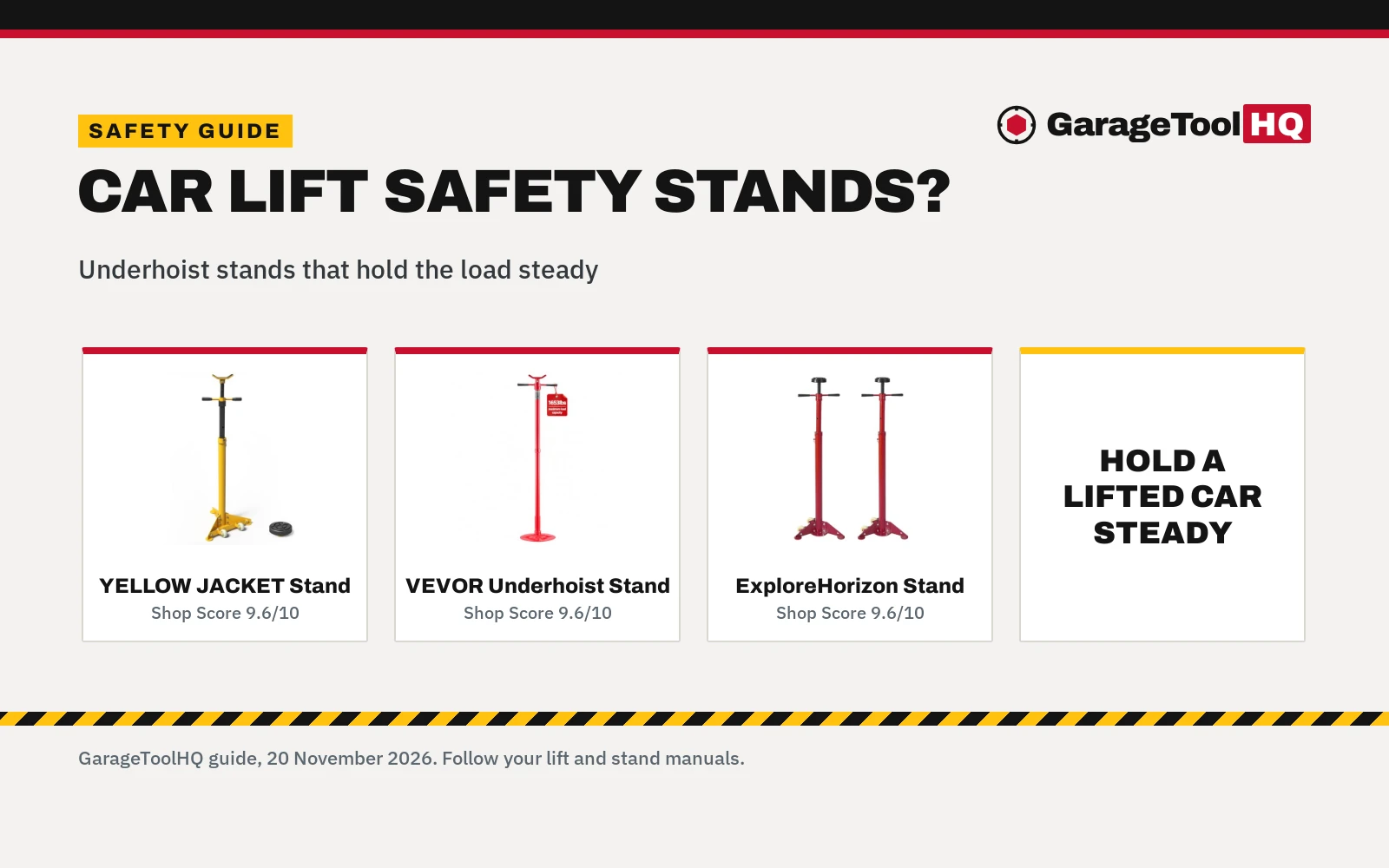
 YELLOW JACKET Underhoist Support Stand9.6/10View on Amazon
- 2
 VEVOR Underhoist Support Stand, 3/4 Ton (1653 lbs)9.6/10View on Amazon
- 3
 ExploreHorizon 2PACK Underhoist Support Stand9.6/10View on Amazon
The car is up on the lift, the wheels are off, and the next job takes you underneath. That is when car lift safety stands do their work: they hold a lifted vehicle steady from below, so the lift is not the only thing between you and the car. This guide explains what these stands are, the types you will see, how to set one, and which underhoist stands fit a home garage lift.
GarageToolHQ earns a commission when you buy through links on our product pages, at no extra cost to you. Read our affiliate disclosure.
Below: what an underhoist stand is, how the types differ, the setup steps to follow, and the stands in this guide.
YELLOW JACKET Underhoist Support Stand
A 3/4 ton underhoist support stand rated at 1650 lbs, with two wheels, a bearing mounted spin handle, a contoured saddle with rubber pads and a self-locking screw, adjusting from 43.3 to 70.9 inches.
Pros
- Two wheels roll the stand into place
- Contoured saddle with rubber pads for a firm hold
- Bearing mounted spin handle with a rubber cover
- 1 year warranty, the longest term here
Cons
- 1650 lbs capacity, the lowest rating here
- 70.9 inch maximum height, the lowest maximum height here
- 43.3 inch minimum height does not fit low lifts
- Contoured saddle suits round contact points, so check fit on flat lift points
VEVOR Underhoist Support Stand, 3/4 Ton (1653 lbs)
A 3/4 ton underhoist support stand rated at 1653 lbs, with a threaded screw that adjusts from 54.02 to 83.86 inches, a bearing mounted spin handle and a grooved rubber-and-metal top pad.
Pros
- Adjusts from 54.02 to 83.86 inches, the tallest reach here
- Self-locking threaded screw holds the set height
- Grooved rubber-and-metal top pad limits lateral movement
- Steel body with a large, stable base and protective coating
Cons
- 54.02 inch minimum height does not fit low lifts
- No warranty term is stated
- 25.13 lb to carry and position by hand
- One stand in the box, so a pair needs a second order
ExploreHorizon 2PACK Underhoist Support Stand
A 3/4 ton underhoist support stand rated at 1653.5 lbs, with a U-shaped tray with rubber padding, a self-locking threaded screw rod and a 6 mm circular base, adjusting from 38.4 to 75.4 inches.
Pros
- 38.4 inch minimum height, the lowest minimum height here
- Self-locking threaded screw rod holds the set height
- U-shaped tray with rubber padding for a non-slip hold
- 6 mm circular base with 3 mm triangular gussets
Cons
- 53.79 lb listed item weight, the heaviest listing here
- 30 day manufacturer warranty, far shorter than a 1 year term
- 75.4 inch maximum height is lower than the tallest stand here
- 12.0 inch square base needs a clear patch of floor
Car lift safety stands: what they are and what they do
An underhoist support stand is a screw-type stand that props up a vehicle already raised on a lift. It does not lift the car itself. You set it under a frame point or a vehicle component, turn the handle to raise the threaded screw until the pad meets the contact point, and the self-locking screw holds that height while you work. The stands in this guide are rated at 1650 to 1653.5 lbs, which suits support work under one side of a lifted vehicle, not lifting the whole car.
That support matters because a lift on its own leaves the vehicle resting on its arms, and a stand under an added support point can steady the load for underbody service, and the VEVOR maker states that its stand helps reduce tilt. The stands here suit underbody inspections, suspension service, wheel work and lift-assisted repairs.
Types of underhoist stands
Every stand here is the same basic type: a screw stand with a self-locking threaded screw and a rubber-padded top. The VEVOR and YELLOW JACKET stands use a bearing mounted spin handle. Reach, base and movement are where they differ.
- Height range. Taken together, the stands here span 38.4 inches at the low end to 83.86 inches at the high end, and no single stand covers that full span, so match each stand’s own range to the height your lift holds the car.
- Top pad. A grooved rubber-and-metal pad, a U-shaped tray with rubber padding or a contoured saddle with rubber pads: each provides a padded contact surface at the contact point.
- Base. A large steel base, a 6 mm circular base with 3 mm triangular gussets, or a 12-inch base with two wheels for rolling the stand into place.
Check the height range and the shape of the top pad against the lift point you plan to use before ordering.
How to set an underhoist stand
- Park the stand on solid, level ground, never on soft or uneven floors.
- Set it under a frame point or component named in the owner’s manual and stand manual, and keep the lift on the concrete and under the ceiling height your lift maker requires.
- Raise the screw to meet the contact point. Turn the spin handle until the pad or saddle meets the vehicle, then let the self-locking screw hold the height.
- Check the stand before going under: the pad flat on the contact point, the base flat on the floor.
- Never work under a vehicle held up by a jack alone. A jack lifts; rated jack stands hold a vehicle raised by a jack. With a lift, keep the vehicle on the lift and raise the underhoist stand to meet it; do not lower the lift onto an underhoist stand or use one as the sole support.
Never get under a vehicle supported only by a jack. Lower it onto rated stands on solid level ground first.
A jack is for lifting, not holding. Never work under a vehicle supported only by a jack: set it on rated jack stands, on solid, level ground, at the manufacturer's lift points, chock the wheels, and give the car a firm shake before you go under. Read our Safety Disclaimer.
The stands: underhoist supports for a lifted car
Each stand below steadies a lifted vehicle from below while you work under it, so pick the height range that matches your lift and check the top pad and base against your floor and lift points.
FAQ: garage tools
Can I work under a car held up by a jack alone?
No. A jack lifts the car; it does not hold it. Lower the car onto rated jack stands on solid level ground, set them under the lift points in the owner’s manual, and only then work underneath.
What height range do I need in an underhoist stand?
Match the range to the height your lift holds the car. Taken together, the stands in this guide span 38.4 inches at the low end to 83.86 inches at the high end, and no single stand covers that full span, so check your lift height against each stand’s own range before ordering.
Do underhoist stands replace jack stands?
No. An underhoist stand supports or steadies a vehicle or component already raised on a lift, while a jack stand holds a car raised by a jack. Neither lifts the car, and both belong on solid level ground.
What should the stand sit on?
Solid, level ground, such as the concrete floor your lift maker requires. Never set a stand on soft ground or an uneven floor, and keep the base flat.
How do I know the stand is locked?
Each stand here uses a self-locking threaded screw that the maker states holds the set height. Follow the stand manual to confirm the screw is locked; a flat pad and flat base check placement, not locking, before going under.
Related: floor jack vs jack stands, how to use a jack lift, floor jack safety bar and the jacks and stands hub.