Carbon Pile vs Digital Battery Tester: Which One Should You Buy?
Carbon pile vs digital battery tester: how variable resistive load, digital signal analysis and fixed-load dial testers compare, with listing figures.

On this page
Top picks at a glance
As an Amazon Associate we earn from qualifying purchases.
- 1
 BT60 PRO 2-120AH Battery Tester 6V/12V/24V 100-3000 CCA QR9.7/10View on Amazon
- 2
 ANCEL BA101 Car Battery Tester9.6/10View on Amazon
- 3
 FOXWELL BT705 Car Battery Tester 24V 12V9.6/10View on Amazon
- 4
 Clore Automotive Solar 1874 500 Amp Carbon Pile Battery LoadView on Amazon
- 5
 Clore Automotive Solar 1876 1000 Amp Carbon Pile Battery LoadView on Amazon
- 6
 500 Amp Carbon Pile Load Tester Test 12 Volt BatteryView on Amazon
- 7
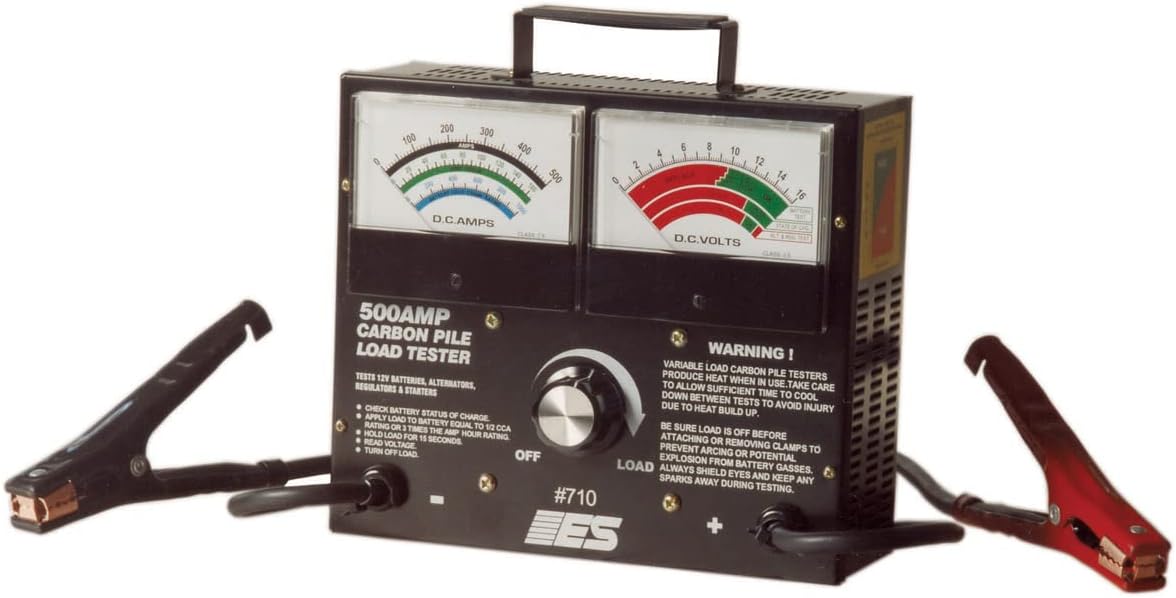 Electronic Specialties Battery Tester Carbon PILE-500ampView on Amazon
- 8
 FJCView on Amazon
Carbon pile vs digital battery tester comes down to how the tool asks the battery its question. A carbon pile tester applies a real, variable resistive load, hundreds of amps, and watches the voltage hold up on a gauge. A digital tester sends a small signal through the battery and computes health from the response, then reports state of health and state of charge on a screen. Both answer “is this battery good,” but the carbon pile does it with heat and current while the digital does it with math. The listings here cover both, plus the analog fixed-load testers in between.
More options to compare
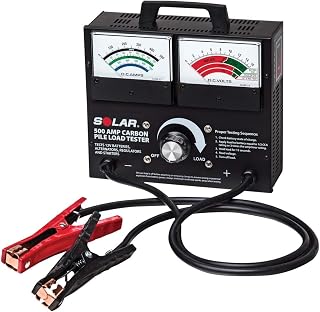 Clore Automotive Solar 1874 500 Amp Carbon Pile Battery LoadCheck price on Amazon
 Clore Automotive Solar 1876 1000 Amp Carbon Pile Battery LoadCheck price on Amazon
 500 Amp Carbon Pile Load Tester Test 12 Volt BatteryCheck price on Amazon
 Electronic Specialties Battery Tester Carbon PILE-500ampCheck price on Amazon
 FJCCheck price on Amazon
GarageToolHQ earns a commission when you buy through links on our product pages, at no extra cost to you. Read our affiliate disclosure.
Carbon pile vs digital battery tester: the short answer
Pick a carbon pile tester when you want a true high-amp load: the Clore Solar 1874 varies the load to 500 amps for batteries to 1000 CCA on 6 and 12 volts, and the 1876 goes to 1000 amps for batteries to 2000 CCA on 6, 12 or 24 volts. Pick a digital tester when you want fast, cool diagnostics with more than a pass or fail: the VDIAGTOOL BT500 covers 5 to 3000 CCA on 6, 12 and 24 volts and reports voltage, resistance, state of health and state of charge, plus cranking and charging system checks. Between them sit the analog fixed-load testers, 100 amps on 12 volts with a dial, from NEIKO, OEMTOOLS, Battery Tender, OTC, KAIHENG, TOPDC and Lianshi.
How a carbon pile tester works
A carbon pile is a stack of carbon discs whose resistance changes as you turn the load knob, so it draws a real, adjustable current from the battery, the way a starter motor does. The Clore Solar 1874 varies the load to 500 amps and rates batteries to 1000 CCA; the 1876 varies to 1000 amps and rates batteries to 2000 CCA with a 56 inch cable reach, at 8.8 pounds and 16.5 by 16 by 11.5 inches. Both use large easy-to-read gauges and heavy-duty clamps the listing says penetrate corrosion on the terminals, and the 1876 states a 1 year warranty. One listing quirk: the 1874 spec table lists its load type as fixed while the title and bullets say variable load to 500 amps and carbon pile, so trust the title and bullets. The price of a real load is heat and size: these are bench-scale tools, not pocket ones.
How a digital tester works
A digital tester does not heat up because it never applies a big load. The VDIAGTOOL BT500 works on 6, 12 and 24 volt batteries from 5 to 3000 CCA, covering flooded, AGM flat plate, AGM spiral, GEL and EFB types, and reports voltage, resistance, state of health (SOH) and state of charge (SOC). It also runs cranking and charging system checks, which helps separate a weak battery from a failing alternator. The listing claims 5-in-1 protection against reverse polarity and short circuits, a shock-resistant ABS body, and 12 languages, in a 6.45 by 3.35 by 0.96 inch package. Limits are stated too: not for lithium, deep-cycle or golf cart batteries, and the 6 volt mode sits under a motorcycle menu. The “99.99% accuracy” line in the bullets is marketing, not a measured figure.
The analog middle ground: fixed-load dial testers
Most of the listings are neither carbon pile nor digital: they are fixed-load testers with an analog dial. The pattern repeats across brands. NEIKO’s 40510A, OEMTOOLS’ 24338, Battery Tender’s 026-0020, KAIHENG’s CSY-4, TOPDC’s TD-BLT100A and the Lianshi all apply a fixed 100 amp load on 12 volt batteries, 50 amps on 6 volt, and rate batteries up to 1000 CCA, with results in about 10 seconds. The OTC 3181 steps up to 130 amps with a 0 to 16 volt display, CE, RoHS and UL marks in the spec table, and a 1 year warranty. Voltage accuracy is stated at plus or minus 0.2 volts on the NEIKO and KAIHENG and plus or minus 0.3 volts on the Lianshi. Three listings, NEIKO, KAIHENG and Lianshi, state the same operating rule: hold the load for a maximum of 10 seconds.
| Type | How it checks | Load applied | Readout | From the listings |
|---|---|---|---|---|
| Carbon pile | Variable resistive load, watches voltage | To 500 or 1000 amps | Analog gauges | Clore 1874 and 1876; to 2000 CCA |
| Digital | Signal analysis, computes health | Small signal, no heat | Screen: SOH, SOC, cranking, charging | VDIAGTOOL BT500; 5 to 3000 CCA |
| Analog fixed-load | Fixed load, watches voltage drop | 100 amps (12V), 50 amps (6V) | Dial meter | Seven listings; to 1000 CCA |
Which one suits your garage
Match the tester to the batteries you actually own. If the fleet includes trucks or equipment with big batteries, the Clore 1876’s 1000 amp variable load and 2000 CCA rating is the only listed tool that reaches that high. If you want the most information per minute, including whether the alternator is the real problem, the BT500’s cranking and charging checks do that with no heat and no 10-second rule. If the job is a quick good-or-bad verdict on car, motorcycle, RV or boat batteries up to 1000 CCA, any of the fixed 100 amp analog testers does it, and the OTC 3181 adds 130 amps plus stated certifications and a 1 year warranty. For keeping batteries alive between checks, see our battery charger vs maintainer guide, and for the meter alternative, battery tester vs multimeter.
Carbon pile and fixed-load testers turn battery current into heat inside the tool. Three listings state the rule the same way: hold the load for a maximum of 10 seconds, then let the tester cool. Digital testers apply no big load, so they have no such limit.
Lead-acid batteries can release hydrogen while charging, so charge in a ventilated space away from sparks and flames, connect positive first and negative last, set the charger to the battery type (flooded, AGM, gel, lithium), and wear eye protection. Read our Safety Disclaimer.
Frequently Asked Questions
Can a 100 amp tester check a 1000 CCA battery?
That is what the listings rate them for: NEIKO, OEMTOOLS, Battery Tender, KAIHENG, TOPDC and Lianshi all state a 100 amp load on 12 volts for batteries up to 1000 CCA. The 100 amps simulates starter draw; it does not need to equal the CCA number.
Do digital testers work on 24 volt systems?
The BT500 lists 6, 12 and 24 volts. On the load side, the Clore 1876 lists 6, 12 and 24 volts while the 1874 lists 6 and 12. The fixed 100 amp testers here list 6 and 12 volts only.
Can a digital tester replace a load check?
They measure different things: the digital computes health from a signal, the load tester watches voltage under real current. The listings do not claim one replaces the other, so treat them as complementary, not interchangeable.
How long do you hold the load?
A maximum of 10 seconds, per the NEIKO, KAIHENG and Lianshi listings, then release and let the tester cool before the next check.
What do SOH and SOC mean on a digital tester?
The BT500 listing uses SOH for state of health and SOC for state of charge, alongside voltage and resistance. Health is the battery’s condition; charge is how full it is right now.
Related: battery testers for cars, tester vs multimeter, our diagnostics and electrical hub and jump starter vs battery charger.