Dial Indicator vs Micrometer: Which One Should You Buy?
A dial indicator shows movement from a set point, a micrometer reads a size directly, and the 4 tools below cover the dial indicator side for garage work.

On this page
Top picks at a glance
As an Amazon Associate I earn from qualifying purchases.
- 1
 Neoteck Digital Dial Indicator Gauge and Magnetic Base Set9.7/10View on Amazon
- 2
 GEARWRENCH 1/2" Drive Micrometer Torque Wrench 30-250 ft/lbs.9.6/10View on Amazon
- 3
 Dial Bore Gauge 2"-6" / 0.001" Engine Hole Cylinder9.4/10View on Amazon
- 4
 WEN 10703 1 in. Precision Dial Indicator with .001 in.View on Amazon
- 5
 WEN Magnetic Base for Dial IndicatorsView on Amazon
- 6
 Neoteck 1"/25.4mm Digital Dial Indicator 0.0005"/0.01mm DialView on Amazon
- 7
 Starrett 25 Series Dial IndicatorView on Amazon
- 8
 Neoteck 0-12.7mm/0.5" Digital Dial Indicator 0.01mm/0.0005"View on Amazon
Dial indicator vs micrometer: they measure different things, and that is the point. A micrometer reads a size directly, closing on a part and giving its dimension. A dial indicator shows movement from a set point, with its tip resting on a surface and its needle showing how far that surface moves. Pick the micrometer when the job needs a size, and pick the dial indicator when the job needs to know whether a surface runs true.
Other tools worth a look
 WEN 10703 1 in. Precision Dial Indicator with .001 in.Check price on Amazon
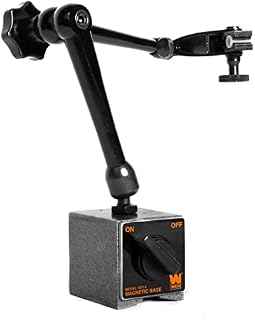 WEN Magnetic Base for Dial IndicatorsCheck price on Amazon
 Neoteck 1"/25.4mm Digital Dial Indicator 0.0005"/0.01mm DialCheck price on Amazon
 Starrett 25 Series Dial IndicatorCheck price on Amazon
 Neoteck 0-12.7mm/0.5" Digital Dial Indicator 0.01mm/0.0005"Check price on Amazon
GarageToolHQ earns a commission when you buy through links on our product pages, at no extra cost to you. Read our affiliate disclosure.
Below: what each tool measures, how a dial indicator reads, how a micrometer reads, which one fits which job, and the dial indicator gear for the garage.
Dial indicator vs micrometer: what each one measures
A micrometer is a direct measuring tool: it closes on a part and reads the size at that spot, such as the thickness of a brake rotor or the diameter of a shaft. A dial indicator is a comparison tool: it mounts on a base, its tip touches a surface, and its needle shows how far that surface moves from the point where the needle was set to zero. The micrometer answers how big a part is. The indicator answers whether a part runs true, and by how much it moves.
That difference decides the tool. Measuring a shaft diameter or a rotor thickness calls for a micrometer, since the job needs a size. Checking runout on a rotor, end play on a shaft or variation across a surface calls for a dial indicator, since the job needs movement from a set point, not a size. Neither tool replaces the other: a micrometer cannot show runout, and an indicator cannot read a size on its own.
How a dial indicator reads
A dial indicator mounts on a stand, usually a magnetic base, and its tip rests against the surface to check. The operator sets the needle to zero at a chosen spot, then turns the part or moves the surface, and the needle shows the movement from that zero point. The reading is a difference, not a size: it shows how far the surface moved, in the units the dial states.
The base matters as much as the indicator. A magnetic base holds the indicator steady on flat steel, and its arm positions the tip where it needs to touch. Without a steady base, the needle moves with the stand instead of the part, and the reading means nothing. The WEN base below holds with over 175 pounds of magnetic force, and the Neoteck set and the KATSU set each include a magnetic base with its indicator.
How a micrometer reads
A micrometer is self-contained: it needs no base and no stand. The operator closes its faces on the part and reads the size straight from the tool, in the units the micrometer states. It reads 1 spot at a time, so checking a shaft means measuring at several spots along its length and comparing the readings. It gives a size, not a movement: it cannot show whether a spinning part wobbles, since it only reads the size where its faces touch.
Which one fits which job
Reach for a micrometer when the job asks how big a part is: a shaft diameter, a rotor thickness, a bearing journal. Reach for a dial indicator when the job asks whether a part runs true: rotor runout, shaft end play, a surface that should sit flat. The 2 tools often work together: the micrometer sizes the part, and the indicator checks how it runs once fitted.
For garage work, the indicator needs a steady base and the micrometer needs nothing else. A dial indicator without a magnetic base is hard to hold steady, while a micrometer works in the hand. That is why 2 of the gear picks below pair an indicator with a base: the base is part of the measurement, not an extra.
The gear: dial indicators and magnetic bases
The gear below covers the dial indicator side: 2 sets pair an indicator with a base, 1 is an indicator on its own, and 1 is a base on its own. No micrometer is featured here, since the listings below are all dial indicator tools. The KATSU set leads the gear section as the most complete kit, then the digital Neoteck indicator, then the small-range Neoteck set, then the WEN base for an indicator already owned.
KATSU dial indicator with magnetic base and 22 indicator points. The most complete kit here: a dial indicator with a 0 to 1.0 inch range and 0.001 inch accuracy, a magnetic base with 132 lbs (60kg) holding power, and a 22-piece set of indicator points in a storage case. The base has 2 magnetic faces, on the bottom and the back, with an on/off switch and a fine adjustment long arm. The points let the tip reach different surfaces, and the case keeps the set together. For automotive and engineering use, per the listing.
Neoteck digital dial indicator, 0 to 1 inch. The digital readout here: a 0 to 25.4 mm (0 to 1 inch) range with 0.01 mm (0.0005 inch) resolution on a large LCD display, with inch/metric conversion and zero setting at any position. The rear cover has a 6.5mm hole and is removable for use on a magnetic base holder stand. A 1.5V battery is included, and the listing notes the indicator does not remember the zero setting position after auto off, so re-zero it after the display shuts off. The spec table lists an 18 months warranty and a weight of 0.37 pounds.
Neoteck dial indicator and magnetic base set, 0 to 0.03 inch. The small-range set here: a dial indicator with a 0 to 0.03 inch range and 0.0005 inch accuracy, on a magnetic base with a maximum tensile force of 90lbs (40kg). The base needs a metal surface 30mm thick or more for the full 90lbs, per the listing. The set includes 1 indicator, 1 magnetic base holder, 1 plastic case and 2 steel dovetail clamps, with a lower arm of 2.6 inches (6.6cm) and an upper arm of 2.7 inches (7cm). The clamping diameter is 3/8 inch (9.52mm). One listing quirk: the total height is given as 5.7 inches (13.6cm), and the inch and centimeter figures do not match, so take the height as approximate. For machine setup and narrow area measurement, per the listing.
WEN magnetic base for dial indicators. A base on its own, with no indicator included: a 3-arm system that pivots, bends and locks in a full 360 degrees, reaching up to 14.5 inches in height, with a quick-release knob that locks and releases all 3 joints at once. The base creates over 175 pounds of magnetic force with the turn of a switch, and the 2.5 by 2-inch v-groove base sits on round and flat surfaces. Mounting holes are 3/8-inch, 6mm and 8mm, with a 4mm bushing and a dovetail clamping slot. It fits the WEN dial indicator and the majority of other dial indicators on the market, per the listing.
Use rated jack stands on solid ground, wear eye protection with power and air tools, keep fuel-burning equipment out of a closed garage, and follow the manual for every tool. Read our Safety Disclaimer.
FAQ: garage tools
Is a dial indicator the same as a micrometer?
No. A dial indicator shows movement from a set point, while a micrometer reads a size directly. The indicator needs a steady mount, usually a magnetic base, and a reference surface, while the micrometer works in the hand on its own.
Do I need a magnetic base for a dial indicator?
Yes, for steady readings. The indicator must stay fixed while the part moves, and a magnetic base holds it on a flat steel surface. The WEN base below holds with over 175 pounds of magnetic force, and the Neoteck set and the KATSU set each include a magnetic base.
What does 0.0005 inch resolution mean on a digital dial indicator?
It is the smallest change the display shows: the Neoteck digital indicator reads to 0.01 mm (0.0005 inch) on its LCD display. Resolution is not the same as accuracy, and the listing states resolution, not accuracy, for that indicator.
Can a dial indicator measure a shaft diameter?
Not on its own. An indicator shows movement from a set point, so it can show whether a shaft runs true, but it cannot read the shaft size directly. A micrometer reads the diameter, and the indicator checks how the shaft runs once fitted.
Which dial indicator should I pick for machine setup?
The Neoteck set is built for machine setup and narrow area measurement, with a 0 to 0.03 inch range, 0.0005 inch accuracy and a magnetic base. The KATSU set covers a wider 0 to 1.0 inch range with 0.001 inch accuracy, a 132 lbs (60kg) base and 22 indicator points. Match the range to the movement to check, and the base to the surface it must hold on.
Related: the best dial indicator for engine work, the best digital dial indicator, micrometer vs caliper and the engine and shop equipment hub.