Dielectric Grease Uses for Car Electrical Connections
Dielectric grease seals electrical connections against moisture and corrosion, and this guide covers where to use it on a car, where not to, and the greases in this guide.

On this page
A spark plug boot sticks, a battery terminal blooms green, and a trailer plug quits in the rain. Dielectric grease uses come down to one job: keeping moisture and corrosion out of electrical connections so the metal stays clean and the connection lasts. It is a silicone grease that coats the connection, seals out water and air, and keeps the metal underneath from corroding.
As an Amazon Associate I earn from qualifying purchases. GarageToolHQ earns a commission when you buy through links on our product pages, at no extra cost to you. Read our affiliate disclosure.
Below: what dielectric grease does, where to use it on a car, where not to use it, and the greases in this guide.

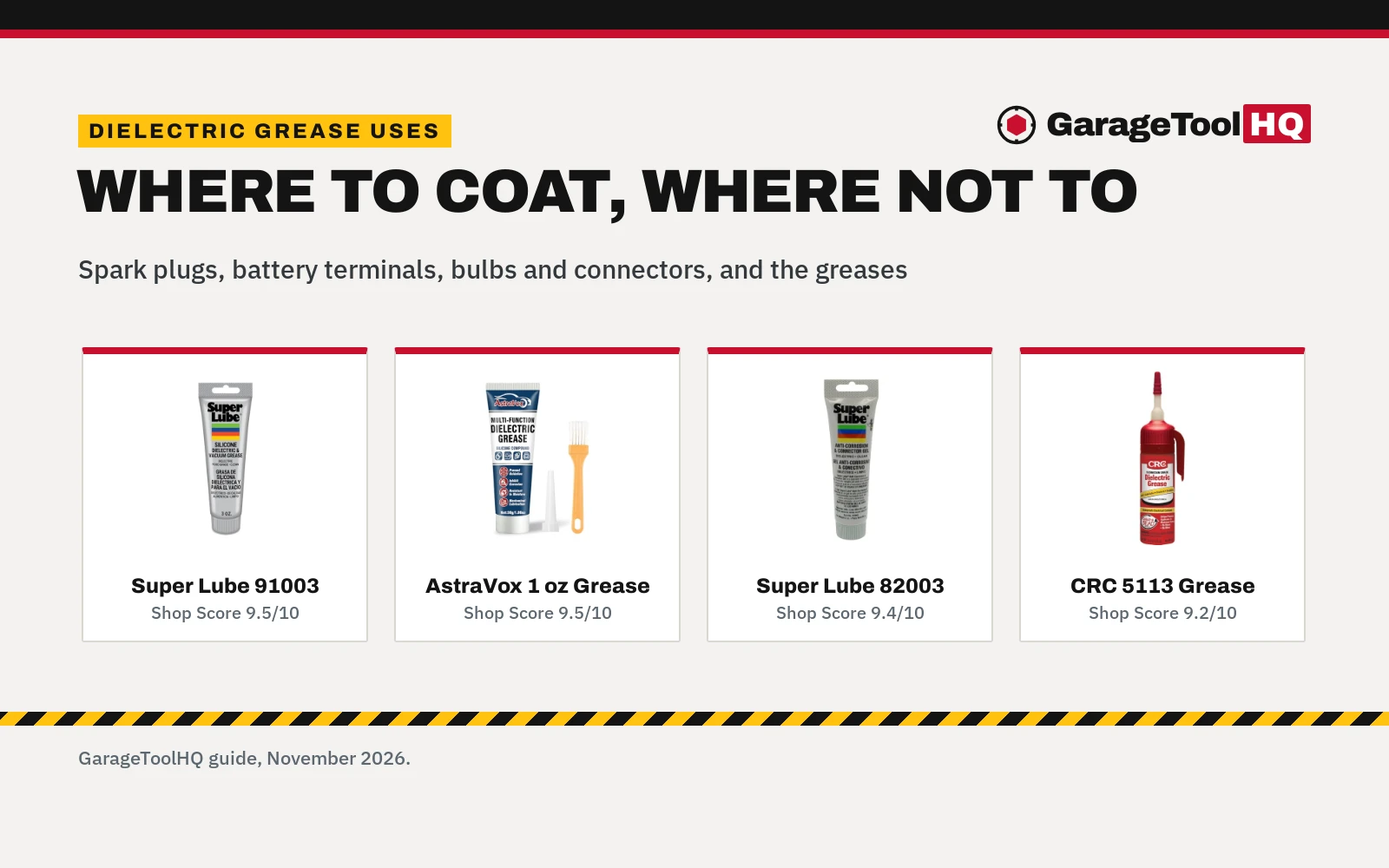
Super Lube 91003 Silicone High-Dielectric
A 3 oz tube of silicone dielectric and vacuum grease for battery terminals, bulbs, brakes and vacuum systems, NSF H1 registered.
Pros
- 3 oz tube of silicone dielectric grease for vacuum and electrical work
- Listed for brake grease, bulb grease, battery terminals and vacuum systems
- Does not harden or dry out over time, per the listing
- NSF H1 registered food-grade lubricant
Cons
- Table lists the weight as 0.01 pounds, against the 3 oz tube size
- No warranty term is stated in the listing
- No applicator brush is listed
- No temperature range is stated in the listing

AstraVox Silicone Dielectric Grease for Electrical
A 1 fluid ounce silicone dielectric grease with a brush, rated from -50℃ to 200℃, for spark plugs, battery terminals and connectors.
Pros
- Brush included for coating connectors
- Rated from -50℃ to 200℃, the only stated temperature range here
- Listed for cable connectors, plugs, switches, ignition systems and spark plugs
- Keeps dust and moisture out of the connection, per the listing
Cons
- Smallest size here at 1 fluid ounce
- Title spells it Dialectric, against dielectric in the bullets
- No warranty term is stated in the listing
- No food-grade or other registration is stated

Super Lube Anti-Corrosion & Connector Gel
A 3 oz tube of NLGI 0 anti-corrosion connector gel for battery terminals, exposed connectors, fuse holders and spark plugs, NSF H1 registered.
Pros
- 3 oz tube of anti-corrosion connector gel
- NLGI 0 thin viscosity gel, easy to coat with
- Listed for battery terminals, exposed connectors, circuit boards, fuse holders and spark plugs
- NSF H1 registered food-grade lubricant
Cons
- No temperature range is stated in the listing
- No warranty term is stated in the listing
- No applicator brush is listed
- No vacuum use is listed, unlike the 91003

CRC 5113 Grease
A CRC 5113 grease in an opaque white gel, with a weight and dimensions stated but no use listed.
Pros
- Opaque white gel, per the spec table
- Weight of 0.20625 pounds and box dimensions stated
- Part number 5113 stated for matching the CRC line
- Simple listing: one size, one part number
Cons
- No uses are stated anywhere in the listing
- No temperature range is stated
- No warranty term is stated in the listing
- No applicator, brush or size choice is listed
Dielectric grease uses: what it does
Dielectric grease is a silicone grease that insulates. It does not carry current, and it does not repair a connection. What it does is coat the metal, seal out moisture and air, and keep corrosion from starting on the contact surfaces. A clean connection stays clean longer with a thin coat on it, and a dirty connection still needs cleaning first.
The grease also keeps rubber boots and seals from drying out and sticking, so they come off without tearing when the plug or bulb needs changing. That is the whole job: seal the connection, protect the metal, and keep the boot from sticking. 3 of the listings in this guide describe the same basic job, and they differ on size, applicator, temperature range and stated uses. The CRC listing states no use at all.
Where to use it on a car
Start with the connections that face water, heat and time. Spark plug boots take a thin coat inside the boot, where it keeps the boot from sticking to the plug and seals out moisture. Battery terminals take a coat after cleaning and tightening, over the outside of the assembled connection, where it slows the green corrosion that creeps across the post. Bulb sockets take a coat around the seal, so the bulb comes out clean at the next change.
Connectors, fuse holders and circuit boards take a coat where the listing names them. The Super Lube connector gel lists exposed connectors, circuit boards and fuse holders, and the AstraVox lists cable connectors, plugs and switches. Brake caliper pins take a coat too, per the AstraVox listing, and trailer plugs and bulb sockets are the same kind of job: a connection that sits outside and gets wet.
Vacuum systems take the Super Lube 91003, which the listing calls a vacuum grease as well as a dielectric grease. That use reaches beyond car electrical work, and it shows how wide the same tube reaches.
Where not to use it
Dielectric grease is an insulator, so it does not belong between mating metal contacts that must carry current on their own. Coat the seal and the boot, not the contact face itself, and never use grease as a fix for a loose, burnt or broken connector. A connector that is loose needs repair or a new terminal, not a thicker coat.
It also does not belong on brakes beyond the brake uses the listings name, and it does not replace anti-seize on threads. Grease for a thread and grease for a connection are different jobs, and none of these listings names a thread use. See the dielectric grease vs anti seize guide when the job is a thread, not a plug.
The greases in this guide
Each grease below fits a different buyer: the brush-on AstraVox for spark plugs and tight boots, the Super Lube tubes for terminals, connectors and fuse holders, and the CRC for buyers who already know the part number.
How to apply it
Clean the connection first. Wipe off corrosion and dirt, and let the metal dry before the grease goes on. Grease over corrosion only seals the corrosion in, and the connection stays bad underneath.
Put on a thin coat. A brush, like the one in the AstraVox box, lays a thin coat inside a boot or around a terminal. A tube, like the Super Lube tubes, puts a dab where a finger or a small brush can spread it. Reconnect the plug or terminal, wipe off the excess, and check that the boot seats all the way home.
Less is more here. A thick coat squeezes out and collects dirt, while a thin coat seals the connection and stays put. Reapply when the connection comes apart for other work, since the coat does not last forever once the seal is broken.
Work on electrical connections with the power off. Disconnect the battery before cleaning terminals, and keep grease off hot exhaust parts and away from open flame.
Use rated jack stands on solid ground, wear eye protection with power and air tools, keep fuel-burning equipment out of a closed garage, and follow the manual for every tool. Read our Safety Disclaimer.
FAQ: garage tools
Does dielectric grease conduct electricity?
No. Dielectric grease is an insulator, not a conductor. It seals the connection and keeps corrosion out, but the metal contacts still carry the current themselves. It protects a good connection, and it does not fix a bad one.
Can I use dielectric grease on battery terminals?
Yes. Battery terminals are a listed use on the AstraVox grease and on both Super Lube greases in this guide. Clean the terminal first, reconnect and tighten it, then coat the outside of the assembled connection. The coat slows the corrosion that creeps across the post.
Can I use dielectric grease on spark plugs?
Yes. Spark plugs and spark plug boots are listed uses on the AstraVox grease, and spark plugs are a listed use on the Super Lube connector gel. Coat the inside of the boot so it seals and comes off clean, and keep the grease off the electrode and the plug threads.
Does dielectric grease keep water out of a connection?
Yes, that is its main job. The listings describe it as a barrier against moisture that keeps water and dust out of the connection. It seals the connection rather than conducting, and it does not make a damaged connector sound again.
What is the difference between dielectric grease and regular grease?
Dielectric grease is a silicone grease made to insulate and seal electrical connections. Regular grease is made for bearings and moving parts, where it cuts friction. They serve different jobs: use dielectric grease to seal a connection, and the grease the manual names for a bearing or a moving part.
Related: best dielectric grease automotive electrical, best dielectric grease for battery terminals, dielectric grease vs anti seize, battery terminal protector vs dielectric grease, and the diagnostics and electrical hub.