Direct Vent vs Ventless Garage Heater: Which One Should You Buy?
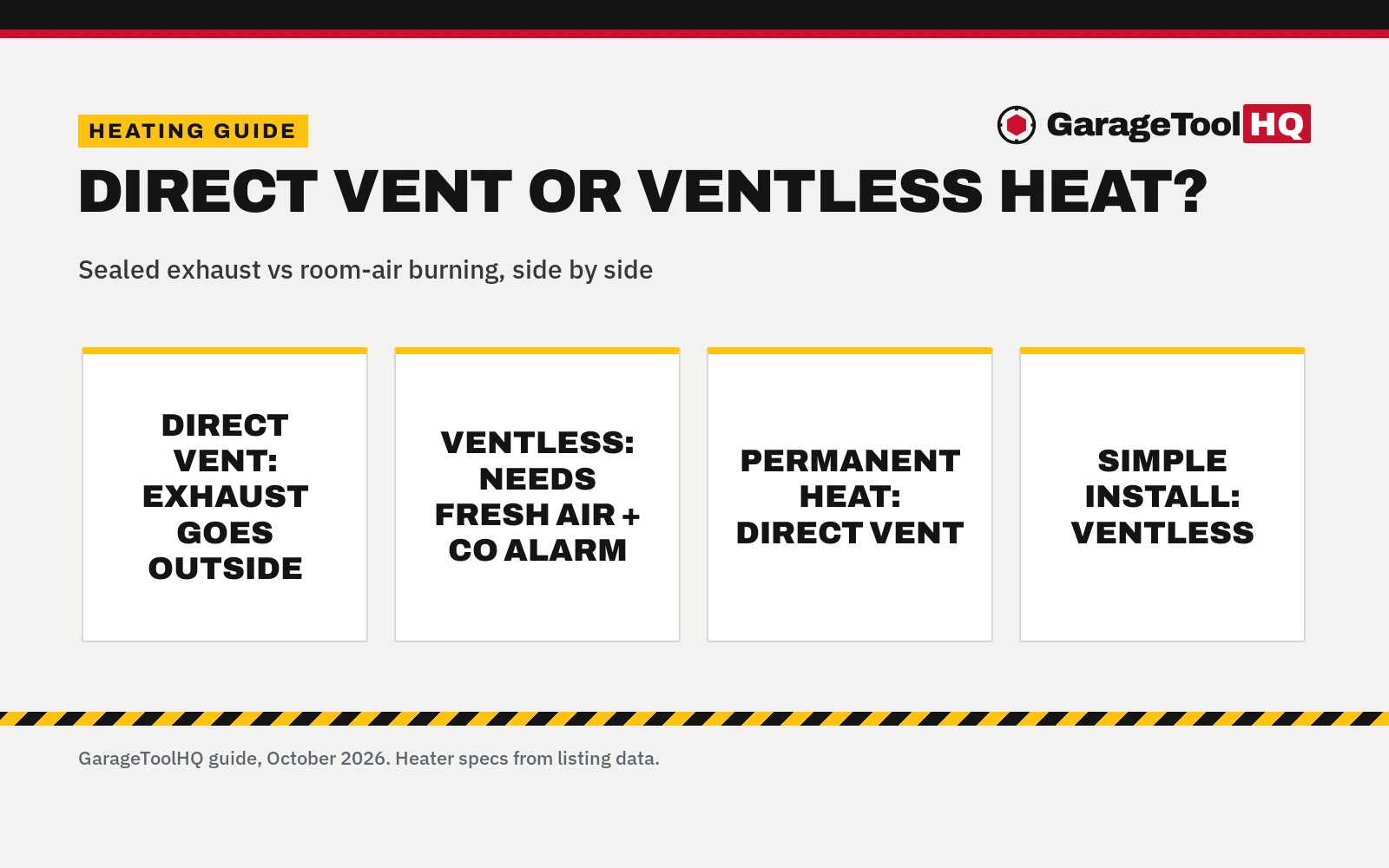
Direct vent heaters send exhaust through the wall; ventless heaters burn room air and need fresh air plus a CO alarm. Which one fits your garage.

On this page
Top picks at a glance
As an Amazon Associate we earn from qualifying purchases.
- 1
 Mr. Heater 309.6/10View on Amazon
- 2
 ProCom Heating Liquid Propane Ventless Blue Flame Heater With9.7/10View on Amazon
- 3
 F299201 Blower Fan Kit for Mr Heater9.2/10View on Amazon
- 4
 Mr. Heater 18View on Amazon
- 5
 Comfort Glow 25View on Amazon
- 6
 Comfort Glow 11View on Amazon
- 7
 Modine Liquid Propane Direct Vent Garage Heater Hot DawgView on Amazon
- 8
 Empire Comfort Systems Direct-Vent Wall Furnace Size: 35View on Amazon
- 9Mr. Heater 30View on Amazon
The job is a brake job in January, your fingers are numb by the second caliper, and the question is direct vent vs ventless garage heater: which kind of gas heat belongs in your garage. A direct vent heater seals its combustion away from the room and sends exhaust straight through the wall outside. A ventless heater burns room air and puts its combustion products into the garage, so it needs the fresh-air opening its manual calls for and a working carbon monoxide alarm. Direct vent is the set-and-forget permanent answer. Ventless is the simpler install for supplemental heat.
More options to compare
 Mr. Heater 18Check price on Amazon
 Comfort Glow 25Check price on Amazon
 Comfort Glow 11Check price on Amazon
 Modine Liquid Propane Direct Vent Garage Heater Hot DawgCheck price on Amazon
 Empire Comfort Systems Direct-Vent Wall Furnace Size: 35Check price on Amazon
 Mr. Heater 30Check price on Amazon
GarageToolHQ earns a commission when you buy through links on our product pages, at no extra cost to you. Read our affiliate disclosure.
Below: what the vent changes about safety and installation, where each type wins, and what the listings say about BTU, coverage and hookup.
Direct vent vs ventless garage heater: what the vent does
The vent decides where the exhaust goes, and that decides everything else. A direct vent heater like the Comfort Glow DVP08 is a sealed burn system: it pulls combustion air from outside and pushes exhaust back outside through a vent pipe in the wall, with a safety pilot that stops the gas if the pilot goes out. The room air never touches the flame. A ventless heater like the Mr. Heater 18,000 BTU or the Comfort Glow KWP212 burns the garage’s own air and releases the combustion products into the room, which is why every ventless listing leans on its oxygen depletion sensor: the Mr. Heater lists a low oxygen safety shut-off and the KWP212 lists a built-in oxygen depletion sensor. An ODS shuts the heater down when oxygen drops, but it does not measure carbon monoxide, so the alarm still matters.
| Direct vent | Ventless | |
|---|---|---|
| Exhaust | Sealed system vents through the wall outside | No venting; combustion stays in the room |
| Installation | Wall hole for the vent pipe, gas line, clearances; the DVP08 ships a professional vent kit and fits 4.5 to 10 in walls | Hangs on the wall, connects to gas; no hole in the wall |
| Combustion air | Drawn from outside | Drawn from the garage; needs the manual’s fresh-air opening |
| Safety equipment | Safety pilot and pressure regulator; CO alarm still recommended | Oxygen depletion sensor plus a CO alarm, no exceptions |
| Heat range in the sample | 8,000 BTU (DVP08) to 35,000 BTU (Empire DV35) | 12,000 BTU (KWP212) to 18,000 BTU (Mr. Heater) |
| Power outages | No electricity needed on the DVP08 and DVN17 listings | No electricity required on the Mr. Heater and KWP212 listings |
One listing note: the Mr. Heater spec table strays from its own title and bullets, listing 10,000 BTU and 300 sq ft against the title’s 18,000 BTU and 700 sq ft. The title and bullets agree with each other, so those are the figures used here.
When direct vent is the better choice
- Permanent garage heat. If the heater runs all winter, sealed combustion is the right engineering: nothing from the flame ends up in your lungs or on your tools.
- Attached garages. Exhaust goes outside through the wall instead of into the room that shares air with the house.
- Bigger spaces. The sample’s direct vent range runs from the 8,000 BTU DVP08 to the 35,000 BTU Empire DV35, and the Modine Hot Dawg lists 1,500 sq ft of coverage for a ceiling mount over the work bays.
- Bedrooms and tight rooms. The DVP08 listing is approved for bedrooms, bathrooms and HUD housing, which is a rating ventless heaters do not carry.
When ventless is the better choice
- No wall to vent through. Renters, detached sheds and shops where cutting a vent hole is not on the table.
- Supplemental heat. Taking the edge off for a few hours of work, not keeping the garage warm all winter.
- Simple install. The KWP212 hangs on a wall bracket with manual heat control and no electricity required; the Mr. Heater adds a built-in thermostat and electronic ignition at 20.7 lb.
- Power outages. Both ventless listings state no electricity required, so the heat works when the grid does not.
What the listings say about size and hookup
Match BTU to the space before anything else. In the sample, the Mr. Heater lists 18,000 BTU for up to 700 sq ft, the KWP212 lists 12,000 BTU for 400 sq ft, the DVP08 lists 8,000 BTU, the DVN17 lists 17,000 BTU of natural gas for 500 sq ft, the DVP25 lists 25,000 BTU of propane for 750 sq ft, and the Empire lists 35,000 BTU with 24,500 BTU of output. The DVP08 and DVP25 listings both require a minimum propane tank size (20 lb and 100 lb respectively) and a two-stage low-pressure regulator, which is a gas supplier conversation, not a hardware store one. Work out your space first with our garage heater sizing guide, then compare real models in our infrared garage heater picks.
The safety rules that are not optional
Every heater here burns fuel, so the rules apply to both sides, with extra weight on the ventless side:
- Carbon monoxide alarm in the garage. Fit one before the first burn, and one in the house if the garage is attached. An oxygen depletion sensor is not a CO alarm.
- Fresh air the way the manual says. Ventless heaters list a required ventilation opening; running one in a sealed garage is how CO builds up.
- Clearances and combustibles. Hold the manual’s distances from walls, cars and anything flammable. Gas cans, solvents and paint live far from the heater.
- Gas work by a pro. Gas piping, regulators and venting go to a licensed installer, and the vent kit parts have to match the heater. See our electric vs propane garage heater comparison if you would rather skip combustion entirely.
Never run a fuel-burning heater, generator or engine in a closed garage: carbon monoxide builds up fast and has no smell. Fit a CO alarm, keep clearances to cars and storage, use vented gas heaters installed to code, and put 240V electric heaters on a dedicated circuit. See CPSC carbon monoxide guidance. Read our Safety Disclaimer.
Frequently Asked Questions
Is a ventless heater safe in a garage?
It can be, set up the way the manual demands: the fresh-air opening it specifies, the clearances it lists, and a working CO alarm. Never run one in a sealed garage, and never sleep with it running.
Do I need a CO alarm with a direct vent heater?
Yes. Sealed combustion is the safest arrangement, but it is still a fuel burner with a gas connection. A CO alarm is cheap insurance against a cracked vent or a bad connection.
Can I install a direct vent heater myself?
The heater hangs on the wall easily enough, but gas piping, the regulator and the vent run belong to a licensed installer in most areas, and the vent kit has to suit your wall thickness. The DVP08 kit fits 4.5 to 10 in walls; anything else needs a different plan.
What size heater does a 2-car garage need?
It depends on insulation, ceiling height and climate, not just floor area. The listings here span 8,000 to 35,000 BTU, which covers everything from a mild-climate single bay to a big insulated shop. Run your numbers through our sizing guide before you buy.
Is ventless the same as vent-free?
Yes. Ventless, vent-free and unvented all describe heaters that burn room air with no flue. The Mr. Heater and KWP212 listings use “vent free” in their titles.
Will a ventless heater work in a power outage?
Yes. The Mr. Heater and KWP212 listings both state no electricity required, and the DVP08 direct vent lists the same. Match or piezo ignition lights them without the grid.
Related: forced air vs radiant heater, infrared vs forced air garage heater, our garage heaters for a single car garage picks and the propane heater pros and cons.