How to Clean Spark Plugs at Home
Carbon on the electrodes makes a plug misfire, and cleaning it at home takes a brush, a cleaner or a blast of air and grit, plus a gap check before the plug goes back in.

On this page
Top picks at a glance
As an Amazon Associate I earn from qualifying purchases.
- 1
 Red Line 60103 SI-1 Complete Fuel System Cleaner9.7/10View on Amazon
- 2
 Red Line 60103 SI-1 Complete Fuel System Cleaner9.6/10View on Amazon
- 3
 Lucas Oil 10020 Fuel Treatment9.6/10View on Amazon
How to clean spark plugs at home starts with a plug that comes out of the engine black with carbon and an engine that idles rough and starts hard. Carbon on the electrodes and the insulator nose weakens the spark, and a weak spark means misfires, wasted fuel and a car that feels tired. Cleaning the plug can bring back a sharp spark, and the job needs a brush or a cleaning kit, a way to clear grit, and a gap check before the plug goes back in.
GarageToolHQ earns a commission when you buy through links on our product pages, at no extra cost to you. Read our affiliate disclosure.
Below: what builds up on a plug, the cleaning methods that work at home, the process from removal to refitting, and how to tell when a plug is past cleaning.
How to Clean Spark Plugs at Home: What Builds Up on the Plug
Combustion leaves deposits on the plug, and the deposits collect on the electrodes and the insulator nose where the spark has to jump. Oil from a worn engine and a rich fuel mixture add to the layer, and the layer grows until the spark finds an easier path or fades altogether. A plug that looks black and dry usually carries carbon, while a wet, oily plug points to oil getting past the seals, which cleaning alone will not fix.
- Carbon. Dry, black soot on the electrodes and insulator nose. Carbon is the deposit that home cleaning handles well.
- Oil. Wet, dark film that comes back soon after cleaning. Oil fouling means the engine needs attention beyond the plugs.
- Wear. Rounded electrodes and a gap that has opened up with use. Cleaning cannot put metal back on a worn electrode.
- Damage. A cracked insulator or a bent electrode. A damaged plug belongs in the bin, not back in the engine.
Read the plug before cleaning it: the deposits tell you whether cleaning is worth the effort.
Ways to Clean a Spark Plug at Home
Home cleaning comes down to a brush, a cleaning kit or a blast of air and grit. A brush suits light carbon, a kit reaches the threads and tight passages, and a sandblaster suits heavy carbon but needs a compressor and a way to catch the grit.
| Method | What it uses | When it fits |
|---|---|---|
| Hand brush | Steel and nylon brushes, picks and hooks | Light carbon on plugs that still look sound |
| Cleaning kit | Wires, needles and brushes in small sizes | Carbon in threads and tight passages |
| Pneumatic sandblaster | Air and grit at 90 PSI | Heavy carbon on the electrodes |
Match the kit to the job by its contents. The Motfittings kit (on Amazon) holds 13 wires, 10 needles, 5 brushes and 1 pick, with needle diameters from 0.4 mm to 0.8 mm and wire sizes of 2mm, 3mm, 4mm, 5mm and 7mm. The Fododo kit (on Amazon) holds 13 wires, 5 nylon brushes, 10 needles, 1 throttle wrench, 1 pointed tweezers, 3 double-ended brushes and 4 hooks, with sizes from 1.5mm to 7mm and tools about 4.33 inches long. The Gwukaop 36-piece kit holds 13 wires sized 0.4-1.6mm, 10 needles, 5 nylon brushes, 2 large brushes, 4 hooks, a pick and a wrench.
Pneumatic cleaners run on shop air. The ABN cleaner (on Amazon) lists a 90 PSI pressure rating and 7.7CFM air consumption, with a 1/4-inch NPT inlet and a 3/8-inch hose, and its kit includes a 1.7 oz bag of abrasive. The CNRAQR kit (on Amazon) lists the same 90 PSI and 7.7CFM figures and includes 50g of silicon carbide. Each cleaner needs a compressor that can hold the pressure and flow the cleaner asks for.
How to Clean Spark Plugs at Home, Step by Step
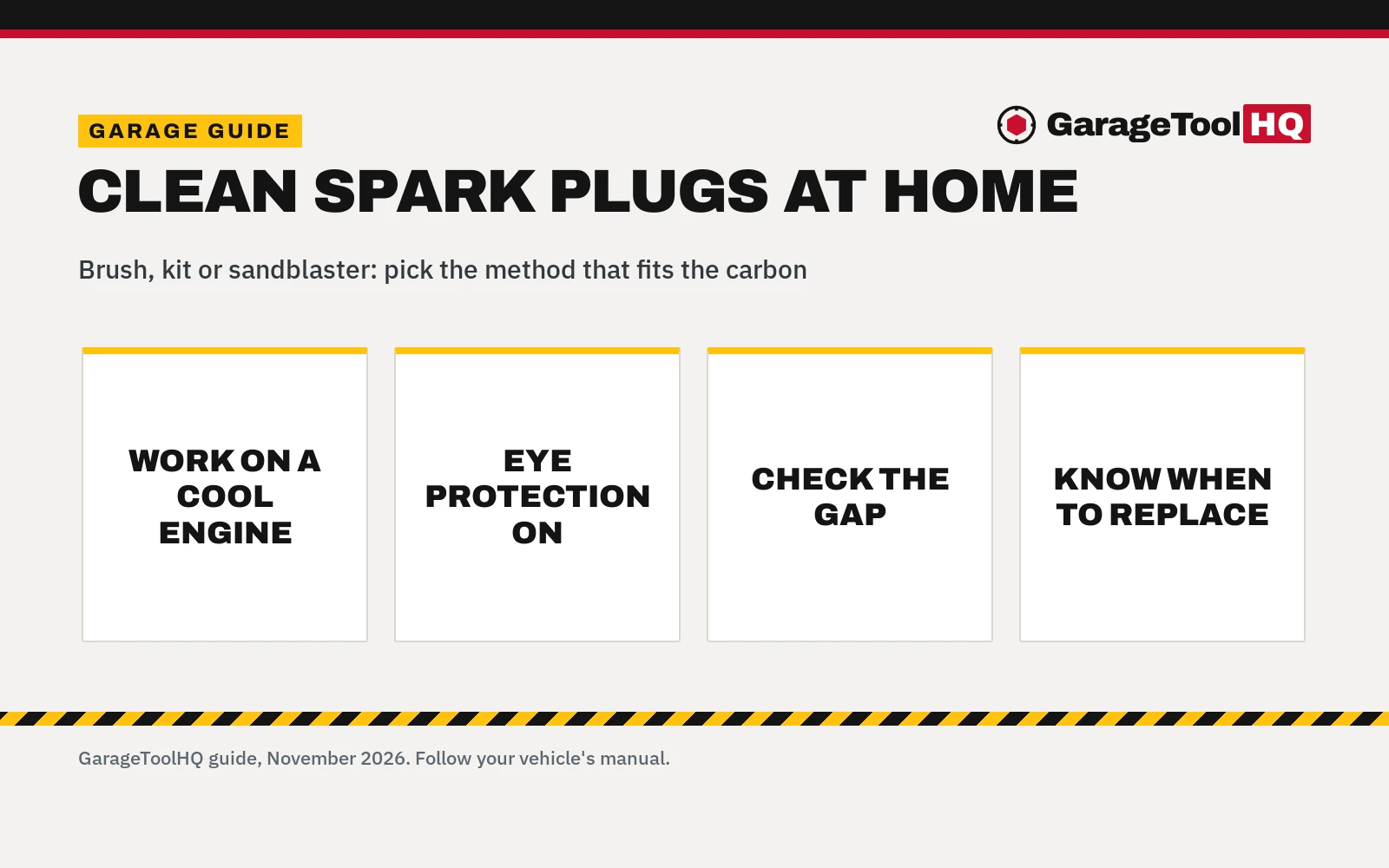
Work on a cool engine, in fresh air, with eye protection on. Never run an engine in a closed garage, and keep the work area clear of fuel and solvents while the plugs are out.
- Mark the wires. Label each wire or coil so each plug goes back to its own cylinder.
- Clear the plug wells. Brush or blow loose dirt away from the base of each plug before removal, so grit cannot fall into the cylinder.
- Remove the plugs. Use a spark plug socket that fits the plug size, and lift each plug out with care. See the guide to spark plug socket sizes if the socket slips or will not seat.
- Read each plug. Note the color and the state of the electrodes. Set aside any plug with a cracked insulator or a worn electrode for replacement.
- Brush the plug. Work a wire brush over the electrodes, the insulator nose and the threads until the carbon lifts. A pick from the cleaning kit clears carbon from the thread roots.
- Use the kit for tight spots. Pick a wire or needle that fits the passage, and work it through with a light hand. The Motfittings needles run from 0.4 mm to 0.8 mm, so start small and move up only if the passage needs it.
- Blast heavy carbon. For thick deposits, fit the plug into the sandblaster with the electrode facing down, add the grit, and run the cleaner at the 90 PSI the maker lists. Move the plug in a circular motion so the grit reaches all surfaces, as the ABN instructions describe.
- Clear every trace of grit. Brush and blow the plug clean, and check the threads and the electrode gap for grit. Grit left on a plug can score the cylinder wall.
- Check the gap. Slide the feeler gauge between the electrodes and read the gap against the figure in the vehicle manual, using a gauge from the best spark plug gap tool picks. The Peuxmall gap tool (on Amazon) fits most 10mm, 12mm, 14mm and 16mm plugs, and the CNRAQR gauge covers a 0.04mm-0.88mm range. The Peuxmall maker notes that electrodes spring back when adjusted, so aim a touch under the target gap.
- Refit and reconnect. Seat each plug by hand, tighten with the socket, and reconnect each wire to its marked cylinder. Start the engine in fresh air.
Carbon monoxide from a running engine can build up fast in a closed space, even with the door partly open. Do the cleaning with the engine off, and only start it with the garage door open and fresh air moving through.
Read the manual before first use, wear eye protection, keep the work area clear and ventilated, and stay within every stated rating. Read our Safety Disclaimer.
When Cleaning Is Not Enough
Cleaning restores a plug that carries light carbon and still holds its shape. It cannot fix a cracked insulator, a worn electrode or oil fouling that returns once the engine runs. If the same plug fouls again soon after cleaning, the cause sits upstream of the plug, and a new plug only buys time. See the signs that point to replacement in the guide to spark plug problems, and the plug types an engine can take in the guide to types of spark plugs.
FAQ: garage tools
Can you clean spark plugs with a wire brush?
Yes. A wire brush clears light carbon from the electrodes, the insulator nose and the threads, and a pick from a cleaning kit reaches the thread roots. Brush with a light hand so the electrodes keep their shape, and clear all loose grit before the plug goes back in.
Can a pneumatic spark plug cleaner damage a plug?
Used as the maker directs, a sandblaster cleans carbon off the plug, and the CNRAQR kit describes its process as gentle and without damage. The ABN and CNRAQR cleaners list 90 PSI and 7.7CFM, and each kit supplies the grit and the bag to catch it. Wear eye protection, keep the plug moving so the grit reaches all surfaces, and clear every trace of grit before refitting.
How do you check the gap after cleaning?
Slide a feeler gauge between the electrodes and read the gap against the figure in the vehicle manual. The Peuxmall feeler gauge, with 32 blades, fits most 10mm, 12mm, 14mm and 16mm plugs, and it does not fit 18mm plugs. If the gap has opened up with wear, cleaning will not close it, and a new plug is the answer.
What size cleaning kit fits small passages?
Match the tool to the passage: the Motfittings needles run from 0.4 mm to 0.8 mm, the Fododo kit covers sizes from 1.5mm to 7mm, and the Gwukaop wires run 0.4-1.6mm. Start with the smallest wire that fits.
Should you clean or replace fouled spark plugs?
Clean plugs that carry light carbon and still hold their shape, and replace plugs with cracked insulators, worn electrodes or oil fouling that returns fast. A plug that fouls again soon after cleaning points to a fault upstream.
Can you clean spark plugs without removing them?
No. Proper cleaning needs the plug out of the engine, so the electrodes, the insulator nose and the threads can all be reached and so grit cannot fall into the cylinder. Additives poured into the tank do not reach the plug the way a brush or a blaster does, and a plug cleaned in place cannot be checked for cracks or gap.
Related: how to get a spark plug socket out, the best spark plug gap tool picks, the feeler gauge set vs spark plug gap tool comparison and the best spark plug socket set picks.