How to Use a Brake Bleeding Kit: Steps, Adapters and 3 Kits Compared
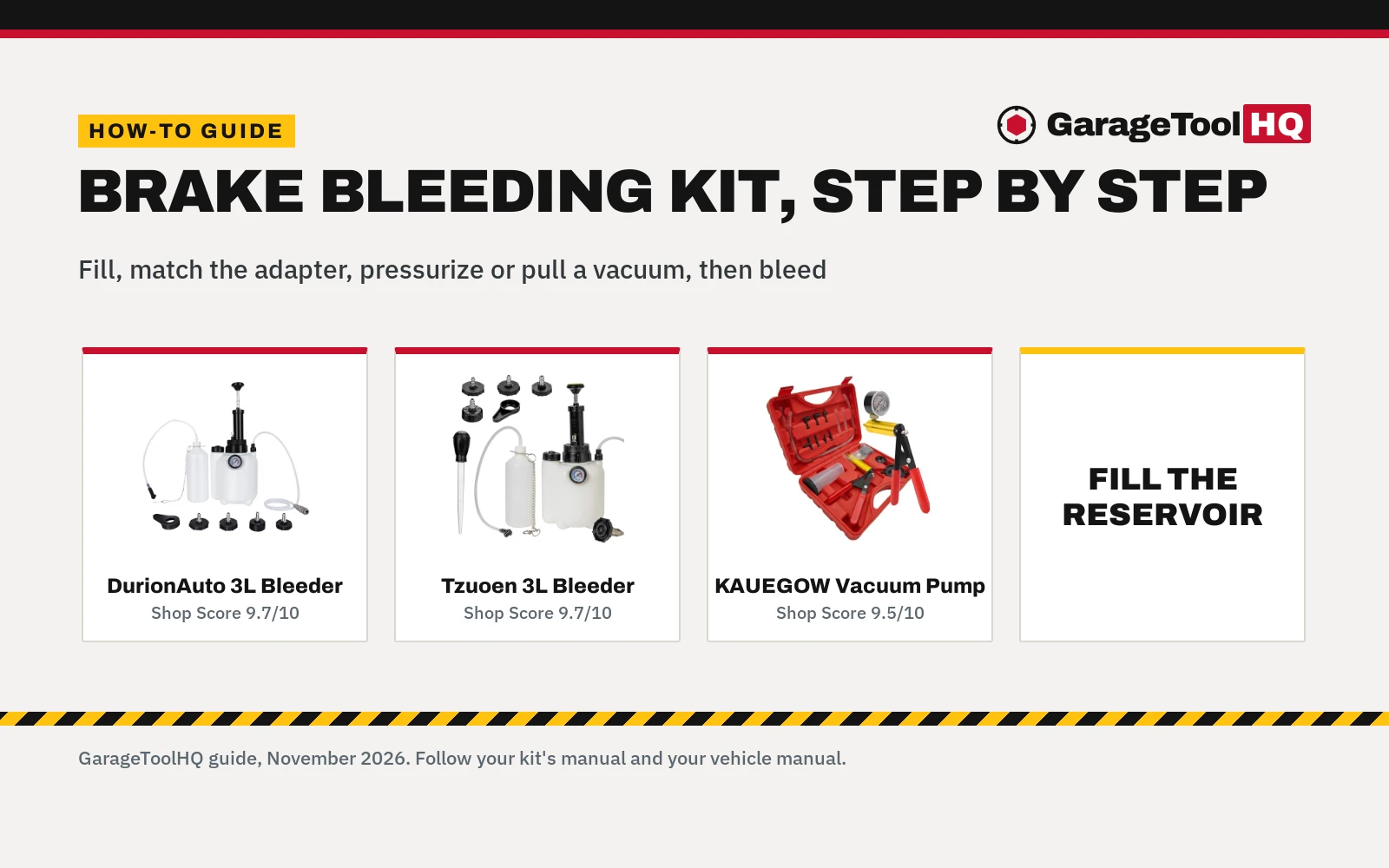
Fill the reservoir, match the adapter to the master cylinder, pressurize the system or pull a vacuum, and bleed until fresh fluid arrives, with 3 kits that cover both methods.

On this page
Top picks at a glance
As an Amazon Associate I earn from qualifying purchases.
- 1
 3L Brake Bleeder Kit,Brake Bleeder Vacuum Pump Kit9.7/10View on Amazon
- 2
 3L Brake Bleeder Kit, Manual Brake Fluid Bleeder9.7/10View on Amazon
- 3
 KAUEGOW Hand Held Vacuum Pump Brake Bleeder Kit9.5/10View on Amazon
How to use a brake bleeding kit? Fill the reservoir with fresh fluid, fit the adapter that matches the master cylinder, pressurize the system or pull a vacuum at the bleeder, then open the bleeder and let old fluid and trapped air out until fresh fluid arrives. The steps below follow the kits in this guide, and the gear section names the kits that handle each part of the job.
GarageToolHQ earns a commission when you buy through links on our product pages, at no extra cost to you. Read our affiliate disclosure.
3L Brake Bleeder Kit,Brake Bleeder Vacuum Pump Kit
A 3L pressure bleeder kit with a 1L catch bottle, 4 master cylinder adapters, a dual-scale PSI/Bar gauge and lifetime quality support.
Pros
- 3L reservoir and 1L catch bottle handle a full fluid replacement on most vehicles
- 4 adapters cover 95% of vehicles, from cars and trucks to ATVs and motorcycles
- Dual-scale PSI/Bar gauge monitors pressure in real time and prevents over-pressurization
- Ring wrench, anti-slip base and chain hook for stable one-person work
Cons
- No vacuum function, so it cannot draw fluid at the bleeder the way the KAUEGOW kit does
- No protective case is stated, unlike the KAUEGOW kit
- No reservoir graduations are stated for reading the fluid level
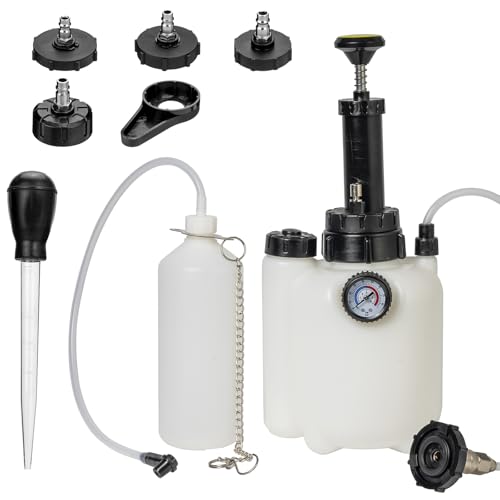
3L Brake Bleeder Kit, Manual Brake Fluid Bleeder
A 3L pressure bleeder kit with a 1L waste bottle, 4 master cylinder adapters, a push-button relief valve and a 48 month warranty.
Pros
- Push-button relief valve releases pressure before disconnecting, so fluid does not spray
- 3L reservoir and 1L waste bottle for a full fluid replacement
- 4 adapters fit Chrysler, Dodge, Jeep, Plymouth, European models, Mazda, GM, Mitsubishi, Nissan, Subaru, Ford and Lincoln
- Dual-unit PSI/Bar gauge monitors the pressure inside the container
Cons
- No vacuum function, so it cannot draw fluid at the bleeder the way the KAUEGOW kit does
- No protective case is stated, unlike the KAUEGOW kit
- No reservoir graduations are stated for reading the fluid level
- The title lists a fluid dropper that the bullets do not describe
KAUEGOW Hand Held Vacuum Pump Brake Bleeder Kit
A hand held vacuum pump kit with a gauge, 7 adapters, 2 long hoses, 2 short hoses and a protective case, for brakes, clutch lines and fuel systems.
Pros
- 7 adapters with 2 long hoses, 2 short hoses, 2 covers and a protective case
- Works on brake systems, clutch lines and fuel supply systems
- Reservoir graduations from 0 to 120 milliliters for easy reading
- Suits bicycles, motorcycles, trucks and cars, with independent one-person operation
Cons
- No warranty term is stated
- No reservoir capacity in litres is stated, only graduations from 0 to 120 milliliters
- The 7 adapters come with no stated sizes, unlike the 4 sized adapters in the pressure kits
- No pressure mode, so it cannot push fluid from the reservoir the way the pressure kits do
How to use a brake bleeding kit, step by step
- Match the adapter. Pick the adapter that fits the master cylinder. The pressure kits here include 4 adapters: A1 43.5mm (1.42in) for Chrysler, Dodge, Jeep, and Plymouth; A2 45mm (1.47in) for most European models; A3 49.5mm (1.62in) for some Mazda cars and most GM late-model Chevrolets, Cadillacs, Hummers, Buicks, and GMCs; A4 50.7mm (1.66in) for most modern cars, such as Mitsubishi, Nissan, and Subaru, and some Dodge, Ford, and Lincoln cars.
- Fill the reservoir with fresh fluid. With a pressure kit, fill the 3L reservoir with fresh brake fluid and keep the cap on, so the system draws fresh fluid in as old fluid leaves. The vacuum kit has no 3L reservoir: its reservoir carries graduations from 0 to 120 milliliters, and it draws old fluid out under negative pressure, so the fluid that has moved is easy to read.
- Pressurize, or pull a vacuum. With a pressure kit, work the hand pump and watch the dual-unit PSI/Bar gauge, which monitors the pressure inside the container. With the vacuum pump kit, work the ergonomic handle to draw fluid out under negative pressure. The listings state no target pressure, so follow the kit’s manual.
- Connect the catch bottle. On the pressure kits, connect the 1L waste bottle or 1L catch bottle for fluid collection, so old fluid has somewhere clean to go. On the pressure kits, a ring wrench tightens the cap or the adapter, and the chain hook holds the kit to the car while the work goes on. The vacuum kit collects fluid in its own reservoir instead.
- Open the bleeder and watch for air. Open the bleeder and let old fluid and trapped air out while fresh fluid is drawn in. The kits are built for one-person work, so no helper is needed, and the work moves from one wheel position to the next without coordinating with anyone else.
- Release the pressure before disconnecting. On the Tzuoen kit (on Amazon), press the push-button relief valve on the cap to release internal pressure before disconnecting the system, so fluid does not spray or overflow. The other kits state no relief valve, so follow the kit’s manual before disconnecting.
- Check the level and repeat as needed. Check the reservoir and, on the pressure kits, the catch bottle, top the reservoir up with fresh fluid, and repeat the bleed until the fluid that comes out is fresh and free of trapped air.
Pressure bleeder or vacuum pump: which kit fits the job
| Type | How it works | Capacity stated | Adapters stated |
|---|---|---|---|
| Pressure bleeder | Hand pump pressurizes the reservoir and pushes fluid to the bleeder | 3L reservoir, 1L catch bottle | 4 master cylinder adapters |
| Vacuum pump | Hand pump pulls a vacuum at the bleeder and draws fluid out | Reservoir with graduations from 0 to 120 milliliters | 7 adapters, 2 long hoses, 2 short hoses |
The pressure kits suit a full fluid replacement on most vehicles: the 3L reservoir and 1L catch bottle give ample capacity without frequent refills, per the DurionAuto listing, and the DurionAuto kit (on Amazon)‘s adapters cover 95% of vehicles, per the same listing. The vacuum kit suits bicycles, motorcycles, trucks and cars, and it also works on clutch lines and fuel supply systems, per the KAUEGOW listing.
Read the manual before first use, wear eye protection, keep the work area clear and ventilated, and stay within every stated rating. Read our Safety Disclaimer.
The gear for the job
The steps above need a kit that pressurizes the reservoir or pulls a vacuum at the bleeder, and these 3 kits cover both approaches, with the adapters, gauges and hoses the job needs.
FAQ: garage tools
Can one person bleed brakes alone with these kits?
Yes. The pressure kits are built for one-man bleeding, and the vacuum kit enables fully independent operation by a single person, per the listings. No helper is needed at the pedal.
Which adapter fits my car?
The steps above list all 4: A1 43.5mm (1.42in) for Chrysler, Dodge, Jeep, and Plymouth; A2 45mm (1.47in) for most European models; A3 49.5mm (1.62in) for some Mazda cars and most GM late-model Chevrolets, Cadillacs, Hummers, Buicks, and GMCs; A4 50.7mm (1.66in) for most modern cars, such as Mitsubishi, Nissan, and Subaru, and some Dodge, Ford, and Lincoln cars. The same 4 adapters come with both pressure kits here.
What is the difference between a pressure bleeder and a vacuum pump kit?
A pressure bleeder pushes fluid from the reservoir to the bleeder with a hand pump, while a vacuum pump kit draws fluid out at the bleeder under negative pressure. The pressure kits here hold 3L with a 1L catch bottle and 4 adapters; the vacuum kit has 7 adapters, 2 long hoses, 2 short hoses and a protective case.
Can the vacuum kit bleed a clutch?
Yes, per the listing. The KAUEGOW kit (on Amazon) works on brake systems, clutch lines and fuel supply systems, and it suits bicycles, motorcycles, trucks and various other vehicles.
Do I need a helper at the pedal?
No. These kits are built for one-person work, so the bleeding goes on without a helper, with one person operating the pump.
Which of these kits states a warranty term?
Two of them. The Tzuoen kit states a 48 month warranty, and the DurionAuto kit states lifetime quality support. The KAUEGOW kit states no warranty term.
Related: pressure vs vacuum brake bleeder, best brake bleeder kit, gravity vs pressure brake bleeder, best reverse brake bleeder and DIY brake bleeder kit.