How to Use Jump Starter Pack: A Step-by-Step Guide
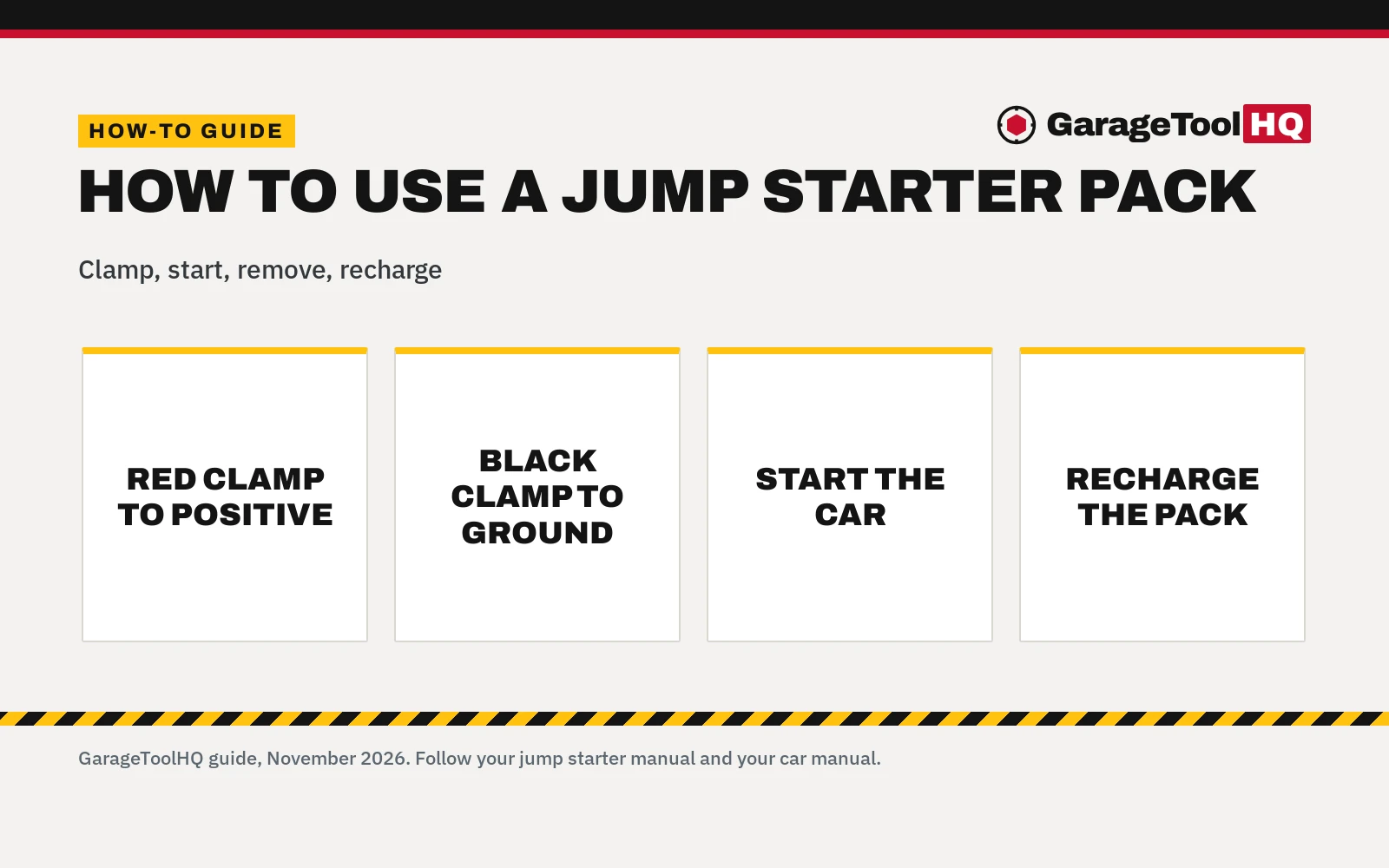
A jump starter pack starts a car with a dead battery without a donor car: clamp red to positive, black to ground, start the car, then remove the clamps and recharge the pack.

On this page
Top picks at a glance
As an Amazon Associate I earn from qualifying purchases.
- 1
 WOLFBOX 4000A Jump Starter9.7/10View on Amazon
- 2
 NOCO Boost X GBX155: 4250A UltraSafe Jump Starter9.7/10View on Amazon
- 3
 Powrun P-ONE Jump Starter9.7/10View on Amazon
- 4
 HALO Bolt AIR 1500A Jump StarterView on Amazon
- 5
 Clore Automotive Jump-N-Carry JNC660 1700 Peak Amp 12 VoltView on Amazon
- 6
 GOOLOO GT4000S 12V 4000A Peak Jump Starter with 100W Two-WayView on Amazon
- 7
 Clore Automotive Jump-N-Carry JNC770R 1700 Peak Amp PremiumView on Amazon
- 8
 Clore Automotive Booster PAC ES5000 1500 Peak Amp 12V JumpView on Amazon
- 9
 GOOLOO GP3000 Jump StarterView on Amazon
How to use jump starter pack? Clamp the red clamp to the positive terminal, the black clamp to a bare metal ground point, switch the pack on, start the car, then switch the pack off and take the clamps off in reverse order. A dead battery on a cold morning is the usual reason a pack comes out of the garage, and the job goes smoothly when the clamps land on the right terminals. Your car manual and your pack manual have the final word on your exact setup.
Other tools worth a look
 HALO Bolt AIR 1500A Jump StarterCheck price on Amazon
 Clore Automotive Jump-N-Carry JNC660 1700 Peak Amp 12 VoltCheck price on Amazon
 GOOLOO GT4000S 12V 4000A Peak Jump Starter with 100W Two-WayCheck price on Amazon
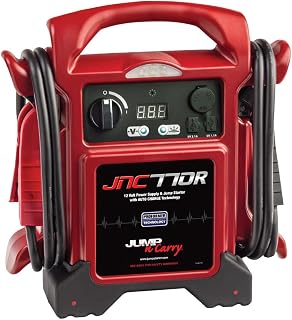 Clore Automotive Jump-N-Carry JNC770R 1700 Peak Amp PremiumCheck price on Amazon
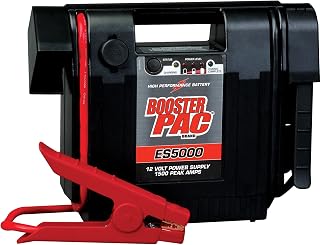 Clore Automotive Booster PAC ES5000 1500 Peak Amp 12V JumpCheck price on Amazon
 GOOLOO GP3000 Jump StarterCheck price on Amazon
GarageToolHQ earns a commission when you buy through links on our product pages, at no extra cost to you. Read our affiliate disclosure.
Below: what a jump starter pack does, how to hook it up clamp by clamp, what to do when the car will not start, and how to put the pack away charged and ready.
What a jump starter pack does
A jump starter pack is a portable battery with clamps and a power switch, built to give a starter motor the burst of power it needs when the car battery is too flat to turn the engine over. It is not a battery charger: it does not refill a dead battery, it lends the car enough power for a start, and the car alternator takes over charging from there. A pack lives in the trunk or on a garage shelf for the morning the car only clicks when the key turns.
Before you hook anything up, check the pack charge light: a pack with a low charge may not have the power for a start. Recharge the pack after each use, and check the light now and then so the pack is ready when the car needs it.
How to use jump starter pack, step by step
Work on level ground with the car in park, or in neutral with the parking brake on if the car has a manual gearbox, and the ignition off, and keep the pack and its cables clear of belts, fans and hot parts. Wear eye protection, and keep the clamps from touching each other or any bare metal while the pack is on.
- Switch everything off. Turn the ignition off, switch off lights, heater, radio and any chargers plugged into the car, so more of the pack power is available for the starter.
- Check the pack charge. Look at the charge light on the pack. If the pack shows a low charge, recharge it before you start; a flat pack cannot jump a flat battery.
- Find the battery terminals. Pop the hood and find the car battery. The positive terminal usually wears a red cover and a plus sign, the negative terminal a black cover and a minus sign. If the battery sits under a cover or in the trunk, your car manual shows where the jump points are.
- Clamp red to positive. Clip the red clamp firmly on the positive terminal, with the teeth biting clean metal. Wiggle it gently: a loose clamp is a common reason a jump fails.
- Clamp black to ground. Clip the black clamp to a bare, unpainted metal point on the engine block or the car body, away from the battery and from moving parts. Never clip the black clamp to the negative terminal of the dead battery.
- Switch the pack on. Turn the pack power switch on and watch for its ready light. If the pack warns of reversed clamps with a light or a buzzer, switch it off right away, take the clamps off and start over with red on positive.
- Start the car. Turn the key or press the start button. If the engine turns over, let it run. If it only clicks, switch the pack off, check the clamp contact, and try again.
- Switch the pack off and remove the clamps. With the engine running, switch the pack off, take the black clamp off its ground point, then take the red clamp off the positive terminal. Keep the clamps apart as you put them away.
- Let the car run. Drive the car or let it idle so the alternator starts recharging the battery. A flat battery needs a longer drive or a proper charger to come back to full charge.
- Recharge the pack. Plug the pack in as soon as you are back, and let it charge until its light shows full. A pack put away flat is a pack that will not help next time.
Reversed clamps can damage the pack, the car electronics and the battery. If the pack warns you with a light or a buzzer, switch it off, remove the clamps and start over with red on positive. Some packs refuse to send power when the clamps are reversed, and some warn with a light or a buzzer; a pack with neither feature gives no warning at all, so check the clamps by eye before you switch on.
Lead-acid batteries can release hydrogen while charging, so charge in a ventilated space away from sparks and flames, connect positive first and negative last, set the charger to the battery type (flooded, AGM, gel, lithium), and wear eye protection. Read our Safety Disclaimer.
What to do when the car will not start
If the engine only clicks or turns over slowly, switch the pack off and check the clamps. Corrosion on the terminals breaks the contact, and a clamp that looks tight can still sit on crust. Clean the terminals and clamp again, and check that the pack charge light shows a full charge. Our guide to how to clean corroded car battery terminals walks through the cleaning job.
If the car still will not start with good clamp contact and a charged pack, the fault may sit deeper: a battery past saving, a worn starter, a loose cable or a drain that flattened the battery overnight. A pack cannot fix those. Charge the battery with a proper charger or have a mechanic look at the car. If the battery will not hold a charge at all, our guide to why a car battery will not charge lists the causes and checks.
Jump starter pack vs jumper cables
A pack and a set of jumper cables do the same job by different means, and the choice comes down to whether another car is handy:
- Jump starter pack: carries its own charge, so no donor car is needed. It must be kept charged, and it takes up trunk or shelf space.
- Jumper cables: need another car with a charged battery, and the cars must sit close enough for the cables to reach. Cables never run flat, and they cost less than a pack, but they are useless on an empty road with no other car around.
If you drive alone on quiet roads, a pack is the safer bet. If you park near other cars and want the simplest kit, cables do the job. For cables, our picks for the best jumper cables for beginners compare sets that are easy to handle.
Keeping the pack ready
A pack is only useful when it holds a charge, so treat charging as part of the job. Recharge the pack after each jump, and check the charge light now and then through the year. Store the pack where it stays dry and out of extreme heat and cold, and keep the clamps clean and the cables free of nicks. Our guide to how to charge a jump starter pack covers the charging job in detail.
FAQ: garage tools
Can I use a jump starter pack on any car?
A pack made for car batteries works on most cars with a standard battery. Check your car manual and the pack manual for the battery type the pack covers, and do not use a pack on a battery type its manual rules out.
Do I need another car to use a jump starter pack?
No. That is the point of the pack: it carries its own charge, so no donor car is needed. Hook the clamps up as above, start the car, and put the pack away charged.
What if the clamps spark when I connect them?
A small spark at the ground clamp can happen as the circuit closes. If you see heavy sparking, smoke or heat, switch the pack off right away, remove the clamps and check the connections before you try again.
How long does a jump starter pack hold its charge?
That depends on the pack and how it is stored. Check the charge light before you need the pack, and recharge it after each use so it is ready. A pack that will not hold a charge may be worn out.
Can I leave the pack connected after the car starts?
No. Switch the pack off and remove the clamps after the engine is running, black clamp off its ground point and red clamp off the positive terminal, then recharge the pack. Leaving a pack connected can damage the pack and the car electronics.
What do I do if the car still will not start?
Check the clamp contact and the pack charge, then try again. If the car still will not start, the fault may be the battery, the starter or another part, and a mechanic should look at it.
Related: diagnostics and electrical guides, the best heavy duty jump starters, our best jump starters with a tire inflator and how to use a portable car battery charger.