How to Use Transmission Jack: Step-by-Step Shop Guide
A complete guide on how to use a transmission jack safely, from saddle alignment and tie-down chains to hydraulic lowering and vehicle stand safety.

On this page
Top picks at a glance
As an Amazon Associate we earn from qualifying purchases.
- 1
 High Lift Hydraulic Transmission Jack9.7/10View on Amazon
- 2
 VEVOR Transmission Jack9.6/10View on Amazon
- 3
 Transmission Jack Adapter for Cars9.5/10View on Amazon
- 4
 Powerbuilt 2 Ton Triple Lift Floor JackView on Amazon
- 5
 1100 lb Hydraulic Transmission JackView on Amazon
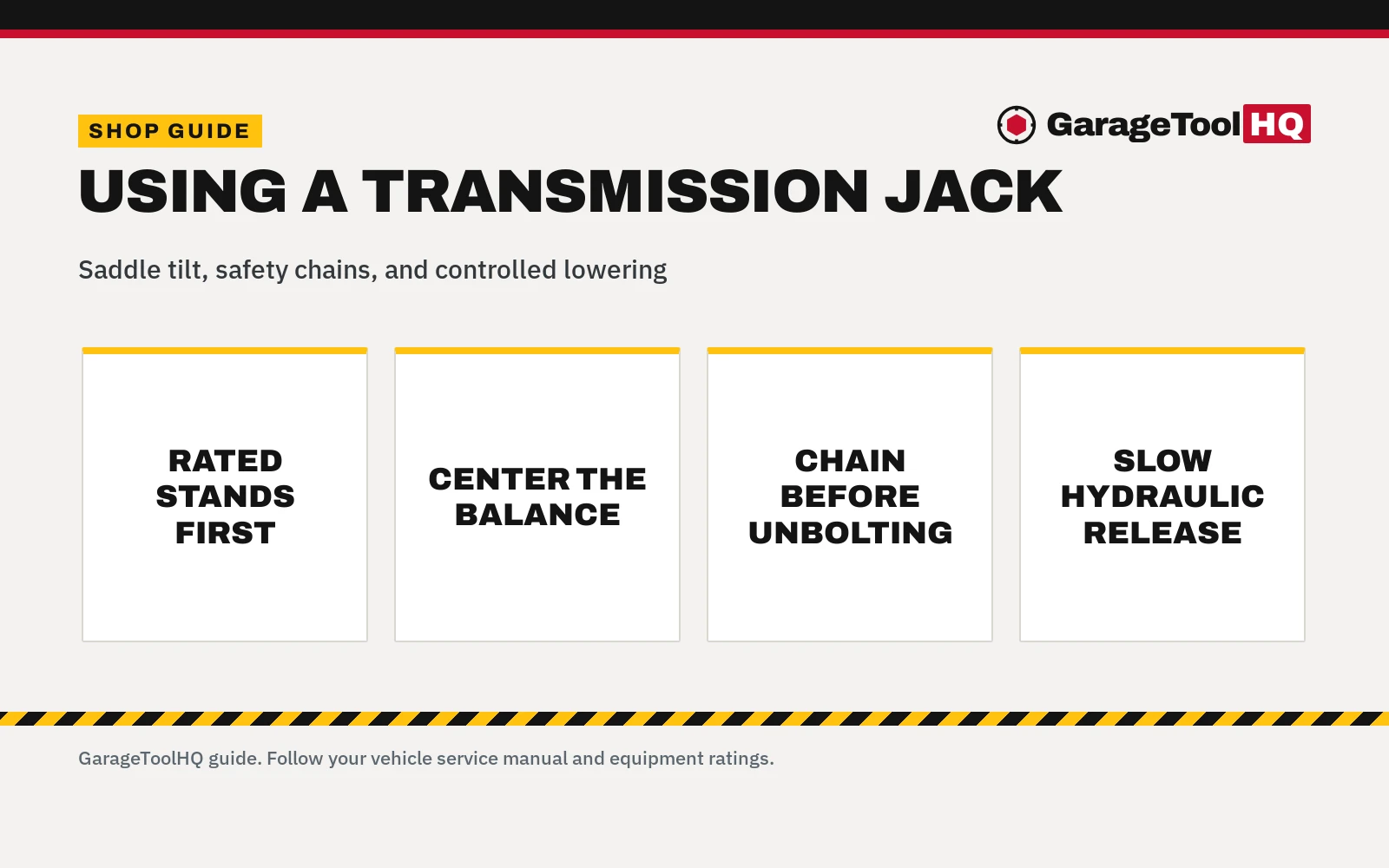
Wondering how to use transmission jack equipment safely in your shop? Support the vehicle on rated jack stands or an automotive lift, align the adjustable saddle beneath the transmission pan balance point, fasten the housing with safety chains or straps, and lower the hydraulic ram slowly. A transmission jack cradles, balances, and maneuvers a heavy transmission or transfer case during removal and installation. Never rely on any jack alone to hold up a vehicle, always position rated stands on solid, level ground, and follow the lift points in your vehicle manual.
More options to compare
 Powerbuilt 2 Ton Triple Lift Floor JackCheck price on Amazon
 1100 lb Hydraulic Transmission JackCheck price on Amazon
GarageToolHQ earns a commission when you buy through links on our product pages, at no extra cost to you. Read our affiliate disclosure.
Below: essential setup rules before unbolting drivetrain parts, how low-profile floor units compare with tall telescoping uprights, a step-by-step procedure for removal and installation, and key hydraulic maintenance practices.
How to use transmission jack safely: rules before you begin
Dropping an asymmetric, heavy transmission can damage the vehicle or cause severe injury. Before positioning equipment, follow these core safety rules:
- Vehicle elevation must be mechanical. Never crawl under an automobile held solely by hydraulic pressure. Support the vehicle on rated jack stands on level, solid concrete, or lock an automotive hoist.
- Locate the balance point. Gearboxes carry mass unevenly. Consult your vehicle manual to locate the specified lifting surface.
- Clear the floor. Transmission jacks roll on swivel casters. Clear away debris, tools, and air hoses so casters roll without binding.
- Drain fluid if possible. Fluid sloshing inside the pan shifts weight unexpectedly. Drain fluid beforehand if a drain plug is available to lighten the assembly and avoid spills.
Transmission jack types and shop setups
Transmission jacks fall into distinct categories designed for specific workspace arrangements. Choosing the right design depends on whether your vehicle is elevated on tall service posts or positioned on shop stands close to the ground:
| Style | Lifting mechanism | Shop setup |
|---|---|---|
| Telescoping upright jack | Hydraulic or air-assisted ram, multi-stage telescoping column | Vehicles raised on an automotive service lift |
| Low-profile floor jack | Scissor mechanism or telescoping horizontal ram | Vehicles raised on heavy-duty jack stands |
| Floor jack adapter head | Converts removable floor jack saddle shaft | Home garages using an existing hydraulic floor jack |
Telescoping upright units serve full-rise bays. Sunex Tools lists the 7793B with a 35-inch minimum height, a 74-inch maximum height, and a 1,000 lb capacity. VEVOR lists the HTJ-1322 with a 34.3 in to 68.5 in range at 1322 lbs capacity, and the GW-0.8 with a 34.6 to 69.3 in range at 1660 lbs capacity. LARBANKE lists a 1322 lbs capacity model spanning 33.4 inches to 68.8 inches, and VORTEXTOVE lists an 1100 lbs load capacity from 33.5 to 67 inch lift height. For lower undercar clearances on stands, low-profile floor units fit beneath the vehicle. Garvee lists a 450 LBS capacity low-profile unit with a 7-23 Inch lift range from a 7-inch minimum height. Maxority lists a low-profile model with a 2000 lb capacity, a 6.9-inch minimum height, and a 31.7-inch maximum height. For existing floor jacks, Lucky Seven lists an adapter rated for 1100 lbs that fits a 1-5/32” removable saddle shaft.
Step-by-step guide: how to use a transmission jack
Follow this systematic procedure to separate, support, and lower the gearbox safely:
- Raise and support the vehicle. Lift at factory points. On stands, verify solid placement before working underneath. If using an overhead hoist, see our guide on how to use a 2 post lift for mechanical lock engagement.
- Disconnect lines and support the engine. Disconnect battery terminals, linkages, wiring, cooler lines, and driveshafts. Support the rear of the engine with an overhead bar or jack to prevent backward tilt when removing mounts.
- Position the jack. Roll the jack beneath the transmission balance point, aligning corner brackets with the pan flange or case ribs rather than thin pan sheet metal.
- Raise saddle into light contact. Elevate the saddle until brackets meet the case flange. If resting against a stamped steel pan, place a wood block between the saddle and pan to distribute weight. Do not lift the transmission yet.
- Adjust saddle alignment. On longitudinal drivetrains, tilt the saddle to match the engine incline. Lucky Seven lists its adapter head with 30° tilt forward and 30° backward. VEVOR lists up to 30° saddle tilt on the HTJ-1322 and GW-0.8 models, with the GW-0.8 tray offering 360° rotation. LARBANKE lists pallet tilt up to 30°. Sunex Tools lists for its 7796 model a saddle tilt of 37 degrees forward, 26 degrees backward, and 12 degrees left and right.
- Fasten safety restraints. Wrap chains or straps around the housing and draw them tight. Lucky Seven lists double 25″ long safety chains. LARBANKE lists two fixed chains, and Sunex Tools provides a tie-down strap on the 7796 and 7793B models.
- Unbolt the crossmember. Support transmission weight on the saddle. Remove mount bolts, then unbolt the crossmember from the frame.
- Unbolt the bellhousing. Remove torque converter bolts if servicing an automatic, then remove bellhousing bolts, leaving two side bolts loosely threaded until ready to pull.
- Separate the gearbox. Release caster brakes. Remove the remaining bolts and draw the bellhousing off the engine dowel pins along the crankshaft centerline.
- Lower the ram and roll clear. Once clear of the engine, open the release valve smoothly to lower the ram to its lowest point, minimizing tip risk while rolling.
A hydraulic jack is a lifting and positioning tool, not a permanent holding fixture. Always keep the vehicle supported on rated jack stands or a mechanical lift lock. Never crawl under a car or truck that rests only on hydraulic jacks.
A jack is for lifting, not holding. Never work under a vehicle supported only by a jack: set it on rated jack stands, on solid, level ground, at the manufacturer's lift points, chock the wheels, and give the car a firm shake before you go under. Read our Safety Disclaimer.
Saddle alignment, tilt angles, and load balance
Aligning the saddle angle with the engine tilt prevents contact along only one edge. Under load, an uneven saddle can slip or distort the pan sheet metal. Adjust pitch and roll knobs until brackets make flat contact across structural ribs or pan flanges.
Sunex Tools provides four ratcheting saddle arms on its 7796 model that adjust to the oil pan flange, with a 30.25 in. square base for stability. For air-hydraulic models, Sunex Tools specifies regulating shop air to 100 psig for the primary air-activated stage. When working on jack stands, pairing your setup with a best floor jack for cars provides sufficient entry clearance to roll low-profile gear underneath.
Safety chains or straps are mandatory on every pull. Drivetrain units are oily and shift unexpectedly. Thread chains around the main case and hook them firmly into saddle slots before loosening crossmember bolts.
Hydraulic maintenance, bleeding air, and caster care
Proper maintenance ensures that a hydraulic transmission jack operates smoothly without dropping or binding:
- Bleeding air. If the ram feels spongy or fails to reach full height, open the release valve fully, pump rapidly several times to purge air from the circuit, then close the valve and raise the ram without load.
- Checking oil. Keep hydraulic oil filled to the plug with clean hydraulic jack oil. Never use brake fluid, motor oil, or transmission fluid, which ruin internal seals.
- Inspecting casters. Ensure casters turn freely. VEVOR lists four wheels with two brakes on the HTJ-1322 and GW-0.8 models. Lock brakes during adjustments, but unlock them before drawing the transmission backward.
- Storage. Lower the ram fully to relieve internal pressure and protect the piston rod. If pulling an engine simultaneously, transfer it to a best engine stand rather than holding it on a jack.
Frequently Asked Questions
Can I use a regular floor jack instead of a transmission jack?
A standard floor jack has a small round saddle that allows an irregular transmission to slip off easily. A transmission jack provides a wide, tilting saddle with corner brackets and chains to cradle the housing. If using a floor jack, install an approved transmission adapter head.
How do you find the balance point on an unfamiliar transmission?
Consult your vehicle service manual for the lifting point. On rear-wheel-drive units, the center of gravity is typically near the middle of the main case or pan flange, while front-wheel-drive transaxles balance closer to the bellhousing. Keep chains snug before unbolting mounts.
Why does my hydraulic transmission jack drift down under load?
Drifting down under load usually indicates a loose release valve knob, air in the fluid, or worn internal seals. Check that the release valve is shut firmly. If drift continues, bleed trapped air from the hydraulic circuit.
Can one person safely remove a transmission using this equipment?
While the jack bears the physical weight, having a helper is strongly advised. A helper assists with watching harness clearances, steadying the casing, and guiding alignment during reinstallation.
What should I do if the transmission hangs up on the engine dowel pins?
Do not force the jack. Ensure all bellhousing, converter, and starter bolts are removed. Confirm the rear of the engine is supported at the same angle, adjust saddle tilt to relieve dowel pin bind, and draw the casing straight back along the crankshaft centerline.
How much lifting capacity do I need for passenger car transmissions?
Passenger car transmissions are well within typical shop equipment ratings. Garvee lists a 450 LBS capacity low-profile unit, Sunex Tools rates models at 1,000 lb capacity, and VEVOR lists models at 1322 lbs and 1660 lbs. Always select a jack rated above your assembly weight.
Related: our guide on how to use a 2 post lift, the best jack stands for stable undercar support, our review of the best engine stand models, the best floor jack for cars, and our engine and shop equipment hub.