Impact Wrench vs Impact Driver: Differences Explained
Impact wrenches and impact drivers compared for garage work: how their anvils and torque outputs differ, which automotive jobs each handles, and four cordless examples from our review.

On this page
Top picks at a glance
As an Amazon Associate we earn from qualifying purchases.
- 1
 DEWALT 20V MAX Cordless Impact Wrench9.6/10View on Amazon
- 2
 Seesii Impact Wrench 665 FT-LBS9.6/10View on Amazon
- 3
 1/2" Cordless Impact Wrench9.5/10View on Amazon
- 4
 OEMTOOLS 24666 1/2” Drive Heavy Duty Impact WrenchView on Amazon
- 5
 Ingersoll Rand 231C 1/2" Drive Air Impact Wrench Features upView on Amazon
- 6
 Ingersoll Rand 2235TiMAX 1/2"-Drive Air Impact WrenchView on Amazon
- 7
 AIRCAT 1056-XL 1/2" Nitrocat Composite Compact Impact WrenchView on Amazon
- 8
 MILWAUKEE'S Mid-Torque Impact WrenchView on Amazon
- 9
 Ingersoll Rand 2135QXPA 1/2" Drive Air Impact Wrench FeaturesView on Amazon
Verdict: Choose an impact wrench if you work on cars, change vehicle wheels, and need high torque to break loose stubborn suspension bolts or lug nuts. Choose an impact driver if you assemble furniture, drive long wood screws, install lag bolts, or do general DIY construction around the house.
When deciding between an impact wrench vs impact driver, the main difference comes down to the drive mechanism, torque scale, and intended fasteners. An impact wrench uses a heavy square anvil to spin large nuts and machine bolts, while an impact driver uses a 1/4 inch hex collet to drive screws and smaller fasteners. This comparison explains how their internal mechanisms differ, which automotive jobs each handles, and reviews four cordless examples from our comparison group.
GarageToolHQ earns a commission when you buy through links on this page, at no extra cost to you. Read our affiliate disclosure.


DEWALT 20V MAX XR Impact Driver
A 20V cordless impact driver with a brushless motor delivering 1825 in-lbs of torque, 3-speed control and a 5.1 in head.
Pros
- Brushless motor delivers 1825 in-lbs of torque
- Compact 5.1 in length and 2.0 lbs weight
- 3-speed selector with variable speed trigger and 3-LED light
- 3 year limited warranty
Cons
- Bare tool only, battery and charger not included
- Spec table incorrectly lists a 0.5 inch maximum chuck size instead of 1/4 inch hex
- Not designed for vehicle lug nuts or heavy suspension bolts
- No safety certifications stated

DEWALT 20V MAX Cordless Drill and Impact Driver
A 20V combo kit featuring a 1/4 in hex impact driver delivering 1700 in-lb of torque alongside a 1/2 in drill driver.
Pros
- Includes DCF885 impact driver and DCD771 drill driver
- Impact driver delivers 1700 in-lb of torque at 2.8 lbs
- Includes two 20V 1.3 Ah batteries, charger and bag
- 3 year limited warranty
Cons
- Older single-speed brushed motor platform
- Spec table lists package weight as 3.6 pounds while drill driver alone is 3.6 lbs
- 1.3 Ah battery packs provide basic runtime compared to larger packs
- No safety certifications stated

Robustrue Cordless Impact Wrench
A 1/2 in cordless impact wrench rated at 590 ft-lbs (800 Nm) with two 4.0 Ah batteries, charger and four sockets.
Pros
- Maker rates maximum torque at 590 ft-lbs (800 Nm)
- Includes two 4.0 Ah batteries and 1-hour fast charger
- 3 speed settings up to 2800 RPM with reverse brake-stop mode
- Includes tool case and four sockets (17mm, 19mm, 21mm, 24mm)
Cons
- No warranty term is stated
- Spec table lists only 1 impact wrench under included components despite kit contents in bullets
- Unsubstantiated marketing claim of being the market's highest torque cordless impact wrench
- No safety certifications stated
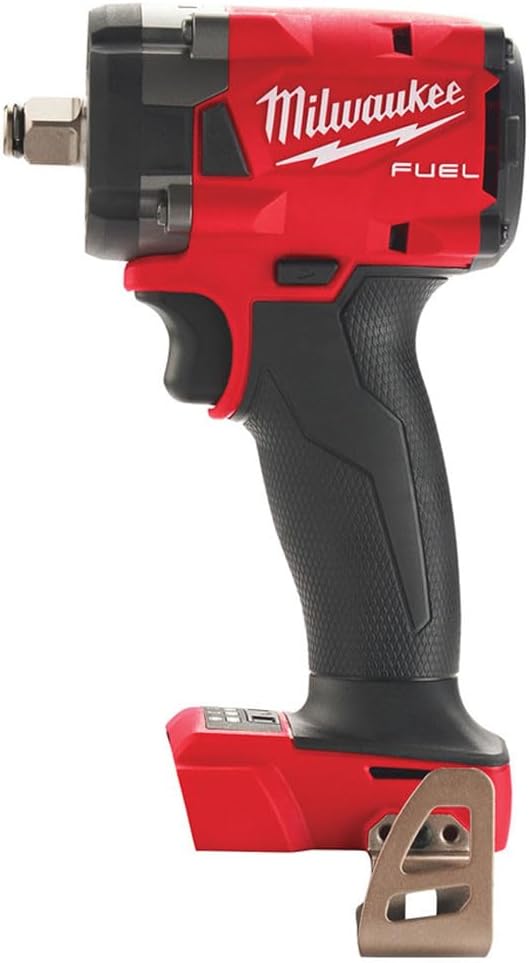
Milwaukee M18 FUEL 3/8" Compact Impact Wrench
A compact 3/8 in cordless impact wrench delivering up to 250 ft-lbs of nut-busting torque with a 4.8 in head length.
Pros
- Delivers up to 250 ft-lbs of nut-busting torque
- Very compact 4.8 in overall length
- 4-Mode DRIVE CONTROL includes 20 ft-lb auto shut-off mode
- Tri-LED lighting surrounds the 3/8 in anvil
Cons
- No warranty term is stated
- Spec table contradicts bullets by listing torque as only 20 ft-lb
- Tool weight is not stated in the listing
- Bare tool only, battery and charger not included
More options to compare
 OEMTOOLS 24666 1/2” Drive Heavy Duty Impact WrenchCheck price on Amazon
 Ingersoll Rand 231C 1/2" Drive Air Impact Wrench Features upCheck price on Amazon
 Ingersoll Rand 2235TiMAX 1/2"-Drive Air Impact WrenchCheck price on Amazon
 AIRCAT 1056-XL 1/2" Nitrocat Composite Compact Impact WrenchCheck price on Amazon
 MILWAUKEE'S Mid-Torque Impact WrenchCheck price on Amazon
 Ingersoll Rand 2135QXPA 1/2" Drive Air Impact Wrench FeaturesCheck price on Amazon
Side by side
| Impact wrench | Impact driver | Takeaway | |
|---|---|---|---|
| Drive anvil | Square drive (3/8 in and 1/2 in in our examples) | 1/4 in hex chuck | Square anvil holds sockets; hex collet holds driver bits |
| Primary jobs | Lug nuts, suspension bolts and heavy automotive hardware | Driving wood screws, assembling furniture and sheet metal | Heavy vehicle repair vs light fastening and construction |
| Socket and bit fit | Accepts impact sockets directly onto square anvil | Accepts 1/4 in hex shank bits | Direct socket fit transfers rotational energy efficiently |
| Example torque | 250 ft-lbs (Milwaukee) to 590 ft-lbs (Robustrue) | 1700 in-lb (DCK240C2) to 1825 in-lbs (DCF845B) | Impact wrench examples deliver higher rotational torque |
| Example head length | 4.8 in (Milwaukee) and 5.9 in (Robustrue) | 5.1 in (DCF845B) and 5.55 in (DCF885) | Both formats offer compact heads for tight spaces |
| Example tool weight | 3.74 lbs with battery (Robustrue); Milwaukee not stated | 2.0 lbs (DCF845B) and 2.8 lbs (DCF885) | DEWALT driver examples weigh less than the Robustrue wrench; Milwaukee not stated |
| Speed controls (examples) | 3 speeds or 4 modes | Single speed or 3 speeds | Multi-speed settings help control fastening |
| Lug nut removal | Designed for vehicle wheel service and heavy bolts | Not intended for high-torque vehicle lug nuts | Impact wrenches provide necessary breakaway torque |
Example figures are manufacturer rated, as published on each listing and collected 9 October 2026.
Impact wrench vs impact driver: drive mechanism and anvils
The most visible physical difference between these two tools is the output drive. An impact wrench ends in a solid square anvil, typically in 3/8 inch or 1/2 inch sizes for automotive shop work. In the listings reviewed, the Milwaukee example features a 3/8 inch square anvil with a friction ring, while the Robustrue example uses a 1/2 inch square drive. Sockets snap directly onto this square anvil, eliminating adapters that absorb rotational energy.
An impact driver features a 1/4 inch quick-release internal hex chuck. Both DEWALT examples in our review group use this 1/4 inch hex collet designed to hold standard 1 inch driver bits and hex-shank accessories. Because the hex collet locks bits in place with a spring-loaded collar, bit changes are quick, with the DEWALT DCK240C2 listing specifically highlighting one-handed loading for 1 inch bit tips. However, the smaller 1/4 inch hex shank cannot withstand the rotational torque required for heavy automotive bolts.
Torque output and rotational force
Impact wrenches operate on a much higher torque scale than impact drivers. Automotive bolts, especially vehicle lug nuts and suspension components, require substantial breakaway power. For instance, the Robustrue impact wrench listing claims a maximum torque of 590 ft-lbs (800 Nm), and the compact Milwaukee example lists 250 ft-lbs of nut-busting torque. When working on wheel service, review our guide on how much torque you need to remove lug nuts to match tool output to vehicle specifications.
Both impact driver listings in our review group measure their output in inch-pounds rather than foot-pounds. The DEWALT DCF845B listing states 1825 in-lbs of torque, while the DEWALT DCK240C2 spec table states 1700 in-lb. An impact driver delivers rapid rotational pulses optimized to sink fasteners smoothly without camming out screw heads, but it does not provide the brute rotational force found on heavy automotive wrenches.
Fasteners and intended garage jobs
The fastener dictates which tool you should pick up. An impact wrench belongs on vehicle chassis, wheel hubs, brake caliper mounts, and rusted suspension hardware. Heavy machine bolts require direct engagement through thick-walled sockets that can transfer high torque without shattering. Attempting to loosen rusted suspension bolts with an impact driver will over-stress the tool or snap hex adapters.
An impact driver excels at carpentry, metal framing, panel removal, and interior vehicle work. It drives long wood screws, deck fasteners, self-tapping sheet metal screws, and small lag bolts. While you can attach a hex-to-square adapter to turn small sockets on an impact driver, doing so on high-torque automotive fasteners risks snapping the adapter shank.
Sockets, bits and safety considerations
Tool accessories require careful selection. Impact wrenches must only be paired with thick-walled, impact-rated sockets made from ductile alloy steel. Never use thin chrome-plated hand sockets on an impact wrench, because the repetitive hammering blows can crack or shatter chrome sockets, creating flying debris. Always wear safety glasses when operating any impact power tool.
Impact drivers use 1/4 inch hex bits engineered for impact resistance. Standard screwdriver bits made for manual drivers often twist or break when subjected to the rapid concussive hits of an impact driver. While impact wrenches can spin lug nuts rapidly, never use an impact wrench for final wheel torquing. Review our guide on using an impact wrench to tighten lug nuts and always finish with a calibrated manual torque wrench.
Size, weight and maneuverability
Both tool types have grown remarkably compact in recent years. In the listings reviewed, the Milwaukee 3/8 inch impact wrench measures 4.8 inches in length, allowing it to squeeze between suspension linkages. The Robustrue 1/2 inch impact wrench lists a length of 5.9 inches and a weight of 3.74 lbs with a battery.
On the impact driver side, the DEWALT DCF845B measures 5.1 inches long and weighs 2.0 lbs, making it effortless to hold overhead. The older DEWALT DCF885 driver in the combo kit measures 5.55 inches and weighs 2.8 lbs. For extended driving tasks like building garage shelving or hanging drywall, the 2.0 to 2.8 lb weight of the DEWALT driver examples reduces arm fatigue compared to heavier tools.
Choose an impact wrench if
- You service vehicle wheels, brakes and suspension components
- You need high torque for heavy automotive bolts
- You work directly with 3/8 inch or 1/2 inch square drive sockets
- You need to break loose seized or rusted machine hardware
Choose an impact driver if
- You drive screws into wood, metal or drywall
- You need a lightweight tool for overhead or all-day fastening
- You work with 1/4 inch hex shank bits and driver accessories
- You build garage workbenches, shelves and storage units
Example tools
For more choices, see the best cordless impact wrench for automotive, and if you are shopping for wheel service, our guide to what size cordless impact wrench for lug nuts.
Use rated jack stands on solid ground, wear eye protection with power and air tools, keep fuel-burning equipment out of a closed garage, and follow the manual for every tool. Read our Safety Disclaimer.
Frequently Asked Questions
Can an impact driver remove lug nuts?
An impact driver is not designed to remove vehicle lug nuts. Lug nuts require substantial breakaway torque that exceeds the output of a 1/4 inch hex driver, and using a hex adapter to turn lug nuts can snap the adapter pin or overheat the driver motor. An impact wrench with a square drive anvil is the proper tool for lug nuts.
Can I use an impact wrench to drive screws?
While you can buy adapters that convert a square drive to a 1/4 inch hex collet, an impact wrench is generally too powerful and heavy for driving small screws. The massive torque can easily snap screw heads or drive fasteners straight through wood and drywall.
Do I need special sockets for an impact wrench?
Yes. You must always use impact-rated sockets with an impact wrench. Standard chrome sockets have thinner, brittle walls designed for hand ratchets. Under the concussive hammering of an impact wrench, chrome sockets can crack, shatter, and launch metal fragments.
Why are impact driver specs given in inch-pounds instead of foot-pounds?
In tool listings, impact drivers are typically rated in inch-pounds because they are designed for screws and lighter fasteners where torque is traditionally measured in smaller units. Impact wrenches handle heavy machine bolts and wheel hardware, so their output is rated in foot-pounds.
Which tool should a home mechanic buy first?
If your primary focus is vehicle maintenance, tire rotations and brake jobs, choose an impact wrench first. If you primarily do general home repairs, woodwork, and light fastener driving with only occasional minor automotive work, choose an impact driver first.
Related: our guide on should you use an impact wrench to tighten lug nuts, understanding how much torque you need to remove lug nuts, the best cordless impact wrench for automotive, and our cordless tools category.