Should You Use an Impact Wrench to Tighten Lug Nuts? What to Know
Why you should never use an impact wrench for final lug nut tightening, the risks of overtightening, and how to tighten wheels correctly with a torque wrench.

On this page
Top picks at a glance
As an Amazon Associate we earn from qualifying purchases.
- 1
 Alloyman Cordless Impact Wrench 1500 FT-LBS9.6/10View on Amazon
- 2
 1500 FT-LBS9.6/10View on Amazon
- 3
 1500 FT-LBS9.6/10View on Amazon
- 4
 OEMTOOLS 24666 1/2” Drive Heavy Duty Impact WrenchView on Amazon
- 5
 Ingersoll Rand 231C 1/2" Drive Air Impact Wrench Features upView on Amazon
- 6
 Ingersoll Rand 2235TiMAX 1/2"-Drive Air Impact WrenchView on Amazon
- 7
 AIRCAT 1056-XL 1/2" Nitrocat Composite Compact Impact WrenchView on Amazon
- 8
 MILWAUKEE'S Mid-Torque Impact WrenchView on Amazon
- 9
 Ingersoll Rand 2135QXPA 1/2" Drive Air Impact Wrench FeaturesView on Amazon
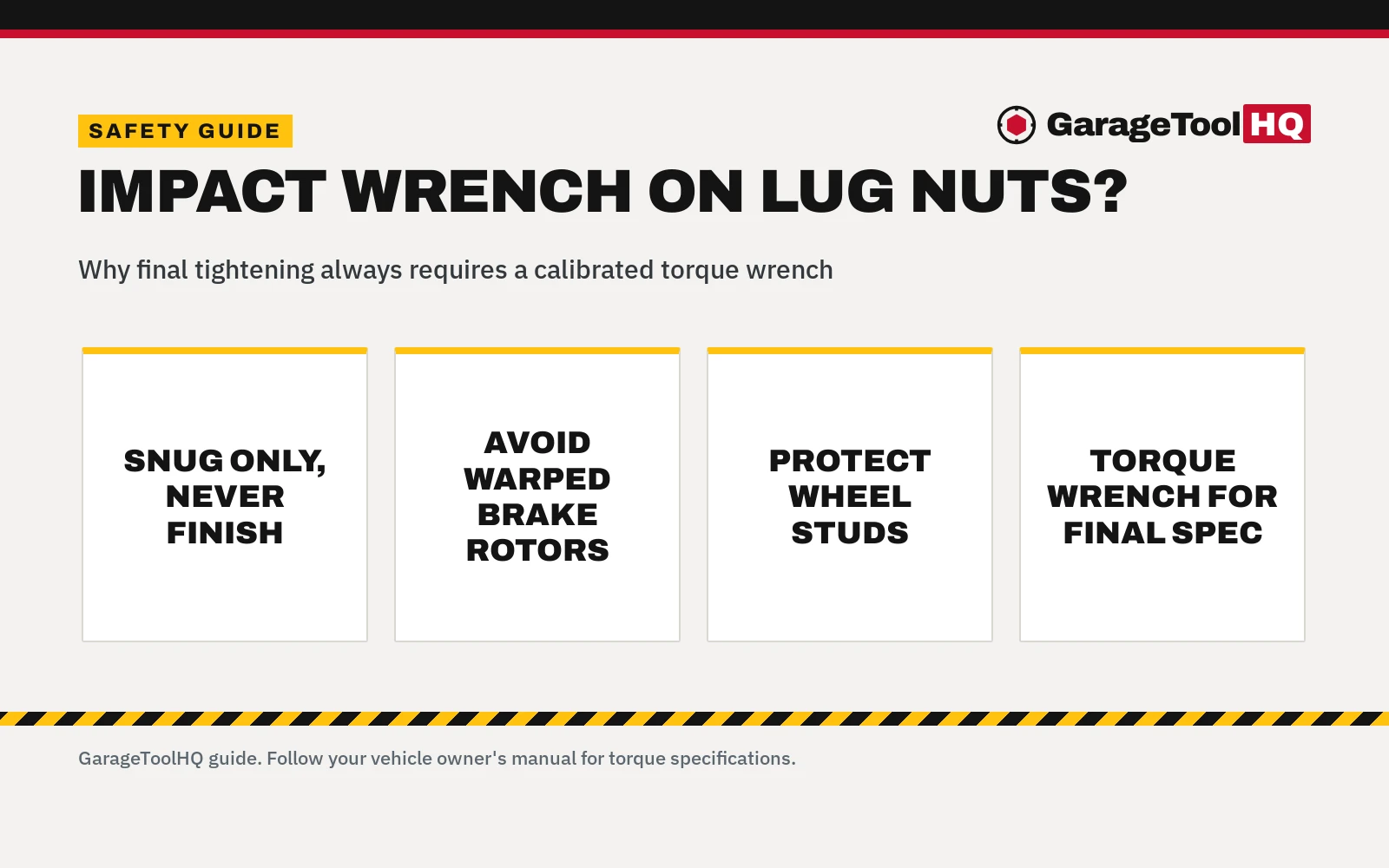
Should you use an impact wrench to tighten lug nuts? No, you should never use an impact wrench to perform final tightening on wheel lug nuts. While an impact wrench is an efficient tool for spinning lug nuts off during wheel removal or running them down onto the wheel studs, it cannot accurately regulate torque. Gunning lug nuts tight with an impact wrench risks stretching wheel studs, stripping threads, warping brake rotors, and overtightening hardware past its yield point. Always seat lug nuts gently and finish tightening with a calibrated torque wrench set to your vehicle manufacturer specification.
More options to compare
 OEMTOOLS 24666 1/2” Drive Heavy Duty Impact WrenchCheck price on Amazon
 Ingersoll Rand 231C 1/2" Drive Air Impact Wrench Features upCheck price on Amazon
 Ingersoll Rand 2235TiMAX 1/2"-Drive Air Impact WrenchCheck price on Amazon
 AIRCAT 1056-XL 1/2" Nitrocat Composite Compact Impact WrenchCheck price on Amazon
 MILWAUKEE'S Mid-Torque Impact WrenchCheck price on Amazon
 Ingersoll Rand 2135QXPA 1/2" Drive Air Impact Wrench FeaturesCheck price on Amazon
GarageToolHQ earns a commission when you buy through links on our product pages, at no extra cost to you. Read our affiliate disclosure.
Below: why uncontrolled impact torque damages wheel assemblies, how impact wrenches compare to torque sticks and torque wrenches, and the correct step-by-step procedure to secure wheels safely.
Should you use an impact wrench to tighten lug nuts? Where the risks come from
An impact wrench accelerates an internal rotating mass to strike an output anvil, generating rapid rotational blows designed to break stubborn fasteners free. While effective for loosening seized hardware, this hammering action cannot deliver the smooth, measurable tension required for wheel safety.
The torque delivered by an impact gun fluctuates unpredictably with air pressure, battery charge, trigger duration, and thread friction. High-torque half-inch cordless models publish power ratings that vastly exceed wheel fastening limits: DOVAMAN lists 550 ft-lbs of fastening torque and 1000 ft-lbs of breakaway torque, Milwaukee rates its stubby half-inch tool at 550 ft-lb, Houselife lists 750 ft-lbs, STRCEAT lists 737 ft-lbs, and Getsai lists 1033 ft-lbs of loosening torque. Heavy-duty tools reach even higher levels, with Dong Cheng listing 515 ft-lbs of tightening torque and 670 ft-lbs of nut-busting torque, and AIDERAR listing 1328 ft-lbs of breakaway torque. Hammering with these power levels quickly damages wheel hardware:
- Stud stretching and failure: Over-torquing stretches wheel studs past their elastic limit into plastic deformation, permanently weakening the steel until studs shear off under driving loads.
- Warped brake rotors: Uneven torque across the lug pattern causes uneven clamping on the rotor hat, leading to lateral runout and brake pedal pulsation.
- Gouged wheel seats: Hammering violently against soft aluminum alloy lug seats deforms the contact taper, preventing proper seating and allowing fasteners to loosen over time.
- Stripped threads: High-speed spinning can cross-thread fasteners instantly, destroying stud and lug nut threads.
- Roadside emergencies: Gunning lug nuts tight with a power gun prevents removal with a standard factory lug wrench during a flat tire emergency.
Comparing lug nut tightening methods: impact wrench, torque stick, and torque wrench
| Method | Torque control mechanism | Suitable for final tightening? |
|---|---|---|
| Impact wrench alone | Rotational hammer blows without torque measurement | No; risks stretched studs, damaged threads, and warped brake rotors |
| Impact wrench with torque stick | Torsion bar flexes to absorb excess impact blows | Only to snug; requires final verification with a torque wrench |
| Calibrated torque wrench | Calibrated internal spring mechanism indicates exact torque | Yes; the required method for accurate clamping force |
While an impact wrench speeds up wheel removal, only a calibrated torque wrench delivers the precise, uniform clamping force required across wheel hubs.
How to tighten lug nuts correctly: the step-by-step checklist
- Inspect and clean hardware. Wipe wheel studs and lug nuts clean of dirt and rust. Unless your vehicle manual explicitly calls for lubricant, always install wheel fasteners dry to prevent over-stretching the studs.
- Start lug nuts by hand. Spin each lug nut onto its stud by hand until threads engage smoothly, preventing cross-threading.
- Snug fasteners in a criss-cross pattern. Use a manual socket wrench or breaker bar to snug the nuts against the wheel seat in a star sequence. If an impact tool is used to spin nuts down free threads, keep it on a low setting and stop before contacting the wheel face; never allow it to hammer. If using a socket set like Bates Choice CR-MO steel sockets, ensure the socket size matches the lug nut hex cleanly.
- Lower the vehicle until tires contact the ground. Lower the jack just enough so the tire grips the floor without spinning. Never work under or around a vehicle supported solely by a hydraulic jack; always use rated jack stands on solid ground.
- Torque to final specification. Set a calibrated click-type torque wrench to the exact foot-pound rating in your vehicle owner’s manual. Pull smoothly in a star pattern until the wrench clicks once. Never jerk the handle or click repeatedly.
- Re-check after driving. Re-torque lug nuts with your torque wrench after a brief driving interval to ensure clamping remains stable as wheels settle.
An impact wrench is built for fastener removal and rapid assembly run-down, not precision measurement. Brief hammering can deliver force far beyond stud capacity, causing silent metal fatigue and wheel detachment.
Use rated jack stands on solid ground, wear eye protection with power and air tools, keep fuel-burning equipment out of a closed garage, and follow the manual for every tool. Read our Safety Disclaimer.
Impact wrench vs torque wrench for wheel maintenance
Each tool serves a dedicated role in wheel service:
- Impact wrench: Built for high speed and breakaway torque. It drives an internal hammer against an anvil to spin stubborn lug nuts off quickly, but cannot measure or stop at a target torque. See our guide to the best cordless impact wrench for lug nuts to compare models with brushless motors and reverse auto-stop features.
- Torque wrench: Built strictly for precision tightening. It uses a calibrated internal spring mechanism that clicks when target fastener tension is reached. Using a quality model from our guide to the best torque wrench ensures even clamping across the hub.
For more details, read our comparison of impact vs torque wrench tools. To choose the right removal tool, see what size cordless impact wrench for lug nuts delivers sufficient power.
Torque sticks: do torque-limiting extensions really work?
Torque sticks are spring-steel extension bars fitted between an impact wrench and socket. Designed to twist elastically at a set resistance, they absorb excess kinetic energy to prevent severe overtightening during high-volume shop work.
However, torque sticks are not precision tools:
- Tool sensitivity: High-output tools can overpower the torsion bar if the trigger is held down, driving fasteners past rated limits.
- Friction variations: Rust, thread wear, and socket tolerances alter torque transfer.
- No verification: A torque stick cannot display or verify achieved clamping force.
Torque sticks are suitable only for rapid run-down to snug fasteners. Technicians must always verify final torque with a calibrated manual torque wrench.
Frequently Asked Questions
Can you use an impact wrench to remove lug nuts?
Yes. Removal is the primary job for an impact wrench. Its hammering action breaks free rusted or stubborn fasteners quickly. For heavy-duty removal guidance, see how much torque you need to remove lug nuts.
Can I use an impact wrench with torque sticks instead of a torque wrench?
No. Torque sticks only limit gross overtightening during run-down. Variations in tool power, socket fit, and trigger duration mean you must always verify final torque with a calibrated torque wrench.
What happens if lug nuts are overtightened with an impact gun?
Overtightening causes permanent stud stretching, warped brake rotors, cracked or gouged alloy wheel seats, and stripped threads, while making roadside tire changes impossible with hand tools.
Can I run lug nuts down with an impact wrench on low power?
You can use an impact tool only to spin nuts down free threads, stopping immediately before contact with the wheel face. Never allow the tool to hammer against the wheel, and always finish tightening with a torque wrench.
Why do professional tire shops use impact wrenches on wheels?
Shops use impact wrenches for speed during removal and initial run-down. Responsible shops use torque-limiting sticks on low settings to snug fasteners, followed immediately by hand-clicking a calibrated torque wrench on every lug nut.
Should wheel studs be lubricated before tightening lug nuts?
No, unless your vehicle manual explicitly calls for it. Torque specifications are engineered for clean, dry threads. Adding lubricant reduces friction, causing excessive stud stretching and potential breakage at specified torque settings.
Related: our guide to how much torque you need to remove lug nuts, our roundup of the best cordless impact wrench for lug nuts, our sizing guide on what size cordless impact wrench for lug nuts, our comparison of an impact vs torque wrench, and our cordless tools hub.