Lithium vs AGM Battery Charger: Which One Should You Buy?
Lithium and AGM batteries need different charging profiles. This guide explains the difference and compares two dual-chemistry chargers with dedicated modes for each.

On this page
Top picks at a glance
As an Amazon Associate we earn from qualifying purchases.
- 1
 AstroAI S8 Ultra 12V 4000A Lithium Jump Starter Up to All9.8/10View on Amazon
- 2
 NOCO GENIUS2D 2A 12V Onboard Battery Charger9.8/10View on Amazon
- 3
 NOCO GENIUS5 5A 6/12V Smart Battery Charger9.7/10View on Amazon
- 4
 Mroinge MBC022View on Amazon
- 5
 Haisito 20-Amp Smart Battery ChargerView on Amazon
- 6
 CTEK 56-926 Lithium USView on Amazon
- 7
 OptiMATE Lithium 4s 0.8AView on Amazon
- 8
 LiTime 12V 80A Lithium Battery Charger for LiFePO4View on Amazon
- 9
 12V 20A Lithium Battery Charger VATRER POWER 14.6V LiFePO4View on Amazon
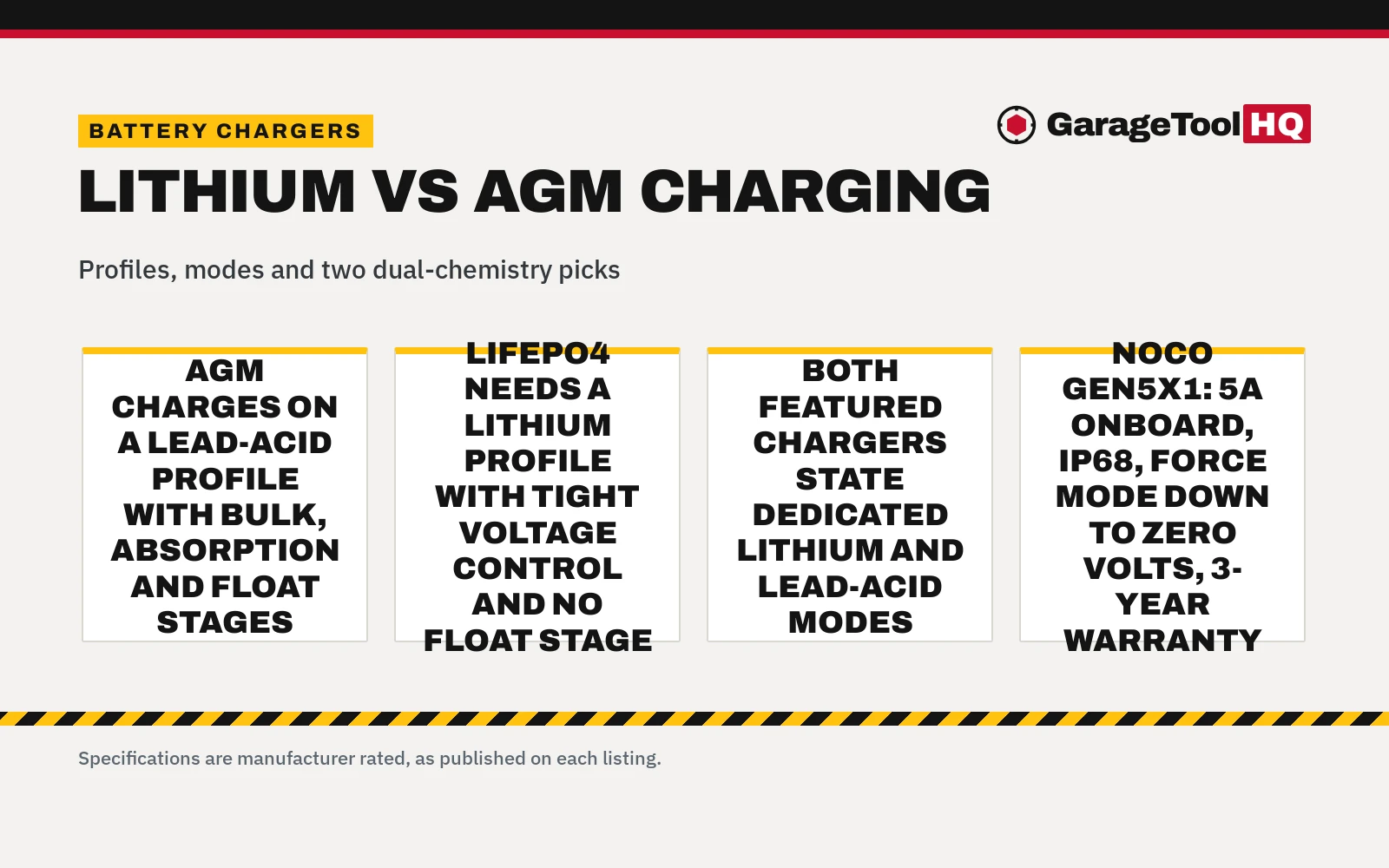
Lithium vs AGM battery charger comes down to charging profile: an AGM battery charges on a lead-acid profile with bulk, absorption and float stages, while a lithium (LiFePO4) battery needs a lithium-specific profile with tighter voltage control and no float stage. The practical answer: buy a charger with selectable modes for both chemistries, like the two dual-chemistry chargers featured in this guide, and set the mode to match your battery. A charger locked to one chemistry can undercharge or overcharge the other.
More options to compare
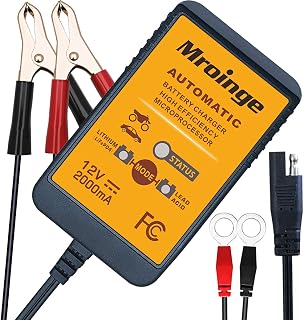 Mroinge MBC022Check price on Amazon
 Haisito 20-Amp Smart Battery ChargerCheck price on Amazon
 CTEK 56-926 Lithium USCheck price on Amazon
 OptiMATE Lithium 4s 0.8ACheck price on Amazon
 LiTime 12V 80A Lithium Battery Charger for LiFePO4Check price on Amazon
 12V 20A Lithium Battery Charger VATRER POWER 14.6V LiFePO4Check price on Amazon
GarageToolHQ earns a commission when you buy through links on this page, at no extra cost to you. As an Amazon Associate I earn from qualifying purchases. Affiliate disclosure.
Lithium vs AGM battery charger: what the charger does differently
AGM is a sealed lead-acid battery: it charges like other lead-acid types, rising to a set voltage, holding it through absorption, then dropping to a float voltage for maintenance. Lithium LiFePO4 charges at a constant current to a precise voltage cutoff and then stops; there is no float stage, and holding it at float voltage can stress the cells and the battery management system (BMS). That is why the Haisito listing warns that generic chargers “claim compatibility but risk damaging your BMS” and instead offers 3 independent Lithium LiFePO4 and Lead-Acid (PB) modes, with the smart chip “precisely locking the voltage” on the lithium setting. The NOCO GEN5X1 takes the same approach with selectable 12V, 12V AGM, 12V Lithium and 12V Repair modes per bank.
The takeaway: “charges lithium and lead-acid” is not enough on its own. A charger that merely tolerates both is different from one with a dedicated profile for each. Both chargers in this guide state dedicated modes, which is the feature to look for.
Why the wrong mode hurts
Run a lithium battery on an AGM profile and the float voltage sits above what the lithium cells want, which can stress the cells and the BMS. Run an AGM battery on a lithium profile and the missing float stage leaves it undercharged, which shortens lead-acid life through sulfation. The NOCO listing addresses a related problem with an integrated thermal sensor that adjusts charging based on ambient temperature, “preventing overcharging in heat and undercharging in cold”, since charge voltage needs shift with temperature. The Haisito covers the same ground with temperature compensation and a large LCD that displays real-time charging current, voltage, temperature and battery percentage, so you see what the charger is doing instead of guessing from blinking lights.
See the lithium vs lead acid battery charger comparison for the flooded-battery side of the same question, and AGM vs flooded battery charger for how AGM differs from conventional lead-acid.
The two chargers in this guide
NOCO GEN5X1: the onboard waterproof pick
The NOCO GEN5X1 is a 1-bank onboard charger rated at 5 amps total, 5 amps per bank, for 12V batteries in marine, boat, starter and deep-cycle systems. It is 37% smaller and 43% more powerful than the GENM1 per the listing, fully sealed at IP68 for waterproof protection, and mounts in any orientation, even upside down, with an integrated anti-vibration backing. The box includes 72-inch DC cables with 3/8-inch eyelets, a 72-inch AC cable (Type-B) and two mounting screws. It weighs 2.5 pounds, is engineered in the USA, and carries a 3-year warranty.
For dead batteries, the NOCO charges from as low as 1 volt, or uses Force Mode to manually begin charging down to zero volts for deeply discharged batteries. That is the strongest recovery claim of the two chargers here.
Haisito 20A: the high-amp portable pick
The Haisito is a portable smart charger delivering 20 amps continuous at 12V and 10 amps at 24V, with automatic 12V/24V detection on connection. The listing claims it charges up to 200% faster than standard 8A/10A chargers, a marketing figure, but the 20A rating itself is the highest stated current here and suits large SUVs, pickups and farm tractors. It covers Lithium LiFePO4, AGM, GEL, SLA and lead-acid, with a pulse Repair Mode for old, idle or stratified batteries and a forced charging mode if a weak 24V battery is misread as 12V. The compatible-device list runs from cars and motorcycles to ATVs, lawn mowers and trucks.
One limit to note: the Haisito listing states it cannot activate a totally dead battery at 0V, where the NOCO’s Force Mode goes down to zero volts. No warranty term is stated for the Haisito.
What to check before buying
Dedicated modes, not just compatibility
Both chargers here state dedicated lithium and lead-acid modes, which is the baseline requirement. The Haisito’s warning about generic “compatible” chargers risking BMS damage is the point: a lithium mode that locks voltage is different from a lead-acid charger that happens to work. Set the mode to the battery on the bench, every time. Our best battery chargers for automotive shops roundup covers more dual-chemistry options.
Amperage for your battery size
The Haisito delivers 20A at 12V (10A at 24V); the NOCO delivers 5A per bank. Higher current charges faster, but 5A suits maintenance and small batteries, and the NOCO is an onboard maintainer by design. Match amps to the job: big banks and dead batteries want current, stored vehicles want a maintainer.
Voltage: 12V only or 12V and 24V
The NOCO is 12V only. The Haisito auto-detects 12V or 24V systems. If everything you own is 12V, the NOCO’s dedicated 12V modes are fine; if you run 24V equipment, the Haisito’s auto-detection matters.
Onboard vs portable
The NOCO mounts permanently in the vehicle or boat, sealed at IP68, with anti-vibration backing. The Haisito is a portable unit you carry to the battery. Onboard suits marine use where the charger lives with the battery; portable suits a garage serving many vehicles.
Dead-battery recovery
The NOCO’s Force Mode starts charging down to zero volts. The Haisito’s pulse Repair Mode helps old, idle or stratified batteries but cannot start a 0V battery. If you regularly revive neglected batteries, the recovery floor is a deciding spec.
Cold weather behavior
The NOCO’s thermal sensor adjusts for ambient temperature to prevent overcharging in heat and undercharging in cold; the Haisito states temperature compensation and targets cold winter starts. See the best car battery charger for winter roundup for more cold-weather picks.
Warranty in writing
The NOCO states a 3-year warranty. The Haisito states no warranty term. A stated term is the only promise that counts.
Lead-acid batteries can release hydrogen while charging, so charge in a ventilated space away from sparks and flames, connect positive first and negative last, set the charger to the battery type (flooded, AGM, gel, lithium), and wear eye protection. Read our Safety Disclaimer.
Frequently Asked Questions
Can I charge a lithium battery with an AGM charger?
Only if the charger has a dedicated lithium mode. An AGM-only profile holds a float voltage that a LiFePO4 battery does not want. Both chargers in this guide state dedicated lithium modes.
Can I charge an AGM battery with a lithium charger?
Only in a lead-acid or AGM mode. A lithium-only profile skips the float stage AGM needs. Set the charger to 12V AGM on the NOCO or the lead-acid mode on the Haisito.
What does repair mode do?
The NOCO’s 12V Repair Mode and the Haisito’s pulse Repair Mode target old, idle or stratified batteries to restore lost performance. Neither is a fix for a physically damaged battery.
Which charger recovers a fully dead battery?
The NOCO, with Force Mode down to zero volts. The Haisito states it cannot activate a battery at 0V.
Do I need a 24V charger?
Only if you own 24V systems. The Haisito auto-detects 12V or 24V; the NOCO is 12V only.
Is a maintainer the same as a charger?
A maintainer holds a charged battery at full without overcharging; the NOCO is designed as an onboard charger and maintainer. See trickle charger vs float charger for the maintenance-stage details.
Related: the car battery charger vs jumper cables comparison for emergency starts.
More picks: battery chargers for automotive shops, car battery charger for winter, trickle charger vs float charger.