Manual Truck Tire Changers: Types and Uses
A manual truck tire changer breaks the bead and mounts truck tires by hand, and the right pick starts with matching its rim range to your wheels.

On this page
A manual truck tire changer is a hand-powered stand that breaks the bead, pulls a tire off the rim, and mounts a replacement without electricity; the pneumatic-assist type uses shop air for its bead breaker cylinder instead of arm strength alone. The wheel locks onto a center post or cone, a bead breaker arm presses the tire away from the rim edge, and a lever with a duck head guides the bead over the rim. For a truck owner who changes tires at home or on a farm, it turns a shop-machine job into garage work done with muscle and patience.
As an Amazon Associate I earn from qualifying purchases. GarageToolHQ earns a commission when you buy through links on our product pages, at no extra cost to you. Read our affiliate disclosure.
Below: the types, the steps for a tire change, the sizes that fit truck wheels, and how a manual changer compares with a powered machine.
Manual Truck Tire Changer: What It Is and How It Works
A manual truck tire changer has a small set of parts that work together. A steel base holds the unit steady. A center post with a cone centers the wheel and locks it so it cannot spin while the tire is levered. A bead breaker arm presses down on the sidewall near the rim edge. A long lever with a duck head hooks the tire bead and walks it over the rim lip. Some units add a gear set or an air cylinder to cut the effort.
The bead is the stiff inner edge of the tire that seals against the rim, and breaking it means pressing that edge inward, away from the rim seat. Until the bead breaks free on each side, the tire cannot come off the rim. That is why the bead breaker arm, not the lever, does the heavy work at the start of the job. Once the bead is free, the lever guides it over the rim until the tire lifts away.
Manual changers suit tire work that happens now and then rather than all day. A home garage, a farm shop, or a mobile repair setup can hold a changer in a corner and bring it out when a truck tire needs swapping.
Types of Manual Tire Changers
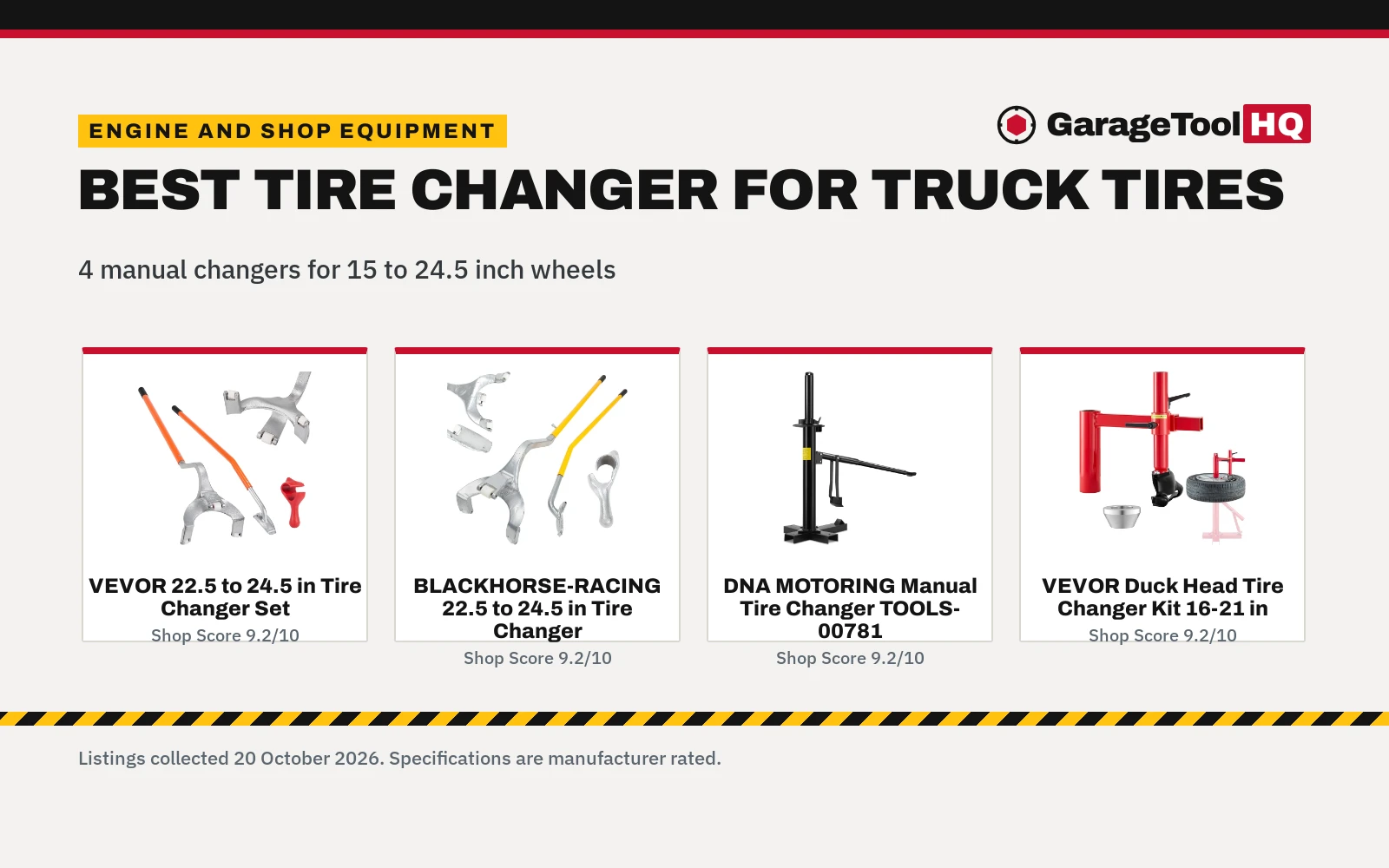
Manual changers differ in how much help the tool gives the lever. A plain lever changer relies on arm strength and a long handle. A gear-drive changer adds a gear set that multiplies the force from the handle. A pneumatic-assist changer uses shop air to drive the bead breaker. A duck head adapter kit fits onto a changer base and centers on the wheel with a cone.
| Type | How it works | Rim range |
|---|---|---|
| Duck head adapter kit | A duck head guides the bead while a cone centers the wheel | 16 to 21 inches |
| Gear-drive changer | A gear set multiplies lever force; a wrench-style screw sets tightness with a lift and twist | 16 to 21 inches |
| Pneumatic-assist changer | A cylinder and foot pedal drive the bead breaker with shop air | 12 to 21 inch rims, tires up to 39 inches |
| Portable lever changer | A bead breaker arm and lever work the tire by hand | 4 to 16.5 inches, and 4 to 21 inches on wide-range models |
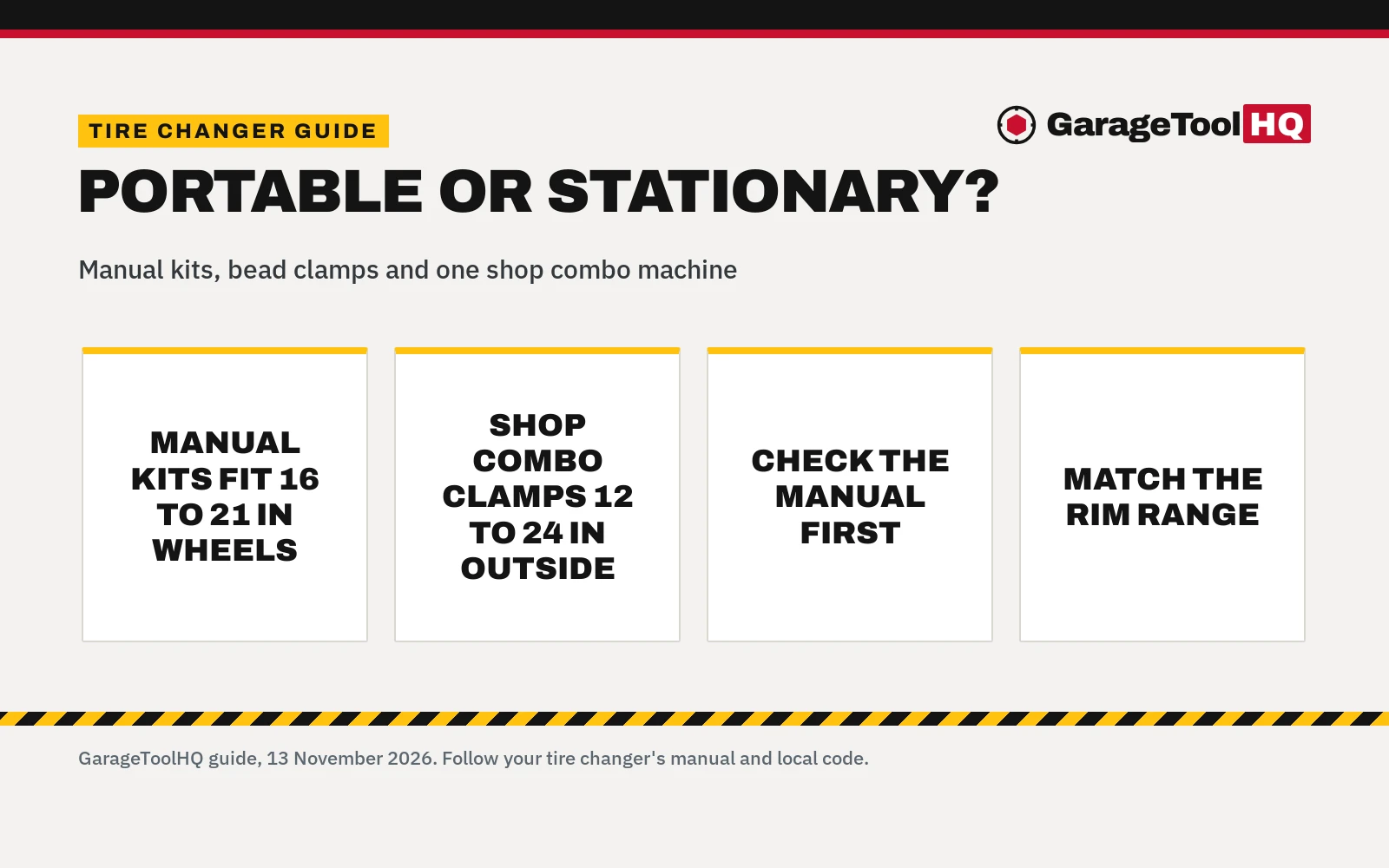
The rim range decides whether a changer fits a given wheel. The duck head kit and the gear-drive changer each cover 16 to 21 inch wheels. The pneumatic-assist changer covers 12 to 21 inch rims and tires up to 39 inches, or 990 mm, in diameter. Portable lever changers vary more: the smaller portable unit lists 4 to 16.5 inch rims, while the wide-range portable unit lists 4 to 21 inch rims. Match the changer range to the wheel before ordering.
Weight and footprint decide where the changer lives. The wide-range portable unit weighs 34.0 pounds and measures 37.4 inches by 17.7 inches by 14.5 inches. The smaller portable unit weighs about 61.6 pounds and measures 26.38 inches by 20.08 inches by 13.39 inches. The pneumatic-assist unit weighs 80 lbs. A lighter unit moves to the job; a heavier unit holds steadier under the lever.
How to Use a Manual Truck Tire Changer
Work on solid, level ground with room to swing the lever.
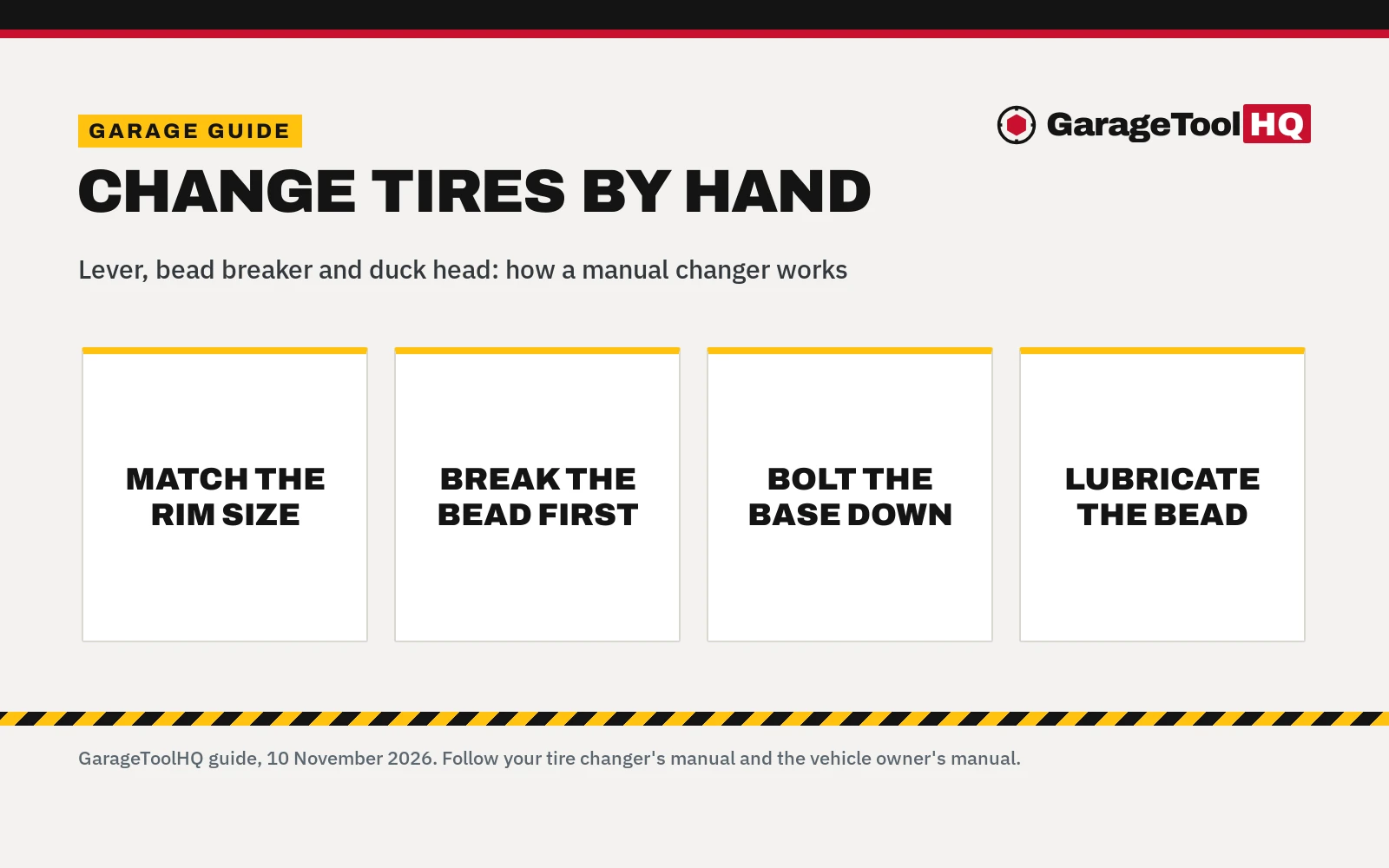
- Deflate the tire fully. Remove the valve core so the air escapes, and leave it out until the new tire is mounted. See our guide to how to remove a valve core.
- Set the changer and lock the wheel. Bolt the base to a suitable work surface when the model allows it. Set the wheel on the center post, fit the cone through the hub center hole, and tighten the locking nut.
- Lubricate the bead and rim edge. Brush tire lubricant around the bead on each side. Lubrication lets the bead slide over the rim instead of catching.
- Break the bead on each side. Press the bead breaker arm against the sidewall until the bead comes off the rim seat. Work around the tire, then turn the wheel over and break the other side.
- Lever the tire off. Hook the duck head under the top bead and walk it over the rim lip in a slow circle, keeping hands clear. Then work the lower bead over the rim the same way.
- Mount the new tire. Lubricate the new tire beads, set it on the rim, and lever the lower bead over the rim lip first, then the upper bead.
- Seat the bead with air. Refit the valve core and inflate the tire so the beads pop onto the rim seats, using the pressure marked for the tire. The 120 to 145 psi, or 8 to 10 bar, range listed for the pneumatic-assist changer is the operating range of its bead breaker cylinder, not a tire inflation pressure. If a bead will not seat, see our guide to how to get a tire to bead at home.
- Check the finished tire. Confirm the bead sits evenly on the rim, then brush soapy water around the bead and valve and watch for bubbles.
Keep hands away from the bead area while the arm presses or the lever moves, keep the wheel locked on the post, and stop and reset when anything slips or binds.
What Size Manual Tire Changer Fits Truck Wheels
Start with the rim diameter, stamped on the wheel and printed on the tire sidewall. A changer that covers 16 to 21 inch wheels fits many truck wheels, while the 12 to 21 inch range reaches smaller wheels as well. The pneumatic-assist changer handles tires up to 39 inches in diameter.
Check the rim diameter and tire diameter against the changer range, and the hub center hole against the cone. The duck head kit and the pneumatic-assist changer each use a cone to center the wheel, and when the cone cannot center the wheel, the wheel will wobble under the lever.
Manual vs Powered Tire Changers
A manual changer and a powered machine do the same job at a different pace. The manual changer needs no power and, except for the pneumatic-assist type, no air supply, so it works in a garage with no compressor. A powered machine mounts and demounts faster and asks less of the operator, but it needs power, floor space, and a larger outlay.
See our comparison of portable vs stationary tire changers and our picks for the best air compressor for RV tires when the job needs air at the tire.
FAQ: garage tools
Can a manual tire changer handle truck tires?
Yes, when the changer range covers the wheel. Changers covered here span 16 to 21 inch wheels, and the pneumatic-assist changer handles tires up to 39 inches in diameter.
What size manual tire changer do I need?
Measure the rim and tire diameter, then pick a changer whose range covers each figure. A changer rated for 12 to 21 inch rims fits a wider set of wheels than a changer rated for 16 to 21 inch rims, and the cone must fit the hub center hole.
Do I need compressed air for a manual tire changer?
Lever and gear-drive changers need no air at all. The pneumatic-assist changer uses shop air for its cylinder, and the maker lists an operating range of 120 to 145 psi, or 8 to 10 bar. Seating the bead still needs air from a compressor.
Can a manual tire changer mount low-profile tires?
The pneumatic-assist changer is listed as suitable for tubeless and low-profile tires. Low-profile beads sit tight, so lubricate the bead well and work the lever in a slow circle rather than forcing a single spot.
How heavy is a manual tire changer?
The listed units run from 34.0 pounds for the wide-range portable unit and about 61.6 pounds for the smaller portable unit to 80 lbs for the pneumatic-assist unit.
Do I need to bolt a manual tire changer to the floor?
Bolting adds stability but is not required on every model. The smaller portable unit offers a bolt-down or portable setup, and the wide-range portable unit has an X-shaped base with pre-drilled mounting holes. Bolt the base down when the unit shifts during bead breaking.
Related: portable vs stationary tire changers, how to get a tire to bead at home, tire mounting machine parts, our engine and shop equipment hub and the best portable tire inflator for cars.