Mid Rise vs Full Rise Lift: Which One Should You Buy?
Mid rise vs full rise lift: when a mid-rise lift wins, when full-rise wins, and how ceiling, slab and the work you do pick the answer.

On this page
Top picks at a glance
As an Amazon Associate we earn from qualifying purchases.
- 1
 QISHIDA 7000 LBS Portable Car Lift Mid Rise Scissor Lift 110V9.6/10View on Amazon
- 2
 KATOOL Portable Car Lift Mid Rise Scissor Lift 110V Electric9.6/10View on Amazon
- 3
 X90 8000Lbs 110V Portable Car Lift Scissor Lift Electric9.5/10View on Amazon
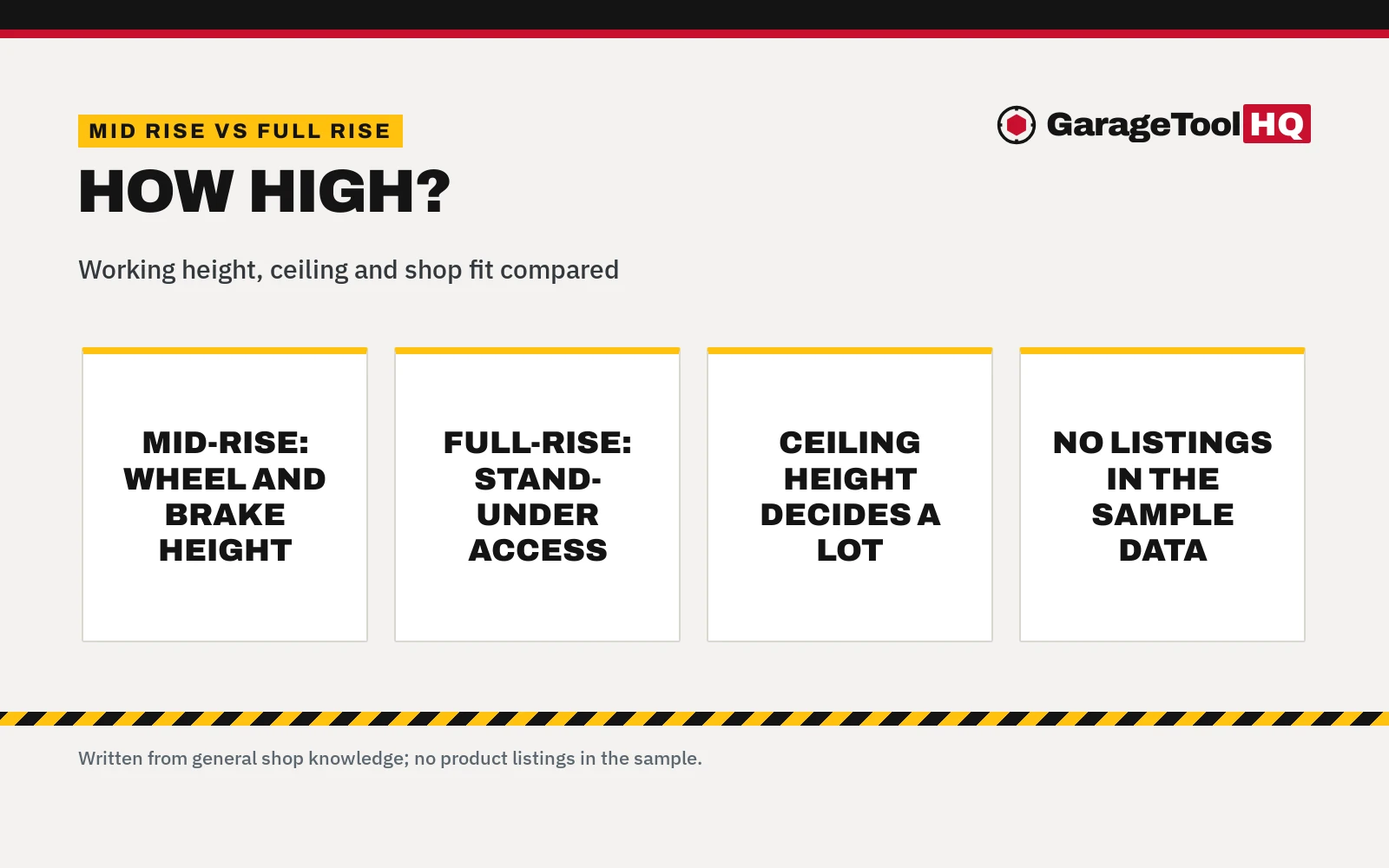
The garage is getting a lift, and the mid rise vs full rise lift question is how high the car needs to go. A mid-rise lift raises the car to a comfortable working height for wheels, brakes and undercar jobs you do sitting or on a creeper. A full-rise lift raises the car high enough to stand under, opening the whole underside for exhaust, transmission and drivetrain work. Mid-rise suits low ceilings and wheel work; full-rise suits standing-height undercar access. The ceiling, the slab and the work you actually do pick the winner.
GarageToolHQ earns a commission when you buy through links on our product pages, at no extra cost to you. Read our affiliate disclosure.
Mid rise vs full rise lift: the difference in one paragraph
The difference is working height. A mid-rise lift, usually a scissor or portable design, lifts the car to around waist to chest height: perfect for brake jobs, tire rotations, suspension work and detailing the lower body, all without a tall ceiling. A full-rise lift, usually a two-post or four-post, lifts the car overhead so you stand upright underneath with the whole underside exposed. Mid-rise asks less of the shop: lower ceiling, smaller footprint, often portable. Full-rise asks more and gives more: standing access to everything under the car.
When mid-rise is the better choice
Pick mid-rise when the ceiling is low or the work stays at wheel level. Most home garages cannot fit a full-rise lift under the ceiling, and a mid-rise scissor does the common jobs, brakes, wheels, suspension, oil changes, at a height your back will thank you for. Portable mid-rise lifts move around the shop and store against the wall, and many run on standard household power. If your lift time is mostly wheels-off work and you sit or kneel to do it, mid-rise is the honest answer. See clearance for car lift for measuring your ceiling.
When full-rise is the better choice
Pick full-rise when you work under the car standing up. Exhaust systems, transmissions, differentials, fuel tanks and full undercar inspections want the car overhead with room to move. Two-post lifts give open access to the wheels and underside with the car held by its lift points; four-post lifts drive on and suit storage plus service with the right accessories. Full-rise needs the ceiling height, a slab that can take the anchors and the budget for a bigger machine. If the underside is where your projects live, nothing else substitutes.
Ceiling height decides a lot
Measure before anything else. A full-rise lift needs enough ceiling to raise the car plus clearance above it, and the number surprises first-time buyers once the car is on the lift. Mid-rise lifts sidestep this: they top out well below the ceiling in most garages. Also check the door: a tall vehicle on a full-rise lift may not clear a standard garage door header. Our clearance guide walks through the measuring.
Two-post, four-post or scissor
Lift style matters as much as height. Scissor lifts are the classic mid-rise: compact, often portable, and kind to low ceilings, but they block the center of the underside, so transmission work is awkward. Two-post lifts are the classic full-rise: the car hangs on its lift points with the wheels free and the whole underside open, which is why shops love them, but they need bay width and a stout slab for the posts. Four-post lifts drive on, which suits storage and quick service, though wheel work needs extra jacking accessories. Pick the style for the jobs you do most, then pick the height the shop allows.
What to check before you buy
Capacity comes first: the lift must handle your heaviest vehicle with margin. Then the slab: surface-mount lifts anchor into concrete, and the slab must be thick and sound enough for the anchors. Then power: many lifts run on standard household voltage, bigger ones want a dedicated circuit. Then the locks: mechanical safety locks hold the car at height, and the lock design is worth comparing across models. Finally the footprint: a two-post needs bay width for the posts and door swing, a four-post needs length for the runways, a portable scissor needs floor space to store. See car lift maintenance once it is installed.
Think about the next five years
Buy for the shop you are building, not just the job this weekend. A mid-rise lift that fits today’s garage may feel limiting once the projects get ambitious, while a full-rise lift in a cramped bay gets used less than a mid-rise that is always set up and ready. Consider the vehicles too: a lift bought for a sedan may need to handle a truck or an EV next, and heavier vehicles want more capacity and a stronger slab. The right lift is the one that still suits the work after the novelty wears off.
Frequently Asked Questions
Can I stand under a mid-rise lift?
No. Mid-rise lifts top out at a comfortable working height for wheel and brake work, not standing height. If you need to stand under the car, that is full-rise territory.
Do I need a special ceiling for a full-rise lift?
You need enough height, not a special ceiling. Measure the ceiling, subtract the lift’s raised height plus the car’s height on it, and leave working clearance. Low ceilings point at mid-rise.
Will a lift damage my garage slab?
Not if the slab is up to it. Surface-mount lifts need sound, adequately thick concrete for their anchors. Thin, cracked or unknown slabs should be checked before you drill.
Portable or bolted?
Portable mid-rise lifts move, store and suit renters or multi-use garages. Bolted two-post and four-post lifts suit dedicated bays and heavier undercar work. Match the commitment to the shop.
What about lowered cars?
Lowered cars need a low lowered height and the right arm or pad setup to get under the car. See our best car lift for lowered cars picks for models built for that.
Related: the car lift alternatives guide, the clearance for car lift guide and the car lift maintenance guide.