Clearance for Car Lift: Ceiling Height and Garage Fit Guide (2026)
How to determine the required clearance for a car lift: calculating ceiling height, overall lift dimensions, overhead safety buffer, and garage bay width.

On this page
Top picks at a glance
As an Amazon Associate we earn from qualifying purchases.
- 1
 QISHIDA 7000 LBS Portable Car Lift Mid Rise Scissor Lift 110V9.6/10View on Amazon
- 2
 KATOOL Portable Car Lift Mid Rise Scissor Lift 110V Electric9.6/10View on Amazon
- 3
 APlusLift HW-8S 8000LB 4-Post Storage Service Car Lift 3 Year9.6/10View on Amazon
Whether you are rolling a creeper underneath for an oil change, dropping an exhaust system, or pulling wheels for a brake job, knowing the required clearance for car lift installation in a home garage determines what kind of hoist you can safely set up. Required clearance for car lift installations depends on key measurements: total ceiling height relative to overhead obstructions, vehicle overall height plus maximum lifting height, and bay width for drive-through access. A full-rise 2-post lift requires tall ceiling clearance to raise a vehicle to full working height, whereas a mid-rise scissor lift or portable car lift fits inside garages with lower overhead room while still providing ample working space for routine chassis maintenance.
GarageToolHQ earns a commission when you buy through links on our product pages, at no extra cost to you. Read our affiliate disclosure.
Below: how to calculate overhead ceiling clearance, what bay width different lift styles require, and a step-by-step checklist before installing a lift in your home garage.
Clearance for car lift: how to calculate garage ceiling height
Working out vertical clearance depends on hoist design. For low-rise and mid-rise scissor lifts without vertical columns, vertical clearance equals vehicle height plus the lift’s maximum lifting height plus an overhead safety buffer. For post-style hoists, your garage ceiling must satisfy that raised-vehicle calculation while also clearing the lift’s rigid steel columns.
Evaluate each vertical factor before choosing a lift:
- Vehicle height: Measure from the shop floor to the highest point on your vehicle roofline, including roof racks or antennas.
- Maximum lifting height: Full-rise hoists raise vehicles higher for standing work, while mid-rise and portable lifts provide clearance for seated creeper access.
- Lift column height: Rigid vertical posts must stand upright safely below ceiling joists, drywall, and roof trusses.
- Overhead safety buffer: Maintain extra clearance above the vehicle roofline to prevent contact with garage framing and allow unlocking travel.
- Overhead obstructions: Measure to the lowest hanging object in the bay, such as garage door tracks, opener motors, or lighting.
Lift types and clearance requirements compared
| Lift Type | Maximum Lifting Height | Overall Height and Dimensions | Garage Clearance Considerations |
|---|---|---|---|
| Full-rise 2-post lift (KATOOL) | 70.86 inches (minimum height 4.25 inches) | Overall height 110.15 inches; 12,000 lbs capacity | Requires tall ceiling clearance for vertical posts, overhead room for raised vehicles, and solid concrete anchoring. |
| Full-rise 2-post lift (Weize) | 71.65 inches | Overall height 112 inches; 137 inches length, 20 inches width; 101 inch drive-through width; 12,000 lbs capacity | Wide bay footprint with 101 inch drive-through width; vertical columns require 112 inches of unobstructed headroom. |
| Mobile single-post lift (XK) | 1800mm | Total height 2380mm; total length 1800mm, total width 1100mm; 6200 lb capacity | Single vertical column requires 2380mm overhead clearance; mobile base rolls across flat concrete floors. |
| Mid-rise scissor lift (KATOOL) | 39 inches (minimum height 4.3 inches) | Compact floor footprint; 7,000 lbs capacity | Fits restricted ceilings; provides 39 inches of lift for brake jobs, tire rotations, and exhaust work. |
| Portable car lift (VEVOR) | 25.6 inches (pad range 5.12 to 18.5 inches; minimum height 9.06 inches) | 72.2 x 14.2 x 17.2 inches dimensions; 5,000 lbs capacity | Low-profile frame slides under chassis; stores on wall handles; fits standard ceilings without post interference. |
| Portable car lift (Real Relax) | 26.8 inches (pad range 6.5 to 20 inches; minimum height 10.24 inches) | 80 x 14 x 18.66 inches dimensions; 7000 lbs capacity | Adjustable columns modify height up to 3.2 inches; operates on flat surfaces with slopes not exceeding 4 degrees. |
| Portable scissor lift (Albott) | 27.4 inches (pad height 22 inches; lifting range 19.7 to 27.4 inches) | 75 inches overall length with 8.3 inches extension plate; 8,000 lbs capacity | Compact scissor profile requires only vehicle height plus lift stroke; operates on slopes not exceeding 4 degrees. |
| Portable scissor lift (Albott) | 25.4 inches (pad height 20 inches; lifting range 17.7 to 25.4 inches) | 70.7 inches overall length with 7.1 inches extension plate; 7000 lb capacity | Low-profile scissor frames store compactly against walls; requires no overhead post clearance. |
Full-rise post models require ceiling clearance that accommodates both their rigid steel columns (measuring 110.15 inches on KATOOL or 112 inches on Weize) and the height of the vehicle when raised up to 70.86 inches on KATOOL or 71.65 inches on Weize off the floor. In contrast, portable scissor units from Albott and VEVOR raise vehicles between 25.4 inches and 27.4 inches without permanent vertical posts, fitting garages with lower ceilings.
How to measure clearance for a car lift: the garage checklist
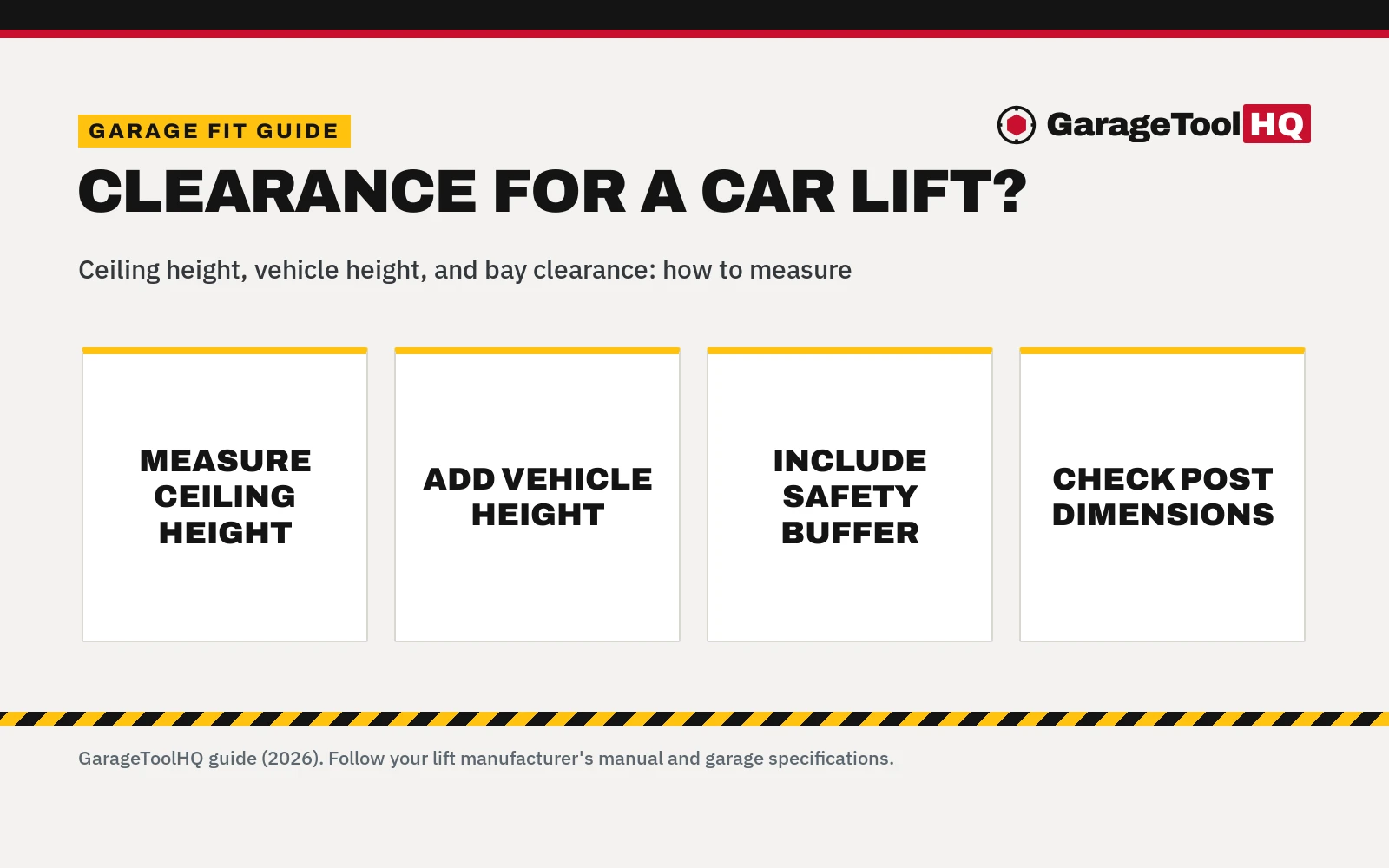
- Measure floor-to-ceiling clearance at the lowest point. Pull a tape measure from the floor to the lowest obstruction, including garage door tracks, opener heads, and lights.
- Measure overall vehicle height on its tires. Measure your tallest vehicle from the floor to the highest point of the roofline, including racks or antennas.
- Calculate total working height. Add vehicle height to the maximum lifting height of the hoist. Raising an SUV on a 39 inches mid-rise hoist from KATOOL needs far less headroom than on a 70.86 inches KATOOL 2-post lift.
- Add an overhead safety buffer. Maintain clearance above the elevated vehicle. On mechanical-lock hoists, lowering requires raising the carriage slightly to disengage locking dogs, requiring extra overhead room.
- Verify post column height during installation. Rigid columns must clear ceiling joists when tilted upright. Posts measuring 110.15 inches on KATOOL or 112 inches on Weize sweep through a diagonal arc during setup.
- Measure bay width and drive-through clearance. Weize specifies a drive-through width of 101 inch and overall dimensions of 137 inches by 20 inches by 112 inches, requiring lateral space to drive through and open vehicle doors.
- Inspect concrete floor thickness and slope. For portable scissor lifts, Albott and Real Relax specify flat, solid surfaces with slopes not exceeding 4 degrees. Permanent post lifts require a level slab meeting the lift maker’s concrete and ceiling requirements.
Always lower the car lift onto its mechanical safety locks before stepping underneath. Never work under any raised vehicle supported only by hydraulic pressure. Never get under a vehicle supported by a jack alone, always use rated stands on solid level ground, and lift only at owner’s manual lift points.
Check the lift's rated capacity against your heaviest vehicle, and its ceiling and concrete requirements (thickness and strength) before you buy. Install it exactly as the manufacturer specifies, use the mechanical locks before you go under, and look for ALI certification on the model. See the Automotive Lift Institute (ALI). Read our Safety Disclaimer.
2-post vs 4-post lift clearance in a home garage
Comparing a 2-post vs 4-post lift clarifies which structural design suits your garage bay:
- 2-post lift clearance: Uses two columns bolted to concrete with swing arms that reach chassis lift points, leaving wheels and undercarriage open for repairs. Posts require tall ceiling clearance and bay width for doors. Learn spotting techniques in our guide on how to use a 2 post lift.
- 4-post lift clearance: Features four perimeter posts supporting drive-on runways for easy drive-on parking and storage, but consumes a larger floor footprint.
- Low-ceiling alternatives: If vertical posts will not clear your ceiling, explore the best car lift for low ceiling spaces for mid-rise scissor lifts and portable frames, or browse our overview of car lift types.
Garage door tracks, side clearance, and electrical supply
Garage door tracks: In standard garages, open sectional doors and horizontal tracks hang below ceiling joists, reducing usable overhead clearance. Modifying tracks to high-lift configurations or adding a wall-mounted opener restores vertical space.
Side clearance: Leave adequate room around the hoist to roll tool carts, remove wheels, and swing vehicle doors open past posts.
Electrical supply: High-capacity post hoists require dedicated electrical service. KATOOL and Weize 12,000 lbs lifts use 4.0 HP motors on 220V 60Hz power, while the XK mobile lift specifies a 220V supply with a 30A minimum circuit breaker. Portable units like VEVOR and Real Relax use 120V power units, and KATOOL mid-rise uses 110V. For 220V circuits and heavy shop wiring, use a licensed electrician rather than attempting DIY wiring.
Compare shop designs in our guide to the best car lift for home garage and verify dimensions in car lift size.
Frequently Asked Questions
How tall does ceiling need to be for car lift?
Ceiling height must clear the lift’s vertical columns (110.15 inches on KATOOL or 112 inches on Weize) and provide room for your vehicle fully raised (vehicle height plus maximum lifting height of 70.86 inches on KATOOL or 71.65 inches on Weize, plus a safety buffer). Garages with lower ceilings can use mid-rise scissor lifts like KATOOL (39 inches maximum lift) or portable scissor units from Albott (25.4 inches to 27.4 inches maximum lift). See our guide on what ceiling height do I need for a car lift.
How much height do you need for a car lift?
Portable and mid-rise scissor units need only vehicle height plus lift stroke, ranging from 25.6 inches on VEVOR to 39 inches on KATOOL, plus a safety buffer. Full-rise post lifts require clearing post heights of 110.15 inches or 112 inches while raising vehicles up to 70.86 inches or 71.65 inches. Review operation steps in how to use scissor lift equipment safely.
Can you put a car lift in a residential garage?
Yes, provided you have sufficient ceiling clearance, adequate bay width, and a solid, level concrete floor meeting the manufacturer’s foundation specifications (with portable lifts from Real Relax and Albott requiring slopes not exceeding 4 degrees). Read can you put a car lift in a residential garage for planning details.
How does a car lift work?
An electric-hydraulic pump sends hydraulic fluid, such as No. 46 hydraulic oil specified by Real Relax and Albott, or AW32 and AW46 specified by XK, into hydraulic cylinders to raise lifting arms or scissor platforms. Mechanical safety locks engage automatically as it ascends, and the operator lowers the hoist onto these mechanical locks before starting maintenance.
How thick does concrete need to be for a car lift?
Concrete thickness and compressive strength requirements are set by each hoist manufacturer. Permanent 2-post hoists exert heavy leverage at their baseplates, requiring a reinforced slab poured on flat ground. Consult your manual and review our guide on how thick does concrete need to be for a car lift.
Related: car lifts hub, our picks for the best car lift for home garage, our comparison of the best car lift for low ceiling, our guide on how to use a 2 post lift, and car lift size dimensions.