Oil Filter Size Chart: Common Sizes Explained
An oil filter size chart matches a filter's diameter, height and thread to your vehicle, so you can pick the right filter and the wrench that fits it.

On this page
Top picks at a glance
As an Amazon Associate I earn from qualifying purchases.
- 1
 Motivx Tools Oil Filter Wrench for Toyota Camry9.7/10View on Amazon
- 2
 Lisle 57030 Standard Oil Filter Swivel Wrench9.7/10View on Amazon
- 3
 GEARWRENCH Heavy-Duty Oil Filter Strap Wrench9.7/10View on Amazon
An oil change can stall on the last part of the job: the old filter will not move, and the wrench in your hand does not fit it. The filter is round, slick with oil, and tucked against the block where a hand cannot get a grip. That is the moment an oil filter size chart earns its place on the wall: it matches a filter to the tool that fits it, so the job ends with a clean swap instead of a crushed can.
An oil filter size chart lists filter sizes by diameter, height and thread, and ties each size to the vehicle it fits. There is no size that fits every car: filters differ by make, model and engine, so the right size is the size your vehicle’s manual calls for. Use the chart to read the size, then match the wrench to the filter in front of you.
GarageToolHQ earns a commission when you buy through links on our product pages, at no extra cost to you. Read our affiliate disclosure.
Below: how to read the sizes on a chart, the tool sizes that fit them, and a plain way to find the filter your vehicle needs.
Oil filter size chart: what the sizes mean
Read a filter size in parts: diameter, height and thread. Diameter is the width across the round can, and it decides which wrench can grip it. Height is the length of the can, and it decides whether the filter clears the parts around it. Thread is the fitting on the mounting stud, and it must match the engine, or the filter will not seat and seal.
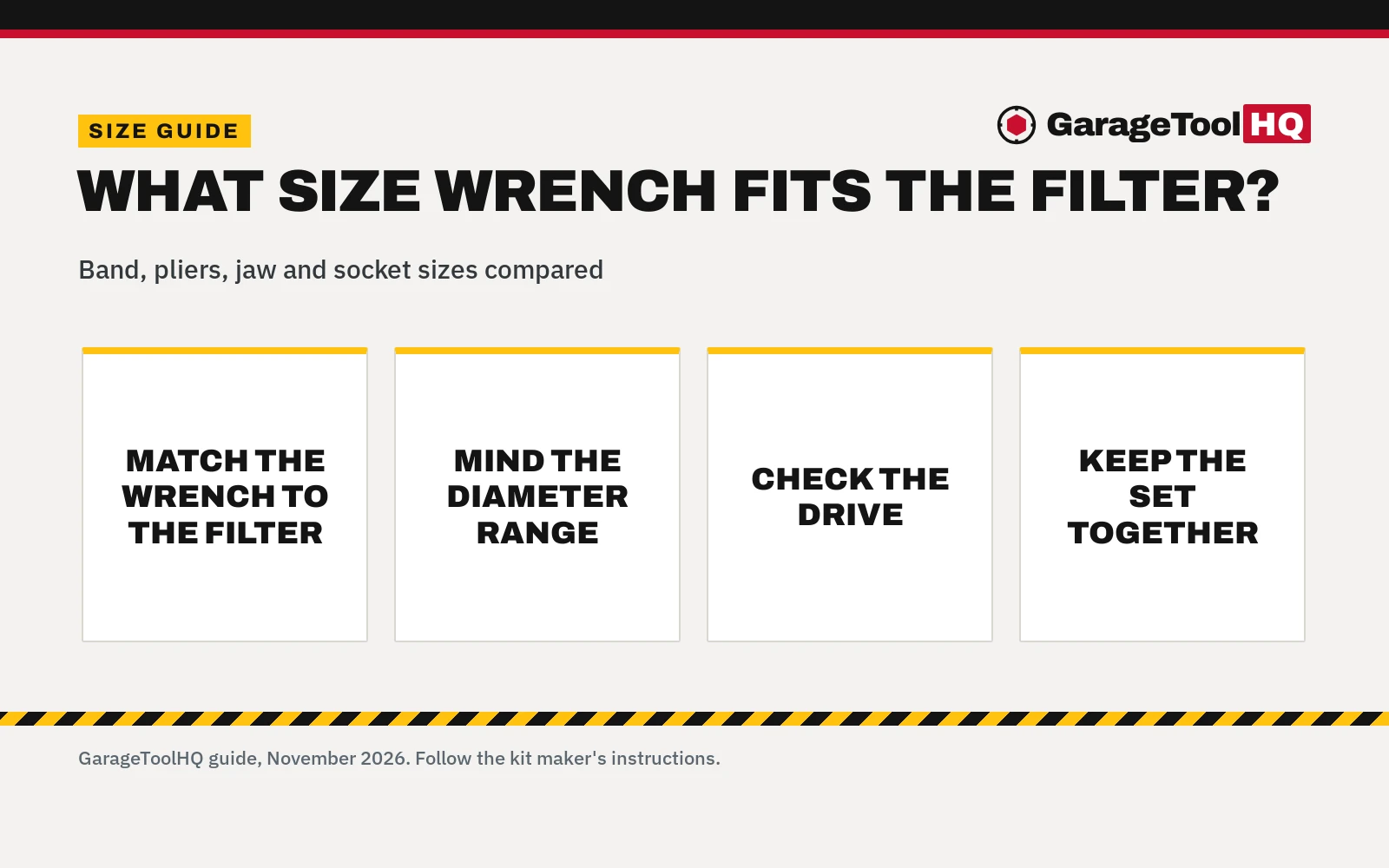
Diameter is where most charts start, because it sets the wrench size. A 9-piece oil filter wrench set shows the range a home garage meets: its steel band wrenches span 2-3/4 inches to 5-1/4 inches, and the set also holds a 3-jaw wrench and a 64mm socket for cartridge-style caps. A band wrench in that range wraps around the can and holds its grip while you turn, and the 180-degree swivel on the handles helps in tight spots around hoses and frames.
Height matters when the filter sits close to a frame rail, a hose or an exhaust part. A can that is too tall can hit the parts around it, so height is a clearance question, not a seating question: the thread and gasket decide whether the filter seats and seals. Check the height on the chart against the space around the mount before you order, and keep the old filter beside the new filter to compare them side by side.
Thread is the part you cannot measure with a wrench. The thread must match the mounting stud, and the gasket must match the sealing surface. When the thread is wrong, the filter will not spin on straight, and forcing it can damage the stud. Check the manual for the thread your engine calls for, and match the gasket to the old filter before you fit the new filter.
Common oil filter sizes and the tools that fit them
A 9-piece set covers the range a filter job needs, from a band wrench that wraps the can to pliers that bite a stuck filter. The table below lists the sizes in the set and what each tool fits.
| Tool | Size | What it fits |
|---|---|---|
| Steel band wrench | 2-3/4 inches to 5-1/4 inches | Filters in that diameter range; the set holds 4 swivel-handle band wrenches |
| 3-jaw wrench | Grips the end of the can | Filters where a band cannot reach |
| Socket | 64mm | Cartridge-style filter caps sized 64mm |
| Adjustable pliers | 9 inches and 12 inches | Stuck filters; the 5-position sliding joint adjusts the bite |
| Drive adapter | 1/2 inch to 3/8 inch | Switches between ratchets for filters deep in the bay |
Set a cheap oil drain pan under the filter before you loosen it, and keep the drained oil in a sealed container; the best oil containers for shop picks cover storage for the shop. To open a used filter and read its condition, see the best oil filter cutter picks and the oil filter cutter vs oil filter wrench guide.
How to find the right oil filter size
Work through the list in order, and check each point against the old filter before you order the new filter.
- Check the manual. The manual lists the filter your vehicle calls for, with the diameter, height and thread it needs. Trust that entry over any guess.
- Match the old filter. Read the size printed on the old filter, and match the new filter to it in diameter, height, thread and gasket. When the print is worn off, measure the old filter and take it with you to compare.
- Measure the diameter. Measure straight across the widest part of the can, and compare the result with the chart. A band wrench that spans 2-3/4 inches to 5-1/4 inches covers the range this 9-piece set is made for.
- Check the thread and gasket. Compare the thread and gasket of the new filter with the old filter, and look for a match in size and shape before you fit it. A gasket that does not match will not seal, even when the can looks right.
- Pick the wrench that fits. Choose a band wrench in the 2-3/4-inch to 5-1/4-inch range, the 3-jaw wrench, or the 64mm socket, whichever grips the filter without slipping. The 9-inch and 12-inch pliers suit a stuck filter in a tight bay, and the 5-position sliding joint adjusts the bite. The 1/2-inch to 3/8-inch drive adapter lets you switch between ratchets when the filter sits deep in the bay.
Read the manual before first use, wear eye protection, keep the work area clear and ventilated, and stay within every stated rating. Read our Safety Disclaimer.
Oil filter wrench sizes
With the filter size known, the wrench follows it. The guide to oil filter wrench sizes charts the wrench for each filter, and the picks in the best oil filter wrench roundup cover the common styles. An adjustable oil filter wrench suits a garage that services many vehicles, and a heavy duty oil filter wrench set covers the full range, with a storage case that keeps the set organized. Large filters on trucks call for a large oil filter wrench, while small filters on compact cars suit a small oil filter wrench. Diesel owners can check the oil filter wrench for diesel trucks picks.
FAQ: garage tools
What size oil filter do I need?
The size your vehicle’s manual calls for. Match the diameter, height, thread and gasket to the manual and to the old filter, and use a chart to read the size. There is no size that fits every vehicle, so a guess based on looks alone can leave you with a filter that will not seal.
How do I measure an oil filter?
Measure straight across the widest part of the can for diameter, and end to end for height. Compare the thread and gasket with the old filter, and check the result against the chart and the manual. When the print on the old filter is still readable, match the new filter to it.
Can I use a larger oil filter?
Only when the manual lists it as a fit for your vehicle. A larger can may not clear the parts around the mount, and a thread or gasket that does not match will not seal. Check the manual before you swap in a size it does not call for.
What wrench size fits my oil filter?
Match the wrench to the diameter of the can. Band wrenches that span 2-3/4 inches to 5-1/4 inches cover the range of this 9-piece set, the 64mm socket fits cartridge-style caps sized 64mm, and the 9-inch and 12-inch pliers suit a stuck filter. The 3-jaw wrench grips the end of the can where a band cannot reach.
Are all oil filters the same size?
No. Filters differ by make, model and engine, so the size that fits a compact car may not fit a truck. Use the manual and a chart to find the size for your vehicle, and match the new filter to the old filter before you fit it.
Related: oil filter wrench sizes, the best oil filter wrench picks and the best oil filter cutter picks.