Propane Heater Safety Tips for a Garage
Propane heater safety tips for garage work: rating checks, ventilation, clear space, shut-off features and shutdown steps, with three heaters compared.

On this page
Top picks at a glance
As an Amazon Associate I earn from qualifying purchases.
- 1
 InoKraft MAXHEAT MH85M 85,000 BTU Forced Air9.7/10View on Amazon
- 2
 BILT HARD 85,000 BTU Propane Torpedo Heater9.6/10View on Amazon
- 3
 Mr. Heater 30,000 BTU Vent Free Blue Flame Dual9.6/10View on Amazon
Propane heater safety tips come down to matching the heater to the space and running it the way its manual directs: use only a heater rated for the space you are heating, keep fresh air moving through the area, keep the heater and its tank clear of anything that can burn, and shut it down the moment anything smells, sounds or looks wrong. This guide walks through the checks that matter before, during and after a burn, and the heaters below show which safety features to look for.
GarageToolHQ earns a commission when you buy through links on our product pages, at no extra cost to you. Read our affiliate disclosure.
InoKraft MAXHEAT MH85M 85,000 BTU Forced Air
An 85,000 BTU forced air propane torpedo heater with adjustable output, CSA certification and overheat auto-shut-off, for ventilated garage work.
Pros
- Adjustable output from 45,000 to 85,000 BTU
- CSA certified with overheat auto-shut-off protection
- 10ft hose and 4.9ft power cord included
- Heating areas up to 2,000 sq. ft. stated
Cons
- Needs a 20lb. propane tank or larger, bought separately
- Stated for well-ventilated areas, not sealed rooms
- Forced air fan needs an outlet to run
- 1 year warranty term stated by the maker
BILT HARD 85,000 BTU Propane Torpedo Heater
An 85,000 BTU propane torpedo heater with adjustable output, CSA listing and stated runtime figures, for ventilated garage and jobsite heat.
Pros
- Adjustable output from 50,000 to 85,000 BTU
- CSA certified with overheat auto-shut-off protection
- 8 hours on low with a 20 lb. tank stated
- 16.01 pounds, lighter than the Mr. Heater at 26.13 pounds
Cons
- 20 lb. propane tank is not included
- Recommended for ventilated environments only
- Needs a 120v outlet for the fan and ignition
- 1 year warranty term stated by the maker
Mr. Heater 30,000 BTU Vent Free Blue Flame Dual
A 30,000 BTU vent free dual fuel heater stated as indoor safe, with a low oxygen safety shut-off and adjustable thermostat.
Pros
- Stated indoor safe with no outdoor venting required
- Low oxygen safety shut-off system built in
- Dual fuel LP/NG operation stated
- No electricity required to run
Cons
- 30,000 BTU output is the lowest here
- Heats up to 1,000 sq. ft., the smallest coverage
- Blower fan kit is sold separately
- 26.13 pounds, heavier than the BILT HARD torpedo at 16.01 pounds
Propane Heater Safety Tips: Before You Light It
Start with the rating. A forced air torpedo heater made for jobsites and garages is a different tool from a vent free heater made for indoor use, and the manual states which spaces each one belongs in. Read that page first, along with the clearance and ventilation directions for your model, and follow the stricter of the manual and your local fire code.
Check the setup while everything is cold. Look over the hose and regulator for damage, confirm the tank connection is snug, and place the heater on a flat, stable surface with the clear space around it that the manual calls for. Keep fuel cans, solvents, rags and sawdust out of that clear space, and keep the tank upright and held so it cannot tip.
While It Runs
Ventilation is the running rule. The torpedo heaters in this guide state that the area should be well ventilated for clean burning, and a vent free indoor model still burns room air, so follow the fresh-air direction in your manual rather than sealing the space. Keep an eye on the flame and the heater body, and use the built-in protections the maker lists, such as overheat auto-shut-off on the torpedo models and the low oxygen safety shut-off on the vent free model, as backstops rather than substitutes for watching the heater.
Never leave a propane heater running unattended, and never use one where you sleep unless the maker rates that exact model for it. Keep children and pets out of the clear space, and route hoses and cords so nobody trips over them or pulls the heater over.
Gear for the Job: Heaters With Stated Safety Features
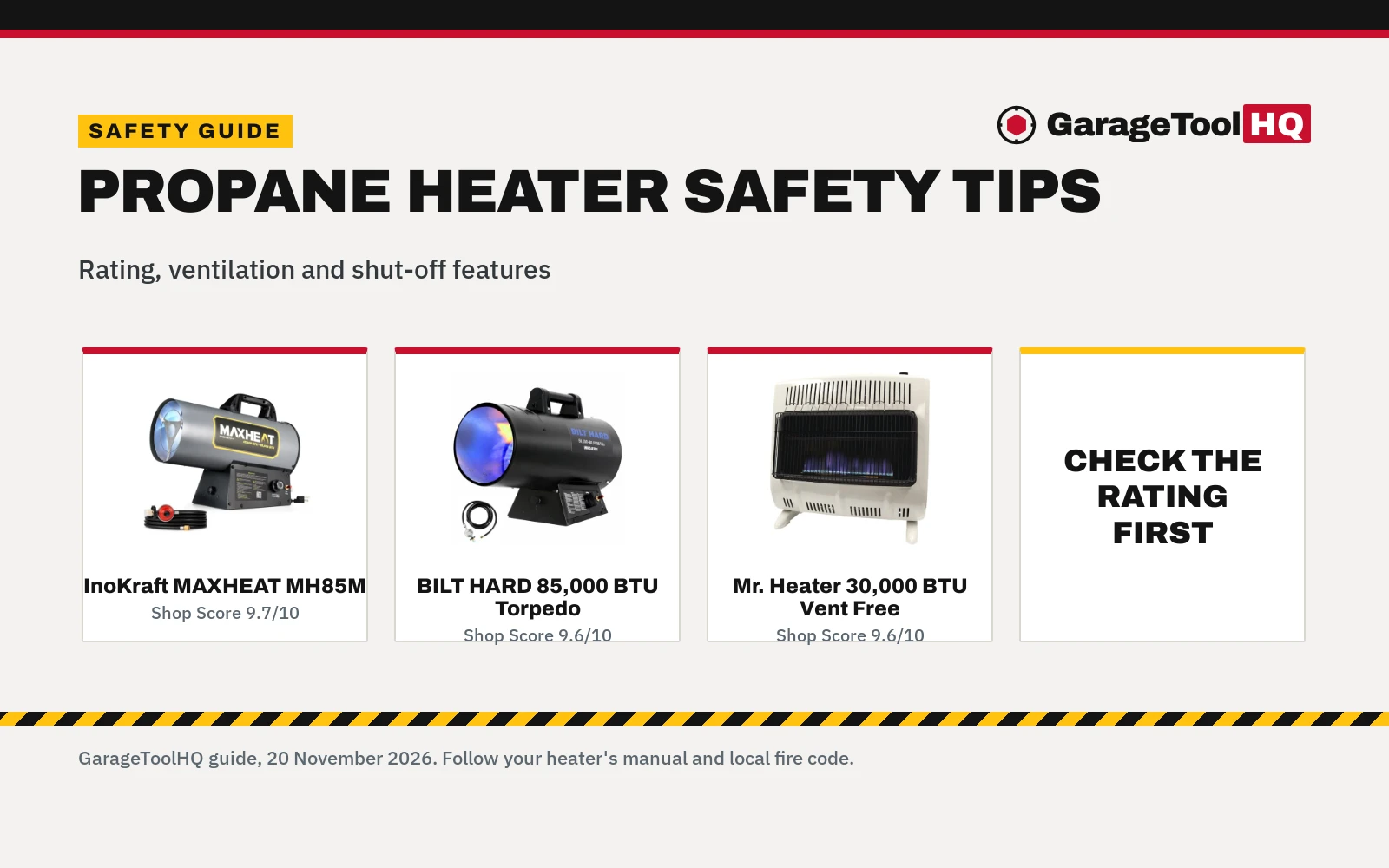
Every safety step above depends on the heater in front of you, so the three heaters below are the gear for this job: two CSA certified torpedo heaters with overheat shut-off for ventilated garage and jobsite work, and one vent free dual fuel heater with a low oxygen shut-off for indoor-rated use.
After the Burn: Shutdown and Storage
Shut the heater down in the order the manual gives, close the gas supply valve, and let the unit cool fully before moving or covering it. Store the heater where it stays dry and protected, and store propane tanks upright in the place your local fire code allows, away from ignition sources. Check hoses and connections again before the next use, and replace anything worn or damaged with the maker’s parts. See our propane tank storage tips and the best propane heater for shop guide for the storage and sizing sides of the job.
Never run a fuel-burning heater, generator or engine in a closed garage: carbon monoxide builds up fast and has no smell. Fit a CO alarm, keep clearances to cars and storage, use vented gas heaters installed to code, and put 240V electric heaters on a dedicated circuit. See CPSC carbon monoxide guidance. Read our Safety Disclaimer.
FAQ: garage tools
Is a propane heater safe to use indoors?
Only a model the maker rates for indoor use belongs indoors. The Mr. Heater vent free model here is stated as indoor safe with a low oxygen safety shut-off, while the torpedo heaters state they should be used in a ventilated environment. The manual for your exact model decides.
What safety features should a propane garage heater have?
Look for the features the makers state on these picks: CSA certification, overheat auto-shut-off and auto-cut-off protection on the torpedo heaters, and a low oxygen safety shut-off on the vent free heater. A stated warranty term is worth comparing too.
How long does the BILT HARD torpedo heater run on one tank?
The BILT HARD torpedo heater states 8 hours on a low setting and 5.5 hours on a high setting with a 20 lb. propane tank. Runtime on your tank depends on the setting you run, so plan refills around the maker’s figures.
Can I leave a propane heater running while I work elsewhere?
No. Keep the heater in sight while it burns, keep the clear space around it empty, and shut it down when you leave the area. Built-in shut-off features are backstops, not a substitute for watching the heater.
More garage guides
See every garage upgrades guide, plus our types of gas heaters comparison and propane tank fitting types guide.